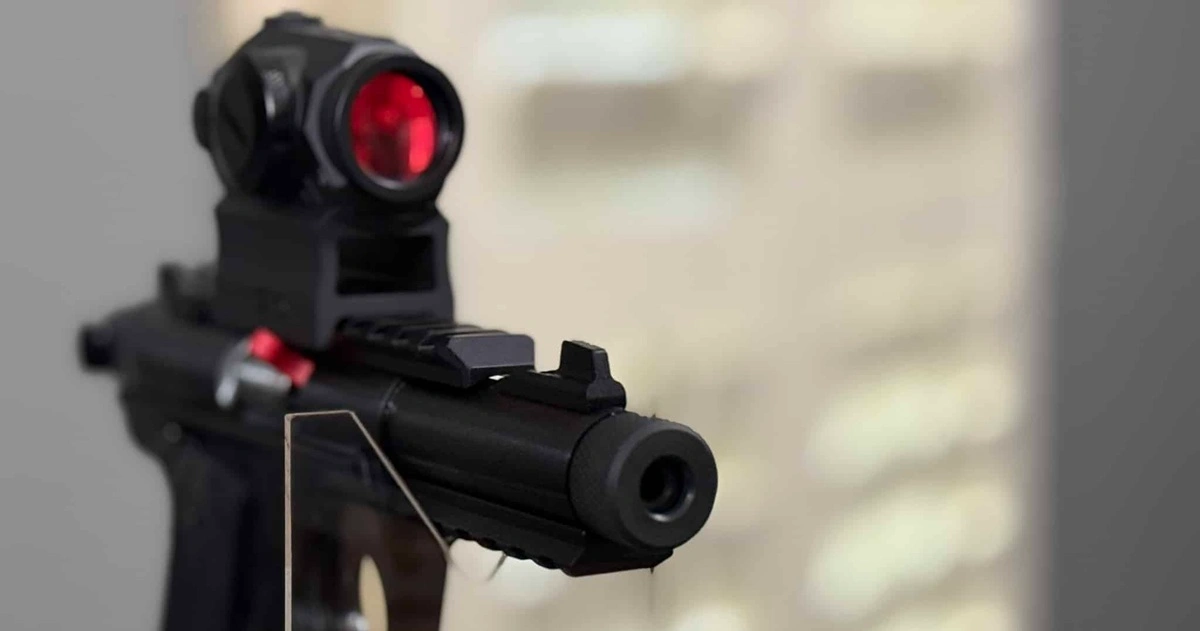
The Ruger 22 pistol is one of the rare firearms that can sit comfortably in three places at once: on a collector table, in a family range bag, and in the memory of someone who learned sight picture and trigger control with a rimfire pistol that simply worked. It is affordable enough to have been common, durable enough to survive decades of use, and distinctive enough that a silhouette alone usually gives it away.
For Ruger revolver serial-number tables and connected Security-Six, GP100, Blackhawk, and Single-Six research, visit the Ruger Revolver Serial Number Hub.
That combination is why the Ruger .22 deserves more than a short model note. The pistol launched Sturm, Ruger & Co. in 1949, gave Bill Ruger a national foothold, challenged older target pistols on price and utility, and evolved through the Standard, Mark I Target, Mark II, Mark III, Mark IV, and 22/45 branches. Modern shooters may use the shorthand “Ruger Mark pistol,” but collectors know that early fixed-sight guns, target-marked guns, 22/45 variants, commemoratives, and recent Mark IV models all tell slightly different chapters of the same story.
Looking for a Ruger Mark I serial number date? Ruger’s factory Standard & Mark I records cover production from 1949 through 1982. Use the serial number to estimate the production year, then confirm the pistol by sights, barrel profile, markings, and other physical features. Jump to Ruger Mark I serial-number information
Ruger 22 Pistol Quick Facts
- Original maker
- Sturm, Ruger & Co., founded by William B. Ruger and Alexander McCormick Sturm.
- First model
- Ruger Standard Auto, a .22 Long Rifle semi-automatic pistol introduced in 1949.
- Collector family
- Standard Auto, Mark I Target, Mark II, Mark III, Mark IV, 22/45, and special Target, Hunter, Competition, Lite, Tactical, and anniversary variations.
- Why it Resonates
- It was Ruger’s first commercial product, it helped establish a major American firearms company, and its basic profile stayed recognizable across generations.
Why Ruger Resonates with Collectors
The best collector guns usually have more than one kind of appeal. Some are rare. Some are mechanically unusual. Some are tied to a famous designer or a defining moment in the industry. The Ruger 22 pistol has all of those elements in moderation, but its real strength is broader: it made good design feel ordinary. A shooter did not need a high-end target pistol budget to own a .22 semi-auto with a reputation for accuracy, reliability, and long service life.
On Gun Collectors Club, I usually separate “valuable” from “important.” A collectible pistol does not have to be museum-rare to be historically important. The Ruger Standard and Mark-series pistols are important because they show how postwar American manufacturing changed the market. They belong beside other rimfire classics such as the Colt Woodsman and the Smith & Wesson K-22 Masterpiece, even though the Ruger story comes from a different lane: lean production, bold pricing, and a design that looked familiar without being a copy of the old domestic target-pistol playbook.
For the broader semi-auto collector, the Ruger 22 pistol is also an anchor page. It connects early postwar entrepreneurship, rimfire training culture, target-pistol evolution, and the modern optics-ready rimfire market. That is why it belongs in a semi-automatic pistol collection even when the buyer is more interested in centerfire service pistols, 1911s, or military sidearms.
Collectors do not chase Ruger .22 pistols only because they are rare. They chase the right examples because the series is the origin story of one of America’s most successful arms makers.

The 1949 Standard Auto: Ruger’s Opening Move
Sturm, Ruger & Co. was not born as a broad-line manufacturer. It began with one pistol, one idea, and a willingness to compete on value. Don Findley’s American Rifleman history notes that Ruger and Alexander Sturm formed the company in 1949 with a $50,000 loan, set up in Southport, Connecticut, and brought a .22 Long Rifle autoloading pistol to market at $37.50.1 That price is part of the legend because it explains the disruption. Ruger was not simply offering another .22 pistol; he was offering a credible, attractive, American-made pistol at a number that made established makers look expensive.
The early business story is just as important as the gun. American Rifleman reported that the August 1949 advertisement generated strong demand, that the first shipment went out on October 6, 1949, and that 1,138 pistols shipped in the first year.1 Those numbers gave the new company momentum, but they also created an early collector trail. Early serial numbers, early boxes, early medallions, and early paperwork now matter because they connect a specific pistol to the company’s first commercial chapter.
Collectors should also be careful with names. The earliest fixed-sight pistol is properly understood as the Standard Auto, while the Mark I Target version arrived as a target-oriented branch. Ruger’s own serial-number history groups the “Standard & Mark I Pistol” as manufactured from 1949 to 1982, a date range that is useful for research but can blur the naming distinction if a collector looks only at the database header.2 In plain language: not every early Ruger .22 is a Mark I, even if many people casually call it one.
Design DNA: Nambu Lines, American Manufacturing
Part of the Ruger 22 pistol’s charm is that it looks like it came from more than one design tradition. American Rifleman’s “I Have This Old Gun” feature explains that Bill Ruger was inspired after seeing a Japanese Type 14 Nambu pistol brought back by a Marine veteran, and that the Ruger pistol borrowed the outline and rear bolt concept while becoming a .22 rimfire design.3 That Nambu influence is visible, but the finished Ruger was not merely a military souvenir scaled into rimfire. It was a practical American blowback pistol built around cost control, reliable function, and a profile that felt distinctive from the start.
The design also avoided a conventional reciprocating slide. The cylindrical bolt runs inside the receiver, and the barrel-receiver relationship gives the pistol a fixed-sight-plane feel that many shooters associate with its accuracy. Ruger’s modern Mark IV overview still highlights the internal cylindrical bolt construction and sight-to-barrel alignment as part of the design’s accuracy potential.4 That continuity helps explain why a 1950s Standard and a modern Mark IV can seem like relatives rather than strangers.
For collectors, the design lesson is simple: look past the surface. The sloped grip, round receiver, bolt ears, tapered or heavy barrel, sight arrangement, and grip-frame details all work together. A pistol may be a humble field gun, a target gun, a later stainless variant, a polymer-frame 22/45, or a Mark IV Tactical, but the family resemblance remains the first clue.


The Generations: Standard, Mark I, Mark II, Mark III, and Mark IV
The Ruger .22 pistol is best understood as a family tree. The outline stayed familiar, but the operating details, safety features, magazine controls, grip frames, and takedown systems changed across generations. A collector does not need to memorize every catalog variation before buying, but he should know the big transition points.
From a collector perspective, the Mark II often gets special affection because it retains a traditional feel while adding practical refinements. The Mark IV is admired for solving a long-running maintenance frustration. The early Standard and Mark I pistols, though, remain the historical heart of the series because they are closest to Ruger’s beginning.
Collector Identification Clues
When a Ruger 22 pistol appears in a case, the first task is not to ask “what is it worth?” The first task is to identify what it actually is. Start with the receiver markings, rear sight, barrel profile, grip-frame type, magazine release location, finish, and box label. Many casual listings use “Mark I” as a blanket term for early Ruger .22 pistols, but a fixed-sight Standard and an adjustable-sight Mark I Target are not the same collector item.
Early grip medallions deserve attention. Sturm designed the company’s eagle emblem, and early red-background medallions are part of the founding-era look described in American Rifleman’s historical treatment.1 Later black-background medallions are also authentic, but the change is one of those small details that collectors notice when evaluating period-correct presentation.
Rear sights are another fast clue. A fixed rear sight generally points toward a Standard-style pistol, while adjustable target sights suggest a Mark I Target or later target configuration. Barrel shape matters too. The slim tapered barrel gives the classic Standard silhouette, while heavier target barrels, bull barrels, slab-side or fluted variants, and later Hunter or Competition forms move the pistol into different collector lanes.
Variations Collectors Notice
The Ruger 22 pistol line expanded because the base design was flexible. The Standard Auto gave the company its foundation; the Mark I Target answered the target-pistol buyer; the Mark II became a long-running workhorse; the Mark III layered in modern features; and the Mark IV made field-stripping dramatically simpler. Along the way, Ruger added barrel lengths, target models, stainless variants, commemoratives, and specialized configurations.
The 22/45 branch deserves special mention. American Rifleman’s history notes that Ruger introduced the 22/45 in 1992 with a polymer frame intended to emulate the angle and feel of the M1911.1 This matters because 22/45 pistols are not just “lighter Mark pistols.” They represent Ruger trying to blend rimfire economy with a familiar service-pistol grip angle. For some collectors, early 22/45 examples, Lite variants, and threaded Tactical versions define a separate sub-theme.
Anniversary pistols are another logical collecting lane. Ruger’s 50th Anniversary Mark II, the MK-50, was offered in 1999 and intentionally echoed the outline of the 1949 Standard pistol while using special anniversary markings and red grip medallions.1 These guns appeal to collectors who want a factory-recognized tribute rather than the risks and pricing of a very early Standard.

What Collectors Look For
Condition is still king, but Ruger .22 condition has its own language. On a blued Standard or Mark-series pistol, look closely at muzzle wear, high-edge receiver wear, grip screw condition, rear sight condition, and the crispness of rollmarks. On stainless examples, look for scratches, buffing, mismatched sheen, and signs of aggressive polishing. On polymer-frame 22/45 pistols, examine the frame, rail, screw holes, and any accessory mounting points.
Boxes and papers can matter a great deal. A complete early pistol with the correct box, manual, warranty paperwork, and period magazine tells a stronger story than the same pistol loose in a zippered case. For special editions and anniversary pieces, box labels and paperwork are part of the collector object. The pistol is the center, but the paperwork is what keeps the story attached to it.
Magazine correctness is a common trap. Across the long production life of the Standard, Mark I, Mark II, Mark III, Mark IV, and 22/45 families, magazine compatibility and release styles changed. Do not assume that a magazine tossed into a box proves originality or even compatibility. Photograph the pistol, magazine, box label, and serial markings together for your own collection inventory, and keep those records with the gun’s file.
Alterations should be separated into reversible and permanent categories. A modern optic, rail, grip panel, or magazine may be perfectly fine on a shooter. Permanent drilling, non-factory refinishing, altered markings, or heavily modified internals can reduce collector appeal. When in doubt, preserve original parts in a labeled bag and note the changes in your records. That same habit helps with any collectible firearm, and it is one reason I recommend a consistent collection photography routine.
Ruger Mark I Serial Numbers and Production Dates
Ruger’s factory serial-number resources are the starting point for dating a Standard, Mark I, or Mark II pistol. The official Standard & Mark I table lists approximate beginning serial numbers from 1949 through 1982, while the Mark II table lists approximate beginning serial numbers from 1982 through 2005.25 These tables are useful, but they should not be treated as a factory letter. Ruger itself cautions that the numbers are points of reference and that firearms may not always be produced or shipped in strict serial-number order.2
For a collector article, the practical advice is straightforward: use serial-number tables to estimate the year, then confirm the model by physical features. Do not let a database label override what the pistol itself shows. A fixed-sight early pistol, a target-sighted pistol, a Mark II-marked pistol, or a 22/45 frame should all be identified by the whole gun, not by a single number typed into a search field.
For broader site research, see the Gun Collectors Club serial number charts and identification guides. Ruger rimfire pistols are especially good candidates for careful recordkeeping because so many examples were used hard, modified, reboxed, or casually mislabeled over the years.
Safety, Recall, and Modern Ownership Notes
Collector research should never push safety into the background. Ruger issued a Mark IV recall covering Mark IV pistols, including 22/45 variants, manufactured before June 1, 2017, because of a potential unintentional discharge condition tied to the safety lever being between positions.8 Ruger’s recall page also states that Mark I, Mark II, and Mark III pistols are not affected by that Mark IV recall.8
That recall does not make the Mark IV undesirable. It simply means a buyer should verify whether an early Mark IV has been retrofitted or whether it falls outside the affected serial range. When examining any used firearm, follow safe handling rules, verify condition through a qualified professional when needed, and avoid assuming that a gun is safe because it looks clean.
Range Reputation Without Losing Collector Value
Part of the Ruger 22 pistol’s staying power is that it is not a fragile collector artifact by nature. Many examples spent years doing exactly what they were built to do: teaching new shooters, riding in range bags, knocking down steel plates, and putting inexpensive .22 Long Rifle ammunition to work. That real use is part of the charm. A completely mint example is wonderful, but an honest pistol with family history can be just as meaningful in a collection.
The trick is to match the gun to its purpose. A pristine early Standard with box and paperwork should be preserved differently than a modern Mark IV set up for optics. A shooter-grade Mark II may be the right range companion. A scarce variation or high-condition early pistol may be better suited to careful storage, periodic inspection, and photography. For storage and preservation habits, the same principles used in long-term gun storage and cleaning vintage firearms apply: protect finish, avoid unnecessary abrasion, document changes, and keep original parts together.

Collector Takeaway
The Ruger 22 pistol is iconic because it did not have to be exotic to matter. It launched a company, gave American shooters a practical rimfire semi-auto at a disruptive price, and evolved without losing its family identity. The early Standard Auto and Mark I Target pistols carry the origin story. The Mark II represents a long-running sweet spot for many shooters and collectors. The Mark III documents a transitional era. The Mark IV shows Ruger responding to generations of owner feedback while preserving the profile that made the pistol famous.
For collectors, the best approach is patient and specific. Learn the difference between Standard and Mark I. Study rear sights, barrel profiles, receiver markings, medallions, and grip frames. Use serial-number tables as a starting point, not a final verdict. Value boxes, manuals, magazines, and family provenance. Above all, remember that Ruger .22 pistols are not just common rimfire handguns. They are a long-running American design story hiding in plain sight.
Suggested Next Reading
Continue the research path with related Gun Collectors Club pages:
From My Bench
If you are setting up your own workspace or maintaining a rimfire collection, I keep a curated list of tools, books, cleaning gear, storage items, and bench accessories that fit the way I work.
Collector GearAs an Amazon Associate I earn from qualifying purchases. I only link to products, books, tools, and accessories that fit the editorial purpose of Gun Collectors Club.

About Greg Cook
Greg Cook writes about firearms collecting, personal history, and the stories behind interesting guns. His Army MOS was 76Y, Unit Armorer, and his REFORGER 85 background gives him a practical appreciation for safe handling, maintenance, and documentation.
Sources and References
- Don Findley, “Bill Ruger’s .22 Pistol,” American Rifleman. Historical overview of Ruger’s founding, early production, pricing, Mark I Target, 22/45, and anniversary notes.
- Ruger Standard and Mark I Serial Number History. Factory reference table for Standard & Mark I pistols manufactured from 1949 to 1982.
- “I Have This Old Gun: Ruger .22 Pistol,” American Rifleman. Background on the Nambu influence and early Ruger .22 pistol history.
- Ruger Mark IV Overview. Current factory description of Mark IV design features, including bolt construction and takedown system.
- Ruger Mark II Serial Number History. Factory reference table for Mark II pistols manufactured from 1982 to 2005.
- “Mark IV: The Ruger Evolution,” American Rifleman. Summary of generational changes leading to the Mark IV.
- Ruger News, “Ruger Perfects Rimfire — Again: Introducing the One-Button Takedown Mark IV”. Ruger’s September 22, 2016 announcement of the Mark IV.
- Ruger Mark IV Recall. Official recall information for Mark IV pistols manufactured before June 1, 2017.