Gun Collectors Club · Collector Reference
Ruger Blackhawk
Identification Guide
How to distinguish the Flat-Top (1955–1962), Three-Screw Old Model (1962–1973), and New Model (1973–Present) — in hand and from photographs
By Greg Cook · Collector Reference · Updated July 2026
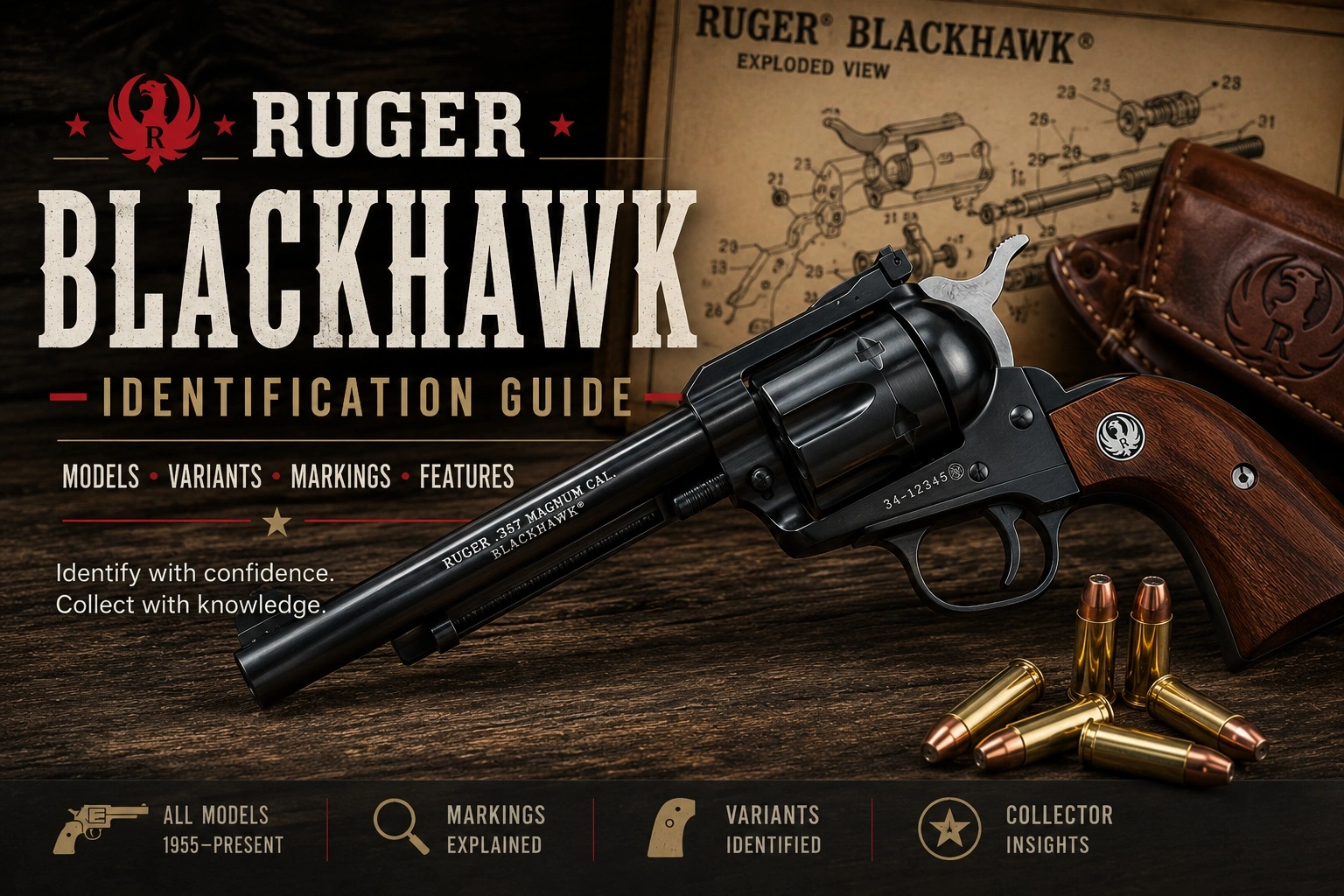
Three Eras of the Ruger Blackhawk
When Colt discontinued the Single Action Army before World War II, a vacuum opened in the American firearms market that no manufacturer rushed to fill. Shooters who loved the classic single-action revolver — its deliberate manual cocking, its iconic profile, its connection to the American frontier — were left without a modern production option. Bill Ruger recognized that demand in 1955 and answered it with the Blackhawk, a single-action revolver built on a modern investment-cast frame, chambered for the potent .357 Magnum cartridge. It was an instant commercial success and the beginning of one of the most collected revolver lines in American history.
Over the next seven decades, the Blackhawk evolved through three distinct production eras, each with defining mechanical and cosmetic characteristics. The Flat-Top (1955–1962) represents the earliest, most collectible configuration with its unprotected rear sight. The Three-Screw or Old Model (1962–1973) added rear sight protection and expanded the caliber lineup dramatically. The New Model (1973–present) introduced Ruger's patented transfer bar safety, fundamentally changing the action design and making the revolver safe for six-round carry. Every serious Blackhawk collector must understand these three eras — their differences drive authentication, valuation, and safe handling practices.
The pivotal moment in Blackhawk history came in 1973 when Ruger redesigned the action to incorporate a transfer bar safety mechanism. The Old Model action — shared by both Flat-Tops and Three-Screws — allowed the hammer to rest directly on the firing pin, meaning a sharp blow to the hammer could discharge a loaded chamber. Ruger subsequently offered a free conversion kit program that replaced Old Model internals with New Model transfer bar parts. While the conversion makes the revolver mechanically safer, it also removes the original action — and for serious collectors, an unconverted Old Model with its original three-screw action intact is significantly more desirable than a converted example.
It is critical to understand that serial numbers alone cannot always distinguish Blackhawk variants with certainty. Overlap periods exist between production eras, serial number records have gaps, and converted Old Models may superficially resemble New Models. Physical inspection — examining the rear sight frame, counting frame screws, looking for the transfer bar, and reading rollmarks — remains essential. For definitive authentication, a Ruger factory letter (Letter of Authenticity) is the gold standard, confirming the original configuration, caliber, barrel length, and ship date of any specific serial number.
Quick Answer: How to Tell Them Apart at a Glance
- Flat-Top (1955–1962): No ear guards around the rear sight. Earliest serial numbers (1 through ~39,000 and early prefix series).
- Three-Screw / Old Model (1962–1973): Three visible screws on the left frame panel. Ear guards added to rear sight. No transfer bar.
- New Model (1973–Present): 'New Model' rollmark on frame. Two visible frame screws (one replaced by transfer bar mechanism). Transfer bar safety visible when hammer is cocked.
The Flat-Top Blackhawk
Ruger's First Single-Action Centerfire — The Crown Jewel of Blackhawk Collecting
The Flat-Top was Ruger's first centerfire single-action revolver, chambered in .357 Magnum at its 1955 introduction. The name derives from the flat-topped frame where the rear sight sits without protective "ear" guards on either side — a clean, uncluttered sight channel that gives the revolver its distinctive silhouette. In 1956, nearly simultaneously with Smith & Wesson's legendary Model 29, Ruger released the .44 Magnum Flat-Top — a revolver that has become the stuff of collector legend, with pristine examples commanding prices that dwarf virtually every other production Ruger.
Production ran from serial number 1 in 1955 through approximately serial number 39,490 in 1962, when Ruger transitioned to the Three-Screw design with added rear sight protection. Across roughly 39,000 units produced over seven years, the Flat-Top Blackhawk remains the smallest production run of any Blackhawk era — and the most coveted. Early examples with the Southport, Connecticut barrel address, original wood grips, and unfired or near-mint condition represent the pinnacle of Ruger collecting.
Key Identification Features
Rear Sight Frame — The Defining Feature
The rear sight is mounted on a completely flat frame top — no raised "ear guards" or protective wings on either side of the sight. This is the single fastest visual identifier of a Flat-Top. Look at the top of the frame from the side or slightly above.
Frame Screw Count
Three screws are visible on the left side of the frame — same as the later Three-Screw models. Do not use screw count alone to distinguish Flat-Tops from Three-Screws; use the rear sight frame instead.
Serial Number Range
Flat-Top serial numbers run from 1 (1955) through approximately 39,490 (1962). Numbers are not prefixed — they appear as plain integers or occasionally with early factory codes. Cross-reference with the production chart on the Serial Number Hub.
Calibers Produced
.357 Magnum (1955–1962) — primary production. .44 Magnum (1956–1963, the "Flat-Top .44") — extremely rare and valuable. No other calibers were offered in the Flat-Top era.
Barrel Lengths
4⅝" and 6½" were the standard Flat-Top barrel lengths. The 10" barrel "Buntline" configuration was catalogued but extremely rare in Flat-Top production.
Finish
All original Flat-Top Blackhawks were blued. Stainless steel was not offered in this era. Factory original blue in excellent condition dramatically increases collector value.
Grip Frame
XR3 aluminum alloy grip frame — slimmer and slightly different profile than the later XR3-RED frame introduced with the Three-Screw models. Feel the grip: original XR3 is notably slimmer.
Rollmarks
Left side of barrel: "RUGER BLACKHAWK .357 MAGNUM" (or .44 MAGNUM). Early Flat-Tops have Southport, CT address. Address changed to Newport, NH around 1959–1960. Address on barrel helps sub-date the firearm.
Flat-Top Production Chart
| Starting Serial Number | Year of Production |
|---|---|
| 1 | 1955 |
| 1,737 | 1956 |
| 7,318 | 1957 |
| 11,676 | 1958 |
| 18,688 | 1959 |
| 25,734 | 1960 |
| 34,325 | 1961 |
| 39,490 | 1962 |
Collector Value Notes
- ◆.44 Magnum Flat-Tops are among the most valuable production Ruger revolvers — excellent condition examples regularly exceed $2,000–$4,000+ at auction
- ◆The .357 Magnum Flat-Top is more attainable but still commands strong premiums over Three-Screw models in comparable condition
- ◆Look for matching numbers, original wood grips, and un-polished original blue — refinished examples lose 50–70% of collector premium
- ◆Southport-addressed Flat-Tops (pre-1960) carry additional early-production collector interest
- ◆The 10" Buntline barrel configuration in .44 Magnum Flat-Top is considered one of the rarest Ruger production variants
The Three-Screw Blackhawk (Old Model)
Pre-Transfer-Bar Production — Highly Collectible, Handle with Informed Care
In 1962, Ruger updated the Blackhawk frame to add protective ear guards around the rear adjustable sight — an upgrade that distinguished these from Flat-Tops immediately on visual inspection. The name "Three-Screw" refers to the three visible screws on the left side of the frame, a configuration shared with the earlier Flat-Top but which became the naming convention for this era because collectors needed a way to distinguish it from the later two-screw New Model. This era expanded the caliber lineup dramatically, adding .30 Carbine, .41 Magnum, .45 Colt, .45 ACP (convertible with extra cylinder), and 9mm Luger variants — making it the most diverse Blackhawk production era.
Production continued until 1973 when Ruger introduced the New Model with its transfer bar safety mechanism. Old Models lack the transfer bar — the hammer rests directly on the firing pin, meaning a loaded chamber under the hammer can fire from a blow to the hammer spur. Three-Screw Blackhawks should always be carried with the hammer down on an empty chamber, the traditional "five-round carry rule" that applies to all Old Model single-actions. This safety consideration is not merely historical — it is a critical handling practice for anyone who shoots or carries an unconverted Old Model.
Key Identification Features
Three Frame Screws — The Naming Feature
Three screws are visible on the left side of the frame. This is where the name comes from. The New Model eliminated one screw as part of the transfer bar redesign. Count the screws: three = Old Model.
Ear Guards on Rear Sight
Unlike the Flat-Top, the Three-Screw frame has protective "ears" — raised wings on either side of the rear sight that protect it from damage. This is the quickest way to distinguish a Three-Screw from a Flat-Top.
No Transfer Bar
Cock the hammer slightly and look into the action from the rear. There is no transfer bar between the hammer and firing pin. The hammer directly contacts the firing pin. This is a functional safety difference — never carry with hammer on a loaded chamber.
No 'New Model' Rollmark
The Three-Screw frame does NOT have "New Model" stamped on it. Check the left side of the frame below the cylinder: absence of this rollmark combined with three screws confirms Old Model status.
Serial Number Range (with prefix)
Serial numbers run from approximately 43,698 (1963) through 31-41551 (1973). Numbers in the 30-XXXXX and 31-XXXXX prefix range are Three-Screw production. Plain integers below ~43,698 are typically Flat-Top territory.
Grip Frame — XR3-RED
Three-Screw models use the XR3-RED grip frame — slightly wider and fuller than the original Flat-Top XR3. Compare grip profile side-by-side; the RED designation indicates the revised frame.
Calibers Available
.357 Magnum, .38 Special (cylinder), .30 Carbine, .41 Magnum, .44 Magnum, .44 Special, .45 Colt, .45 ACP (convertible with extra cylinder), 9mm Luger. The expanded caliber lineup is a key collector point.
Converted vs. Unconverted
Ruger offers a free conversion kit replacing Old Model internals with a transfer bar safety. Converted guns have two frame screws (not three) after installation. A converted Three-Screw is mechanically safer but less desirable to collectors — see the "Converted vs. Original" section below.
Three-Screw Production Chart
| Starting Serial Number | Year of Production |
|---|---|
| 43,698 | 1963 |
| 52,569 | 1964 |
| 60,373 | 1965 |
| 73,551 | 1966 |
| 87,269 | 1967 |
| 108,764 | 1968 |
| 30-00001 | 1969 |
| 30-24975 | 1970 |
| 30-81253 | 1971 |
| 31-10018 | 1972 |
| 31-41551 | 1973 |
Caliber Rarity Guide
| Caliber | Relative Rarity | Notes |
|---|---|---|
| .357 Magnum | Common | Primary production caliber |
| .41 Magnum | Uncommon | Strong collector demand |
| .44 Magnum | Uncommon | Overlap with Super Blackhawk; desirable |
| .45 Colt | Scarce | High collector interest; verify convertible vs. single |
| .45 ACP Convertible | Scarce | Came with two cylinders; both needed for full value |
| .30 Carbine | Scarce | Unique chambering; strong niche collector demand |
| 9mm Luger | Very Scarce | Primarily law enforcement; rare on civilian market |
| .44 Special | Very Scarce | Rarely catalogued; verify with factory letter |
Collector Notes
- ◆The Three-Screw in .41 Magnum and .45 Colt are among the most sought-after calibers for serious collectors
- ◆An unconverted Three-Screw in excellent condition with original box and papers is a significant find
- ◆Verify caliber markings carefully — some Three-Screws were restamped or had cylinders swapped; a factory letter is essential for authentication
- ◆The "five-round carry" rule applies: always carry Old Models with hammer down on an empty chamber
- ◆The Super Blackhawk (introduced 1959) shares the Old Model action but has a different frame and grip — do not confuse with the standard Blackhawk
The New Model Blackhawk
Transfer Bar Safety · Still in Production · The Modern Collector Standard
In 1973, Ruger introduced the New Model Blackhawk incorporating their patented transfer bar safety mechanism — a fundamental redesign that eliminated the Old Model's potential for accidental discharge from a blow to the hammer. The transfer bar only rises into firing position when the trigger is deliberately pulled, meaning the New Model can be safely carried with all six chambers loaded. The frame was redesigned with a two-pin internal architecture that eliminated one of the three external frame screws, and "New Model" was added to the left-side frame rollmarks. The transition was not merely cosmetic — it represented the most significant mechanical change in the Blackhawk's history.
The New Model prefix system (32-XXXXX through 38-XXXXX) replaced the Old Model's plain-integer and 30/31-prefix serials, providing a straightforward way to date production by prefix number. The New Model era has produced far more Blackhawks than both previous eras combined, and the line has continued to evolve with variants including the Bisley Blackhawk (1986), stainless steel finishes, the 50th Anniversary edition (2005–2006, 520-XXXXX prefix), and expanded caliber offerings including .327 Federal Magnum. While New Models are generally less expensive than comparable Old Models, early New Model production and special variants have developed significant collector followings of their own.
Key Identification Features
'New Model' Rollmark
Look on the left side of the frame, below the cylinder. The words "NEW MODEL" appear stamped into the frame. This is the definitive factory indicator — no guesswork required.
Two Frame Screws (not three)
The New Model has only two visible screws on the left frame panel. The third screw's function was incorporated into the new action design. Two screws = New Model.
Transfer Bar Visible
Partially cock the hammer and look into the rear of the action. A flat metal bar (the transfer bar) is visible between the hammer and firing pin. This bar only rises when the trigger is fully pulled, preventing accidental discharge.
Serial Number Prefix 32–38 (and 520)
New Model serial numbers begin with the 32-XXXXX prefix (1974) and run through 38-XXXXX in current production. The special 50th Anniversary model (2005–2006) uses the 520-XXXXX prefix.
Safe for 6-Round Carry
Unlike Old Models, the New Model is designed to be carried safely with all six chambers loaded. The transfer bar only allows firing when the trigger is deliberately pulled.
Expanded Caliber and Variant Lineup
The New Model era introduced the Bisley variant (1986), expanded to .327 Federal Magnum, various convertible cylinders, stainless steel finishes (KBNV prefix), and the Bisley Blackhawk. Modern variants include special editions and commemoratives.
Cold Hammer-Forged Barrel (later production)
Post-1980s New Model Blackhawks feature cold hammer-forged barrels — look for the "CHF" notation in modern documentation. Earlier New Models had conventionally rifled barrels.
Grip Frame
New Models retained the XR3-RED grip frame from Three-Screw production. Original Ruger black rubber or wood panels are correct for most New Model production.
New Model Serial Number Chart
| Starting Serial Number | Year of Production |
|---|---|
| 32-33639 | 1974 |
| 32-66489 | 1975 |
| 33-03854 | 1976 |
| 33-51451 | 1977 |
| 34-06008 | 1978 |
| 34-59110 | 1979 |
| 35-07904 | 1980 |
| 35-55902 | 1981 |
| 35-93851 | 1982 |
| 36-22705 | 1983 |
| 36-39399 | 1984 |
| 36-66388 | 1985 |
| 36-73330 | 1986 |
| 36-82139 | 1987 |
| 36-95212 | 1988 |
| 37-01082 | 1989 |
| 37-09149 | 1990 |
| 37-17217 | 1991 |
| 37-20595 | 1992 |
| 37-24885 | 1993 |
Full chart continues through 2015+ — see Ruger Serial Number Hub for complete data
New Model Variant Identification
| Variant | Years | Key Identifier | Prefix |
|---|---|---|---|
| Standard Blackhawk | 1974–Present | "New Model" rollmark, 2 screws | 32–38 |
| Bisley Blackhawk | 1986–Present | Bisley hammer, Bisley grip frame | Shares 36–38 prefix |
| Super Blackhawk New Model | 1973–Present | Larger grip frame, unfluted cylinder option | Separate SN series |
| 50th Anniversary | 2005–2006 | Special rollmarks, presentation case | 520-XXXXX |
| Stainless New Model | 1990s–Present | Brushed stainless finish, KBN prefix | Shares 37–38 prefix |
Side-by-Side Identification Comparison
Use this table when examining a firearm in hand
| Feature | Flat-Top (1955–1962) | Three-Screw (1962–1973) | New Model (1973–Present) |
|---|---|---|---|
| Rear Sight Frame | Flat — no ear guards | Ear guards present | Ear guards present |
| Visible Frame Screws | 3 screws | 3 screws | 2 screws |
| Transfer Bar Safety | None | None | Present |
| 'New Model' Rollmark | Absent | Absent | Present |
| Safe 6-Round Carry | No — 5-round rule | No — 5-round rule | Yes |
| Serial Number Range | 1 – ~39,490 | ~43,698 – 31-41551 | 32-33639+ |
| Serial Prefix Format | Plain integer | None, then 30/31- | 32– through 38– |
| Grip Frame | XR3 (slim) | XR3-RED (fuller) | XR3-RED |
| Calibers | .357 Mag, .44 Mag only | .357, .41, .44, .45 Colt, .30 Carbine, 9mm+ | .357, .45 Colt, .327, others |
| Factory Blue | Yes (only finish) | Yes (primary) | Yes + Stainless |
| Original Box Value | Extremely high | Very high | High |
| Collector Tier | Highest | Very High | Moderate–High |
Converted vs. Original Old Models
What Collectors Need to Know
Ruger's free conversion kit program (begun around 1980) installs a transfer bar safety into Old Model revolvers. The kit replaces five internal parts and removes one frame screw hole's function. A converted Old Model is mechanically safer — it gains the same transfer bar system used in the New Model — but it is no longer original. And for collectors, originality is everything. The conversion cannot be reversed without re-manufacturing original parts. Understanding whether an Old Model has been converted is one of the most critical assessment skills in Blackhawk collecting.
Unconverted Original Old Model
- ✦Three visible frame screws intact
- ✦No transfer bar when action is inspected
- ✦Original internals: hammer, trigger, and bolt are Old Model parts
- ✦Markings: no conversion-related stamps or rollmarks added
- ✦Value: Maximum collector value — unconverted originals are what serious collectors seek
- ✦Safety note: Must be carried with hammer on empty chamber (5-round rule)
Ruger-Converted Old Model
- ✦After conversion: two visible frame screws (third screw hole plugged or absent)
- ✦Transfer bar now visible when action is inspected
- ✦New Model internal parts installed; original parts returned to owner (if requested)
- ✦Value: Reduced collector premium — mechanically safe but no longer original
- ✦Ruger's position: "Value will not be impaired" — collectors generally disagree
- ✦Upside: Safer to carry and shoot; suitable for use rather than display
How to Detect a Conversion in Photographs
Online buying guidance
- ◆Count the frame screws in any left-side photograph — two screws on what should be a Three-Screw is the conversion giveaway
- ◆Look for a visible transfer bar in any cocked-action photograph
- ◆Ask the seller explicitly: "Has this gun been returned to Ruger for the conversion kit?" Never assume
- ◆Original Old Model parts returned by Ruger (if kept by the original owner) are sometimes included with the gun — this is valuable documentation
- ◆A factory letter will not confirm conversion status — this requires physical inspection or seller disclosure
Hands-On Inspection Checklist
Use this before purchasing or authenticating any vintage Blackhawk
Exterior Identification
Action Inspection
Condition Assessment
Documentation
Quick Visual Identifier
Answer three questions to identify your Blackhawk
Question 1
Does the rear sight have protective ear guards on both sides?
Confirm: serial number below ~39,490 with no prefix. Caliber should be .357 Mag or .44 Mag only.
Question 2
Is "NEW MODEL" stamped on the left frame?
Serial prefix 32–38 or 520. Safe for 6-round carry. Transfer bar safety present.
Question 3
How many screws are visible on the left frame panel?
Handle per 5-round safety rule. Highly collectible in original configuration.
Original Three-Screw with Ruger's free conversion kit installed. Mechanically a New Model action in an Old Model frame.
Ruger Collector Research Cluster
Information on this page is provided for collector reference and identification purposes only. Production dates and serial number ranges are approximate. Physical inspection by a qualified gunsmith is recommended before purchase. For official documentation, contact Ruger's Service Department at 336-949-5200. Gun Collectors Club is an independent collector reference site and is not affiliated with Sturm, Ruger & Co., Inc. Always follow safe firearms handling practices — Old Model Blackhawks without the transfer bar conversion should be carried with the hammer resting on an empty chamber.
Related Guides & Resources
Production timelines and serial number lookup for Security Six, GP100, and Blackhawk
View guide →Full Old Model and New Model serial number tables with production year estimates
View guide →How the Super Blackhawk differs from the standard Blackhawk — frame, grip, and cylinder
View guide →Companion guide to Ruger's rimfire single-action line — Flat-Top Single-Six through New Model
View guide →Ruger letter availability, factory-record limits, and documentation options.
View guide →How grading systems, originality, and condition affect collector value.
View guide →