Gun Collectors Club · Collector Reference
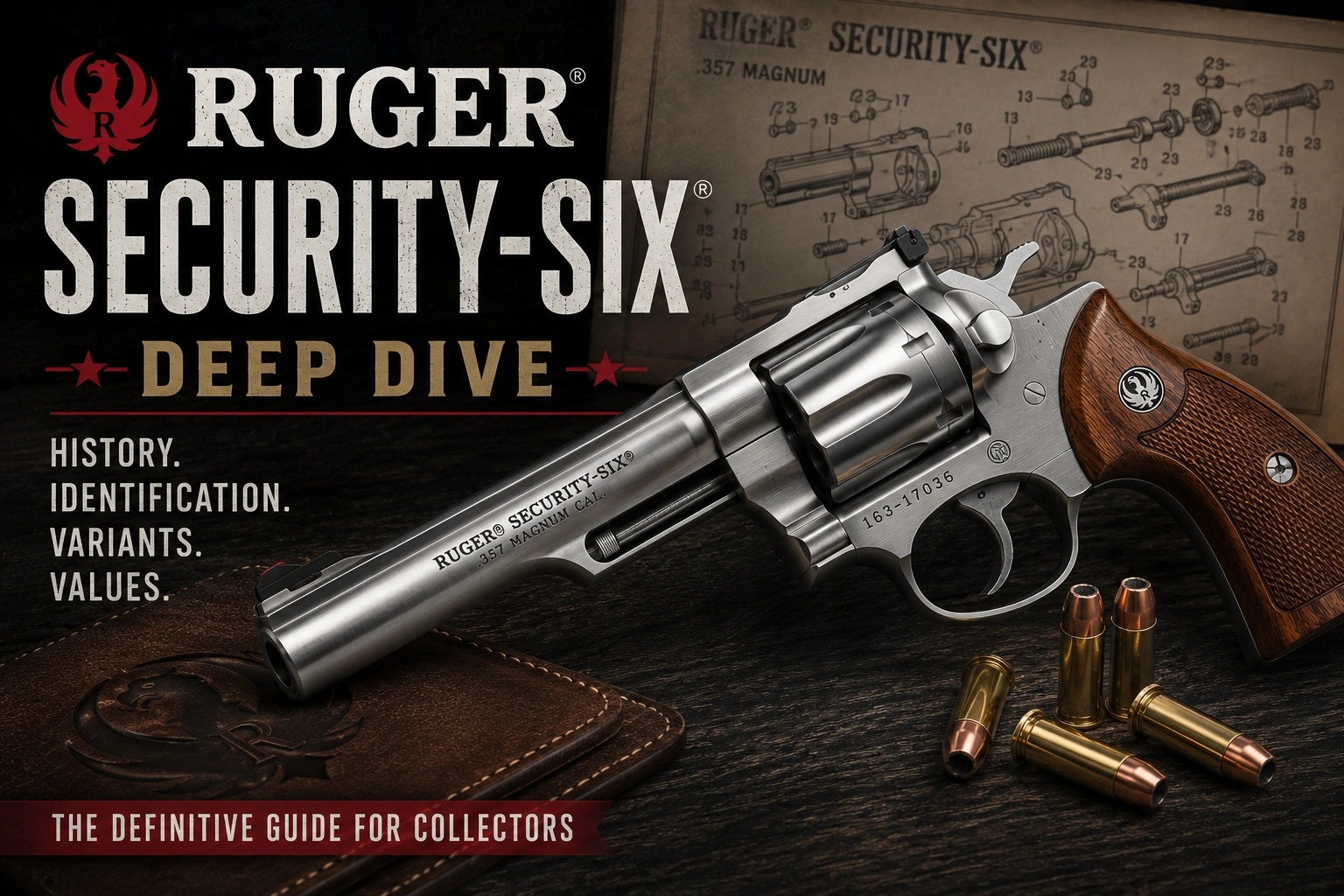
Ruger Security-Six Deep Dive
Use this Ruger Security Six reference to narrow the likely manufacture period and identify the correct model or series. Enter or compare the available markings, then verify the result against the supporting serial-range notes and collector references below.
← Back to Ruger Revolver Serial Number HubRuger's First Double-Action — An American Law Enforcement Icon
In 1972, Sturm, Ruger & Co. introduced the Security Six — the company's first-ever double-action revolver and a direct challenge to the market dominance held by Smith & Wesson and Colt in American law enforcement. The project had been gestating since 1966, when Bill Ruger directed engineers Harry Sefried and Henry Into to design a modern double-action revolver that would leapfrog the competition in both strength and manufacturing efficiency. The result was revolutionary: a solid one-piece frame with no sideplate, produced using Ruger's proprietary investment casting technology. This approach eliminated the traditional sideplate — a known weak point in competitor designs — and allowed Ruger to produce a stronger, more affordable revolver that could undercut S&W's Model 19 on price while matching or exceeding it in durability.
Over its production run from 1972 to 1988, the Six Series — encompassing the Security Six, the Police Service-Six (Service Six), and the Speed Six — achieved remarkable market penetration. Approximately 1.24 to 1.5 million Six Series revolvers were produced across all three variants, a figure that speaks to the line's commercial success. The Six Series was adopted by an impressive roster of American law enforcement agencies: the New York Police Department, the U.S. Border Patrol, the Immigration and Naturalization Service (INS), the U.S. Postal Service Inspection Service, and hundreds of state and municipal police departments from coast to coast. Significant overseas export contracts further expanded the line's global footprint, making the Six Series one of the most widely issued American duty revolvers of the Cold War era.
Ruger discontinued the Six Series in 1988, replacing it with the GP100 — a heavier, more robust design built to handle an unlimited diet of full-power .357 Magnum loads. The discontinuation, however, planted the seeds for the Six Series' current collector renaissance. Thirty-plus years of discontinued status, combined with the line's law enforcement heritage, its famously robust construction, and the finite supply of surviving examples in original condition, have driven steadily increasing collector interest. The Six Series is widely regarded as one of the most undervalued American revolvers of the 20th century — a situation that savvy collectors are correcting with rising prices at auction and in private sales year over year.
A critical note for buyers and researchers: the Security Six, Speed Six, and Service Six all share the same serial number prefix series (150 through 162). This means that a serial number alone cannot tell you which of the three models you are looking at. A Ruger factory letter — available by contacting Ruger's Service Department — is the only authoritative way to confirm the exact model, caliber, barrel length, finish, and ship date for any Six Series revolver. This shared-prefix reality makes factory documentation essential for serious collectors and is a frequent source of misidentification in the secondary market.
How to Identify a Ruger Security Six by Year and Model
Begin with the complete frame serial number, including the three-digit prefix. Compare that number with the correct Six Series production range to estimate the year, but do not use the range alone to choose between a Security-Six, Police Service-Six, and Speed-Six. Ruger produced all three models within the shared 150-through-162 prefix sequence.
Next, read the barrel rollmark and compare the revolver’s physical configuration. A Security-Six normally has an adjustable rear sight and square-butt grip frame. A Police Service-Six has fixed sights and a square butt, while a Speed-Six combines fixed sights with a round butt. Confirm the caliber, barrel length, and finish before accepting the identification.
- Serial prefix and sequence: estimate the likely production or shipping period.
- Barrel rollmark: record the model and caliber exactly as marked.
- Rear sight: adjustable normally indicates Security-Six; fixed sights point toward Service-Six or Speed-Six.
- Grip frame: square butt distinguishes the Service-Six from the round-butt Speed-Six.
- Barrel and finish: verify that length and blue or stainless construction agree with the claimed configuration and period.
If the serial estimate and physical features conflict, describe the revolver by its observed markings rather than forcing a model or exact year. Factory records are the appropriate next step for documenting a collector-grade, contract, or unusual example.
Security Six at a Glance
- Type: Double-action / single-action revolver
- Introduced: 1972 (serial prefix 150-00001)
- Discontinued: 1988 (replaced by GP100)
- Total Six Series produced: ~1.24–1.5 million (all variants)
- Calibers: .357 Magnum, .38 Special, 9mm Luger
- Barrel lengths: 2.75", 4", 6" (Security Six); 2.75", 3", 4" (Speed/Service Six)
- Finishes: Blued carbon steel (1972); Stainless steel added 1975
- Frame: Solid one-piece, no sideplate; investment cast
- Safety: Transfer bar — safe for 6-round carry from day one
- Variants sharing prefix: Security Six, Service Six (Police Service-Six), Speed Six
- Ruger Service: 336-949-5200 · Newport, NH
The Six Series: Security Six, Service Six, and Speed Six
Three distinct models, one shared serial prefix — know the differences before you buy
All three Six Series revolvers share the same basic frame, action, and serial number prefix (150–162), making them interchangeable in production records. The differences lie in sights, grip profile, barrel options, and intended market. A factory letter is the only way to confirm which specific model a given serial number represents.
Security Six
The flagship model — the only Six Series revolver with a fully adjustable rear sight (elevation and windage). Square-butt grip frame. Marketed to civilians and law enforcement agencies wanting a precision adjustable sight. Available in 2.75", 4", and 6" barrels. The Security Six is the most recognizable of the three and the most common on the used market. Calibers: .357 Magnum, .38 Special, 9mm Luger (limited).
Police Service-Six (Service Six)
Designed specifically for law enforcement contract sales. Fixed rear sight (channel cut in the top strap) — more snag-resistant for duty carry. Square-butt grip frame matching the Security Six. Available in 2.75", 3", and 4" barrels. Large quantities were purchased by police departments on contract — many Service-Six revolvers on the used market are surplus law enforcement guns. Calibers: .357 Magnum, .38 Special, 9mm Luger.
Speed Six
The compact carry and plain-clothes variant. Fixed rear sight matching the Service Six. Round-butt grip frame — slimmer profile ideal for concealed carry, plainclothes officers, and backup gun roles. Available in 2.75", 3", and 4" barrels. The Speed Six was the preferred choice for detectives, federal agents, and off-duty carry. Round-butt examples are increasingly scarce in excellent condition. Calibers: .357 Magnum, .38 Special, 9mm Luger.
Model Comparison
| Feature | Security Six | Service Six | Speed Six |
|---|---|---|---|
| Rear Sight | Fully adjustable | Fixed groove | Fixed groove |
| Grip Profile | Square butt | Square butt | Round butt |
| Primary Market | Civilian / LE | Law enforcement contract | LE plainclothes / carry |
| Barrel Options | 2.75", 4", 6" | 2.75", 3", 4" | 2.75", 3", 4" |
| Calibers | .357, .38, 9mm | .357, .38, 9mm | .357, .38, 9mm |
| Finish Options | Blue, Stainless | Blue, Stainless | Blue, Stainless |
| Collector Scarcity | Common | Moderate | Moderate–Scarce |
| Serial Prefix | Shared 150–162 | Shared 150–162 | Shared 150–162 |
Barrel Length Options — Identification and Collector Value
The Six Series was produced in three primary barrel lengths — 2.75", 4", and 6" — with the 3" barrel available on Speed Six and Service Six models. Barrel length is stamped on the barrel and confirmed by a factory letter. The 2.75" barrel is the scarcest and most desirable across all three models.
2.75" Barrel
The shortest barrel offered on the Security Six. Produced in smaller quantities than the 4" — primarily for law enforcement backup roles, plainclothes officers, and civilian concealed carry. The 2.75" Security Six with adjustable sights is a particularly unusual combination — most compact Six Series guns are Speed Six or Service Six with fixed sights. In stainless steel, the 2.75" Security Six commands the strongest collector premiums of any standard production configuration. In 2026, excellent-condition 2.75" stainless examples have sold at auction for $780+.
3" Barrel
The 3" barrel was offered on Speed Six and Service Six models only — not on the Security Six (which used 2.75" for its compact option). A 3" barrel combined with a round-butt Speed Six frame is the iconic compact law enforcement carry configuration. The 3" barrel is slightly longer than the 2.75" — visible in direct comparison. If a seller lists a "3-inch Security Six," verify carefully: it is more likely a Service Six or Speed Six.
4" Barrel
The 4" barrel was the standard law enforcement duty barrel — the most common Six Series configuration in both blued and stainless. Issued by the vast majority of police departments that adopted the Six Series. The 4" Security Six (adjustable sights) was the civilian benchmark; the 4" Service Six (fixed sights) dominated law enforcement contracts. The 4" is the most available configuration on the used market and commands the lowest collector premium among the three lengths — making it the best entry point for new collectors.
6" Barrel
The 6" barrel was offered only on the Security Six — with its adjustable rear sight, this configuration was marketed to hunters and target shooters. Less common than the 4" in law enforcement service. The 6" Security Six has a long sight radius and excellent accuracy potential. In excellent original condition with original wood grips, the 6" blued Security Six is an elegant collector piece. Stainless 6" examples are particularly striking and hold strong collector interest.
Finish Options — Blued Carbon Steel and Stainless Steel
The Six Series launched in 1972 in blued carbon steel only. In 1975, Ruger introduced stainless steel versions of all three models — a significant development that expanded the line's law enforcement appeal and durability. Identifying original finish vs. refinished examples is critical to collector value assessment.
Blued Carbon Steel
Introduced at launch in 1972. The blued finish is a deep, rich blue-black applied to carbon steel. Early production (1972–1974) is blued only — any Six Series gun with a serial number placing it before 1975 should be blued.
Original Ruger factory blue is a cold-blue or hot-blue process producing a characteristic deep, even color. Look for consistency across all surfaces and sharp edge definition — original factory blue retains crisp edges on frame corners and the barrel rib.
Re-blued guns are the most common value-killer in the Six Series market. Signs of re-bluing: rounded edges (polishing removes edge sharpness), uniformly bright blue on worn areas, blue inside screw slots, and sometimes over-blued grip panels or trigger guard.
A first-year 1972 Security Six in excellent original blue is one of the most desirable entry-level Six Series collector finds.
Stainless Steel
Stainless steel versions of all three Six Series models introduced in 1975. The stainless finish is a brushed satin appearance — not polished mirror. Factory stainless on the Six Series has a consistent grain direction across flat surfaces.
Stainless Six Series guns carry a moderate premium over equivalent blued examples — the finish is self-preserving and most stainless guns have seen less aggressive use than blued duty guns. Stainless examples in excellent condition are more common because the finish holds better.
The 2.75" stainless Security Six and Speed Six are the scarcest and most valuable stainless configurations.
Polished stainless (where the factory brushed finish has been polished to a mirror) reduces collector value but does not destroy it the way re-bluing does for carbon steel guns.
Finish Identification Guide
| Indicator | Original Blue | Re-Blued | Original Stainless | Polished Stainless |
|---|---|---|---|---|
| Edge sharpness | Crisp, factory-sharp | Rounded, soft | Crisp, brushed | Rounded, mirror |
| Screw slot interior | Match frame finish | Often over-blued | Match frame finish | Often over-polished |
| Color consistency | Even, slight depth | Flat, very uniform | Consistent grain direction | Mirror across all surfaces |
| High-wear areas | Show appropriate age | Newly blued = suspicious | Minimal wear | May show buffing marks |
| Collector impact | Maximum value | −25 to −40% value | Maximum value | −10 to −20% value |
Law Enforcement Contracts & Agency Adoption
The Security Six as an American duty revolver — agencies, contracts, and what to look for
The Six Series was Ruger's deliberate entry into the law enforcement market, undercutting Smith & Wesson's Model 19 on price while matching or exceeding its durability. Bill Ruger priced the Six Series aggressively, and police procurement offices responded — the Six Series became standard issue at hundreds of American law enforcement agencies during the 1970s and 1980s. Many of these surplus guns are now on the secondary market, often in excellent mechanical condition despite holster wear from decades of carry.
Identifying a law enforcement surplus Six Series revolver adds historical provenance and, in many cases, collector value. Agency markings, specific configurations (fixed sights, 4" barrel), and documentation connecting a specific serial number to a department purchase all contribute to the story — and the desirability — of a surplus duty gun.
Known Agency Adoption
| Agency | Model | Configuration | Notes |
|---|---|---|---|
| New York Police Department (NYPD) | Service Six | .38 Special, 4" | Large contract; many surplus examples on market |
| U.S. Border Patrol | Service Six | .357 Magnum, 4" | Major federal contract; often seen with agency markings |
| Immigration and Naturalization Service (INS) | Service Six | .357 Magnum, 4" | Federal agency; predecessor to modern DHS/CBP |
| U.S. Postal Service (USPS Inspection Service) | Service Six | .357 Magnum, 4" | Postal inspectors carried the Six Series through the 1980s |
| U.S. Army (limited) | Speed Six | 9mm, 4" | Limited military evaluation / contract; 9mm variants rare |
| Numerous state & municipal police | Security Six / Service Six | Various | Hundreds of departments; surplus examples common |
| Overseas exports | All variants | Various | Significant export sales to allied nations' police/military |
Identifying Law Enforcement Surplus Six Series Guns
- Agency property markings: Some contract guns were stamped or electro-penciled with agency property numbers or abbreviations (e.g., "NYPD," "BP" for Border Patrol). These markings are collectible and desirable — do not attempt to remove them.
- Fixed-sight configuration: The vast majority of law enforcement contract guns are Service Six (fixed sights, square butt) or Speed Six (fixed sights, round butt) — a Security Six with adjustable sights was less commonly issued on large contracts.
- Holster wear: Expect consistent holster wear patterns (right-side frame, muzzle, barrel rib) on genuine duty guns. Wear should be consistent with carry, not with shooting or abuse.
- High mechanical condition despite cosmetic wear: Duty revolvers were frequently cleaned and maintained but rarely fired heavily. Many surplus guns have excellent actions despite 30–40 years of holster carry.
- 9mm variants: The 9mm chambering was produced primarily for law enforcement and government contracts. Civilian 9mm Six Series guns are uncommon — a 9mm example often indicates a law enforcement provenance.
- Factory letter: A factory letter for contract guns will often note the agency purchase — this is a significant additional documentation point for provenance collectors.
Caliber Variants — .357 Magnum, .38 Special, and 9mm
All Six Series revolvers were manufactured with .357 Magnum cylinders capable of firing both .357 Magnum and .38 Special. The 9mm variant used moon clips and is the most uncommon civilian chambering in the Six Series.
| Caliber | Availability | Notes | Collector Rarity |
|---|---|---|---|
| .357 Magnum | Standard — all models | Primary production caliber; accepts .38 Special | Common |
| .38 Special | Special order / contract | .38 Spl-only cylinder; less common than .357 | Uncommon |
| 9mm Luger | Law enforcement / contract | Requires moon clips; primarily government contracts | Scarce |
| .38 S&W | Special order | Very limited; primarily export | Very Scarce |
The 9mm Six Series — What Collectors Need to Know
The 9mm variant of the Six Series (Security Six, Service Six, and Speed Six) was produced with a cylinder chambered for 9mm Luger using half-moon or full-moon clips. This chambering was introduced primarily for law enforcement agencies that had standardized on 9mm or for military evaluation purposes. The U.S. Army evaluated the 9mm Speed Six as a potential service sidearm. Civilian 9mm Six Series revolvers exist but are significantly less common than law enforcement examples. On the collector market, the 9mm variant commands a meaningful premium — typically 20–35% over a comparable .357 Magnum example in the same model and condition. Verify chambering from the barrel rollmark: "9mm Luger" or "9mm Parabellum" should be stamped on the barrel.
Fair Market Price Guide — July 2026
Six Series prices have risen steadily as collector interest in discontinued American revolvers grows. The following ranges reflect realistic private-party and completed auction prices as of July 2026. Condition has a dramatic effect — original finish in excellent condition commands 2–3× the price of a worn or refinished example.
| Model / Configuration | Condition | Price Range | Notes |
|---|---|---|---|
| Security Six 4" Blued | Excellent (original finish) | $550–$699 | Strong demand; most common config |
| Security Six 4" Blued | Very Good | $400–$549 | Light holster/handling wear |
| Security Six 4" Blued | Good | $300–$399 | Visible wear; functional |
| Security Six 4" Blued | Re-blued | $200–$350 | Reduced value; disclose finish |
| Security Six 4" Stainless | Excellent | $575–$750 | Stainless premium applies |
| Security Six 2.75" Blued | Excellent | $650–$850 | Scarcity premium; short barrel |
| Security Six 2.75" Stainless | Excellent | $750–$950+ | Highest-demand standard config |
| Security Six 6" Blued | Excellent | $575–$749 | Target/hunting config; strong interest |
| Security Six 9mm (any) | Excellent | +20–35% over .357 | Rare; verify from barrel stamp |
| Service Six 4" Blued | Excellent | $500–$650 | Good shooter/collector value |
| Service Six 4" Surplus | VG (agency marked) | $450–$650 | Agency marks add provenance premium |
| Speed Six 3" Blued | Excellent | $525–$699 | Round butt; compact carry appeal |
| Speed Six 2.75" Stainless | Excellent | $700–$900+ | Most scarce Speed Six; strong premium |
| Any Six w/ original box/papers | Excellent | +15–25% above | Matching serial box is significant |
| Any Six first-year 1972 (150-XXXXX) | Excellent | +20–30% premium | Early production collector interest |
Value Killers
Re-bluing eliminates 25–40% of collector value. Replaced grips (non-original wood or aftermarket rubber) reduce value 5–15%. Polished or stoned trigger components without disclosure reduce value. Always ask: "Is the finish original? Have any internal parts been replaced or modified?"
Original Wood Grips — Identification and Value Impact
The Six Series shipped from the factory with checkered walnut wood grip panels featuring the Ruger eagle medallion inset. These original grips are a key collector indicator — replacement rubber or synthetic grips are common on used examples and reduce collector value. Original grips in excellent condition with intact medallions are increasingly hard to find as separate items.
When evaluating a Six Series revolver, grip assessment should be among your first steps. The difference between original factory walnut and a Hogue monogrip is immediately obvious — but distinguishing factory grips from high-quality aftermarket wood panels (such as Herrett's or Eagle) requires closer attention to checkering pattern, medallion placement, and fit.
Original Factory Grips
- ★ Checkered walnut with fine-line checkering pattern
- ★ Ruger red eagle medallion inset into left panel (black eagle on red field for most production; early guns may vary)
- ★ Grip panels fit frame precisely — no gaps at frame junction
- ★ Light oil or wood finish; shows appropriate aging without cracks or repairs
- ★ Right panel is plain (no medallion on right)
- ★ Matching patina to overall gun condition — grips and metal should show comparable age
Replacement / Aftermarket Grips
- ✕ Hogue rubber monogrip (most common replacement — functional but not original)
- ✕ Uncle Mike's or Pachmayr rubber panels — clearly aftermarket
- ✕ Custom wood aftermarket (Herrett's, Sile, Eagle) — may be period-correct but not factory
- ✕ Oversized or finger-groove designs — clearly aftermarket
- ✕ Any grip with no Ruger medallion — not original
- ✕ Value impact: Replacement grips reduce value 5–15%; original grips significantly increase it
Six Series Inspection Checklist
Use before purchasing any Security Six, Service Six, or Speed Six
Model & Variant Identification
Finish Assessment
Mechanical Inspection
Grips & Documentation
Ruger Security Six FAQ
How do I use this Ruger Security Six guide?
Record the complete serial number and prefix, then compare it with the Six Series production range. Confirm the result using the barrel rollmark, rear-sight type, grip-frame shape, caliber, barrel length, and finish because Security-Six, Service-Six, and Speed-Six revolvers share serial-prefix ranges.
Can a serial number confirm the exact manufacture year of a Ruger firearm?
A published Ruger serial-number range normally provides an approximate production or shipping period rather than an exact manufacture date. Ruger factory records are the stronger source for confirming a specific model, configuration, and ship date.
What markings should I check when the serial number alone is inconclusive?
Check the barrel model and caliber rollmarks, adjustable or fixed rear sight, square or round butt, barrel length, serial prefix, finish, grip medallions, and any agency markings. These features distinguish the Security-Six, Police Service-Six, and Speed-Six when their serial ranges overlap.
What is the difference between a Ruger Security Six and Security 6?
Security Six and Security 6 usually refer to the same adjustable-sight Ruger double-action revolver. Ruger’s model name was Security-Six. It should not be confused with the fixed-sight Police Service-Six or the round-butt Speed-Six.
Where is the serial number on a Ruger Security-Six?
The serial number is stamped on the revolver’s frame. Record the complete prefix and sequence exactly as marked, then compare it with Ruger Six Series records and verify the model from the barrel marking and physical configuration.
Ruger Collector Research Cluster
Information on this page is provided for collector reference and identification purposes only. Production dates and serial number ranges are approximate. Physical inspection by a qualified gunsmith is recommended before purchase. For official documentation, contact Ruger's Service Department at 336-949-5200. Gun Collectors Club is an independent collector reference site and is not affiliated with Sturm, Ruger & Co., Inc. Always follow safe firearms handling practices — Old Model Blackhawks without the transfer bar conversion should be carried with the hammer resting on an empty chamber.