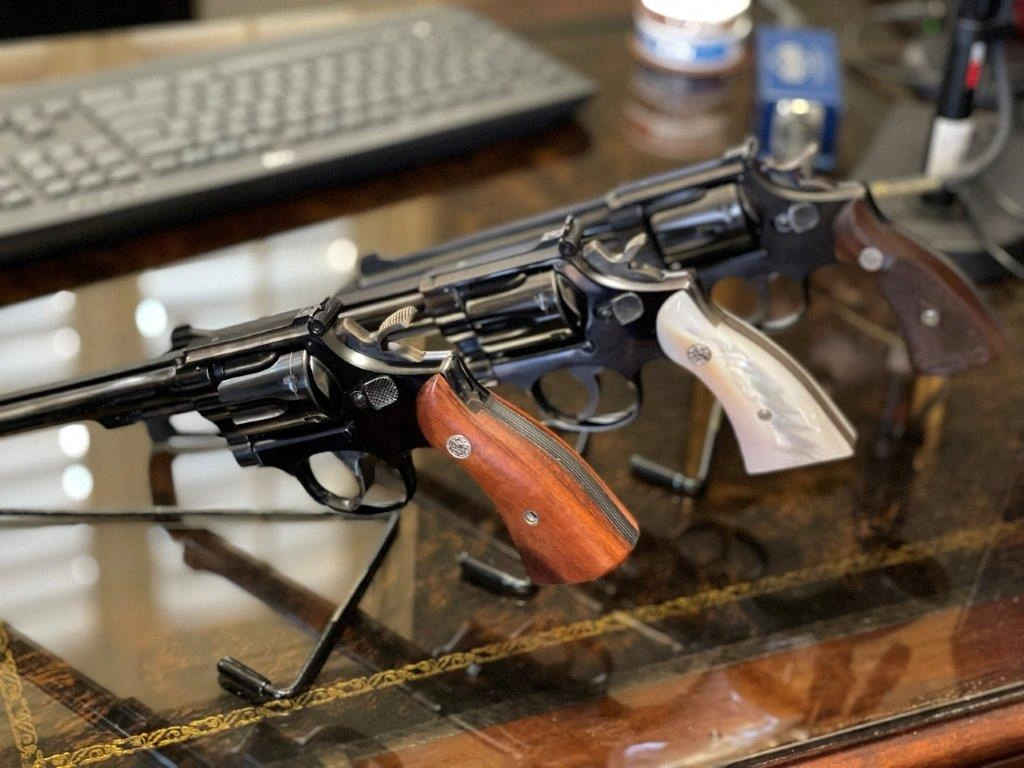
This series wasn’t planned. It started with one K-22… and turned into something else entirely.
What began as a simple purchase turned into a deep appreciation for the post-war Smith & Wesson K-22 Masterpiece revolvers — guns made at a time when craftsmanship still mattered more than production speed. Before long, I found myself Before long, I found myself studying serial numbers, chasing variations, and learning the subtle differences between five-screw, four-screw, and three-screw guns. , chasing variations, and learning the subtle differences between five-screw, four-screw, and three-screw guns.

This five-part series documents that journey — not just the guns themselves, but what they represent: a moment in American manufacturing history that cannot be recreated today.
What Is the Smith & Wesson K-22 Masterpiece?
The Smith & Wesson K-22 Masterpiece was the target-grade .22 Long Rifle member of the company's K-frame family. It combined a medium-size revolver frame with adjustable sights, a full target barrel profile, a crisp single-action pull, and the balance that made Smith & Wesson's post-war target revolvers famous.
Start Here
Complete K-22 Masterpiece Overview
Begin with the long-form overview for K-22 history, production eras, identification features, serial-number context, originality, condition, collecting guidance, and representative photography.
Read the Complete K-22 OverviewThe K-22 was built for accuracy, training, small-game use, and formal target work, but its appeal eventually reached far beyond the firing line. Collectors study these revolvers today because they show Smith & Wesson at a high point of fit, finish, and practical design.
The K-22 Masterpiece emerged during one of the most respected periods in the company's history. Collectors interested in the broader development of the firm can explore the history of Smith & Wesson, including the evolution of the K-frame revolvers that eventually produced the Model 17.
Popular K-22 Collector Guides
Use these featured pages as the main roadmap for the K-22 series. Each guide focuses on a different production period, screw configuration, or representative example from the Gregory J. Cook Collection.
1946
Factory Showcase Gun
An early post-war K-22 with important collector provenance.1948
Third Model K-22
A strong production-year example from the early post-war period.1953
Five-Screw Masterpiece
A classic mid-century K-22 showing the appeal of the five-screw era.1957
Four-Screw Pre-Model 17
A transitional example from the last years before model-number markings.1960
Model 17-1
The K-22 story continues into the numbered Model 17 era.K-22 production timeline
From post-war target revolver to Model 17
The K-22 evolved steadily after World War II. Collectors often divide the post-war guns by screw configuration, factory features, and the 1957 transition from named models to numbered models.
- 1946–1948 — Post-war Third Model production resumes Smith & Wesson returned to peacetime production and brought the K-22 Masterpiece back as a precision .22 target revolver for shooters, outdoorsmen, and competitive pistol enthusiasts.
- 1949–1954 — Mature five-screw era The classic five-screw configuration represents the older style of Smith & Wesson craftsmanship, with careful fitting, traditional polish, and details collectors still study closely.
- 1955–1956 — Transitional four-screw production The upper sideplate screw disappeared, giving collectors an easy visual clue that the K-22 was moving from the older pre-war-influenced style toward a more modern production pattern.
- 1957 — Final pre-Model 17 period Smith & Wesson adopted model numbers, and the named K-22 Masterpiece became part of the numbered Model 17 family while retaining much of the same target-revolver character.
- 1957 onward — The Model 17 carries the story forward The K-22 did not disappear. It continued under the Model 17 designation, preserving the basic concept of a high-grade K-frame .22 revolver for target work and serious rimfire shooting.
How Collectors Identify K-22 Variations
Most K-22 identification begins with four characteristics: Most K-22 identification begins with four characteristics: serial number, screw configuration, barrel markings, and sight style. , screw configuration, barrel markings, and sight style. From there, collectors examine hammer shape, trigger type, stocks, finish, and signs of factory originality.
Five-screw revolvers generally attract strong collector interest because they represent the older production style. Four-screw examples show the mid-1950s transition, while early Model 17 revolvers preserve much of the same K-22 character under the newer model-number system.
Original grips, matching serial-numbered stocks, clean screw slots, correct sights, and an undisturbed factory finish can make a major difference in collector appeal. The individual pages in this series give real-world examples of those features rather than treating the K-22 as a single unchanging model.
The K-22 Masterpiece in Historical Context
The K-22 Masterpiece was not a defensive sidearm, a duty revolver, or a fashionable magnum. It was a precision .22 target revolver built in a period when Smith & Wesson still leaned heavily on skilled labor, traditional fitting, and careful metalwork.
That context is central to the appeal of the series. These revolvers show a company building target handguns for shooters who expected accuracy, balance, and repeatable performance. They also show how small engineering changes, such as screw-count revisions and model-number markings, can become important collector clues decades later.
Gil Hebard and the K-22 Legacy
One individual closely associated with precision pistol shooting during the K-22 era was Gil Hebard, whose influence on American competitive shooting helped popularize many of the target revolvers and accessories collectors still admire today.
Hebard's name belongs in the larger K-22 conversation because the revolver was part of the same target-shooting culture he served. The 1946 showcase gun discussed in this series adds a direct historical thread between Smith & Wesson craftsmanship, competitive pistol shooting, and the collectors who continue to preserve those stories.
Collector Interest and Market Appeal
Collectors continue to pursue K-22 Masterpieces because they combine practical accuracy with strong historical character. A good K-22 can still be taken to the range and enjoyed, yet the best examples also reward careful study of serial numbers, screw patterns, stocks, sights, finish, and provenance.
Condition remains critical. Honest wear may be acceptable on a well-documented shooter, but altered finishes, mismatched stocks, damaged screw slots, or incorrect parts can reduce collector confidence. The strongest examples usually retain their original finish, proper stocks, sharp markings, and clear production-era features.
Read the Series
Each part looks at a different chapter in the K-22 story: the overview, the first post-war showcase gun, the 1948 production surge, the 1953 five-screw example, and the 1957 four-screw pre-Model 17.
Part I
The K-22 Masterpiece Overview
How to identify five-screw, four-screw, and three-screw Smith & Wesson target revolvers.Part II
The 1946 Factory Showcase Gun
The first production K-22 Masterpiece completed in 1946, later connected to Gil Hebard and Roy Jinks.Part III
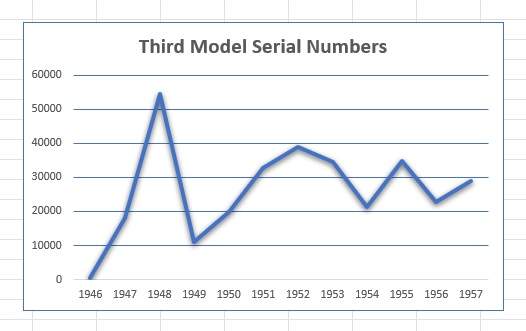
The 1948 K-22
A look at one of the busiest post-war production years and the features that make early third models so interesting.Part IV
The 1953 Five-Screw
A personal look at old-gun craftsmanship, hand fitting, and the appeal of a mid-century Masterpiece.Part V
The 1957 Four-Screw
One of the last pre-Model 17 examples, with the shift from five-screw to four-screw construction.Model 17-1
The 1960 Continuation
A numbered Model 17-era revolver that carries the K-22 Masterpiece story forward.Post-War Craftsmanship and Collector Study
The K-22 Masterpiece was not a defensive sidearm, a duty revolver, or a fashionable magnum. It was a precision .22 target revolver built in a period when Smith & Wesson was still leaning heavily on skilled labor, traditional fitting, and old-school metalwork.

That is what gives these revolvers their charm. The appeal is not only that they shoot well. The appeal is that they carry the feel of the post-war American gun trade — forged parts, hand-fitted wood, careful polish, narrow ribs, pinned barrels, recessed cylinders, and the kind of workmanship collectors still talk about decades later.
The K-22 Masterpiece is more than a .22 target revolver. It is a useful study piece for collectors who want to understand post-war Smith & Wesson workmanship before production efficiency began to reshape the revolver line.
How to Use This Guide
Start with the overview if you are trying to identify a gun. Start with the 1946 showcase gun if you want the most historically significant story. Start with the 1953 or 1957 examples if you want the most personal collector reflections.
The best way to read it, though, is straight through. Taken together, these pages show how one modest .22 target revolver became a collector study in post-war manufacturing, family gifting, serial-number research, and old-gun appreciation.
From My Bench
If you are setting up your own workspace or maintaining a collection, I keep a curated list of tools, books, cleaning gear, and bench items that fit the way I work.
Browse My Gear ListAs an Amazon Associate I earn from qualifying purchases. I only link to products, books, tools, and accessories that fit the editorial purpose of Gun Collectors Club.
Continue Through the Smith & Wesson Cluster
This page is part of the Gun Collectors Club Smith & Wesson research cluster. Use these companion pages to move between company history, serial-number dating, Model 10 variants, K-22 target revolvers, magnum duty guns, galleries, and modern S&W arms.
Hub & serial research
Model 10 research
K-22 / Model 17 target revolvers
- K-22 Masterpiece Series Guide
- Post-War Pre-17 K-22 Overview
- 1946 K-22 Masterpiece
- 1948 K-22 Masterpiece
- 1953 K-22 Masterpiece
- 1957 K-22 Masterpiece
- 1960 Model 17-1 K-22
Smith & Wesson photo galleries
Magnum, duty & J-frame revolvers
Modern S&W arms & accessories

About Greg Cook
Greg Cook writes about firearms collecting, personal history, and the stories behind interesting guns. His Army MOS was 76Y, Unit Armorer, and he brings that practical background to his collector articles.