How to Identify a Smith & Wesson Model 10
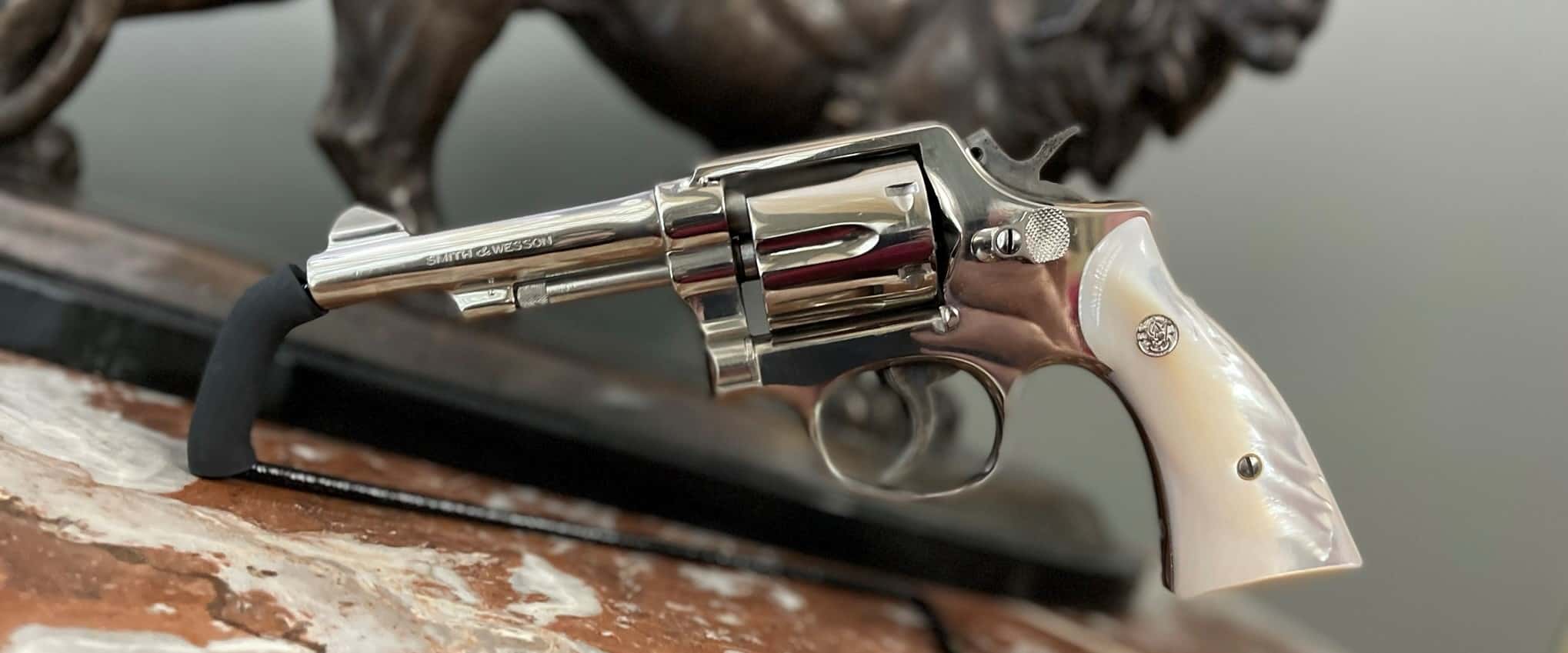
Open the unloaded revolver’s cylinder and read the model marking inside the frame’s yoke cut. A marking such as MOD. 10-5 identifies both the model and engineering-change number. Then record the serial number from the bottom of the grip frame and compare the barrel profile, fixed sights, finish, butt shape, stocks, screws, and barrel pin with the tables below.
The dash number identifies an engineering revision; the serial number helps estimate production timing. They answer different questions and should be used together.
My 1960 gun is a birth-year gun for me. Smith & Wesson introduced the .38 Military & Police line at the turn of the twentieth century, and the same family later became the Victory Model, the post-war M&P, and the numbered Model 10.
The Smith & Wesson Model 10 is a six-shot, double-action .38 Special revolver built on the K-frame with fixed sights. For collectors, its appeal comes from a combination of everyday police service history and small production details: barrel profile, butt shape, finish, stocks, screw count, pinning, serial-prefix era, and whether the gun has a factory letter.
A post-war Model 10 search
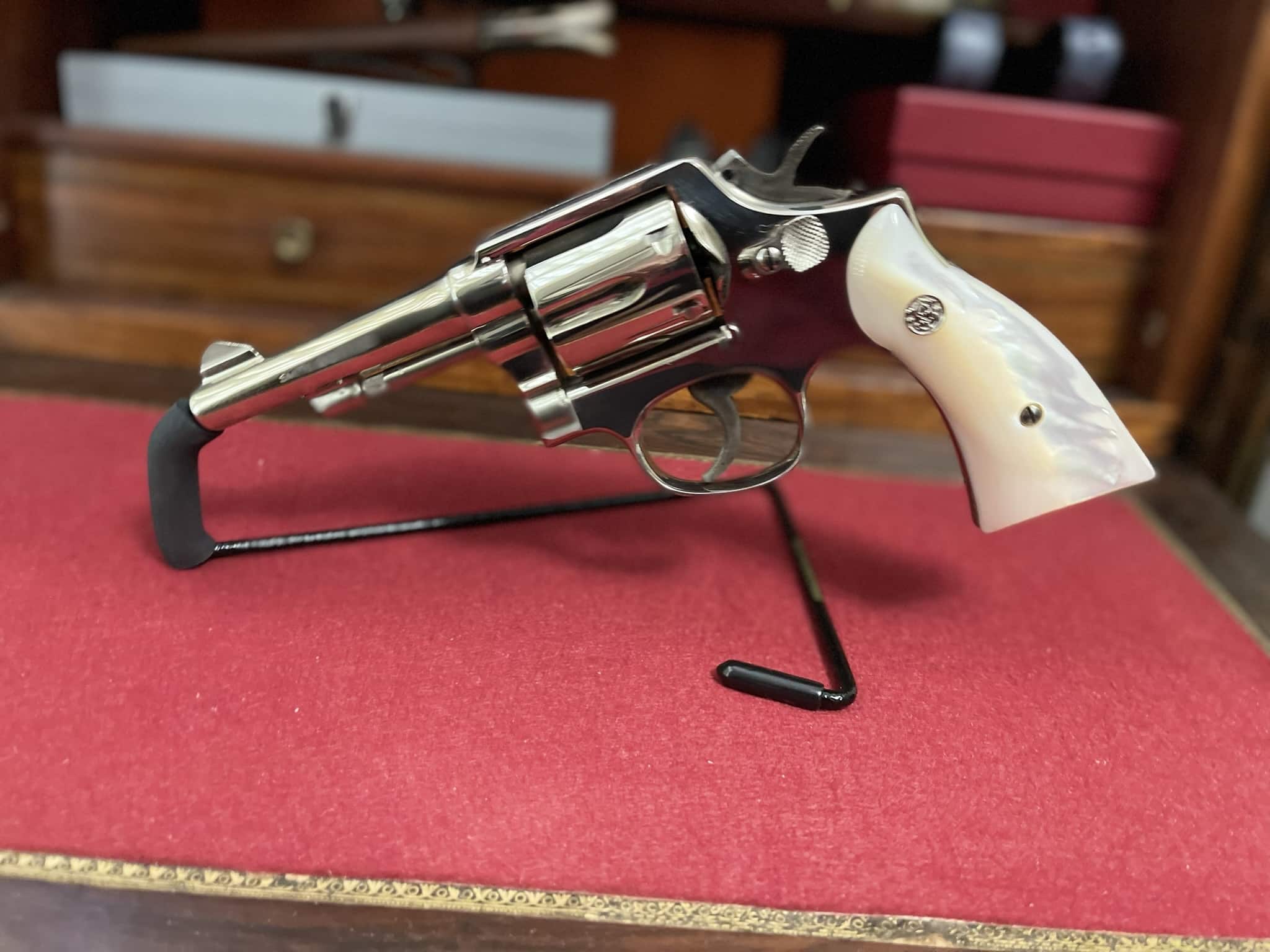
My fascination with guns from the post-World War II Baby Boom period guided my search for an early Model 10. In 1957, Smith & Wesson adopted numeric model designations, and the .38 Military & Police became the Model 10.
My S&W letter arrived, and it says my gun shipped to Tampa, Florida on January 13, 1960.
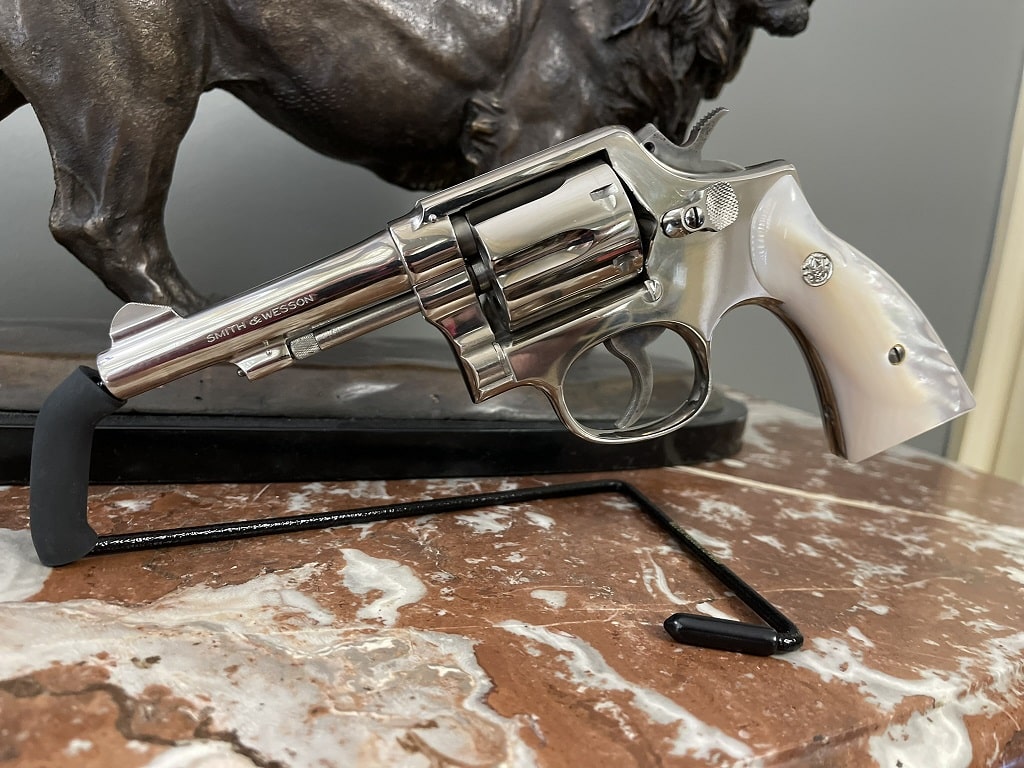
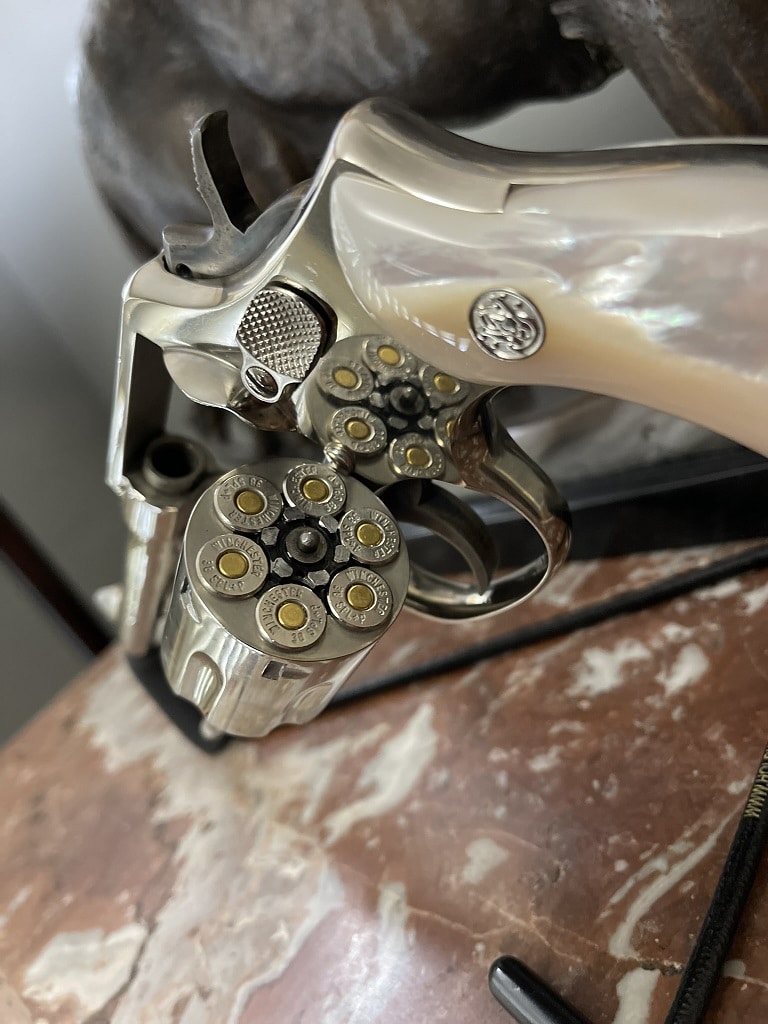
The M&P and Model 10 were offered for decades in blue and nickel finishes, with round-butt and square-butt grip frames, service stocks, and multiple barrel lengths. My revolver sits in an especially interesting transition window: it is an early numbered Model 10, a C-prefix gun, a four-screw revolver, and still has the pinned barrel and hammer-mounted firing pin that many collectors associate with older Smith & Wesson production.
Production Years
The Model 10 name dates to 1957, but the revolver’s roots are older. The Military & Police line grew out of Smith & Wesson’s early hand-ejector revolvers and helped establish the K-frame and .38 Special as American police standards. American Rifleman summarizes the family’s importance by noting that the original M&P introduced the K-frame, improved cylinder release, and .38 Special cartridge, then became one of the most prolific wheelguns of the twentieth century.
For a collector page, it helps to separate the Model 10 era from the broader .38 Military & Police lineage. Pre-war M&P revolvers, wartime Victory Models, post-war pre-Model 10 guns, early numbered Model 10s, and modern Classic-line guns all share family DNA, but they do not all carry the same markings, serial prefixes, finish standards, or value drivers.
| Production period | Collector meaning |
|---|---|
| 1899 onward M&P lineage | Beginning of the K-frame .38 Special service revolver family that later became the Model 10. |
| 1904-1905 transition years | Square-butt frames and short-barrel variants entered the M&P story, creating early configuration differences collectors still track. |
| World War II Victory Model period | V-prefix military and police-service guns, often with wartime finish and lanyard-ring features. |
| 1946-1957 post-war pre-Model 10 | Post-war M&P revolvers before the numbered model system; many have S- or C-prefix serials and old-style features. |
| 1957 Model 10 designation | The Military & Police became the Model 10 when Smith & Wesson moved to model numbers. |
| 1960 collector example | This page’s nickel revolver shipped January 13, 1960, making it an early numbered Model 10 with several pre-modern features. |
| 1962-1997 engineering changes | Triggerguard screw deletion, diamond-stock changes, pinned-barrel deletion, and firing-pin relocation are among the key collector checkpoints. |
| 2025 Classic no-lock return | Smith & Wesson’s modern Classic Series brought back a no-internal-lock Model 10 variant, renewing interest in the older no-lock guns. |
Major production changes and transition years
- 1957: The Military & Police became the Model 10 under Smith & Wesson’s numerical model system.
- 1960: Early numbered Model 10 production still retained many older features; my C-prefix nickel example shipped January 13, 1960.
- 1962: The triggerguard screw was eliminated, creating an easy visual checkpoint between earlier and later engineering variants.
- 1968: Diamond stocks were phased out, so original diamond-checkered grips can matter on early guns.
- 1982: Pinned barrels were eliminated, making earlier pinned-barrel examples more attractive to many collectors.
- 1997: Smith & Wesson moved away from the hammer-mounted firing pin in later Model 10 production.
- 2025: The Model 10 Classic No Internal Lock appeared as a modern-production nod to the old service revolver profile.
Model 10 Dash-Number Identification Table
The dash number stamped after “10” in the yoke cut records an engineering change; it is not a manufacture year or a grade. Use this condensed table for identification, then consult the complete Model 10 dash-number guide for the dash-by-dash discussion, transition caveats, and collector notes.
| Marking | Approximate era | Primary identification clue |
|---|---|---|
| Model 10 / no dash | 1957-1959 | Earliest numbered Model 10 production; older K-frame features may remain. |
| 10-1 / 10-2 | 1959-1962 | Early engineering revisions involving the trigger-guard screw and cylinder-stop stud. |
| 10-5 | 1962-1977 | Classic heavy-barrel service configuration. |
| 10-6 | 1962-1977 | Standard tapered-barrel counterpart to the 10-5. |
| 10-7 | 1977-1988 | Gas ring moved from the cylinder to the yoke. |
| 10-8 / 10-9 | 1988-1997 | Revised lockwork; 10-8 is associated with the heavy barrel and 10-9 with the standard barrel. |
| 10-10 / 10-11 | 1997-2009 | Late-production changes, with the 10-11 representing the internal-lock era. |
Barrel, Sight, Finish, and Frame Variations
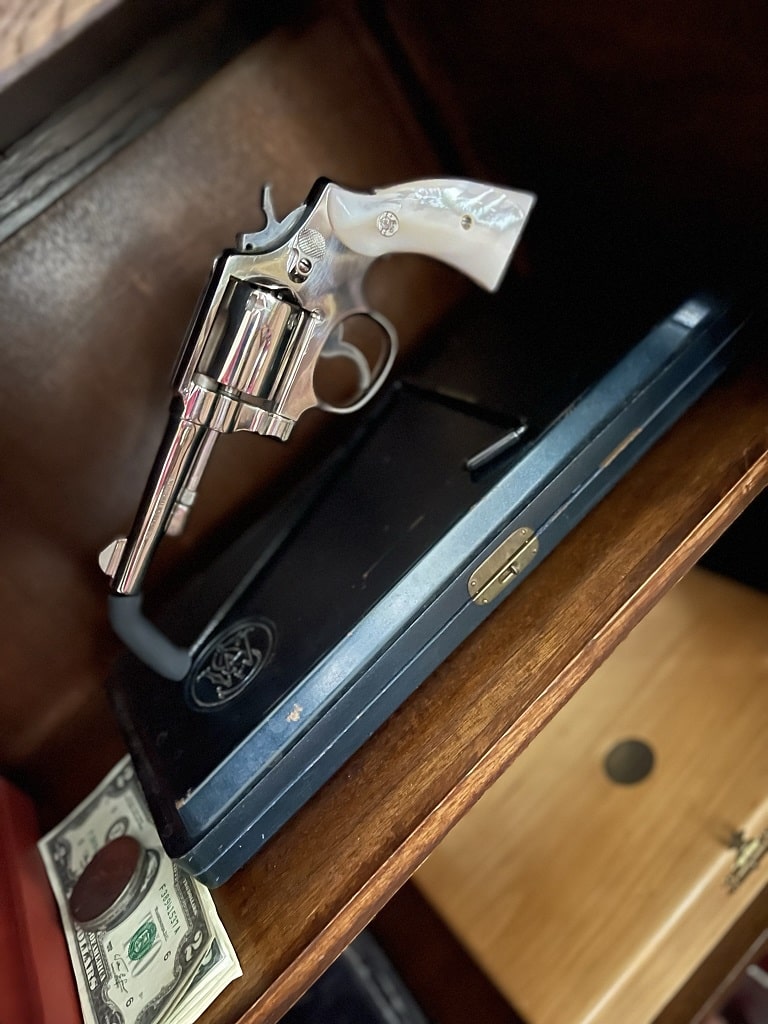
The Model 10 is deceptively simple: fixed sights, six rounds, .38 Special, K-frame. The collecting challenge is that Smith & Wesson made the broader M&P/Model 10 family for so long that small details create many variations. American Rifleman notes early M&P production with blue finish, walnut stocks, round butt, fixed sights, and barrel lengths ranging from 4 to 8 inches, with nickel finish and optional checkered rubber stocks soon offered. A square butt was added in 1904, and a 2-inch barrel appeared in 1905.
Rare configurations are usually rare because they combine originality and documentation. A high-condition two-inch gun, an original nickel revolver with matching factory-letter details, a boxed early C-prefix gun, or a department-marked revolver with paperwork will stand apart from the ordinary service-grade Model 10s that show decades of holster wear.
Serial Number Ranges
Smith & Wesson serial-number research requires caution. The serial number of record is normally on the bottom of the grip frame, not the assembly number often found in the yoke cut. A factory letter is the best way to confirm the original configuration, ship date, and destination when those records are available.
Model 10-family serials span several systems rather than one continuous “Model 10 list.” Wartime V-prefix numbers belong to Victory-era M&P production; post-war guns can use S and C prefixes; later K-frame production moved into D-prefix and subsequent three-letter serial systems. Because Smith & Wesson numbered related K-frame models in shared sequences, the serial number can establish an era without proving that the revolver is a Model 10. Confirm the model in the yoke cut first.
For the broad sequence, use the K-Frame Serial Number Master Guide or the interactive K-frame lookup tool. For a Model 10-only date table, see Model 10 serial-number dates.
The C-prefix table below is included because it directly relates to the early numbered Model 10 era and to my 1960 revolver. These ranges are useful for orientation, but the factory letter controls when a specific gun’s ship date matters.
| S&W year of manufacture range | Beginning serial | Ending serial | Collector note |
|---|---|---|---|
| 1957 | C402924 | C405018 | First numbered Model 10 period after the M&P naming change. |
| 1958-1959 | C405019 | C429740 | Post-war C-prefix K-frame production; dates can be confusing without a letter. |
| 1960 | C429741 | C474148 | Useful range for this page’s 1960 birth-year collector gun. |
| 1961-1962 | C474149 | C622699 | Transition into early 1960s engineering changes. |
| 1963-1965 | C622700 | C810532 | Later C-prefix Model 10 era before D-prefix production. |
Always record the full grip-frame serial, including its letter prefix, compare it with the model marking inside the yoke, and use a factory letter when provenance, exact ship date, or original configuration affects value.
Collector Notes
The Model 10 is one of those firearms where condition and originality do more work than rarity alone. There are many Model 10s, but not many high-condition early guns with a desirable barrel length, original finish, correct stocks, clean screw slots, and documentation.
- Fit and finish: Early post-war and early numbered guns often have the crisp polish, clean roll marks, and hand-fitted feel that collectors associate with classic Smith & Wesson production.
- Accuracy reputation: The fixed-sight K-frame .38 Special earned a strong reputation for practical accuracy and reliability in police, military, and civilian use.
- Desirable years: Pre-model-number M&P guns, early Model 10 C-prefix guns, pinned-barrel revolvers, and pre-lock examples attract extra attention.
- Desirable barrel lengths: Two-inch snubs and clean four-inch service guns are easy to understand and easy to display. Longer barrels appeal to collectors who like traditional range and service configurations.
- Rare markings: Department rack numbers, agency markings, export marks, wartime lanyard rings, and factory-lettered shipping destinations can add story value if they are authentic and documented.
- Packaging differences: A correct box, matching label, tools, instructions, and a factory letter can make a common Model 10 feel much less common.
Known Issues
Most Model 10 issues are collector-inspection issues rather than design failures. These revolvers were working guns, and many lived in police holsters, glove boxes, desks, and nightstands for decades. Condition tells the story.
- Timing and carry-up: Slow or late cylinder carry-up, excessive cylinder play, or inconsistent lockup should be checked before a collector pays a premium.
- Endshake and crane fit: Heavy service use can show up as cylinder endshake or a crane/yoke that does not close with the same precise feel as a low-mileage gun.
- Finish wear patterns: Blue guns often show holster wear at the muzzle and cylinder edges. Nickel guns can show clouding, peeling, or damage around scratches and sharp edges.
- Sideplate and screw damage: Buggered screw slots, pry marks on the sideplate, and mismatched screws suggest poor maintenance or non-factory work.
- Grip originality: Original diamond stocks, numbered stocks, and correct period grips should be inspected carefully; replacements are common.
- Parts-era mismatch: Barrel profile, screw count, stocks, hammer, trigger, and model marking should make sense together. Mismatches are not automatically unsafe, but they affect value.
- Recall notes: I did not find a broad, classic Model 10 recall during this research. Any questionable revolver should be inspected by a qualified gunsmith rather than judged from a serial table alone.
Value Trends
Ordinary Model 10s remain approachable compared with rarer Smith & Wesson revolvers, but values have become more condition-sensitive. TrueGunValue reported a current Model 10 average of $657.93 new and $500.92 used in May 2026, while the twelve-month averages were $676.87 new and $529.59 used. That spread makes sense: police-turn-in service guns, clean early C-prefix examples, factory nickel revolvers, boxed guns, and modern no-lock Classics are not the same market.
| Value driver | Trend |
|---|---|
| Original finish | Strong premium for crisp blue or original nickel; refinishing usually lowers collector value. |
| Pinned barrel and early features | Pinned-barrel, early C-prefix, four-screw, and hammer-mounted firing-pin examples are easier to promote to collectors. |
| Factory letter | Useful for confirming ship date, finish, barrel length, grip style, and destination. |
| Box and papers | Correct packaging, tools, and paperwork can move a common Model 10 into a more collectible tier. |
| Service wear | Honest police holster wear can be charming, but heavy wear, pitting, altered parts, or poor refinishing restrain value. |
| Modern no-lock demand | The 2025 no-lock Classic reinforces interest in older no-lock Smith & Wesson revolvers and traditional K-frame styling. |
For my collection, the premium features are the documented 1960 ship date, C-prefix serial range, nickel finish, pinned barrel, and overall old-school appearance. It was not the bright-blue 1957-1964 example I originally had in mind, but the factory letter and condition made it a keeper.
Many collectors underestimate the importance of maintaining organized records for historic revolvers. Our Gun Collection Inventory Guide explains how to track serial numbers, provenance, acquisition history, and supporting documentation.
When evaluating a Smith & Wesson Model 10, condition, originality, and historical significance all affect value. Learn more in our Guide to Valuing a Gun Collection and our Firearm Condition and Value Guide.
Continue Through the Smith & Wesson Cluster
This page is part of the Gun Collectors Club Smith & Wesson research cluster. Use these companion pages to move between company history, serial-number dating, Model 10 variants, K-22 target revolvers, magnum duty guns, galleries, and modern S&W arms.
Hub & serial research
Model 10 research
- 1960 Smith & Wesson Model 10
- Model 10 Dash Numbers
- Model 10 Photo Gallery
K-22 / Model 17 target revolvers
Smith & Wesson photo galleries
Magnum, duty & J-frame revolvers
Modern S&W arms & accessories

About Greg Cook
Greg Cook writes about firearms collecting, personal history, and the stories behind interesting guns. His Army MOS was 76Y, Unit Armorer, and he brings that practical background to his collector articles.
Research Sources Consulted
This page was expanded from the original article, then checked against collector and manufacturer-adjacent sources for production history, serial-number cautions, current-production context, and value trends.
- American Rifleman: Smith & Wesson Model 10 (Military & Police)
- Smith & Wesson Historical Foundation: Serial Numbers
- Smith & Wesson Historical Foundation: Factory Letters
- Handguns: Smith & Wesson No-Lock Classic Series announcement
- TrueGunValue: Smith & Wesson Model 10 price and historical value data
- Handguns: Smith & Wesson Model 10 Classic No Internal Lock review
How I managed to go this many years without a Model 10 in my collection, I cannot explain. The old-school appearance of this gun is classic Smith & Wesson in every way. For comparison with early semi-automatics, see Pocket Pistols.
Related Reading
For more Smith & Wesson collecting context, a good reference book is useful alongside factory letters and careful comparison of engineering changes.
Best Of Smith & Wesson Next: Smith Model 65As an Amazon Associate I earn from qualifying purchases. I only link to books, tools, and accessories that fit the editorial purpose of Gun Collectors Club.