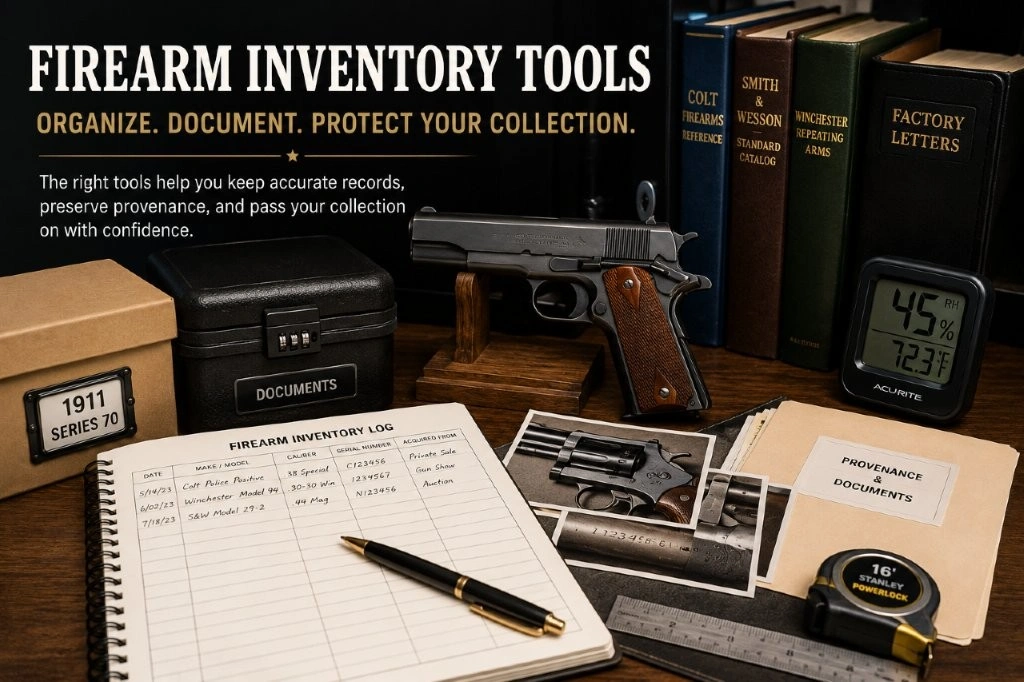
Create records that someone else could understand
A useful inventory should connect each firearm to photos, serial-number notes, acquisition information, condition details, storage location, accessories, receipts, factory letters, and value notes. The system can be simple as long as it is consistent and backed up.
Recommended tools and supplies
Collector Logbook
A bound logbook provides a low-tech backup for model, serial number, acquisition date, source, condition, and storage notes.
- Store it separately from the collection if practical.
- Use consistent abbreviations and date formats.
Acid-Free Document Folders
Document folders help protect receipts, factory letters, appraisals, photos, and provenance paperwork.
- Keep originals and copies organized.
- Use one folder per firearm or manufacturer.
Label Maker
A label maker can identify storage socks, document folders, bins, and photo envelopes without placing adhesive directly on a firearm.
- Label the container, not the collectible item.
- Use serial-number shorthand when privacy matters.
External Backup Drive
A backup drive gives you a separate copy of firearm photos, spreadsheets, scanned receipts, and research documents.
- Keep at least one backup outside the computer.
- Encrypt sensitive inventory files when possible.
Water-Resistant File Box
A durable file box helps protect paper records, appraisals, manuals, and original purchase documents.
- Useful for insurance paperwork and estate planning copies.
- Do not store all copies in one location.
Measuring Tools
A tape measure, calipers, or ruler can help record barrel length, overall length, case size, and accessory dimensions.
- Record measurements consistently.
- Photograph the measurement when it supports identification.
Inventory checklist
- Assign each firearm a simple collection ID.
- Record make, model, caliber, serial number, markings, finish, and condition.
- Attach photos and scans of receipts, letters, and appraisals.
- Note accessories, boxes, manuals, and provenance separately.
- Back up digital records in more than one place.
- Review the inventory after purchases, sales, appraisals, or insurance updates.
Related GCC research pages
Collector FAQ
What should be included in a firearm inventory?
Record make, model, caliber, serial number, markings, condition, acquisition date, storage location, accessories, paperwork, photographs, and value notes.
Should firearm inventory files be backed up?
Yes. Keep more than one backup, secure sensitive files, and store copies where they can be recovered after a computer failure.
Should serial numbers be shared publicly?
Avoid posting sensitive inventory records publicly. Keep serial numbers and storage details in secure private files.

About Greg Cook
Greg Cook writes about firearms collecting, personal history, preservation, documentation, and the stories behind interesting guns. His Army MOS was 76Y, Unit Armorer, and he brings that practical background to his collector articles.