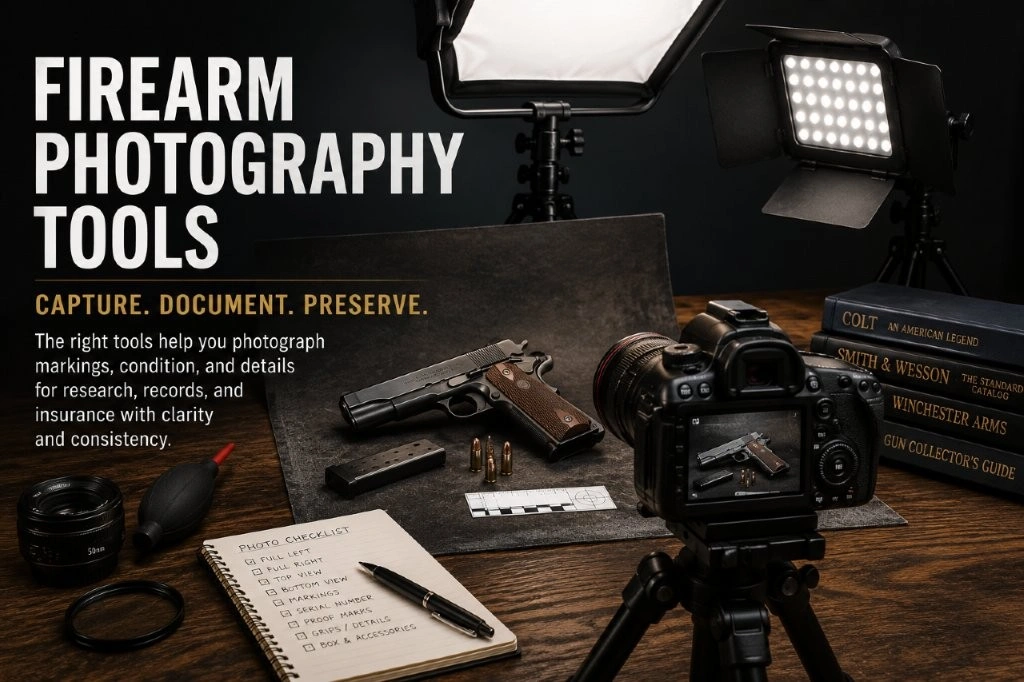
Photograph for identification and condition
Collector photos should show the whole firearm and the details that matter: markings, serial-number areas, proof marks, barrel address, grips, sights, finish condition, box labels, and accessories. Consistent lighting and scale are more important than dramatic styling.
Recommended tools and supplies
Tripod
A tripod keeps photos sharp and repeatable, especially when documenting small markings or photographing indoors.
- Useful for phones and cameras.
- A top-down arm helps with flat-lay documentation.
LED Light Panels
Soft, even lighting helps reveal markings and finish condition without harsh glare or deep shadows.
- Use two lights when possible.
- Diffuse the light to reduce reflections on blued or nickel surfaces.
Neutral Backdrop
A plain backdrop keeps attention on the firearm and makes condition details easier to compare over time.
- Gray, tan, or matte white backgrounds work well.
- Avoid busy patterns that hide edges and markings.
Macro Lens or Phone Clip
A macro lens helps capture proof marks, serial-number areas, roll marks, cartouches, and small condition details.
- Use gentle lighting from the side for stamped marks.
- Take multiple angles if markings are shallow.
Scale Ruler
A ruler or measuring scale in a photo helps document barrel length, accessory dimensions, and case or box size.
- Use it for inventory photos, not beauty shots.
- Keep it parallel to the item being measured.
Microfiber Cloth
A clean cloth helps remove fingerprints before photos and can be used as a soft staging surface for small parts.
- Keep separate cloths for photography and cleaning.
- Avoid abrasive towels around high-condition finishes.
Photography checklist
- Take full-length left and right side photos.
- Photograph serial-number areas, proof marks, barrel address, and model markings.
- Capture grips, sights, buttplate, magazine, box, papers, and accessories.
- Use consistent lighting and a clean background.
- Rename photo files with model, serial-number shorthand, and date.
- Back up images with your inventory records.
Related GCC research pages
Collector FAQ
What photos should be taken for a firearm inventory?
Take full left and right side photos, closeups of serial-number areas, model markings, proof marks, barrel address, grips, sights, accessories, boxes, and papers.
Do collectors need an expensive camera?
No. A modern phone, tripod, steady lighting, clean backdrop, and closeup lens can produce useful documentation photos.
Why use a neutral backdrop?
A plain background keeps attention on markings, edges, finish, and condition rather than distracting patterns.

About Greg Cook
Greg Cook writes about firearms collecting, personal history, preservation, documentation, and the stories behind interesting guns. His Army MOS was 76Y, Unit Armorer, and he brings that practical background to his collector articles.