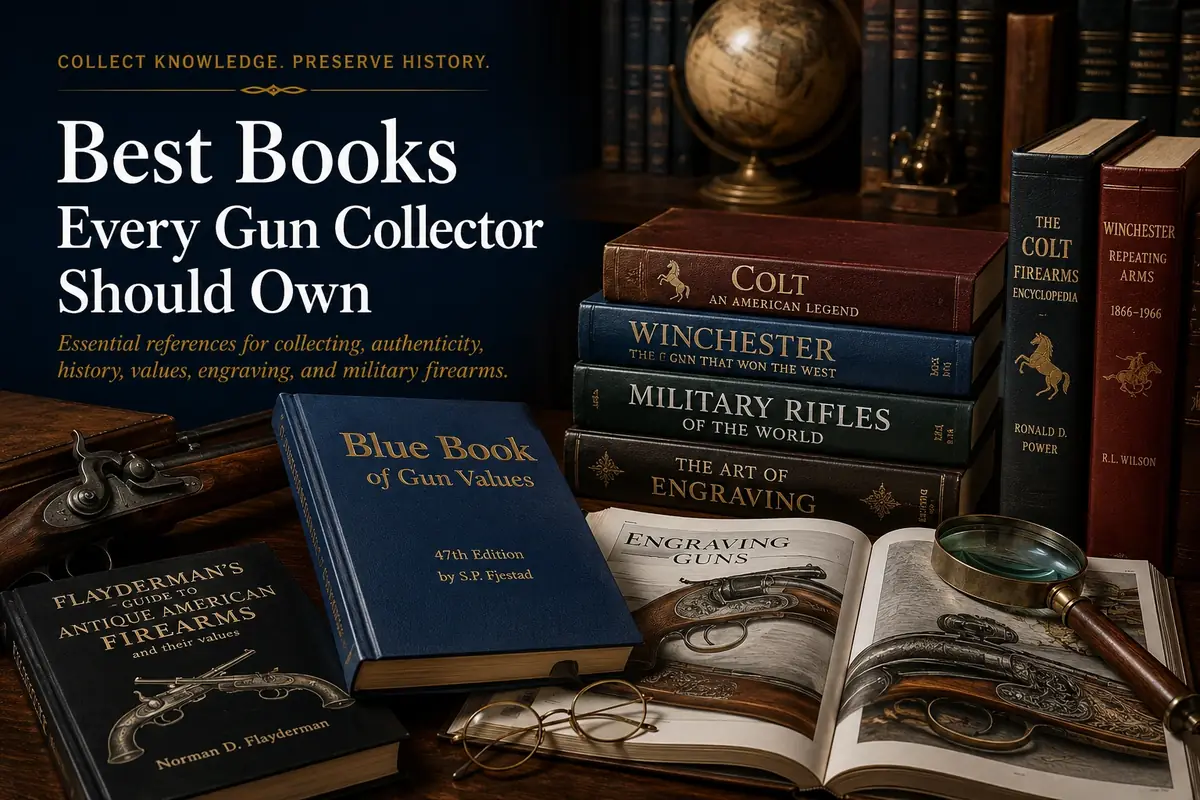
Every serious gun collector eventually learns that reference books are not optional. They are part of the collecting equipment. A good book can help confirm a serial-number range, explain a variation, identify a factory feature, separate original parts from replacements, and prevent a purchase mistake that costs far more than the book itself.
Online research is useful, but it is scattered, inconsistent, and often missing context. A shelf of trusted firearm reference books gives a collector something more durable: a repeatable way to study history, originality, markings, condition, and value.
A good gun book can pay for itself the first time it keeps you from buying the wrong gun, misidentifying a variation, or separating a firearm from its correct paperwork.
Why Gun Collector Books Still Matter
Collectors do not just buy firearms. They buy history, condition, originality, provenance, and confidence. Books support each of those things. They help a collector slow down and ask better questions before an auction, gun show purchase, estate appraisal, or private sale.
The best references usually help with one or more of these:
- identifying models and variations;
- understanding serial-number ranges;
- recognizing factory features and later modifications;
- learning historical context;
- estimating condition and value;
- documenting provenance for future owners.
Blue Book of Gun Values
The Blue Book of Gun Values is one of the best-known general valuation references. It is not perfect, and no printed valuation guide can fully capture a hot auction market, regional demand, or a rare variation. Still, it gives collectors a baseline vocabulary for condition, model identification, and broad value ranges.
Use it as a starting point, not the final answer. Pair it with auction results, specialized references, and first-hand inspection. The Blue Book is especially useful for broad collection review, estate conversations, and identifying items that need deeper research.
Flayderman's Guide to Antique American Firearms
Flayderman's Guide to Antique American Firearms is a cornerstone reference for collectors of antique and historical American arms. It is especially valuable because it combines identification, history, and collecting context in a way that helps readers understand why a firearm matters.
For anyone interested in older American firearms, Civil War-era arms, early cartridge guns, percussion arms, or the broader sweep of American gunmaking, Flayderman belongs on the shelf.
Colt Reference Books
Colt collecting rewards detail. Small variations in barrel markings, grips, finishes, serial-number ranges, box labels, and special-order features can make a major difference. A general guide may identify the model, but a dedicated Colt reference helps explain the variation.
Collectors interested in Colt revolvers, 1911 pistols, Gold Cups, Pythons, Cobras, Single Action Armys, or early automatics should build a Colt section in their library. The right book can help distinguish a desirable original feature from a later replacement.
Important Colt book categories include:
- Colt revolver references;
- Colt automatic pistol references;
- Python and Snake Gun resources;
- Single Action Army references;
- factory letter and provenance guides.
Winchester Reference Books
Winchester collecting is another field where specialized books matter. Pre-64 rifles, lever actions, Model 70s, Model 94s, Model 12s, and earlier Winchesters all have variations that can affect collector interest and value.
A good Winchester reference helps collectors understand configuration, chambering, stock features, sights, production periods, and the difference between ordinary condition and collector-grade originality.
Military Firearms References
Military firearms require their own references because markings, inspector stamps, arsenal rebuilds, serial-number blocks, and component changes can tell much of the story. A military rifle or pistol may be common in one configuration and much more interesting in another.
Useful military firearm references may cover:
- U.S. martial pistols and rifles;
- M1 Garand and M1 Carbine variations;
- 1911 and 1911A1 military pistols;
- Mauser, Enfield, Mosin, and other surplus rifles;
- proof marks, acceptance stamps, and arsenal rebuilds.
For inherited collections, military references can also help families understand whether a firearm is a common shooter, a historically significant piece, or something that deserves specialist attention.
Engraving and Fine Arms Books
Engraved firearms and high-grade arms require a different kind of study. These books help collectors recognize engraving styles, factory patterns, named engravers, regional traditions, and the difference between high-quality work and later embellishment.
Engraving books are not just for owners of expensive guns. They help collectors develop an eye for craftsmanship. That skill carries over into evaluating fit, finish, checkering, metal polish, and presentation-grade firearms.
Auction Catalogs and Old Sale References
Printed auction catalogs can be excellent collector references, especially from major sales of high-end firearms. They often include detailed descriptions, provenance notes, professional photography, and examples of how rare firearms are presented to advanced collectors.
Catalogs are especially useful for studying:
- condition language;
- provenance descriptions;
- scarce variations;
- engraved and presentation arms;
- market behavior over time.
How to Build a Gun Collector Library
Do not try to buy every gun book at once. Build the library around the collection you actually own, the firearms you are actively studying, and the categories where mistakes would be expensive.
| Collector Interest | Best First Book Category |
|---|---|
| General collecting and estate review | Blue Book and broad valuation guides |
| Antique American arms | Flayderman and antique firearm references |
| Colt revolvers and automatics | Dedicated Colt model and variation books |
| Winchester rifles and shotguns | Winchester model-specific references |
| Military arms | U.S. martial, surplus, proof mark, and serial-number references |
| Engraved or high-grade firearms | Engraving, fine arms, and auction catalog references |
Used and Out-of-Print Books
Some of the best firearm references are out of print. That does not make them obsolete. In many cases, older specialized books remain valuable because they preserve research, photographs, charts, and collector knowledge that never migrated cleanly to the internet.
Used books can be excellent purchases if condition is acceptable and the edition is appropriate. For valuation guides, newer editions matter more. For historical and model-specific references, older editions can still be very useful.
From My Bench: Reference Books Worth Having Nearby
For a practical collector library, I would start with a general valuation guide, Flayderman for antique American arms, dedicated Colt and Winchester references for those collecting areas, military firearm references for surplus or martial arms, and at least one good book on engraving or fine arms to sharpen the eye.
Gun LibraryPaid link. As an Amazon Associate I earn from qualifying purchases. I only link to products, books, tools, and accessories that fit the editorial purpose of Gun Collectors Club.
Why Books Build Collector Trust
Books make a collector more careful. They encourage comparison, note-taking, and patience. They also signal to readers, buyers, heirs, and other collectors that the collection was built with study rather than impulse.
For a website like Gun Collectors Club, reference books also support credibility. They show that collecting is not merely ownership. It is research, preservation, and context.
Essential Gun Collector Book Checklist
- One current general valuation guide.
- One antique American firearms reference.
- Model-specific books for your strongest collecting interests.
- Military firearms references if you own martial arms.
- Books on engraving, high-grade arms, or fine craftsmanship.
- Auction catalogs or sale records for advanced study.
- A notebook or inventory system for recording what each book teaches you about your own collection.
Collector Takeaway
The best gun collector books do more than sit on a shelf. They help collectors make better decisions, avoid costly mistakes, document firearms accurately, and understand why certain guns matter.
A carefully chosen reference library is one of the highest-value investments a collector can make. Firearms may be the center of the hobby, but books often provide the knowledge that keeps the collection from becoming just a group of objects with forgotten stories.
Continue the Collector Utility Series
This article is part of the Gun Collectors Club preservation and gear guide series. These related pages help connect storage, preservation, documentation, display, and collector workbench decisions.

About Greg Cook
Greg Cook writes about firearms collecting, personal history, and the stories behind interesting guns. His Army MOS was 76Y, Unit Armorer, and he brings that practical background to his collector articles.