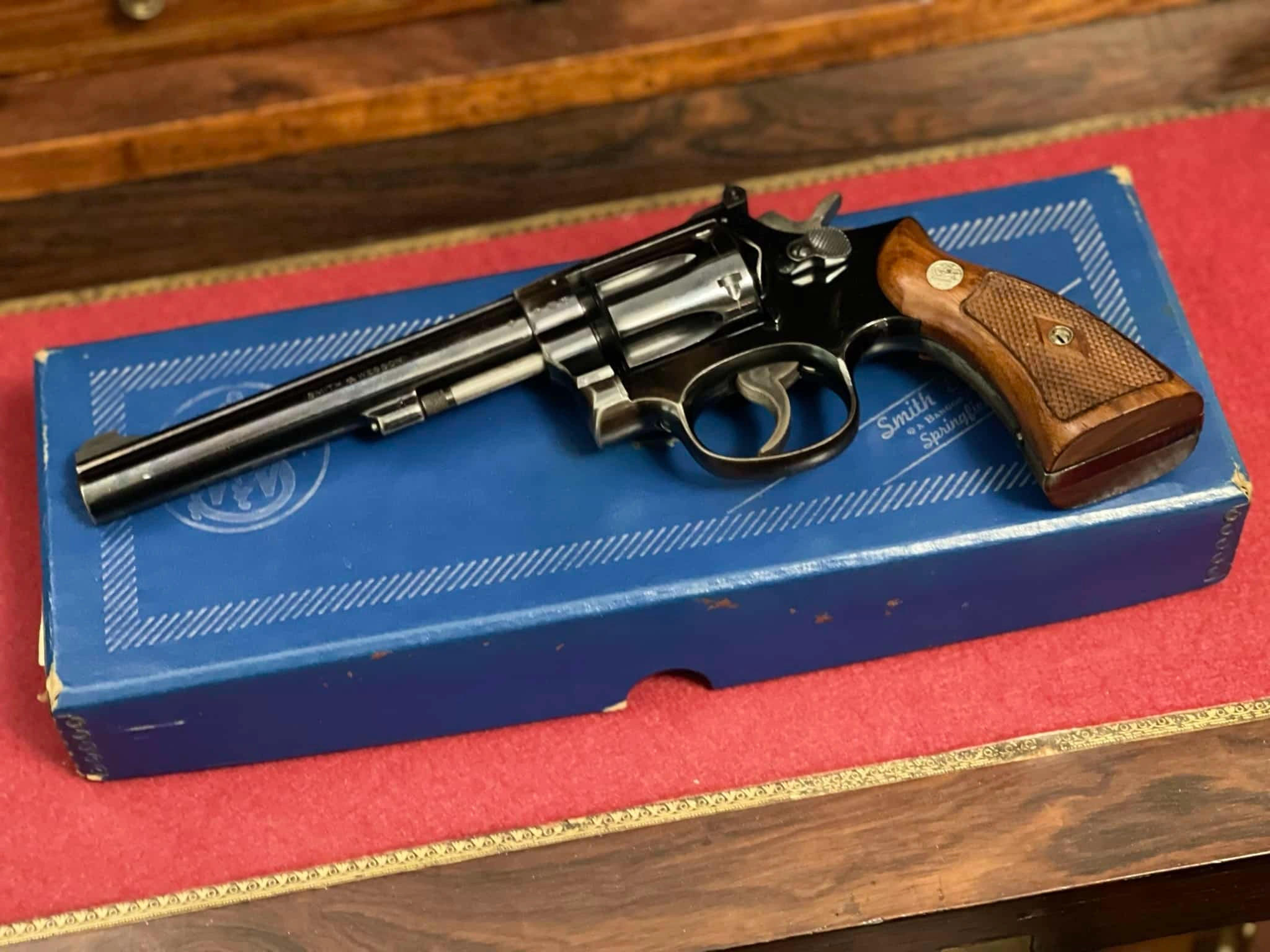
Smith & Wesson 1960 Model 17-1
My interest in the K-22 Masterpiece began in November of this year. After researching these handguns, I decided to focus on the third model guns of the 1950s. While reading my Blue Book of Gun Values, I noted the Model 17-1 commanded a 25% premium. This piqued my interest since the 17-1 was from my birth year, a big deal to a lot of collectors.
To understand how the Model 17 continued the earlier K-22 story, read the complete Smith & Wesson K-22 Masterpiece Overview.
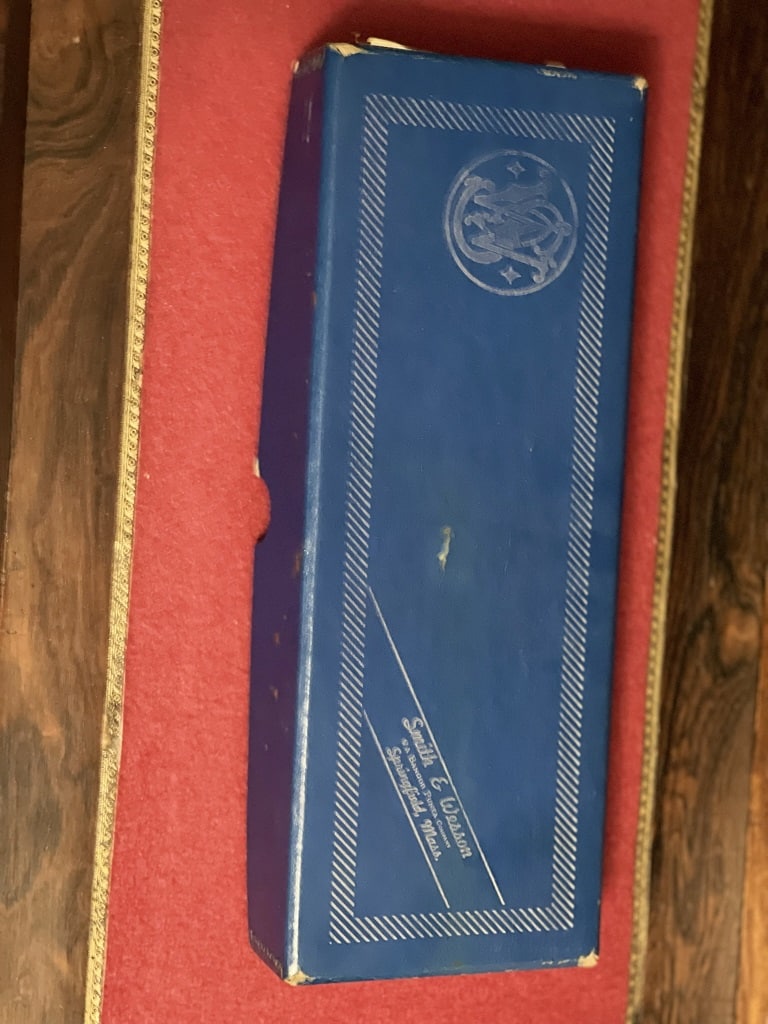
Then one day as I am browsing the auction website... This Model 17-1 shows up with almost no bids. The gun had replacement Target Grips from a much later period. It did not have the original box or cleaning tools. So I thought, I am going to bid on this gun and see where it goes. I won the gun.
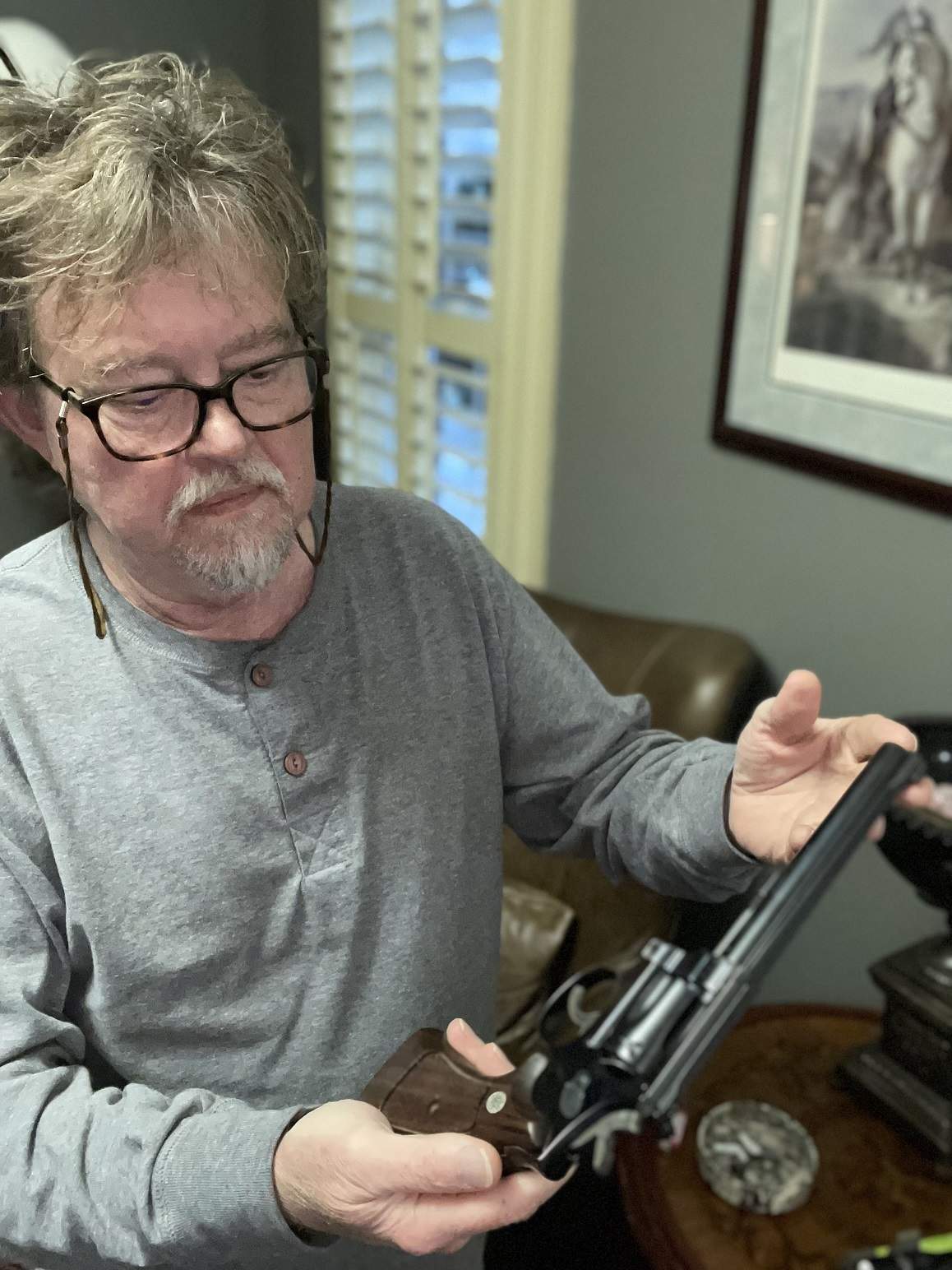
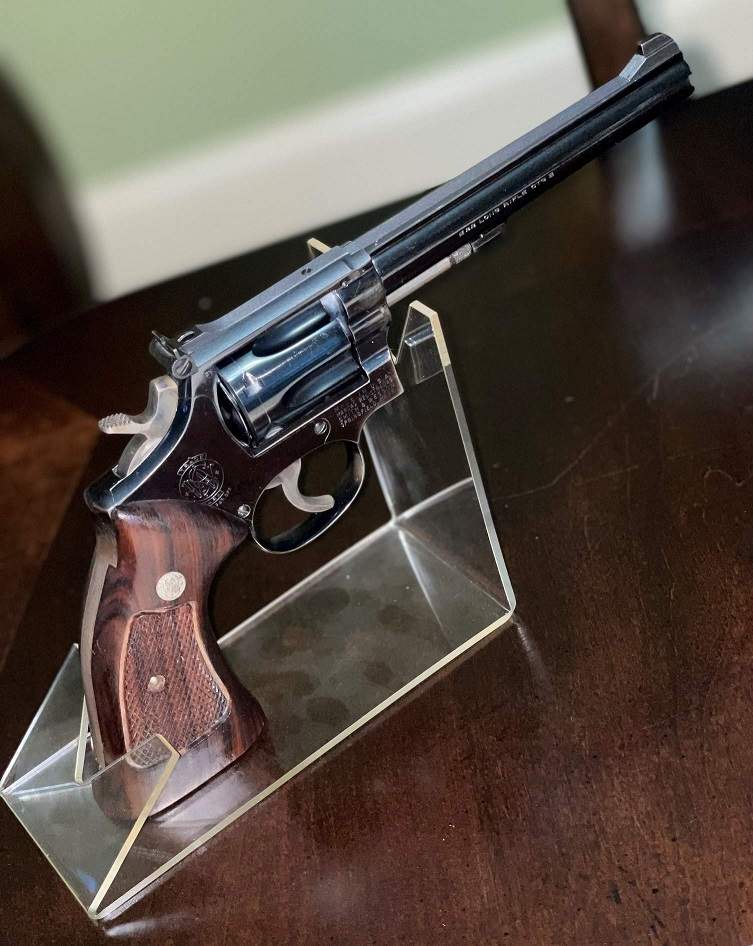
The Target Grips are much bulkier than the Magna Grips, which are my favorite. Still, this gun appealed to me. The fact that the 17-1 was one of the last 4-Screw guns was also a compelling reason to add one to my collection, like I needed an excuse. Just to be sure, I just stood up, walked over to the gun cabinet, opened the door, closed my eyes and ran my finger down the face of the trigger guard. Yep. It has a screw there. I personally recommend using a quality hollow-ground gunsmith screwdriver set when removing these screws.
$726 Purchase Price Break-Down
| Item | Cost |
|---|---|
| Online Auction Winning Bid | $625 |
| Sales Tax | $66 |
| Shipping | $35 |
Another factor that I believe adversely affected the market price of this gun, was the fact that it has import marks on it. The stampings are only visible upon close inspection. The presence of the markings may actually add to the historic importance of the gun in my mind. After obtaining a letter, I shall see. In the meantime, the K-Frame Serial Number Master Guide confirms this serial falls solidly in the 1960 Model 17-1 range.
Some say rules are made to be broken. Well, I broke one of my own rules when I bought this one. That $726 would have went a long way toward a nicer gun. By nicer, I simply mean one with less bluing loss, original grips and box. I have to routinely remind myself to always buy the best example of a model that you can and you will not be disappointed in the long run. It is true.
Designation Note
The Model 17-1 Designation
In 1958 when Smith & Wesson began stamping Model 17 on the yoke of the K-22 Masterpiece, they did not stop referring to it as the K-22 Masterpiece. The box, instruction sheet, advertisements and all paperwork like the spec sheet were still calling it the “K-22 Masterpiece.”
It is important to note that the name “Masterpiece” was never actually stamped on any of these guns.
The left side of the barrel is stamped “Smith & Wesson” while the right side of the barrel is stamped “22 Long Rifle Ctg.”, which are exactly the same barrel stampings on my 1948 example.
So what was the change that precipitated the dash one designation? The modification was changing the ejector rod from right hand to left hand thread to prevent the rod from backing out during recoil. The next change made by Smith & Wesson that transitioned the 17-1 to the 17-2, was the removal and deletion of that fourth screw on the face of the trigger guard. The fact that so little time elapsed between the two changes made the Model 17-1 the shortest-lived of all the model designations. Hence the rarity or scarcity and the 25% premium in pricing.
Model 17-1 Serial Number Ranges
The Model 17-1 serial number should fall in this range (see the full K-Frame Serial Number Master Guide for the complete K-series production table):
| Year | Serial Number Range |
|---|---|
| 1960 | K386805 - K429894 |
| 1961 | K429895 - K468098 |
It is obvious that the dash one change was an effort to improve the gun, while the dash two change was merely a production cost-saving measure. It is clear to me that if the Dash-One improvement was considered significant enough, it might add value to the collectibility of that version. However, what is not entirely clear to me, is the 25% premium being based on scarcity or rarity.
When you look at the Serial Number Tables, you might conclude that the Model 17 No Dash gun would be equally as scarce.
| Year | Serial Number Range |
|---|---|
| 1958 | K317823 - K350547 |
| 1959 | K350548 - K386804 |
Again, I am new to the K-22 and I have a lot to learn.
In my quest to locate a high serial number 5-screw, I saw a K-38 serial number K2564xx that was a 5-screw. That number would put it in mid 1955 just prior to the dropping of that fifth screw. Again, I am not saying that a 5-screw gun is better, but in my mind, the deletion of that fifth screw signaled the beginning of many cost-saving changes to the gun.
Summary: The gun I bought is very nice, but it has grips that do not belong on it and considerable bluing loss. In the last week, I have seen only one other 17-1 and it was ANIB for $1,950. With sales tax and shipping it would have cost $2,161. I would have been hesitant to shoot it and I can shoot this one all I want and not think twice.
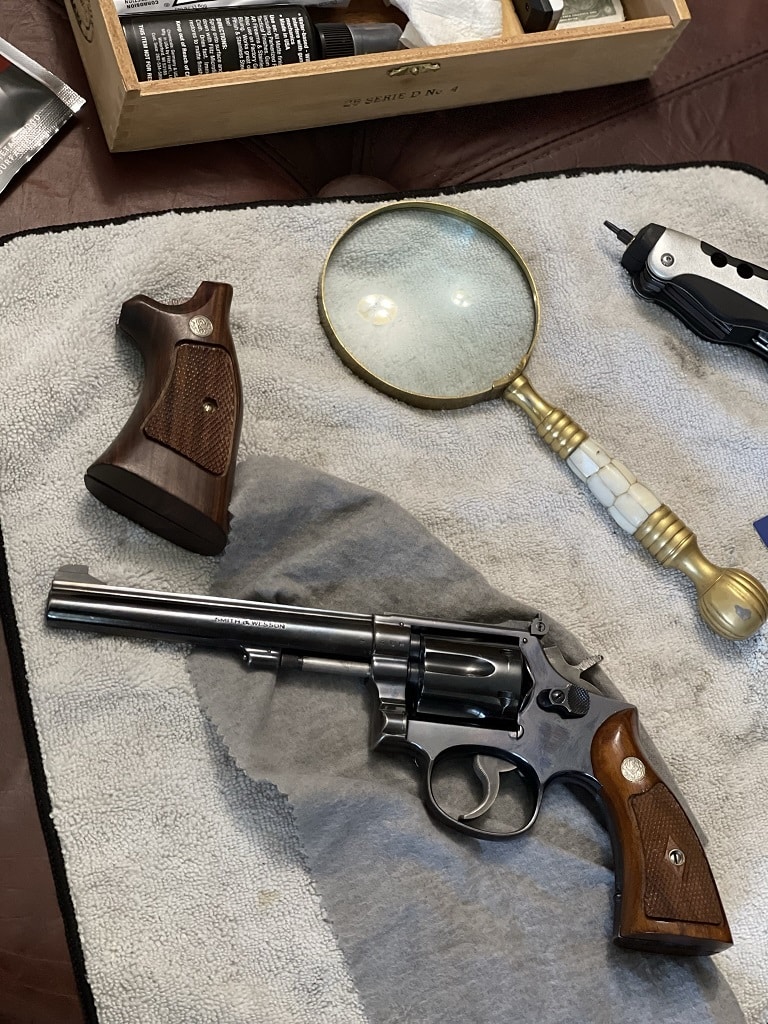
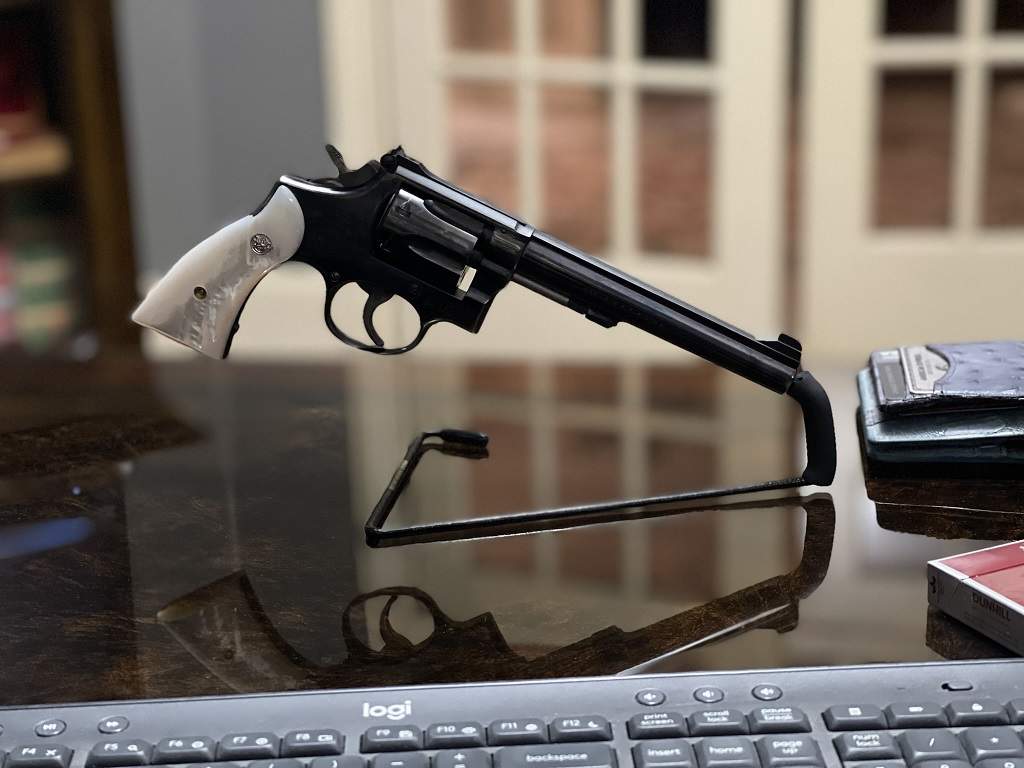
I just needed those Walnut Diamond Magna or Mother of Pearl grips for it to wear while I am staring at my birth-year gun in the cabinet. Update 12/23/2021: Vintage mother of pearl grips are hard to find normally, but I located some rather quickly for this one. It is almost funny. Almost. I paid more for the grips than I paid for the gun.
More Detail
Detailed Photos of the 1960 Model 17-1 K-22 Masterpiece
The original page pointed readers to a dedicated photo gallery for the 1960 K-22.
1960 K-22 Photo GalleryContinue Through the Smith & Wesson Cluster
This page is part of the Gun Collectors Club Smith & Wesson research cluster. Use these companion pages to move between company history, serial-number dating, Model 10 variants, K-22 target revolvers, magnum duty guns, galleries, and modern S&W arms.
Hub & serial research
Model 10 research
K-22 / Model 17 target revolvers
Smith & Wesson photo galleries
Magnum, duty & J-frame revolvers
Modern S&W arms & accessories

About Greg Cook
Greg Cook writes about firearms collecting, personal history, and the stories behind interesting guns. His Army MOS was 76Y, Unit Armorer, and he brings that practical background to his collector articles.
More Samples from the K-22 Masterpiece Collection
1946
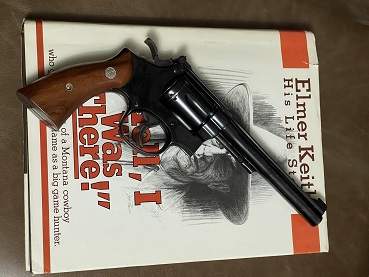
This was the first production K-22 Masterpiece completed in 1946 and was used by the factory to showcase their K-22 line of revolvers.
1948
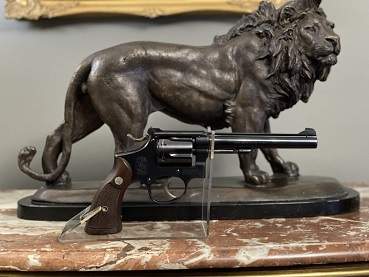
Looking at the Serial Number Table, one would surmise that Smith & Wesson turned out more of the third model, post war, pre-model 17 guns in 1948...
1953
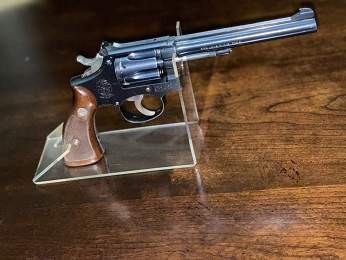
Only another gun enthusiast could understand the passion that can overtake you when that one gun comes along. Oh boy! It can take you by surprise...
1957
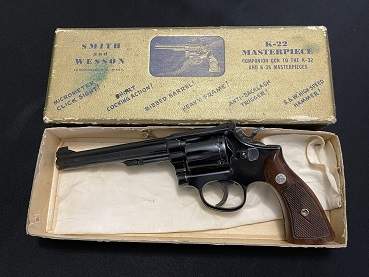
You do not name a gun Masterpiece and not back it up with workmanship. Smith & Wesson went beyond backing up the claim, no brag, just fact.