
Gun Collectors Club · Collector Reference
Ruger Revolver Serial Number Hub
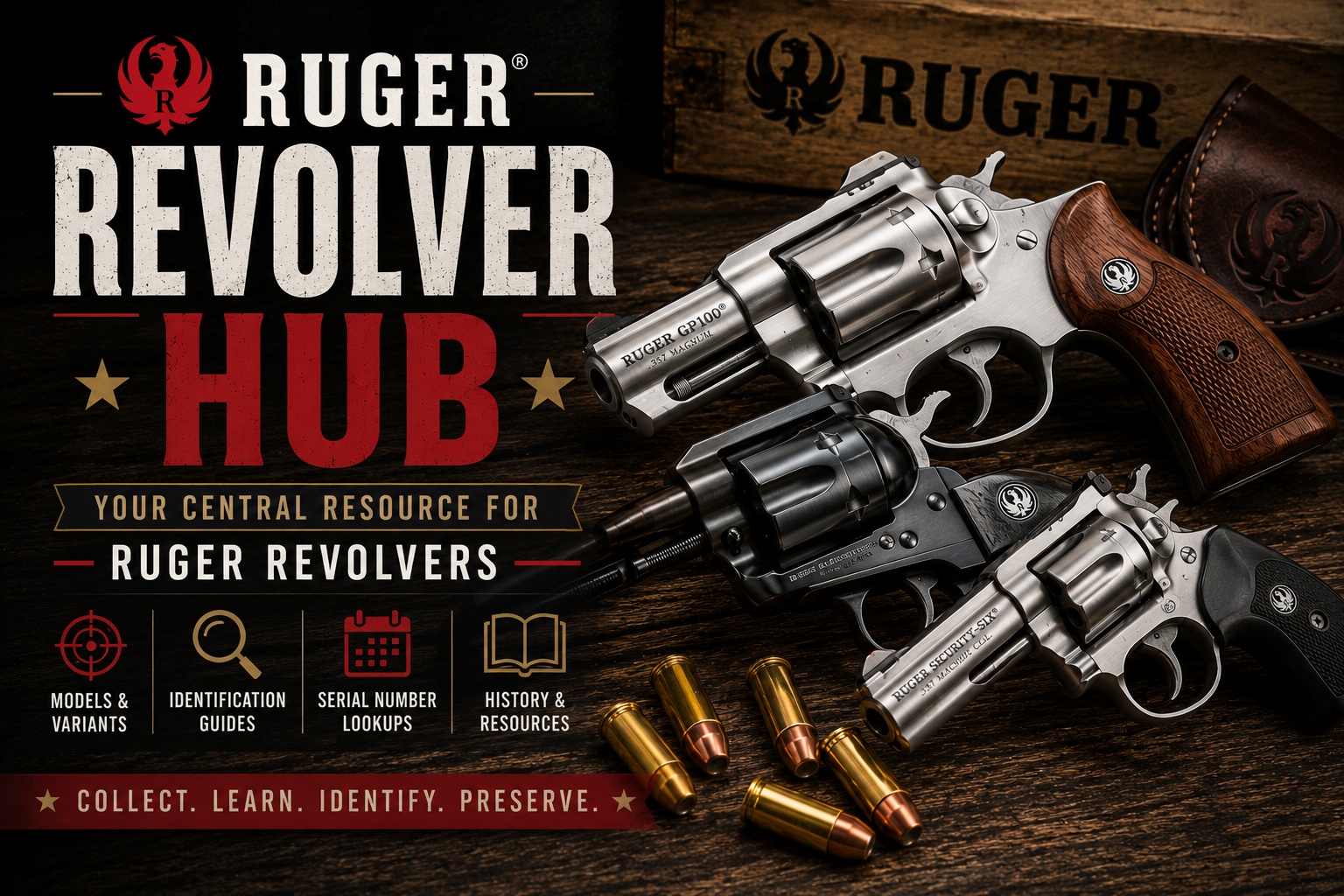
Production timelines, serial-number charts, identification guidance, and original collector photography for the Security-Six, GP100, Blackhawk, Single-Six, and related Ruger revolvers.
About These Ruger Revolvers
The Ruger Revolver Serial Number Hub is the primary Gun Collectors Club reference for identifying and dating Ruger revolvers. Start here to compare serial-number prefixes, approximate first-shipped years, model families, and major production changes for the Security-Six, GP100, Blackhawk, and related Ruger revolvers. The charts and linked model guides are organized to help a collector move from a number stamped on the frame to a more complete identification based on configuration, markings, sights, barrel length, grips, finish, and mechanical features.
The lineage traced on this page begins with the Security Six, introduced in 1972 as Ruger's bold entry into the double-action revolver market. Designed to compete head-to-head with Smith & Wesson and Colt offerings already entrenched in police service, the Security Six proved its mettle quickly and earned widespread law enforcement adoption throughout the 1970s. When the time came to modernize, Ruger introduced the GP100 in 1985–1986 — a heavier, stronger platform engineered to handle an unlimited diet of full-power .357 Magnum ammunition without the long-term wear concerns of its predecessor. The GP100 remains in production today, a testament to the soundness of its design.
Standing apart in both mechanism and heritage is the Blackhawk, Ruger's single-action revolver born in 1955 from the post-war fascination with the American frontier. The Blackhawk delivered the aesthetics and handling of a Colt Single Action Army in a modern, stronger package capable of chambering the then-new .357 Magnum — and soon after, the thunderous .44 Magnum. The Blackhawk's evolution from Flat-Top to Three-Screw to New Model traces one of the most compelling collector timelines in the firearms world, with pre-1973 "old model" examples commanding significant premiums.
The first Ruger I ever owned back in 1979 was a Super Blackhawk .44 Mag. and man did thing have a thunderous report. When it went bang, everyone knew it, for quite some distance.
Serial numbers are the collector's primary tool for dating these revolvers. Ruger maintained factory records indicating the approximate first serial number shipped each year, and those figures form the basis of the charts on this page. It is important to note that Ruger did not always produce or ship firearms in strict sequential order — serial numbers indicate an approximate first-shipped year, not an exact manufacture date. For definitive documentation, collectors should request an official factory letter from Ruger's service department.
Use this hub as the starting point for Ruger revolver research. Date a revolver with the Ruger serial-number lookup app, then confirm its configuration with the Security-Six family guide, GP100 buyer's guide, Blackhawk identification guide, or Single-Six reference. Each model guide adds the physical features, variants, inspection points, and collector context that a serial number alone cannot provide.
Featured Ruger Research Path
Ruger Serial Numbers, Revolvers & Rimfire Icons
From the first Standard .22 pistol that launched Sturm, Ruger & Co. in 1949 to the Blackhawk, Single-Six, Security-Six, and GP100 revolvers that followed, Ruger firearms tell one of the great American manufacturing stories: practical designs, hard-use reliability, and collector details hiding in plain sight.
Start with the Ruger serial number lookup tool to narrow the likely production period, then move into the individual guides to compare barrel lengths, frame changes, transfer-bar differences, loading gates, grips, markings, finishes, and the small variations that separate a shooter-grade Ruger from a meaningful collector piece.
This section is built like a collector's workbench: serial number chart open, revolver in hand, and the visual clues laid out one page at a time.
🔍 Serial Number Lookup Tool
Enter a serial number to estimate the production year across the supported Ruger model tables.
Serial numbers indicate approximate first-shipped year. Ruger did not produce strictly in order. For an official letter, contact Ruger at 336-949-5200.
Ruger Security Six
The Security Six represented a watershed moment for Sturm, Ruger & Co. when it debuted in 1972 as the company's first double-action revolver. Chambered primarily in .357 Magnum (with .38 Special and 9mm variants following), the Security Six was designed from the ground up to be a duty-grade sidearm capable of withstanding the rigors of daily law enforcement carry. Its relatively compact frame, available in 2.75-inch, 4-inch, and 6-inch barrel configurations, made it versatile enough for plainclothes work, uniformed patrol, and sporting use alike. Police departments across the United States adopted the Security Six throughout the 1970s, cementing Ruger's reputation as a serious contender in the service revolver arena.
The Security Six shared its serial number prefix block (150–162) with two companion models: the Speed-Six (a round-butt, fixed-sight variant optimized for concealed carry) and the Police Service-Six (a fixed-sight duty model). Together, this trio gave Ruger a complete law enforcement product line. Production continued robustly through 1985, when the introduction of the GP100 signaled the beginning of the end for the Security Six family. The last Security Six revolvers were shipped in 1988, closing a sixteen-year chapter. Today, well-preserved examples — particularly the scarce 2.75-inch barrel models and the less common 9mm variant — are increasingly sought by collectors who appreciate the Security Six as the revolver that proved Ruger could compete with Smith & Wesson and Colt on their home turf.
Production Timeline
Serial Number Chart
| First Serial Shipped | Year |
|---|---|
| 150-00001 | 1972 |
| 150-35383 | 1973 |
| 150-64961 | 1974 |
| 151-21780 | 1975 |
| 151-76180 | 1976 |
| 152-61012 | 1977 |
| 153-60425 | 1978 |
| 154-63332 | 1979 |
| 155-76844 | 1980 |
| 156-94383 | 1981 |
| 158-12020 | 1982 |
| 159-45126 | 1983 |
| 159-81307 | 1984 |
| 160-58768 | 1985 |
| 161-80082 | 1986 |
| 161-84833 | 1987 |
| 162-39887 | 1988 |
Collector Notes
- The "150" prefix series encompasses the Security Six, Speed-Six, and Police Service-Six — same prefix block for all variants.
- 2.75" barrel Security Sixes are the most scarce and command collector premiums.
- The 9mm variant was primarily produced for law enforcement and is less common on the civilian market.
- Blued finish examples in excellent condition are increasingly rare; stainless was introduced later in production.
- "Three-screw" models predate the Security Six; verify actual model by markings, not prefix alone.
- Factory letter from Ruger confirms exact model, caliber, and barrel length for authentication.
Ruger GP100
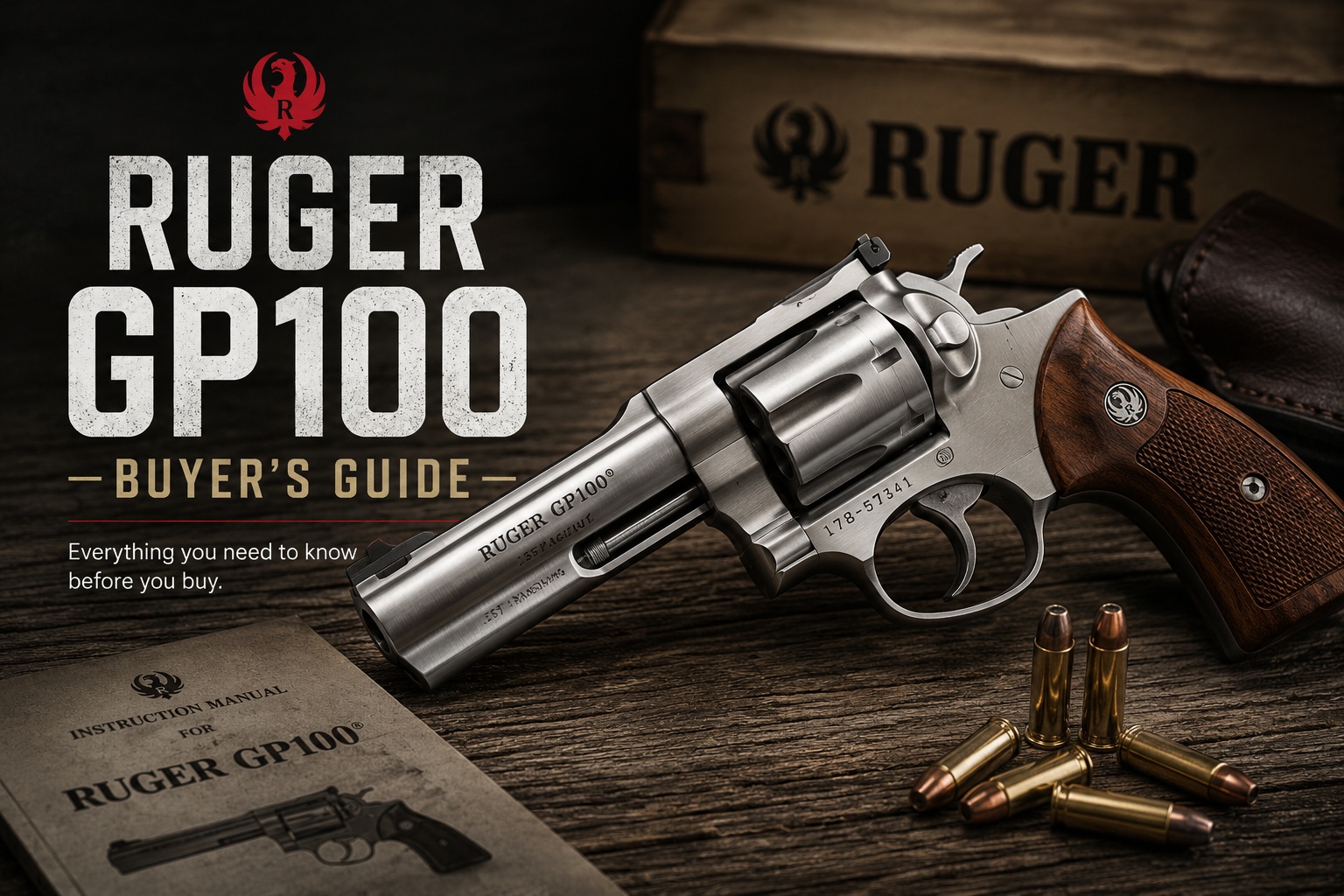
The GP100 arrived in 1985–1986 as the natural evolution of the Security Six, engineered from the outset to be the strongest medium-frame double-action revolver on the market. Where the Security Six had proven itself reliable, Ruger's engineers sought to build a platform that could handle an unlimited volume of full-power .357 Magnum ammunition without the frame-stretching concerns that plagued lighter designs over tens of thousands of rounds. The result was a heavier, more robust revolver featuring a triple-locking cylinder for superior lockup, a modular peg-style grip system that allowed shooters to customize ergonomics without a gunsmith, and an overall design philosophy that prioritized longevity above all else.
In the decades since its introduction, the GP100 has expanded far beyond its original .357 Magnum/.38 Special chambering. Ruger has added variants in .327 Federal Magnum, 10mm Auto, .44 Special, and a popular 10-shot .22 LR model — transforming the GP100 from a single-purpose duty revolver into a versatile platform serving target shooters, handgun hunters, and collectors alike. Specialty models like the Match Champion (introduced around 2012) brought competition-grade features to the line. Still in production today, the GP100 stands as one of the longest-running and most respected double-action revolvers in American firearms history, and early-production examples from the 170-prefix serial range are beginning to attract dedicated collector interest.
Production Timeline
Serial Number Chart
| First Serial Shipped | Year |
|---|---|
| 170-00001 | 1986 |
| 170-18081 | 1987 |
| 170-40819 | 1988 |
| 171-33130 | 1989 |
| 172-00859 | 1990 |
| 172-30612 | 1991 |
| 172-49299 | 1992 |
| 172-73459 | 1993 |
| 173-10032 | 1994 |
| 173-32506 | 1995 |
| 173-55795 | 1996 |
| 173-69135 | 1997 |
| 173-86751 | 1998 |
| 173-98541 | 1999 |
| 174-14075 | 2000 |
| 174-30948 | 2001 |
| 174-54400 | 2002 |
| 174-62013 | 2003 |
| 174-73415 | 2004 |
| 174-94092 | 2005 |
| 175-07470 | 2006 |
| 175-23438 | 2007 |
| 175-38226 | 2008 |
| 175-58296 | 2009 |
| 175-83537 | 2010 |
| 176-07061 | 2011 |
| 176-30507 | 2012 |
| 176-51462 | 2013 |
| 176-92800 | 2014 |
| 177-34524 | 2015 |
Collector Notes
- GP100 serial numbers in the 170-XXXXX range are earliest production and most desirable to collectors.
- The peg grip system allows aftermarket grip customization — original Ruger wood panels with early production guns are prized.
- Triple-locking cylinder was a significant engineering advancement over the Security Six's dual lock.
- Stainless GP100s (KGP prefix models) have strong collector interest for durability and aesthetics.
- Match Champion and competition variants (post-2012) are distinct from the standard GP100 collector timeline.
- Compare GP100 serial numbers against the Security Six chart — the 170 prefix series clearly marks the transition.
Ruger Blackhawk
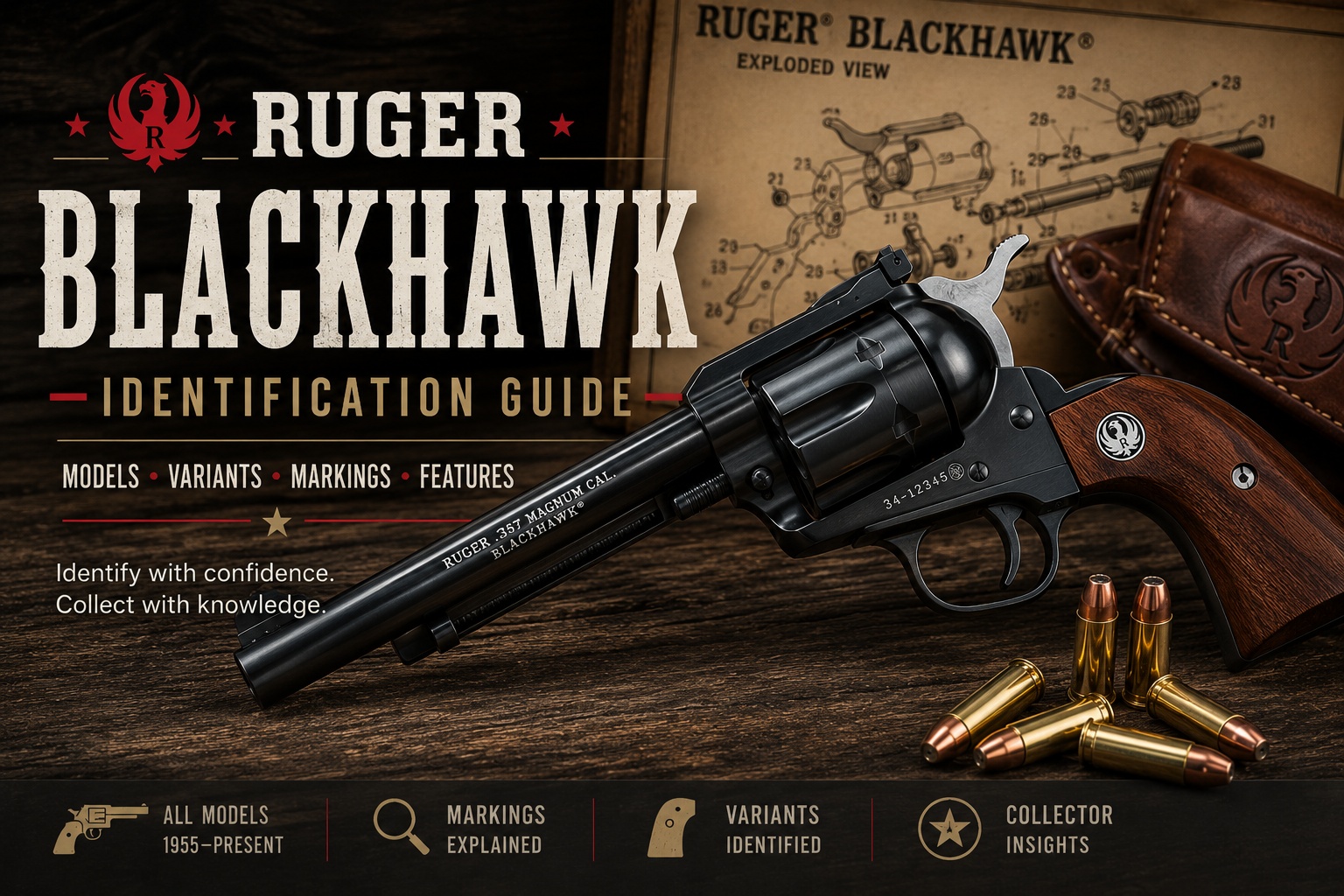
The Ruger Blackhawk burst onto the American firearms scene in 1955, born from the postwar fascination with the frontier West and the enduring appeal of the single-action revolver. Bill Ruger recognized that shooters craved the look and feel of the classic Colt Single Action Army but demanded modern metallurgy and engineering capable of handling contemporary magnum cartridges. The original Blackhawk, chambered in .357 Magnum, delivered precisely that — and within a year, Ruger introduced a .44 Magnum variant that arrived on dealer shelves nearly simultaneously with Smith & Wesson's legendary Model 29, making the Blackhawk one of the very first production revolvers chambered for that thundering cartridge.
Collectors divide Blackhawk history into distinct eras defined by both design and safety mechanism. The earliest guns (1955–1962) are known as "Flat-Top" models, identified by the absence of protective ear guards on the rear sight — these are the rarest and most valuable production Blackhawks. From 1962 through 1972, the "Three-Screw" era saw the addition of a redesigned top strap and frame, identifiable by three visible screws on the left side of the frame. These pre-1973 revolvers lack the transfer bar safety that would define all subsequent production, making them both mechanically distinct and highly prized by collectors who value original-condition firearms.
In 1973, responding to concerns about the traditional single-action mechanism's vulnerability to accidental discharge if dropped on a loaded chamber, Ruger implemented a voluntary recall and conversion program. The company offered to retrofit all existing "old model" Blackhawks with a new transfer bar safety mechanism free of charge — a program that remains active to this day. The "New Model" Blackhawk, introduced in 1974 with the transfer bar built in from the factory, became the standard and continues in production through the present. Unconverted old models that retain their original mechanism are the most desirable to serious collectors, though they require disciplined safe-handling practices. The Bisley variant, introduced in 1986 with its distinctive grip shape and lowered hammer, added yet another chapter to the Blackhawk's rich collector legacy.
Model Variant Identification
| Variant | Years | Key Identifier |
|---|---|---|
| Flat-Top | 1955–1962 | No ear guards on rear sight; earliest serial numbers |
| Three-Screw (Old Model) | 1962–1973 | Three visible screws on left frame panel; no transfer bar |
| New Model | 1974–Present | Transfer bar safety; "New Model" rollmark; prefix 32+ |
| Bisley | 1986–Present | Bisley-style grip and hammer; subset of New Model serials |
| 50th Anniversary | 2005–2006 | Special 520-XXXXX serial prefix |
Old Model Serial Number Chart (1955–1973)
| First Serial Shipped | Year |
|---|---|
| 1 | 1955 |
| 1737 | 1956 |
| 7318 | 1957 |
| 11676 | 1958 |
| 18688 | 1959 |
| 25734 | 1960 |
| 34325 | 1961 |
| 39490 | 1962 |
| 43698 | 1963 |
| 52569 | 1964 |
| 60373 | 1965 |
| 73551 | 1966 |
| 87269 | 1967 |
| 108764 | 1968 |
| 30-00001 | 1969 |
| 30-24975 | 1970 |
| 30-81253 | 1971 |
| 31-10018 | 1972 |
| 31-41551 | 1973 |
New Model Serial Number Chart (1974–2015)
| First Serial Shipped | Year | Notes |
|---|---|---|
| 32-33639 | 1974 | |
| 32-66489 | 1975 | |
| 33-03854 | 1976 | |
| 33-51451 | 1977 | |
| 34-06008 | 1978 | |
| 34-59110 | 1979 | |
| 35-07904 | 1980 | |
| 35-55902 | 1981 | |
| 35-93851 | 1982 | |
| 36-22705 | 1983 | |
| 36-39399 | 1984 | |
| 36-66388 | 1985 | |
| 36-73330 | 1986 | |
| 36-82139 | 1987 | |
| 36-95212 | 1988 | |
| 37-01082 | 1989 | |
| 37-09149 | 1990 | |
| 37-17217 | 1991 | |
| 37-20595 | 1992 | |
| 37-24885 | 1993 | |
| 37-30015 | 1994 | |
| 37-35815 | 1995 | |
| 37-39105 | 1996 | |
| 37-48501 | 1997 | |
| 37-53908 | 1998 | |
| 37-59304 | 1999 | |
| 37-63438 | 2000 | |
| 37-68506 | 2001 | |
| 37-73673 | 2002 | |
| 37-76050 | 2003 | |
| 37-78003 | 2004 | |
| 37-82021 | 2005 | |
| 37-85022 | 2006 | |
| 37-89462 | 2007 | |
| 37-93245 | 2008 | |
| 37-96392 | 2009 | |
| 38-00675 | 2010 | |
| 38-07433 | 2011 | |
| 38-15393 | 2012 | |
| 38-22039 | 2013 | |
| 38-30205 | 2014 | |
| 38-44654 | 2015 | |
| 520-00001 | 2005 | 50th Anniversary Model |
| 520-09778 | 2006 | 50th Anniversary Model |
Collector Notes
- Old Model Blackhawks (pre-1973) without the transfer bar safety are often called "pre-warning" models and are highly collectible.
- Ruger offered a free conversion to New Model safety on all Old Models — unconverted originals are more desirable to purists but require safe handling discipline.
- Flat-Top models (SN 1 through ~39,000, 1955–1962) are the earliest and most valuable production Blackhawks.
- The .44 Magnum Flat-Top (introduced 1956) is among the most sought-after Ruger collectibles.
- Three-Screw models in calibers other than .357 Mag (e.g., .41 Mag, .45 Colt) command strong premiums.
- The 50th Anniversary Model (520-XXXXX) is a distinct collectible with special markings and presentation cases.
- New Model Bisley variants have a dedicated collector following separate from the standard Blackhawk.
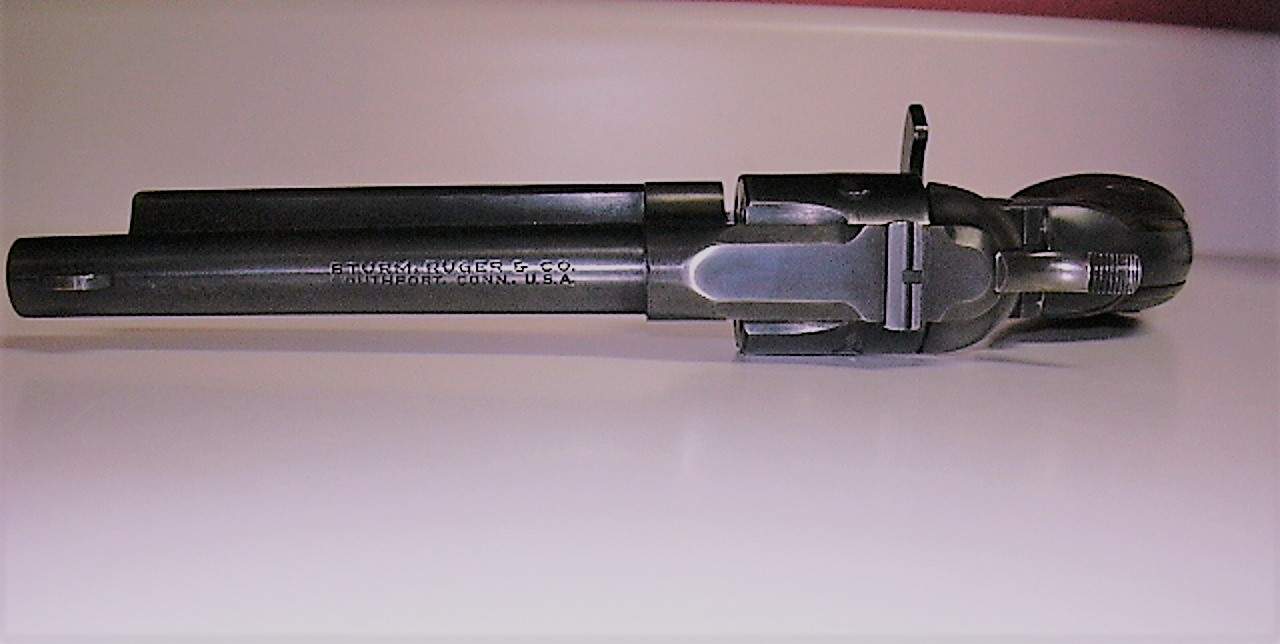
1957 Ruger Flat Gate Single-Six: Original Collector Study
The revolver shown throughout this section is Greg Cook’s own 1957 Ruger Flat Gate Single-Six. Every photograph documents the same early rimfire single-action revolver from a different angle. It is not a Blackhawk, GP100, Security-Six, or later New Model Single-Six. Keeping that distinction clear matters because early Ruger single-actions can look similar at a glance while differing substantially in frame details, loading-gate construction, sight arrangement, grip hardware, serial-number format, and safety mechanism.
This revolver belongs to the early Single-Six story that began in the 1950s, when Ruger adapted the traditional western single-action form to a modern .22 rimfire platform. The example photographed here carries serial number 15872, visible on the left side of the frame in several views. That plain, non-prefix serial format is consistent with early production. Ruger’s historical serial tables should still be treated as approximate first-shipped-year references rather than exact assembly dates, but the number places this revolver within the early collector period and supports its identification as a 1957 example.
The “Flat Gate” name refers to the early loading gate design. On these revolvers, the gate is visually flatter and simpler than the later rounded or contoured gate used on subsequent Single-Six production. That feature is one of the most useful visual clues, but it should never be considered in isolation. A careful identification also examines the unprefixed serial number, frame screws, fixed sights, grip-frame profile, cylinder markings, ejector-rod housing, barrel contour, and the exact Ruger rollmarks.

What the right-side profile confirms
The right-side view establishes the revolver’s overall proportions and makes it easier to separate this rimfire Single-Six from the larger centerfire Blackhawk family. The relatively slender barrel and cylinder, compact frame, and fixed-sight arrangement are consistent with an early Single-Six. The grip panel medallion and frame profile provide additional period clues, while the ejector assembly beneath the barrel shows the classic single-action layout used to remove fired cartridge cases one chamber at a time.
Collectors should resist identifying an early Ruger from silhouette alone. Replacement grips, refinishing, mixed small parts, and later factory service can change the appearance. The strongest conclusion comes from combining the profile with the serial number and close inspection of the loading gate, screws, sights, markings, and internal operating system.


Serial number, frame screws, and originality clues
The left-side photographs are the most useful images for dating and identification because serial number 15872 is visible on the frame. The absence of a later hyphenated prefix is important. Ruger adopted prefix systems as production expanded, so collectors should record the number exactly as stamped rather than adding punctuation or assuming missing digits. An early plain-number Single-Six belongs to a different dating system from later New Model revolvers.
These views also show the screw arrangement associated with Ruger’s early single-action lockwork. The visible screws help distinguish an Old Model action from the later transfer-bar New Model system. Because external appearance can be altered, a collector evaluating a purchase should confirm that the revolver has not received a later safety conversion, replacement grip frame, non-period cylinder, refinished surfaces, or mismatched screws. Factory work is not necessarily undesirable for a shooter, but it can affect collector interest when originality is the goal.


Sight, barrel, cylinder, and loading-gate inspection
The top and front three-quarter photographs document details that a side profile can hide. The fixed sight arrangement is visible along the barrel and top strap. The cylinder-to-frame relationship, hammer shape, barrel contour, and ejector-rod housing can all be compared with known early Single-Six configurations. These views are also useful when looking for uneven gaps, altered sights, bent ejector housings, or refinishing that has softened stampings and edges.
The loading gate deserves special attention because it gives the Flat Gate variation its familiar collector name. The gate should be examined directly from the appropriate angle and compared with a documented early example. A photograph alone cannot establish mechanical condition, and no visual feature substitutes for checking timing, lockup, bore condition, chambers, firing pin, and safe operation. A qualified gunsmith should inspect an older revolver before it is fired when its service history is unknown.

Collector value: condition, originality, and documentation
Early Single-Six collector value depends on more than the production year. Original finish, sharp markings, correct grips, matching period features, mechanical condition, and freedom from unnecessary alteration all matter. The photographs provide a visual record of this particular revolver’s condition at the time they were made, but they are not a substitute for an in-hand examination. Honest wear can be preferable to an attractive refinish when the collector’s priority is originality.
Boxes, manuals, receipts, and correspondence may strengthen provenance only when they can be tied credibly to the revolver. The green soft case shown here is used as a presentation surface and should not be interpreted as factory packaging from 1957. That distinction is included deliberately because captions should separate what a photograph proves from what it merely shows nearby.
The safest research workflow is to record the complete serial number, photograph both sides and all markings, compare the revolver with the Ruger Single-Six reference, consult the Ruger serial-number lookup app, and request factory documentation when exact shipment information or original configuration materially affects value. Greg’s earlier article about his Flat Gate revolver is also available at Ruger Flat Gate Single-Six.
Photo identification note: All six images in this section show the same 1957 Ruger Flat Gate Single-Six, serial number 15872. They are intentionally confined to the Single-Six discussion and are not used as illustrations of the Blackhawk, Security-Six, GP100, or another Ruger model.
How to Identify and Date a Ruger Revolver
A Ruger serial number is an important starting point, but it is not a complete model identification by itself. Ruger used different numbering systems as production expanded, and some closely related revolvers shared a prefix range. The best identification combines the serial number with the exact model rollmark, caliber marking, barrel length, sight style, frame shape, grip frame, finish, and operating system. Begin by recording every marking exactly as it appears before comparing the revolver with a chart or lookup tool.
1. Find and record the complete serial number
On many Ruger revolvers, the serial number is stamped on the frame. Its location varies by model and production era, so inspect the lower frame, grip-frame area, and other factory-marked surfaces without removing parts unnecessarily. Record all digits, the hyphen, and any prefix exactly. A number such as 150-00001 carries different information from a plain early number such as 1737. Do not substitute a catalog number, proof mark, assembly number, or number found only on a removable part.
2. Use the prefix to narrow the model family and era
Ruger prefixes help organize later production, but a prefix may identify a family rather than one exact configuration. The Security-Six, Speed-Six, and Police Service-Six, for example, can appear within related prefix ranges. That means a lookup result should be treated as an approximate production window, followed by a physical comparison with the correct family guide. The Ruger serial-number lookup app provides the fastest first pass, while the detailed charts on this page show the first recorded serial number shipped for many years.
3. Separate shipment year from exact manufacture date
Ruger historical tables generally identify an approximate first-shipped serial number for a calendar year. They do not guarantee that every revolver was assembled, completed, and shipped in perfect numerical order. A revolver near a yearly boundary may have been completed or shipped later than a simple chart suggests. Use the result as an estimated production period, not as a substitute for factory documentation. Boxes, labels, receipts, manuals, and dated correspondence can add useful provenance when they can be tied reliably to the firearm.
4. Confirm the model with physical features
After dating the serial number, compare the revolver's features with the appropriate model reference. For the Security-Six family, note whether the revolver has adjustable or fixed sights, a square or round butt, and the exact barrel length. The Security-Six, Service-Six, and Speed-Six guide explains those differences. For a GP100, inspect the full or partial barrel shroud, grip system, caliber, cylinder capacity, sights, and model markings using the Ruger GP100 collector and buyer guide.
Single-action Rugers require a different set of clues. On a Blackhawk, determine whether the frame is an early Flat-Top, a Three-Screw Old Model, or a transfer-bar New Model. Sight-protection ears, screw locations, loading procedure, rollmarks, and safety-system features are more reliable than assumptions based on appearance alone. Use the Ruger Blackhawk identification guide for that comparison. Rimfire single-actions should be checked against the Ruger Single-Six reference, which covers Old Model, New Model, Convertible, Single-Ten, and Single-Nine variations.
5. Check originality before estimating collector value
Serial-number dating does not establish originality or value. Compare the revolver's finish, grips, ejector-rod housing, sights, cylinder, barrel, screws, and small parts with known factory configurations from the estimated era. Refinishing, replacement grips, barrel changes, aftermarket sights, safety conversions, and mixed parts may affect collector interest even when the revolver remains mechanically sound. Original boxes, manuals, test-fire envelopes, and sales paperwork can strengthen provenance, but only when the serial number and configuration match.
6. Know when a factory letter or professional inspection matters
Use factory documentation when an exact shipping record, original configuration, unusual caliber, scarce barrel length, law-enforcement association, or high-value variation materially affects the conclusion. A qualified gunsmith should inspect any older revolver before firing, especially when condition, timing, lockup, bore condition, or prior modification is uncertain. Collector research identifies what a revolver appears to be; a mechanical inspection addresses whether it is safe and serviceable.
Collector workflow: record the complete serial number → estimate the year with the lookup app or chart → identify the exact model and variation from physical features → evaluate originality and condition → seek factory documentation when the difference matters.
Quick Reference
| Model | Type | Production | Calibers | Key Feature |
|---|---|---|---|---|
| Security Six | DA Revolver | 1972–1988 | .357, .38, 9mm | First Ruger DA; law enforcement staple |
| Speed-Six / Service-Six | DA Revolver | 1973–1988 | .357, .38, 9mm | Variants sharing Security Six serial prefix |
| GP100 | DA Revolver | 1986–Present | .357, .38, .327, 10mm, .44 Spl, .22 | Replaced Security Six; still in production |
| Blackhawk Old Model | SA Revolver | 1955–1973 | .357, .44 Mag, .41 Mag, .45 Colt | Pre-transfer-bar; Flat-Top & Three-Screw eras |
| Blackhawk New Model | SA Revolver | 1974–Present | Multiple | Transfer bar safety; includes Bisley variant |
Ruger Collector Research Cluster
Information on this page is provided for collector reference and identification purposes only. Production dates and serial number ranges are approximate. Physical inspection by a qualified gunsmith is recommended before purchase. For official documentation, contact Ruger's Service Department at 336-949-5200. Gun Collectors Club is an independent collector reference site and is not affiliated with Sturm, Ruger & Co., Inc. Always follow safe firearms handling practices — Old Model Blackhawks without the transfer bar conversion should be carried with the hammer resting on an empty chamber.
Related Guides & Resources
Security Six Deep Dive
Barrel variations, finish options, and law enforcement contract models.
GP100 Buyer's Guide
What to inspect before purchasing a used GP100.
Blackhawk Identification Guide
Flat-Top vs Three-Screw vs New Model — how to tell them apart in hand.
Ruger Single-Six Reference
Companion guide to Ruger's rimfire single-action line.
Ruger Redhawk Serial Number Lookup
Date Redhawk, Super Redhawk, and Alaskan serial prefixes with official first-serial-of-year tables and model-identification guidance.
Full Ruger Serial Number Library
All Ruger models indexed by serial prefix.