Gun Collectors Club · Collector Reference
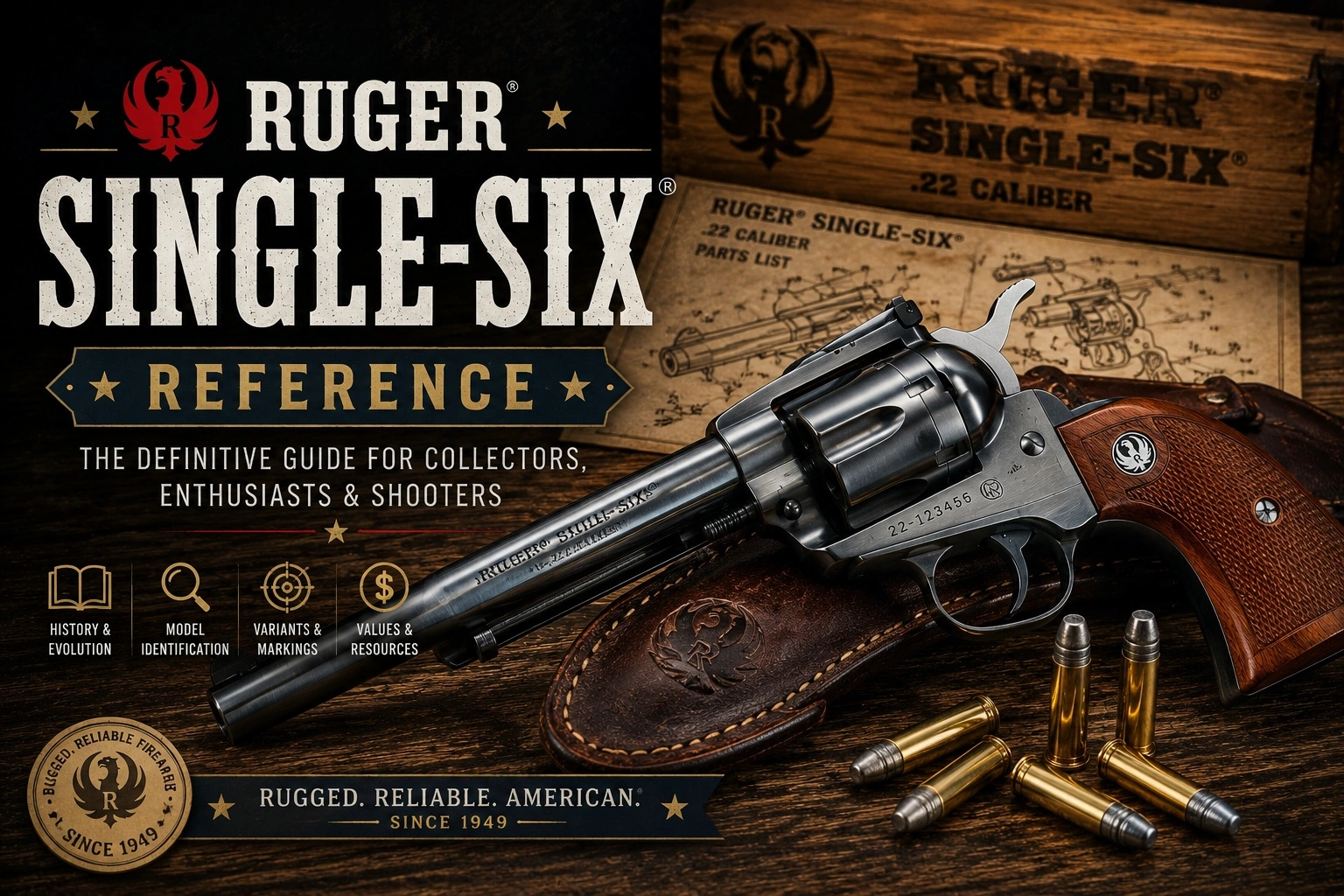
Ruger Single-Six Reference
Use this Ruger Single Six serial number lookup reference to narrow the likely manufacture period and identify the correct model or series. Enter or compare the available markings, then verify the result against the supporting serial-range notes and collector references below.
By Greg Cook · Collector Reference · Updated August 2026
Ruger Single-Six Serial Number Lookup
Start with the complete serial number stamped on the revolver's frame, including any two- or three-digit prefix. Compare it with the Old Model and New Model tables below to estimate the year it shipped. A listed number is generally the first serial number recorded for that year, so treat the result as an approximate production period rather than an exact factory date.
- Record the full number: preserve the hyphen and prefix, because a number such as 20-00001 belongs to a different production sequence than an early number without a prefix.
- Choose the correct era: Old Model revolvers normally have three frame screws and no “New Model” rollmark; New Model revolvers have a transfer bar and the “New Model” marking.
- Find the surrounding range: locate the closest starting serial at or below your number, then confirm the result with the next year's starting number.
- Verify physical details: compare the loading gate, rear sight protection, frame screws, barrel marking, finish, and cylinder markings before assigning a variant.
Important dating limits
Ruger's published Single-Six records contain gaps, and serial numbers can indicate when a revolver was shipped rather than when every part was made. For a documented date or an example inside a records gap, request factory records from Ruger.
America's Rimfire Single-Action — Since 1953
The Ruger Single-Six debuted in June 1953 as Ruger's rimfire companion to the Blackhawk centerfire revolvers. Using investment casting — a manufacturing innovation Ruger had already leveraged for the Standard pistol — the Single-Six delivered cowboy-style single-action quality at a competitive price point that undercut traditional rivals.
The Single-Six's production history divides cleanly into three eras: Old Model Flat-Top (1953–~1960), Old Model Three-Screw (~1960–1973), and New Model (1973–present). More than 700,000 Old Models were produced before the 1973 safety redesign; New Model production exceeded 1,057,000 units by 1993 and continues today. The 1973 transfer bar safety redesign mirrored the parallel recall and redesign of the Blackhawk centerfire line.
Versatility has defined the model: launched in .22 LR, it added a .22 WMR convertible cylinder option, and later the .17 HMR chambering. "Super Single-Six" denotes adjustable sights. The Single-Ten (10-shot .22 LR, introduced 2011) and Single-Nine (9-shot .22 WMR, 2012) are modern derivatives expanding the family.
For collectors, the earliest Flat-Top examples (1953–1960) are the scarcest and command meaningful premiums. Convertible models with both factory-matched cylinders are worth 20–30% more than single-cylinder equivalents. Across all eras, originality — original finish, original grips, and original box — drives value more than any other factor.
Single-Six at a Glance
- Type: Single-action rimfire revolver
- Introduced: June 1953
- Still in production: Yes (New Model, Single-Ten, Single-Nine)
- Calibers: .22 LR, .22 WMR, .17 HMR, .32 H&R Magnum (limited)
- Cylinder capacity: 6 (standard), 9 (Single-Nine), 10 (Single-Ten)
- Barrel lengths: 4.625", 5.5", 6.5", 7.5", 9.5" (by era and model)
- Old Model: 1953–1973 (700,000+ units)
- New Model: 1973–present (1,057,000+ by 1993)
- Transfer bar: New Model only — Old Models use 5-round carry rule
- Ruger Service: 336-949-5200 · Newport, NH
Old Model Single-Six
Flat-Top (1953–~1960) · Three-Screw / Contoured Gate (~1960–1973)
The Single-Six launched in June 1953, serial number 1, from Ruger's Southport, Connecticut facility. The earliest production — now called the "Flat-Top" era — featured a flat frame top with no protective ear guards on the rear sight, and a flat loading gate on the very earliest guns (~pre-1958). Initially chambered in .22 LR only, the .22 WMR option was added in 1959. By approximately 1960, Ruger added ear guards to the rear sight and introduced a contoured (curved) loading gate, marking the beginning of the "Three-Screw" era.
Three-Screw production ran from ~1960 through the 1973 safety redesign. No Old Model Single-Six of any sub-type has a transfer bar — all require the 5-round carry rule (hammer resting on an empty chamber). Ruger offers a free conversion that installs a transfer bar and removes one screw, but this reduces collector value. Unconverted three-screw Old Models are more desirable to collectors.
Flat-Top (1953–~1960)
- Flat frame top — no protective ear guards on rear sight
- Flat loading gate on very earliest production (~pre-1958)
- Serial numbers 1 through ~171,403 (1953–1961 era)
- .22 LR only at intro; .22 WMR option from 1959
- Barrel lengths: 5.5" standard; 4.625" and 9.5" added later
- Blued finish only — no stainless in Old Model era
- Southport CT address on earliest barrels; Newport NH later
Three-Screw / Contoured Gate (~1960–1973)
- Ear guards on rear sight — distinguishes from Flat-Top
- Contoured (curved) loading gate
- Three visible screws on left frame panel
- Serials ~171,403 (1961) through 21-53819 (1973); prefix 20/21-XXXXX from 1969
- Records gap 1963–1968 in Ruger's published data — factory letter recommended
- .22 WMR convertible cylinder option available
- Blued finish only
Old Model Serial Numbers by Year
| Serial | Year | Notes |
|---|---|---|
| 1 | 1953 | |
| 50 | 1954 | |
| 10,734 | 1955 | |
| 31,857 | 1956 | |
| 55,346 | 1957 | |
| 88,245 | 1958 | |
| 122,480 | 1959 | |
| 151,189 | 1960 | |
| 171,403 | 1961 | |
| 187,367 | 1962 | |
| — | 1963–1968 | Records gap — use factory letter |
| 20-00001 | 1969 | |
| 20-39803 | 1970 | |
| 20-77705 | 1971 | |
| 21-16995 | 1972 | |
| 21-53819 | 1973 |
Ruger's published records show a gap in Single-Six Standard serial data from 1962 through 1969. Guns with serials between 187,367 and 20-00001 should be verified via Ruger factory letter.
Old Model Collector Notes
- Flat-Top Single-Sixes (SN below ~171,000) command meaningful premiums over Three-Screw examples — flat frame top is the identifier
- Flat loading gate on very early production (~pre-1958) is a further sub-collector point
- Convertible Old Models with both matched cylinders worth significantly more — both must be present
- Last 3 digits of serial engraved on front face of extra cylinders — verify matching before purchase
- Unconverted Old Models (3 screws, no transfer bar) more desirable; converted = 2 screws, reduced collector value
- Original factory blue increasingly hard to find in excellent condition — re-bluing is the top value-killer
- 9.5" barrel is scarcest Old Model barrel length
New Model Single-Six
Transfer Bar Safety · Convertible · Super Single-Six · Still in Production
The 1973 redesign introduced the transfer bar safety mechanism, making 6-round carry safe for the first time in Single-Six history. New Model serial numbers begin with the 62-XXXXX prefix and progress through 268-XXXXX. The "Super Single-Six" designation — indicating adjustable target sights — became the predominant production variant. Stainless steel construction was added to the lineup, and the .17 HMR chambering followed in 2003.
Modern derivatives expanded the family: the Single-Ten (2011) offers a 10-shot .22 LR cylinder in stainless, while the Single-Nine (2012) provides 9-shot .22 WMR capacity. Both feature fiber-optic sights and have developed their own collector followings. The Bisley Single-Six, with its distinctive hammer and grip frame, has been available from 1986 and carries the 268-XXXXX serial prefix from 1994.
New Model Identification Points
'New Model' Rollmark
Stamped on left frame panel below cylinder; definitive confirmation of post-1973 production
Two Frame Screws
Not three — the third screw's function is incorporated into the transfer bar mechanism
Transfer Bar Visible
Partially cock hammer; flat bar visible between hammer and firing pin — the safety feature
Serial Prefix 62–268
Starts 62-XXXXX (1973), progresses through 66-, then 260–265-, and 268- (Bisley/50th Anniversary from 1994)
Super vs. Standard Sights
Super = adjustable elevation + windage screws; Standard = fixed groove; 'Super' not in rollmark — examine sight physically
Convertible Cylinder Markings
Last 3 digits of serial engraved on front face of each cylinder; must match gun serial number
Stainless Available
Satin brushed finish; 'K' prefix model numbers indicate stainless construction
Cold Hammer-Forged Barrel
Post-1990s production; noted in accompanying documentation
New Model Serial Numbers by Year
| Serial | Year | Notes |
|---|---|---|
| 62-00001 | 1973 | First New Model shipments |
| 62-60261 | 1974 | |
| 63-31002 | 1975 | |
| 64-22659 | 1976 | |
| 64-94851 | 1977 | |
| 65-94609 | 1978 | |
| 66-72106 | 1979 | |
| 67-44104 | 1980 | |
| 68-25002 | 1981 | |
| 69-15052 | 1982 | |
| 69-95871 | 1983 | |
| 260-23867 | 1984 | |
| 260-44317 | 1985 | |
| 261-10138 | 1986 | |
| 261-33448 | 1987 | |
| 261-70551 | 1988 | |
| 261-97610 | 1989 | |
| 262-24203 | 1990 | |
| 262-41476 | 1991 | |
| 262-56030 | 1992 | |
| 262-67559 | 1993 | |
| 262-92015 | 1994 | 268-00501 also begins 1994 |
| 263-03206 | 1995 | 268-02269 also 1995 |
| 263-15020 | 1996 | 268-09980 also 1996 |
| 263-36237 | 1997 | 268-15232 also 1997 |
| 263-44257 | 1998 | 268-18211 also 1998 |
| 263-61976 | 1999 | 268-20561 also 1999 |
| 263-79121 | 2000 | 268-21253 also 2000 |
| 263-95152 | 2001 | 268-22100 also 2001 |
| 264-10104 | 2002 | 268-23823 also 2002 |
| 264-24780 | 2003 | 268-24771 also 2003 (50th Anniv.) |
| 264-32365 | 2004 | 268-33666 also 2004 |
| 264-60988 | 2005 | 268-50010 also 2005 |
| 264-74437 | 2006 | 268-51074 also 2006 |
| 264-86141 | 2007 | 268-51172 also 2007 |
| 264-97975 | 2008 | 268-52830 also 2008 |
| 265-10709 | 2009 | 268-54020 also 2009 |
| 265-21787 | 2010 | 268-55639 also 2010 |
| 265-36909 | 2011 | 268-57840 also 2011 |
| 265-49578 | 2012 | 268-60267 also 2012 |
| 265-62738 | 2013 | 268-61311 also 2013 |
| 265-75240 | 2014 | 268-62600 also 2014 |
| 265-89288 | 2015 |
The 268-XXXXX prefix (from 1994) covers Bisley and 50th Anniversary models. The 262–265- series covers standard and Super Single-Six production.
Single-Six Variant Identification Guide
Standard, Super, Convertible, Bisley, Single-Ten, Single-Nine
Standard Single-Six
Fixed rear sight groove; base model; most common variant. Blued finish in Old Model era; blued and stainless options in New Model production.
Super Single-Six
Fully adjustable rear sight (elevation + windage); marketed to target shooters and hunters. 'Super' not in rollmark — identify by adjustable sight hardware. Current production is predominantly Super.
Convertible
Ships with .22 LR and .22 WMR cylinders; last 3 serial digits engraved on front face of each. Cylinders NOT interchangeable between guns. Missing second cylinder = 20–30% value loss.
Bisley Single-Six
Bisley hammer and grip frame; 268-XXXXX serial prefix from 1994. Dedicated collector following; stainless Bisley particularly desirable.
Single-Six .17 HMR
.17 HMR chambering; initially offered with .17 HM2 companion cylinder. Model numbers 0660–0662 range. Single-Six Hunter variant adds scope-mount provisions.
Single-Six Hunter
7.5" or 9.5" barrel; integral scope-mounting provisions on barrel rib. Adjustable rear sight; stainless construction; marketed for small-game and varmint hunting.
Single-Ten
.22 LR, 10-shot cylinder; stainless; fiber optic front sight; 5.5" barrel; Model 8100. No convertible option. Has developed its own collector following.
Single-Nine
9-shot .22 WMR; stainless; fiber optic sights; 6.5" barrel; Model 8150. Not convertible. The .22 WMR counterpart to the Single-Ten.
Full Variant Comparison
| Variant | Caliber | Capacity | Barrel | Era | Sights | Notes |
|---|---|---|---|---|---|---|
| Standard Single-Six | .22 LR | 6 | 4.625", 5.5", 6.5" | Old & New | Fixed | Base model; most common |
| Super Single-Six | .22 LR / WMR | 6 | 4.625", 5.5", 6.5", 9.5" | New | Adjustable | Current production standard |
| Convertible | .22 LR + .22 WMR | 6 | 4.625", 5.5", 6.5", 9.5" | Old & New | Fixed or Adj. | Dual matched cylinders |
| Bisley Single-Six | .22 LR / WMR | 6 | 5.5", 6.5" | New (1986+) | Adjustable | 268- prefix; Bisley hammer & grip |
| .17 HMR | .17 HMR | 6 | 5.5", 6.5" | New (2003+) | Adjustable | Also w/ .17 HM2 cylinder option |
| Single-Six Hunter | .17 HMR / .22 WMR | 6 | 7.5", 9.5" | New | Adj. + scope | Stainless; optics ready |
| Single-Ten | .22 LR | 10 | 5.5" | New (2011+) | Fiber optic | Stainless; no convertible |
| Single-Nine | .22 WMR | 9 | 6.5" | New (2012+) | Fiber optic | Stainless; .22 WMR only |
The Convertible Single-Six — Cylinder Matching & What to Know
The convertible configuration — shipping with both .22 LR and .22 WMR cylinders from the factory — is one of the most important value drivers in Single-Six collecting. Understanding cylinder matching and compatibility is essential before any purchase.
How to Verify a Factory Convertible
- Front face of each cylinder has last 3 digits of gun's serial engraved
- Both cylinders must show matching last-3 digits
- A cylinder with different numbers is not factory-matched — reduces value
- Ask seller for photos of front face of each cylinder
- Factory letter confirms original convertible configuration
- Never load .22 LR in .22 WMR cylinder — different headspace
Convertible Value Impact
- Verified factory convertible with both matched cylinders = 20–30% premium over single-cylinder
- Convertible missing extra cylinder priced as single-cylinder gun
- Spare cylinders on secondary market: $75–$150 but won't carry matching serial digits
- Old Model convertibles with both matched cylinders scarcer than New Model equivalents
- Both cylinders must be present for full value — always verify before purchase
Cylinder Compatibility Warning
- .22 LR and .22 WMR cylinders NOT interchangeable between different guns — each timed to its revolver
- Installing unmatched cylinder can cause dangerous timing issues
- .22 Short and .22 Long can fire in .22 LR cylinder — not in .22 WMR cylinder
- .17 HMR cylinder NOT compatible with .22 LR or .22 WMR
- Always have gunsmith verify timing if unsure about cylinder compatibility
Fair Market Price Guide — Ruger Single-Six (July 2026)
Prices vary significantly by era, variant, condition, and cylinder completeness. The following ranges reflect secondary market conditions as of July 2026.
| Model / Configuration | Condition | Price Range | Notes |
|---|---|---|---|
| Old Model Flat-Top 5.5" (SN below ~171,000) | Excellent | $600–$950+ | Flat frame top premium |
| Old Model Flat-Top — Convertible (both cyls.) | Excellent | $750–$1,100+ | Matched convertible premium |
| Old Model Three-Screw 5.5" .22 LR | Excellent | $400–$600 | Common Old Model |
| Old Model Three-Screw — Convertible (both cyls.) | Excellent | $500–$750 | Both matched cylinders required |
| Old Model Three-Screw | Very Good | $275–$399 | Shooter-grade |
| Old Model Three-Screw | Good | $175–$274 | Visible wear; functional |
| New Model Super Single-Six 5.5" Blued | Excellent | $350–$499 | Most common New Model |
| New Model Super Single-Six Stainless | Excellent | $375–$525 | Stainless premium |
| New Model Convertible (both matched cyls.) | Excellent | $450–$650 | Complete convertible |
| New Model Bisley Single-Six | Excellent | $450–$650 | Bisley collector premium |
| New Model .17 HMR | Excellent | $400–$575 | Growing interest |
| Single-Six Hunter (7.5"/9.5") | Excellent | $450–$650 | Long barrel / optics config |
| Single-Ten | Excellent (used) | $450–$625 | 10-shot capacity drives demand |
| Single-Nine | Excellent (used) | $425–$599 | .22 WMR 9-shot |
| Any Old Model — original box + papers | Excellent | +$100–$200 above table | Matching serial box significant |
| Any New Model — original box | Excellent | +$50–$100 above table |
Value Killers
- Convertible missing second cylinder = –20 to –30% value
- Re-bluing = –25 to –40% collector premium
- Mismatched replacement cylinder (non-matching serial digits) = permanent value reduction
- Cracked or replaced grip medallion = –5 to –10%
Single-Six Inspection Checklist
Use before purchasing any Old Model or New Model Single-Six
Era & Variant Identification
Cylinder Verification (Convertible)
Finish & Condition
Mechanical Inspection
Grips & Documentation
Old Model vs. New Model — Quick Reference
| Feature | Old Model (1953–1973) | New Model (1973–Present) |
|---|---|---|
| Transfer Bar | None — 5-round carry rule | Present — safe 6-round carry |
| 'New Model' Rollmark | Absent | Present on left frame panel |
| Frame Screws | 3 | 2 |
| Rear Sight Frame | Flat-Top or ear guards | Ear guards standard |
| Stainless Option | Not available | Available throughout |
| Serial Prefix | Plain integer or 20/21- | 62– through 268– |
| Sub-Variants | Flat-Top, Three-Screw | Super, Bisley, .17 HMR, Hunter, Single-Ten, Single-Nine |
| Calibers | .22 LR; .22 WMR from 1959 | .22 LR, .22 WMR, .17 HMR, .32 H&R (limited) |
| Collector Tier | Higher (esp. Flat-Top) | Moderate — active production |
| Safe 6-Round Carry | No | Yes |
| Free Ruger Conversion | Yes — installs transfer bar | N/A |
Ruger Collector Research Cluster
Information on this page is provided for collector reference and identification purposes only. Production dates and serial number ranges are approximate. Physical inspection by a qualified gunsmith is recommended before purchase. For official documentation, contact Ruger's Service Department at 336-949-5200. Gun Collectors Club is an independent collector reference site and is not affiliated with Sturm, Ruger & Co., Inc. Always follow safe firearms handling practices — Old Model Blackhawks without the transfer bar conversion should be carried with the hammer resting on an empty chamber.
Ruger Single-Six Serial Number Lookup FAQ
How do I use the Ruger Single-Six serial number lookup?
Copy the complete frame serial number, including its prefix, and compare it with the appropriate Old Model or New Model table. Use the closest starting number at or below yours for an estimated year, then confirm the era with the frame screws, rollmark, loading gate, and transfer-bar features.
Can a serial number confirm the exact manufacture year of a firearm?
Not always. Published serial tables usually estimate a production or shipment period, and factory records may contain gaps. A Ruger factory record or letter is the better source when an exact documented date matters.
What markings should I check when the serial number alone is inconclusive?
Check the “New Model” rollmark, number of frame screws, transfer bar, loading-gate shape, rear-sight ear guards, barrel address and caliber marking, finish, and the identifying digits on convertible cylinders.
Where is the Ruger Single-Six serial number located?
The primary serial number is stamped on the revolver's frame. Record every digit and any prefix exactly as shown; do not substitute assembly numbers or the matching digits sometimes found on an extra cylinder.
How do Ruger Single-Six serial numbers show the date manufactured?
The tables group serial-number starting points by year. If your complete number falls between two yearly starting numbers, the earlier entry usually gives the likely year range, subject to records gaps and later factory verification.
Related Guides & Resources
Full serial number charts for Security Six, GP100, and Blackhawk plus interactive lookup.
Flat-Top vs. Three-Screw vs. New Model — the Single-Six's centerfire companion.
Barrel variations, finishes, and law enforcement contracts for Ruger's first DA revolver.
What to inspect before purchasing a used Ruger GP100.
Ruger letter availability, factory-record limits, and documentation options.
How grading systems, originality, and condition affect collector value.