Gun Collectors Club · Collector Reference
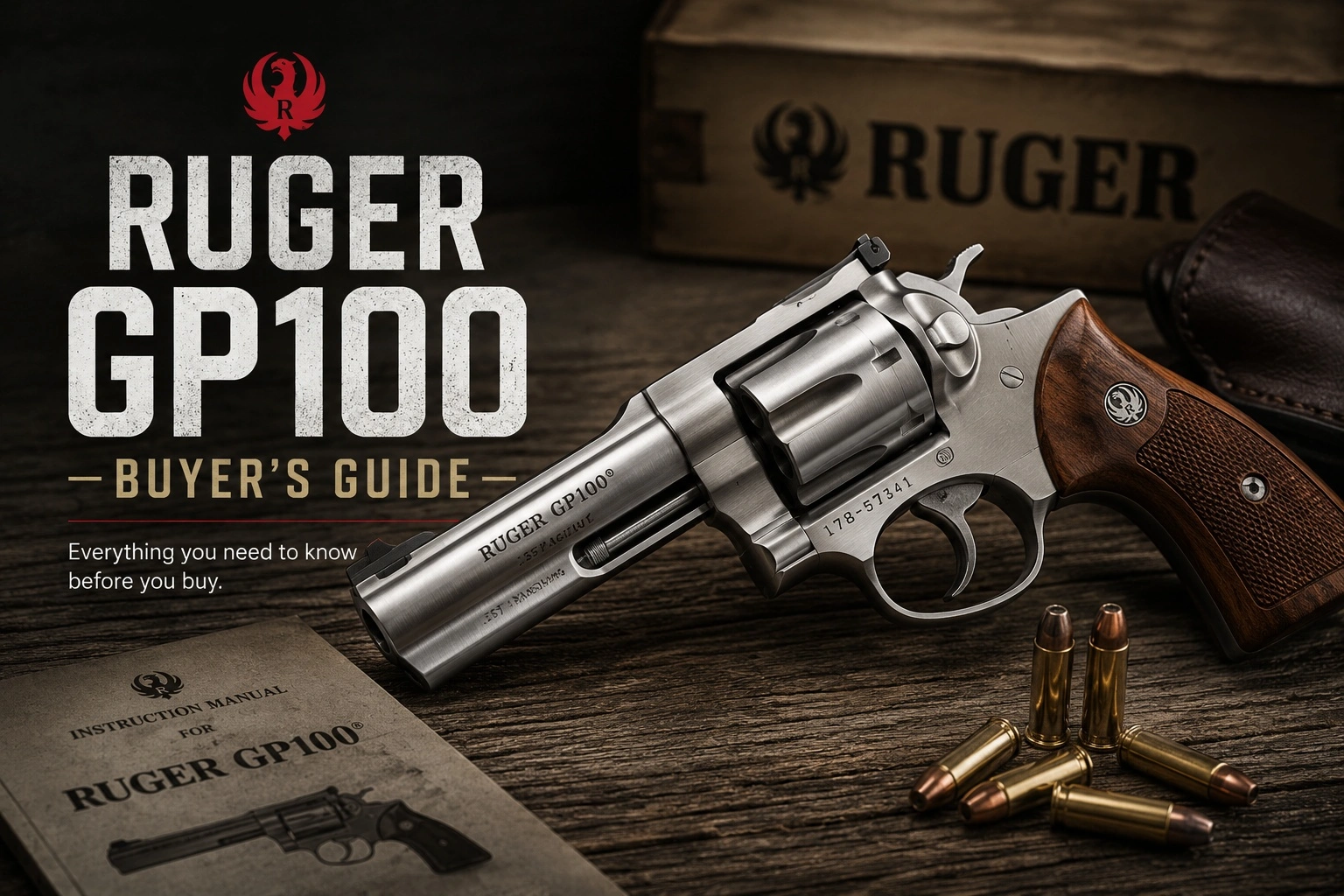
Ruger GP100 Buyer's Guide: Models, Prices & Problems
Compare GP100 variants and prices, learn the common problem areas, and use the inspection checklist before buying a new or used revolver.
By Greg Cook · Collector Reference · Updated September 2026
Why the GP100?
The Ruger GP100 is a strong choice for a durable double-action revolver, but the right price depends on the exact model, caliber, barrel length, condition and whether it is a standard or distributor-exclusive configuration.
- Best all-around choice: a standard .357 Magnum model in original condition with correct timing and tight lockup.
- Inspect first: cylinder gap and endshake, forcing cone, timing, ejector function, barrel alignment and undisclosed action work.
- Verify before paying a premium: model number, serial-number range, caliber, barrel length, sights, grips and distributor-exclusive features.
When Ruger introduced the GP100 in 1986, it was a deliberate engineering response to a question the company had lived with for over a decade: could the Security Six platform truly sustain unlimited .357 Magnum use without reservation? The answer, internally, was "not quite." The GP100 addressed every concern — a heavier, more rigid frame with thicker cylinder walls, a triple-locking cylinder that engaged at the front, rear, and bottom for absolute lockup, and a completely redesigned modular peg grip system that eliminated the integral grip frame of the Security Six. The result was a revolver purpose-built for shooters who fed their guns a steady diet of full-power Magnum ammunition without apology.
In the four decades since its introduction, the GP100 has earned a reputation as one of the strongest double-action revolvers ever manufactured. It is routinely cited alongside the Smith & Wesson L-frame (Models 586 and 686) as the benchmark for the modern .357 Magnum DA revolver. Where the S&W L-frame is praised for its refined trigger and aesthetics, the GP100 is respected for its sheer structural overbuilt quality — a revolver that can digest tens of thousands of rounds of full-power .357 Magnum without meaningful wear to the frame or lockup. For shooters who value durability above all else, it is the default answer.
The buying landscape for the GP100 in 2026 is remarkably broad. The model is still in active production in multiple configurations — standard blued and stainless, the refined Wiley Clapp series, the polished Match Champion, and specialty caliber variants in .327 Federal Magnum, 10mm Auto, .44 Special, and .22 LR. Add distributor exclusives from TALO, Lipsey's, and Davidson's, and the catalog of GP100 variants extends to dozens of distinct configurations. Before you hand over money for any GP100 — new or used — understanding exactly which variant you're looking at is essential. The price difference between a standard 4.2" stainless and a Lipsey's exclusive .44 Special can be hundreds of dollars.
One factor that sets the GP100 apart in the used market is Ruger's legendary customer service program. Sturm, Ruger & Co. will repair virtually any GP100 at no charge — even on second-hand purchases, even on guns decades old. Bill Ruger's original philosophy was that it was cheaper to simply fix problems than maintain warranty bureaucracy, and that ethos persists. Knowing this policy exists means that a GP100 with a minor timing issue or excessive cylinder gap is not a deal-breaker — it's a Ruger service call away from being factory-correct. But knowing what you're getting before you buy prevents weeks of downtime and shipping hassle.
Before evaluating a particular revolver, use the Ruger Revolver Hub to place the GP100 within Ruger's double-action timeline, then check its approximate ship year with the Ruger serial-number lookup app. This buyer's guide should be used for the next step: confirming the exact variant, inspecting condition and function, and deciding whether the asking price fits the revolver in front of you.
- Type: Double-action / single-action revolver
- Introduced: 1986 (serial prefix 170-XXXXX)
- Still in production: Yes — multiple active variants
- Calibers: .357 Magnum / .38 Special (primary); .327 Fed Mag, 10mm Auto, .44 Special, .22 LR (specialty models)
- Cylinder capacity: 6-shot standard; 7-shot (.327 Fed Mag, some .357 variants); 10-shot (.22 LR)
- Frame: Stainless steel or blued carbon steel; triple-locking cylinder
- Barrel lengths: 2.5", 3", 4.2", 5", 6" depending on model
- Ruger Service: 336-949-5200 · Newport, NH
Know What You're Buying — GP100 Variants Explained
The GP100 line has expanded dramatically since 1986. What started as a single blued .357 Magnum revolver now encompasses over a dozen distinct production models and dozens more distributor exclusives from TALO, Lipsey's, and Davidson's. Each variant carries its own market value, accessory compatibility profile, and set of characteristics that affect what a reasonable inspection looks like. Knowing the variant before you buy determines whether you're paying a fair price or overpaying for a standard model mislabeled as something premium.
| Variant | Model # | Caliber | Barrel | Finish | Notes |
|---|---|---|---|---|---|
| Standard GP100 | 1704/1705/1707/1715 | .357 Mag | 3", 4.2", 6" | Blued or Stainless | Workhorse; Hogue monogrip; most common on used market |
| Stainless GP100 | 1707 series | .357 Mag | 4.2", 6" | Satin Stainless | KGP prefix serials; highly durable; strong resale |
| 7-Shot .357 | 1771/1772 | .357 Mag | 4.2" | Stainless | Larger cylinder; hardwood grip insert; newer production |
| Wiley Clapp GP100 | 1751/1752/1753 | .357 Mag | 3" | Matte Blue / Matte SS | Novak dovetail sights; contoured cylinder; melted edges; Altamont laminate grips |
| Match Champion | 1754/1755/1775 | .357 Mag / 10mm | 4.2" | Stainless | Half-lug barrel; 11° target crown; Hogue stippled hardwood; polished internals; centering shims |
| GP100 .22 LR | 1757 | .22 LR | 5.5" | Stainless | 10-shot cylinder; rimfire variant; different collector profile |
| GP100 .327 Fed Mag | 1769 series | .327 Fed Mag | 5" | Stainless | 7-shot; Lipsey's exclusive; growing collector interest |
| GP100 10mm | 1775/1780 | 10mm Auto | 3", 4.2" | Stainless | Newest caliber offering; 6-shot; strong niche demand |
| GP100 .44 Special | 1770 | .44 Special | 5" | Stainless | 5-shot; Lipsey's exclusive; large-bore DA collector interest |
| TALO/Distributor Exclusives | Various | Various | Various | Various | Check model number against TALO/Lipsey's/Davidson's catalogs; verify before purchase |
Ruger's official history begins with serial 170-00001 in 1986; the 170 prefix continued through 1988. Later serial prefixes generally indicate later production, but Ruger notes that firearms are not always produced or shipped in serial-number order. Use the complete serial number—not the prefix alone—for an approximate ship year.
| Prefix | Years | Notes |
|---|---|---|
| 170-XXXXX | 1986–1988 | Earliest production range; verify the full serial against Ruger's table |
| 171-XXXXX | 1989 | 1989 production range |
| 172-XXXXX | 1990–1993 | Mid-early production |
| 173-XXXXX | 1994–2000 | Heavy production years |
| 174-XXXXX | 2001–2005 | Modern production begins |
| 175-XXXXX | 2006–2010 | Variant expansion era |
| 176-XXXXX | 2011–2014 | Match Champion / specialty era |
| 177-XXXXX | 2015–Present | Current production |
Fair Market Price Guide (July 2026)
GP100 prices vary significantly by condition, variant, caliber, and whether the gun is new, unfired, or used. The following ranges represent realistic private-party and dealer prices based on current market conditions. MSRP from Ruger is noted for reference — street price is typically 10–15% below MSRP for standard models. Distributor exclusives and discontinued variants command premiums that can exceed MSRP significantly on the secondary market.
| Model / Variant | Condition | Price Range | Notes |
|---|---|---|---|
| Standard GP100 4.2" Blued | New | $850–$950 | Street price below MSRP $1,029 |
| Standard GP100 4.2" Stainless | New | $900–$1,000 | Slight premium over blued |
| Standard GP100 (any barrel) | Excellent Used | $650–$799 | Minimal wear, original grips |
| Standard GP100 (any barrel) | Very Good Used | $500–$649 | Light holster/handling wear |
| Standard GP100 (any barrel) | Good Used | $400–$499 | Visible wear; functional; re-blued lowers value |
| Wiley Clapp 3" | New/Unfired | $950–$1,100 | Premium for Novak sights and contoured cylinder |
| Match Champion | New | $1,100–$1,299 | MSRP $1,299; polished internals worth premium |
| GP100 .22 LR | New | $950–$1,100 | Rimfire variant; separate collector market |
| GP100 .327 Fed Mag (Lipsey's) | New/Used | $1,000–$1,200 | Distributor exclusive; limited availability |
| GP100 10mm | New | $1,000–$1,200 | Newest offering; growing demand |
| GP100 .44 Special (Lipsey's) | New/Used | $1,000–$1,300 | 5-shot; very limited production |
| Early Production 170-XXXXX (1986–88) | Excellent | $800–$1,100+ | Collector premium depends on full serial, configuration and condition |
| Early Production 170-XXXXX (1986–88) | Very Good | $650–$799 | Verify the complete serial and original configuration |
Re-bluing or refinishing a GP100 eliminates the collector premium and reduces resale value by 25–40%. Always ask whether the finish is original. Polished forcing cones, replaced grips, or spring kits do not significantly affect value but should be disclosed.
What to Inspect Before You Buy
A systematic 6-point inspection — in person and from photographs
Whether buying at a gun show, from a dealer, or online, a systematic inspection catches problems before money changes hands. The GP100 is a robust revolver, but high-round-count guns, neglected cylinders, and forcing cone erosion are real concerns on the used market. Here is what to check — in order of importance.
Cylinder Gap
The cylinder gap — the space between the front face of the cylinder and the rear of the barrel — should measure between 0.004" and 0.008" for optimal function. A gap above 0.010" indicates cylinder endshake or wear and may cause gas leakage and accuracy degradation. Factory spec per Ruger is up to 0.010", but experienced shooters consider anything above 0.007" worth negotiating on or having Ruger service. Use a feeler gauge set. You can eyeball an excessive gap as visible light between cylinder and barrel — not acceptable.
Forcing Cone Condition
The forcing cone is the tapered section at the rear of the barrel where the bullet transitions from cylinder to bore. Look directly down the barrel with a flashlight (cylinder open, gun unloaded). The forcing cone should be smooth and symmetrical with no cracks, erosion pits, or lead buildup. Cracked forcing cones do occur — usually from sustained heavy .357 Magnum use with lead bullets or neglected cleaning. A cracked forcing cone requires a new barrel from Ruger. Lead buildup in the forcing cone dramatically raises chamber pressure and can cause cracks. Inspect for lead fouling as a use indicator.
Cylinder Timing and Lockup
With the gun unloaded, slowly pull the trigger in double-action through each of the six positions and watch the cylinder. The cylinder bolt should drop into the cylinder notch and lock positively before or as the hammer falls — not after. Loose or late lockup indicates timing issues, wear on the cylinder bolt, or a worn cylinder stop. Test cylinder side-play: with the action closed, grasp the cylinder and try to rock it laterally. Minimal play is acceptable; noticeable slop is not. Also check for cylinder endshake by pushing the cylinder forward and backward — it should be minimal. Ruger will fix timing issues under their warranty/service program.
Crane Alignment and Cylinder Release
Open the cylinder and examine the crane — the arm that swings the cylinder out of the frame. It should align perfectly with the frame when closed, with no wobble or lateral play. A bent or worn crane causes cylinder misalignment and accuracy problems. Operate the cylinder release button: it should move smoothly and return crisply. A sticky or gritty release indicates debris or a worn plunger spring. The ejector rod should be straight — a bent ejector rod causes binding during ejection and is a sign of rough handling or a drop.
Trigger Pull and Action Quality
The GP100's stock double-action trigger pull is typically 10–12 lbs from the factory — heavy by competition standards but smooth. Run the trigger in both DA and SA. DA should feel progressive and smooth with no grinding, gritty stages, or catch-and-release hitches. SA pull should be crisp with a clean break and minimal overtravel. Aftermarket spring kits (Wolff, Power Custom) are common on used GP100s — ask the seller. A properly installed spring kit is a positive modification; a poorly done trigger job (excessive stone work, removed material) is not. Listen for any unusual sounds during cycling.
Finish, Frame, and Overall Condition
Examine the finish carefully. Original Ruger blue shows as a deep, even blue-black with consistent sheen. Re-blued guns typically show rounded edges (sharp edges lose definition in the polishing process), overly uniform appearance on previously worn areas, and sometimes blue inside screw slots. Stainless models should show consistent brushed finish without polishing marks or rust staining. Check all screw heads — unmarred slots indicate light use. Screwdriver marks indicate amateur disassembly. Inspect the top strap above the cylinder for erosion (dark staining or pitting from gas cutting — common on high-mileage guns shooting heavy .357 loads).
Known Issues and Ruger's Warranty Program
The GP100 has an excellent reputation for durability, and Ruger's service department is widely considered the best in the firearms industry — they will typically repair any issue at no charge, even on guns well outside any warranty period, and even on second-hand purchases. That said, understanding the known failure modes helps set expectations and informs your pre-purchase inspection.
Forcing Cone Cracking
UncommonThe most serious GP100 failure mode — the forcing cone cracks, usually from sustained heavy .357 Magnum use with lead bullets, or from severe lead buildup that elevates chamber pressure. Requires full barrel replacement from Ruger. Ruger has been known to cover this repair at no charge even on used/second-hand guns. Prevention: keep the forcing cone clean and use jacketed or plated bullets for sustained magnum shooting.
Cylinder Binding After Firing
UncommonCylinder binds or stiffens after shooting — typically caused by carbon buildup under the ejector star or a slightly out-of-spec cylinder. Thorough cleaning (especially under the ejector star) resolves most cases. Persistent binding after cleaning indicates a crane or cylinder spec issue — Ruger service resolves quickly.
Cylinder Endshake / Excessive Gap
UncommonSome GP100s, particularly high-round-count examples, develop excessive endshake (cylinder moving forward/backward) and a widening cylinder gap. Ruger's service department adjusts endshake and gap as a routine repair. Factory spec allows up to 0.010" gap; experienced users prefer 0.004"–0.007".
Action Lock-Up (Mid-Rotation)
RareSome Match Champion and specialty GP100s have exhibited cylinder lock-up mid-rotation — cylinder rotates halfway and action stops. Cause: out-of-spec cylinder or timing components. Ruger service resolves; dealers have reported sending multiple units for the same issue in some production runs. Send directly to Ruger.
Heavy / Gritty Factory Trigger
Very CommonThe GP100's factory DA trigger pull (10–12 lbs) is heavy by modern standards. This is not a defect — it is by design for a duty-grade revolver. A Wolff spring kit (reduced power hammer and trigger return springs) is the near-universal first modification and dramatically improves the pull without affecting reliability. Budget $15–25 for the spring kit.
Hammer Drag on Frame
Uncommon (early)Some early GP100s exhibited the hammer dragging against the frame during cocking, creating a rough feel. Light polishing of the contact surfaces resolves this. A qualified gunsmith can address in under an hour. Less common on later production guns.
Ruger does not publish a formal warranty — Bill Ruger determined it was cheaper to simply fix problems than maintain warranty bureaucracy. In practice, Ruger will repair virtually any GP100 issue at no charge, including on second-hand purchases. Contact: 336-949-5200. Turnaround is typically 2–6 weeks. This policy is a significant factor in the GP100's strong resale value.
Pre-Purchase Inspection Checklist
Print or use on your phone at the gun show — tap items to check them off
Use this checklist before handing over money. Each item is clickable to mark complete. A clean checklist = a confident purchase.
In-Person Inspection — Cylinder
In-Person Inspection — Action
In-Person Inspection — Finish & Condition
Documentation & History
Buying a GP100 Online — What Changes
Photographs Are Your Inspector
Request left-side frame photos, right-side photos, muzzle-end (cylinder gap visible), forcing cone photo (barrel pointed at camera with flashlight), and DA trigger pull video. Any seller unwilling to provide these is a red flag.
Verify the Serial Number First
Ask for the full serial number before committing. Cross-reference it against the GP100 production chart on the Ruger Serial Number Hub to confirm the production year and verify it's a genuine GP100 (170–177 prefix) and not a Security Six (150–162 prefix) or other model.
Confirm the Variant by Model Number
The model number is stamped on the box and typically on the paperwork. Ask for it. A Wiley Clapp (1751/1752/1753) should be distinguishable from a standard 3" (1708/1715) by contoured cylinder, Novak dovetail sight cut, and melted edges. Don't pay Wiley Clapp prices for a standard 1708.
Original Box and Papers
Original box with matching serial number adds 5–10% to fair market value and confirms the gun hasn't been re-serialed or modified since factory. Not essential for a shooter-grade purchase but important for collector-grade buys.
GunBroker / Auction Pricing
GunBroker completed auction prices are the most accurate real-world market reference available. Search "GP100" in completed listings filtered by condition to calibrate your target price before bidding. Auction house premiums (typically 10–15% buyer's fee) should be factored into your bid ceiling.
Transfer to a Local FFL — Factor the Cost
Online GP100 purchases require FFL transfer — typically $25–$50. Factor this into your total cost. Use the FFL transfer appointment as your first hands-on inspection opportunity; most FFLs will allow you to inspect before completing the transfer paperwork.
GP100 vs. Security Six — Should You Buy New or Vintage?
The Security Six (1972–1988) was the GP100's predecessor and shares the same basic double-action revolver DNA. For many shooters and collectors the perennial question is: GP100 new or Security Six vintage? The answer depends on priorities. The GP100 wins decisively on frame strength, cylinder lockup engineering, parts availability, and the security of Ruger's full factory support infrastructure. The Security Six wins on slimmer profile, lighter weight (seven ounces lighter in a 4" configuration), smoother factory triggers on broken-in examples, and growing collector appreciation potential as a discontinued law enforcement heritage revolver.
If your primary intent is to shoot — frequently, with full-power .357 Magnum ammunition — the GP100 is the objectively better choice. If you want a characterful vintage Ruger revolver that carries lighter, points faster, and appreciates in value while you own it, the Security Six has strong appeal. Many serious Ruger collectors own both.
| Feature | GP100 | Security Six |
|---|---|---|
| Frame Strength | Heavier; rated for unlimited .357 Mag | Lighter; considered borderline for sustained .357 Mag |
| Cylinder Lockup | Triple-locking (front, rear, bottom) | Dual-locking |
| Grip System | Modular peg system; wide aftermarket | Integral grip frame; fewer aftermarket options |
| Weight (4" barrel) | ~40 oz | ~33 oz |
| Availability | New production; easy to find | Discontinued 1988; used market only |
| Parts & Service | Full Ruger support; parts available | Ruger still services; some parts scarce |
| Collector Appreciation | Moderate (still in production) | Growing; early production commands premium |
| Trigger (stock) | 10–12 lb DA (improvable) | Similar; often smoother after decades of use |
| Price New | $850–$1,299 | N/A (discontinued) |
| Price Used (Excellent) | $650–$799 | $400–$650 |
| Best For | Shooter, carry, reliability | Collector, lightweight carry, vintage appeal |
Buy a GP100 if you plan to shoot it hard and want full factory support. Consider a Security Six if you want a lighter revolver with collector upside and a connection to Ruger's law enforcement heritage.
Ruger Collector Research Cluster
Information on this page is provided for collector reference and identification purposes only. Production dates and serial number ranges are approximate. Physical inspection by a qualified gunsmith is recommended before purchase. For official documentation, contact Ruger's Service Department at 336-949-5200. Gun Collectors Club is an independent collector reference site and is not affiliated with Sturm, Ruger & Co., Inc. Always follow safe firearms handling practices — Old Model Blackhawks without the transfer bar conversion should be carried with the hammer resting on an empty chamber.
Related Guides & Resources
Full serial number charts and production timelines for GP100, Security Six, and Blackhawk.
Full GP100 production year chart (1986–2015) with prefix breakdown.
Barrel variations, finish options, and law enforcement contract models.
Flat-Top vs. Three-Screw vs. New Model — how to tell them apart in hand.
Ruger letter availability, factory-record limits, and documentation options.
How grading systems, originality, and condition affect collector value.