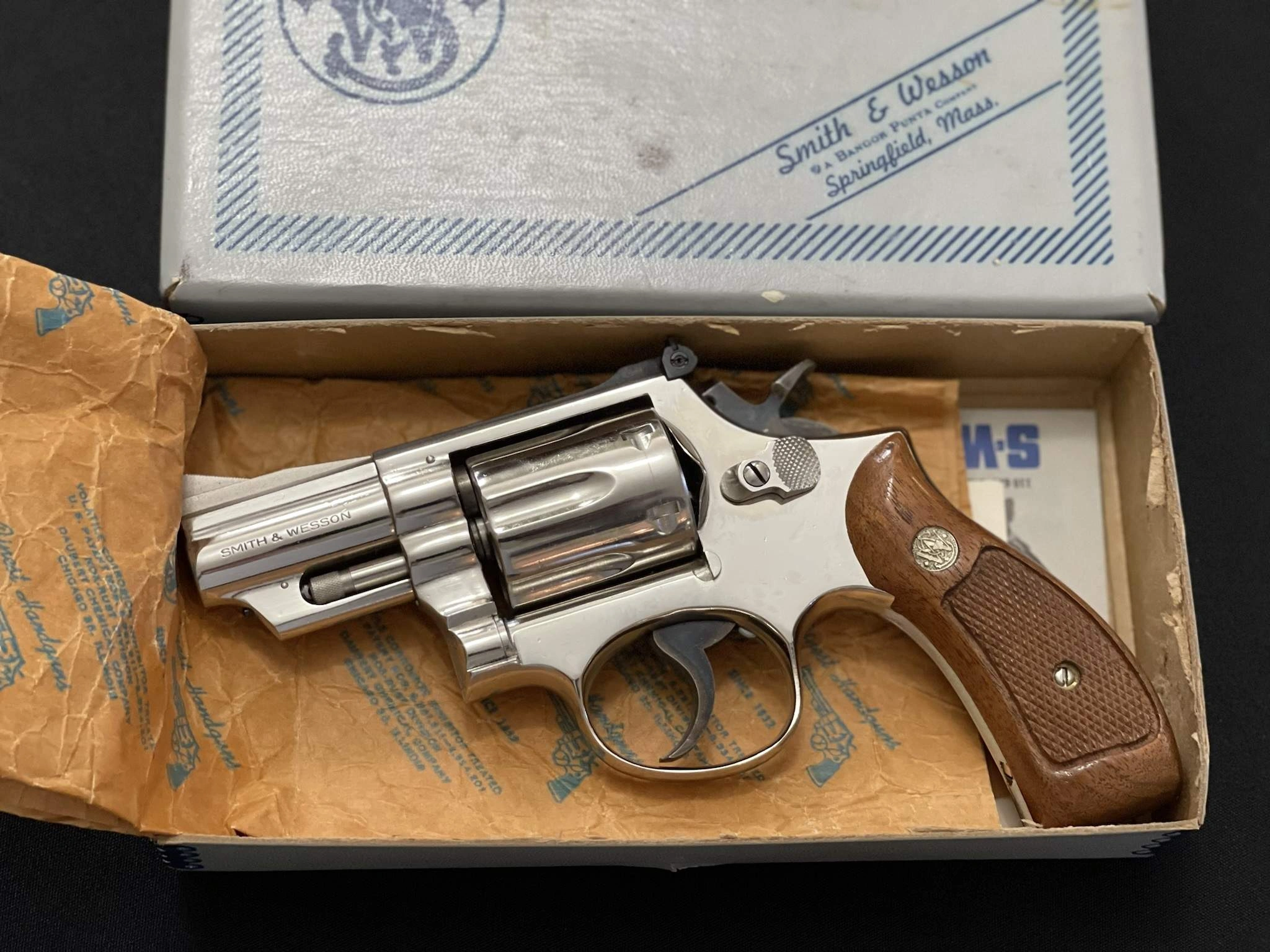
The Smith & Wesson Model 19 is one of the most searched and collected K-frame .357 revolvers. This page is meant to be the serial-number companion to the main Smith & Wesson .357 / Model 19 collector guide, with the serial-number and dash-number details pulled forward for quick research.
Serial-number dating should be treated as a starting point, not a factory record. A serial range can usually place a Model 19 into a production-year cluster, but a Smith & Wesson factory letter is the stronger tool when finish, barrel length, stocks, ship date, or destination matter to value.
If the revolver is the larger N-frame—or the yoke shows REG, MOD 27, MOD 28, or an unexplained number—use the Model 27 Markings Assistant, then compare the result with the Model 27 / Registered Magnum guide.
Serial Lookup Tool
Want a Fast Production-Date Check?
Use the Smith & Wesson K-Frame Lookup Tool for a quick comparison against Model 10, K-22, Model 17, Model 19, and related K-frame serial-number ranges.
Open K-Frame Lookup ToolWhere to Find the Model 19 Serial Number
On a vintage Model 19, look first at the bottom of the grip frame. Target stocks, oversized stocks, or replacement grips may cover the number, so the stocks often need to be removed for a clear photograph. Do not rely only on numbers visible in the yoke cut.
- Serial number: usually on the butt, stamped on the bottom of the grip frame.
- Model marking: usually inside the yoke cut, such as MOD. 19, MOD. 19-2, or MOD. 19-3.
- Assembly numbers: may appear on internal or yoke areas and should not be used for production dating.
- Box label: should be compared to the grip-frame serial number, barrel length, finish, and stock configuration.

Model 19 Production Timeline and Dash Numbers
The dash number is an engineering-change marker. It helps narrow the collector story, but it does not replace the serial number. A Model 19-3, for example, points to a known engineering era, while the serial number helps place the individual revolver into a closer production-year cluster.
| Model / Dash | Approximate Era | Collector Notes |
|---|---|---|
| Model 19 | 1957-1959 | Numbered model era begins after the earlier .357 Combat Magnum designation. |
| Model 19-1 | 1959-1961 | Early engineering-change period; verify features and stocks carefully. |
| Model 19-2 | 1961-1967 | Important early-1960s and mid-1960s collector period; diamond stocks may appear on earlier examples. |
| Model 19-3 | 1967-1977 | One of the most collected vintage Model 19 variations; common in 2 1/2, 4, and 6 inch barrel lengths. |
| Model 19-4 | 1977-1982 | Late pinned-and-recessed period before the major 1982 change. |
| Model 19-5 | 1982-1988 | Change associated with the end of the pinned barrel and recessed cylinder era. |
| Model 19-6 | 1988-1994 | Later classic-production period with additional manufacturing changes. |
| Model 19-7 | 1994-1999 | Late original-production examples before the classic Model 19 line left the catalog. |
| Model 19 Classic | 2018-present | Modern reintroduction; useful as a shooter, but a different collector category from vintage pinned-and-recessed revolvers. |
Smith & Wesson Model 19 Serial Number Dates
The Model 19 belongs to the larger K-frame serial-number family. Early guns use the traditional K-prefix sequence, while 1970s guns move into 1K, 2K, 3K, and later numbered K-prefix clusters. The table below is intended as a collector working guide for production-year orientation.
| Year / Era | Serial-Number Clue | Collector Note |
|---|---|---|
| 1957 | Approx. K260000 range | Numbered Model 19 era begins. Earlier Combat Magnum examples may be marked differently. |
| 1958 | Approx. K290000 range | Early post-numbering K-frame .357 production. |
| 1959 | Approx. K320000 range | Transition into early 19-1 period; verify dash marking. |
| 1960 | Approx. K350000 range | Early 1960s K-prefix production. |
| 1961 | Approx. K390000 range | Model 19-2 era begins around this period. |
| 1962 | Approx. K430000 range | Check original stocks, finish, and barrel length. |
| 1963 | Approx. K460000 range | Mid-1960s K-frame collector range. |
| 1964 | Approx. K500000 range | Useful anchor for mid-1960s Model 19 examples. |
| 1965 | Approx. K550000 range | Late diamond-stock era may be relevant depending on the individual gun. |
| 1966 | Approx. K600000 range | Pre-19-3 transition period. |
| 1967 | Approx. K700000 range | Model 19-3 engineering-change period begins. |
| 1968 | Approx. K779163 and later | End of diamond-center grip inserts is a key collector transition. |
| 1969 | Approaching K999999 | End of traditional high K-prefix sequence before the numbered K-prefix clusters. |
| 1970 | 1K1 to 1K39500; 2K1 to 2K22037 | Early numbered K-prefix clusters. |
| 1971 | 1K39501 to 1K99999; 2K22038 to 2K55996; 3K1 to 3K31279 | Useful for early 1970s Model 19-3 dating. |
| 1972 | 2K55997 to 2K99999; 3K31280 to 3K99999; 4K1 to 4K1627; 5K1 to 5K6616 | Featured 19-3 examples commonly fall into this collector period. |
| 1973 | 4K1628 to 4K54104; 5K6617 to 5K73962 | Continued 19-3 production with strong collector interest. |
| 1974 | 5K73963 and later 1970s K-prefix clusters | Compare against the full K-frame master table for tighter placement. |
| 1975 | 7K-prefix clusters | Mid-1970s Model 19-3 examples; document condition and configuration. |
| 1976 | 9K-prefix clusters | Late Model 19-3 era; boxed examples are desirable. |
| 1977 | Late 9K / early 25K-style clusters | Transition from 19-3 to 19-4 period. |
| 1978-1981 | Later numbered K-prefix clusters | Model 19-4 period; still within the pinned-and-recessed collector era. |
| 1982-1988 | Three-letter S&W prefix era begins across production | Model 19-5 period; no longer the classic pinned-and-recessed configuration. |
| 1988-1994 | Later three-letter prefixes | Model 19-6 era. Values depend heavily on condition, originality, and configuration. |
| 1994-1999 | Late three-letter prefixes | Model 19-7 and final original-production period before discontinuation. |
Pinned and Recessed Model 19 Revolvers
Collectors often use the phrase pinned and recessed when discussing older Smith & Wesson magnums. A pinned barrel has a visible frame pin retaining the barrel. A recessed cylinder has counterbored chambers so the cartridge rims sit flush. On vintage Model 19 revolvers, these details are part of the old-school collector appeal.
The 1982 Model 19-5 change is the major line collectors remember because it marks the end of the pinned-barrel and recessed-cylinder era for the Model 19. Earlier examples, especially clean 19-2, 19-3, and 19-4 revolvers, often receive more collector attention when finish, stocks, box, and papers are correct.
Dating a 1970s Model 19-3
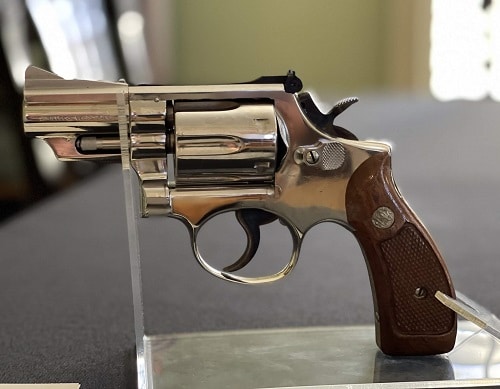
A 1970s Model 19-3 should be documented as a package. Photograph the butt serial number, yoke model marking, barrel markings, cylinder face, stocks, box label, tools, papers, and any factory-letter material. The more those details agree, the stronger the collector case.
- Check the butt serial: remove the stocks if necessary and photograph the full serial number.
- Check the yoke cut: confirm the model and dash number, but do not confuse it with the serial number.
- Check the finish: original blue and original nickel are valued differently from refinished examples.
- Check the stocks: round-butt and square-butt guns require different stocks, and era-correct stocks matter.
- Check the box: a matching end label can support barrel length, finish, and catalog configuration.
- Consider a letter: premium or unusual examples deserve factory-letter research.
Model 19 Configuration Notes
The same serial-number range can contain very different collector guns. A 4-inch blue duty revolver, a 2 1/2-inch nickel snub, and a 6-inch target-style example may all date from the same broad era, but their collector appeal and value factors are not identical.
| Configuration | What Collectors Watch |
|---|---|
| 2 1/2-inch barrel | Strong snub-nose collector demand, especially with original nickel, correct round-butt stocks, box, and papers. |
| 4-inch barrel | The classic Combat Magnum duty configuration. Condition, agency history, and originality matter. |
| 6-inch barrel | Target and sporting appeal. Exceptional finish and correct stocks can make a major difference. |
| Blue finish | Traditional S&W appearance. Watch for muzzle wear, cylinder turn line, and signs of refinishing. |
| Nickel finish | Very desirable when original and clean. Flaking, clouding, or buffed markings hurt collector value. |
| Box and papers | Major value factor when the label matches the revolver's serial number, finish, barrel length, and stocks. |
Smith & Wesson
1972 Model 19-3 Photo Gallery
The photos on this page are retained from the Smith & Wesson .357 collector guide so the new serial-number page has visual support from day one. They can be replaced later with tighter serial-number, yoke-marking, box-label, and detail photographs.
S&W 19-3 Photo Gallery
Photo Notes


From My Library
For readers researching Smith & Wesson history and production changes, the original S&W .357 page highlighted History of Smith & Wesson by Roy Jinks as a useful hardcover reference.
History of Smith & WessonAs an Amazon Associate I earn from qualifying purchases. I only link to products, books, tools, and accessories that fit the editorial purpose of Gun Collectors Club.
Collector Resources
Collector Tools & Supplies
Serious collectors rely on a few basic tools to inspect, document, preserve, and store collectible firearms. These internal guides cover the supplies most useful for research, safe storage, photography, and collection records.
Continue Through the Smith & Wesson Cluster
This page is part of the Gun Collectors Club Smith & Wesson research cluster. Use these companion pages to move between company history, serial-number dating, Model 10 variants, K-22 target revolvers, magnum duty guns, galleries, and modern S&W arms.
Hub & serial research
Model 19 research
- Model 19 Serial Number Dates
- S&W .357 / Model 19 Collector Guide
- Model 19 Dash Number Guide
- Model 19-3 Photo Gallery
K-22 / Model 17 target revolvers
Magnum, duty & J-frame revolvers
Modern S&W arms & accessories

About Greg Cook
Greg Cook writes about firearms collecting, personal history, and the stories behind interesting guns. His Army MOS was 76Y, Unit Armorer, and he brings that practical background to his collector articles.
Research Sources Consulted
This page was built as a serial-number companion to the Smith & Wesson .357 / Model 19 collector guide and should be checked against factory-letter documentation for premium examples.
- Supica, Jim and Richard Nahas. Standard Catalog of Smith & Wesson.
- Jinks, Roy G. History of Smith & Wesson.
- Smith & Wesson Historical Foundation: serial-number guidance
- Smith & Wesson Historical Foundation: factory letters
- American Rifleman: The Smith & Wesson Model 19
- Smith & Wesson: A Testament to the Model 19
- Author observations, collection notes, and comparison with known Model 19-3 examples.