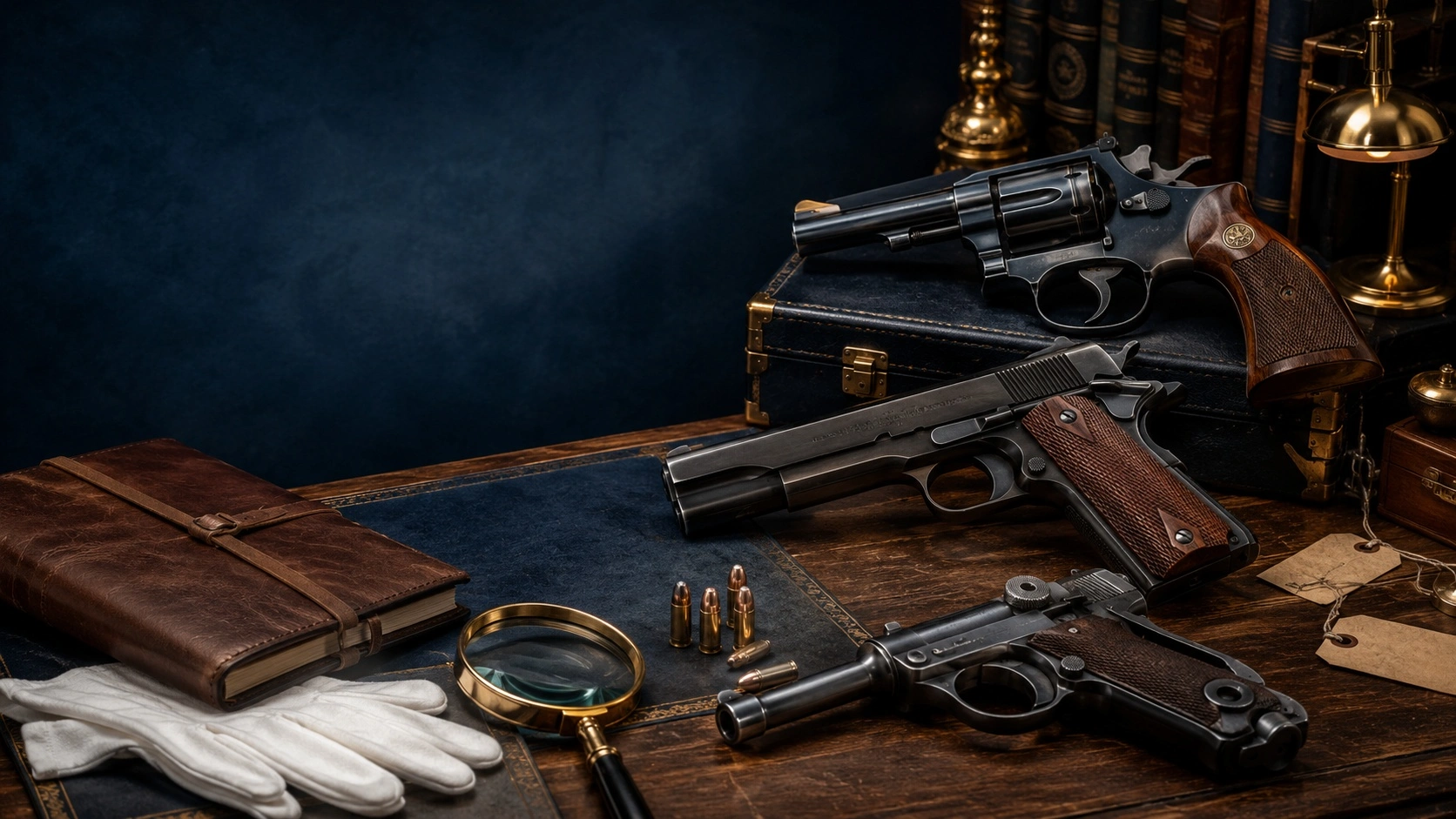
Handgun collecting starts with curiosity, but it becomes rewarding when you build a system. The goal is not to chase every attractive pistol or revolver you see. The goal is to understand why a specific handgun matters, how original it is, how to document it, and where it fits in the larger story of American, European, military, police, sporting and target-pistol history.
This page is written for collectors and enthusiasts. It is not legal advice, investment advice, a self-defense guide, or a substitute for checking current federal, state and local rules. Always follow applicable laws and safe handling practices, and work through qualified dealers, appraisers, museums, gunsmiths and legal professionals when the situation calls for it.
Handgun Collecting Roadmap at a Glance
A strong collection usually follows four principles: choose a narrow lane, buy the best condition you can justify, document every detail, and preserve originality before making changes. That sounds simple, but it separates a pile of handguns from a collection future buyers, heirs, historians or fellow collectors can understand.
Start with one maker, model family, era or purpose instead of collecting everything at once.
Finish, grips, screws, bore, markings and matching parts often matter more than excitement.
Serial-number notes, receipts, factory letters, boxes, manuals and photos become part of the gun.
For collectible examples, reversible care usually beats polishing, refinishing or accessorizing.
What Handgun Collecting Is, and What It Is Not
Handgun collecting is the study and preservation of pistols and revolvers because of history, engineering, craftsmanship, production context, rarity, condition, family provenance or cultural importance. A collector may enjoy range time, but a collection is judged by knowledge and stewardship, not just by ownership.
It is also easy to confuse collecting with accumulating. Accumulating means buying whatever looks interesting. Collecting means having a reason each handgun belongs. A beginner can own only three handguns and still have a better collection than someone with thirty random purchases if those three examples are researched, documented and tied together by a clear theme.
A handgun becomes more collectible when a future owner can answer three questions quickly: what is it, why does it matter, and how original is it?
Stage 1: Build the Foundation Before the First Purchase
The first stage is not model selection. It is responsibility. Before evaluating a Colt, Smith & Wesson, Browning, SIG Sauer, Ruger, Walther, Beretta, High Standard, Mauser, Luger, Remington Rand or U.S. military pistol, make sure your storage, records and legal awareness are ready.
Learn safe handling and secure storage
ATF’s safety guidance emphasizes safe handling, secure storage, keeping firearms unloaded when stored, locking firearms in a secure location, and keeping ammunition locked away from firearms when children are in the home. Those principles are basic, but they matter even more as a collection grows.
Know the legal environment before you shop
Handgun transfers, possession rules, magazine restrictions, age requirements, waiting periods, private-sale rules, estate transfers, shipping rules and C&R rules can vary by state and can change. Build the habit of checking current federal, state and local law before any acquisition, sale, trade, inheritance transfer or move across state lines.
Create a collection record from day one
Record the make, model, serial number, caliber, barrel length, finish, grips, accessories, acquisition date, source, purchase price, photographs and notes about condition. My Catalog & Inventory Systems guide is the natural companion to this roadmap.
Stage 2: Choose Your First Handgun Collecting Lane
The best lane is specific enough to study deeply but broad enough to keep you interested. A lane gives you comparison points. It teaches you what normal looks like, what scarce looks like, and what has been altered.
| Collecting Lane | Good Beginner Focus | Why It Works | Internal Research Links |
|---|---|---|---|
| Classic Colt revolvers | Python, Cobra, Detective Special and related production-era study. | Strong name recognition, deep finish and configuration differences, and useful serial-number research. | Colt Python Serial Numbers, Colt Python Guide, Colt Cobra, Detective Special |
| Smith & Wesson revolvers | K-frame target, duty and magnum revolvers. | Model changes, engineering changes, pinned barrels, recessed cylinders, target stocks and factory boxes all matter. | S&W K-22 Masterpiece, K-22 Series, S&W Model 19-3 |
| 1911 pistols | Government Model, military contract, commemorative and modern premium 1911 variants. | The platform has a century of military, target, custom, commercial and defensive-pistol history. | 1911 Series, Kimber Desert Warrior |
| Rimfire target pistols | Colt Woodsman, High Standard, Ruger Mark series and target-grade .22 pistols. | Great lane for learning finish, grips, boxes, barrel profiles, sights and production-era changes. | Colt Woodsman Match Target, Reference Books |
| Pocket pistols and vest-pocket guns | Baby Browning, Colt pocket autos, small Berettas and similar compact classics. | Small pistols reward close attention to finish, proofs, magazines, grips and import marks. | Baby Browning Serial Numbers, Semi-Automatic Pistols |
| Police trade-ins and duty pistols | Documented agency-marked revolvers and semi-autos. | Honest wear can be part of the story when agency history, markings and paperwork are preserved. | Revolver Guides, Semi-Auto Guides |
| C&R military handguns | Original-configuration pistols with clear age, markings and provenance. | Curio and relic status, matching numbers, proofs, import marks and holster/accessory sets become central. | Serial Number Guides, Research Library |
| Modern collectible handguns | Discontinued models, early production, limited editions, special finishes and complete factory packages. | Modern guns are common until the exact configuration, production story or accessory package makes one stand out. | Firearms Market Trends 2026, TAR-40 Series |
Stage 3: Learn Condition and Originality
Condition is more than “nice” or “rough.” It is the visible evidence of how the handgun has lived. Originality asks a separate question: how much of the handgun still matches the way it left the factory, arsenal, distributor or agency?
| Feature | What to Study | Collector Meaning |
|---|---|---|
| Finish | Original blue, nickel, parkerizing, anodizing, stainless finish, holster wear, freckling and refinish signs. | Original finish usually carries more collector weight than a prettier refinish. |
| Grips and stocks | Correct style, medallions, checkering, wear, repairs, matching numbers or factory fit. | Incorrect grips can be acceptable on a shooter, but they change the collector story. |
| Rollmarks, proofs and import marks | Manufacturer markings, address lines, proof marks, military stamps, agency marks and importer marks. | Markings can confirm production era, origin and sometimes value; damaged marks are a warning sign. |
| Serial numbers | Frame, slide, cylinder, barrel, magazine, grips, crate or box labels when applicable. | Matching or correct numbered parts can separate a collector-grade example from an assembled one. |
| Sights and small parts | Factory style, period-correct replacements, altered sights, non-factory screws and polished edges. | Small parts often reveal refinishing, repair or customization. |
| Box, papers and accessories | Original box, end label, manual, tools, spare magazines, holster, receipt and factory letter. | The complete package can matter as much as the handgun, especially for high-condition examples. |

Stage 4: Use Serial Numbers to Build Context
Serial numbers do not make a handgun collectible by themselves. They give the handgun a place in time. A serial-number table can help you estimate production year, identify engineering changes, recognize early or late examples, and understand whether the features on the gun fit the date range.
Use serial-number research with caution. Some manufacturers reused ranges, changed systems, shipped guns later than production date, or applied assembly numbers that are not the same as serial numbers. When value is meaningful, supplement public tables with factory letters, original invoices, manufacturer records, collector books and expert review.
Serial Number Research Path
Start with the Firearm Serial Number Guides hub, then narrow by maker and model. For handgun collectors, the strongest internal starting points include Colt Python, Colt Woodsman, Colt Detective Special, Baby Browning, Smith & Wesson K-22 and S&W Model 19-3.
Stage 5: Use a Collector Evaluation Checklist
A checklist slows you down. It keeps emotion from replacing research, especially at gun shows, estate sales, auctions, online listings and private collection viewings.
Handgun Collector Evaluation Checklist
- Confirm the transfer and possession rules that apply to your location and the seller’s location.
- Identify the exact make, model, variation, caliber, barrel length, finish and production era.
- Check whether visible features match the serial-number range and documented factory configuration.
- Look for refinishing signs, altered markings, rounded edges, mismatched parts and non-factory holes or sight work.
- Evaluate grips, magazines, boxes, manuals, tools, holsters and any end-label or paperwork match.
- Ask for clear photographs of both sides, markings, serial numbers, muzzle, grips, controls, box label and accessories.
- Compare completed-sale examples, not just optimistic asking prices.
- Budget for taxes, transfer fees, shipping, appraisal, insurance, storage and conservation supplies.
- Record the seller, date, price, condition notes and any representations made at the time of acquisition.
- Decide whether the handgun is collector-grade, shooter-grade, project-grade or simply outside your lane.
Stage 6: Understand C&R, Type 03 FFL and Legal Boundaries
Curio and relic rules matter to handgun collectors because many classic pistols and revolvers reach collectible age before they become rare. ATF describes C&R firearms as firearms of special collector interest because of a quality other than ordinary sporting, offensive or defensive use. ATF recognizes C&R firearms through age, museum certification, or substantial value tied to novelty, rarity, unusual character, or association with a historical figure, period or event.
ATF’s current C&R guidance says firearms automatically attain C&R status when they are at least 50 years old and in original configuration. That does not mean every older handgun is valuable, and it does not erase other federal, state or local rules. It simply means age and originality can change the legal and collecting context.
A Type 03 license is for collectors of curios and relics. ATF lists the Type 03 application fee and three-year renewal at $30 each, and ATF also states that a collector’s license does not authorize a collector to engage in the business of dealing firearms. Treat the license as a collector tool, not a business license.
Practical C&R Takeaway
Do not assume a handgun is C&R because the model is old. Verify the actual manufacture date, original configuration, markings, and any applicable state restrictions. A 50-year rule sounds simple, but details decide whether a specific handgun fits.
Stage 7: Build Inventory, Provenance and Insurance Records
Provenance is the story you can document. It may be a factory letter, a receipt, a veteran bring-back paper, an agency inventory marking, a family letter, a photograph, a shipping record, a box end label, a holster set or simply a well-kept chain of ownership. Keep paper and digital copies, and photograph the handgun before and after any conservation work.
For each collectible handgun, maintain a simple file: identification sheet, serial-number references, photographs, purchase paperwork, correspondence, appraisal notes, maintenance notes and storage location. That record protects your collection from confusion, insurance gaps and estate problems.
Stage 8: Preserve Before You Improve
Many collector losses happen with good intentions. A well-meaning owner polishes nickel, cold-blues a spot, replaces numbered grips, discards a worn box, throws away a damaged manual, or installs modern accessories on a handgun that was more valuable as found.
Preservation is not neglect. It means appropriate humidity control, secure storage, careful handling, non-destructive cleaning, good lighting for inspection, and avoiding changes that cannot be reversed. For more detail, pair this roadmap with Humidity & Rust Prevention, Long-Term Gun Storage, Cleaning Vintage Firearms and Gun Safe Accessories.
Stage 9: Understand Value Without Chasing Hype
Handgun values are not one market. A high-volume modern pistol, a pre-war target revolver, a boxed rimfire, a military sidearm, a rare finish variation and an agency-marked trade-in all behave differently. Value depends on the number of informed buyers watching that exact lane.
Use completed sales, dealer inventory, auction archives, specialty forums, collector books and direct comparison. Compare the same model, same configuration, similar condition, similar accessories and similar date range. Asking prices can show ambition; completed prices show where money actually changed hands.
A Python, 1911, Woodsman or K-frame still needs the right condition, originality and documentation.
Boxes, manuals, tools, receipts and labels often become part of the value story.
Honest holster wear, active rust, buffed markings and poor refinishing are very different problems.
Rare does not automatically mean valuable. The best lanes have both scarcity and an audience.
Stage 10: Move from Owner to Expert
Expertise is built through repeated comparison. Study dozens of examples before paying a premium for one. Read period catalogs, factory literature, collector books, old advertisements, auction descriptions, patents, museum notes and serial-number tables. Photograph your own examples carefully and write notes while the details are fresh.
At the expert level, the collection becomes a thesis. You are not just buying a handgun; you are explaining a period, a manufacturer, a technical change, a law-enforcement transition, a sporting culture, a target-shooting era, a military contract or a family story. That is where collecting becomes research.
A 90-Day Starter Plan for New Handgun Collectors
Choose one narrow area and list ten examples you want to study. Do not buy until you can explain the variations.
Gather books, factory literature, serial-number pages, completed auction examples and saved photographs.
Study original finish, grips, markings, screws, boxes and accessories across multiple examples.
Build a sample inventory sheet and practice documenting a handgun you already own or one you are evaluating.
Internal Case Studies to Study Next
Use these internal pages as working examples of how a collector page can connect model history, condition, serial-number research, production context and personal notes.
A strong revolver lane where barrel length, finish, production date, box and papers can change the story.
A broad semi-auto platform that rewards narrowing by era, maker, contract, configuration or purpose.
A rimfire target-pistol example where sights, barrel profile, grips and serial range matter.
A market-context page that shows how popularity, pricing, new releases and collector signals can be separated.
Handgun Collecting FAQ
What is the best first lane for a new handgun collector?
The best first lane is narrow enough to study carefully. Choose one maker, one model family, one era, or one purpose such as classic Colt revolvers, Smith & Wesson K-frames, 1911 pistols, rimfire target pistols, pocket pistols, police trade-ins or C&R military handguns.
What makes a handgun collectible?
Collector interest usually comes from condition, originality, production era, documented provenance, factory configuration, scarcity, historical importance, accessories, box and papers, and whether future collectors can clearly explain why the handgun matters.
Are modern handguns collectible?
Some are, but most modern high-volume handguns are practical firearms first. A modern handgun becomes more collectible when it has a meaningful variant, low production, special finish, early serial range, agency marking, factory package, discontinuation story or documented connection to a broader platform change.
Should I modify a collectible handgun?
For a collectible handgun, preserve first and modify last. Refinish work, non-factory sights, altered grips, replacement parts and polishing can reduce collector value. If the handgun is shooter-grade rather than collector-grade, the decision is different, but document changes clearly.
Does a Type 03 C&R FFL let me deal firearms?
No. ATF describes the Type 03 license as a collector license for curios and relics. It does not authorize the collector to engage in the business of dealing firearms.
How should I store collectible handguns?
Store them securely, control humidity, avoid foam and damp cases for long-term storage, keep ammunition appropriately secured, and preserve boxes and paperwork separately from anything that could stain, crush or absorb moisture. See the workshop links in the sidebar for storage, humidity and cleaning guides.
Collector Takeaway
The beginner-to-expert path is not about buying faster. It is about seeing more. Learn one lane, study condition, verify serial-number context, preserve documentation, avoid irreversible changes and write down what you learn. A well-documented five-handgun collection can be more serious than a crowded safe full of unexplained purchases.
From My Bench
If you are starting a handgun collection, the most useful gear is often boring: inventory sheets, reference books, humidity control, safe storage, good lighting, magnification, soft handling mats and a consistent photo setup.
Collector GearAs an Amazon Associate I earn from qualifying purchases. I only link to products, books, tools, and accessories that fit the editorial purpose of Gun Collectors Club.

About Greg Cook
Greg Cook writes about firearms collecting, personal history, and the stories behind interesting guns. His Army MOS was 76Y, Unit Armorer, and he brings that practical background to his collector articles.
Research Sources
These sources were used for legal, safety and collector-framework background. Laws and agency guidance can change, so use these links as starting points and verify current requirements before any transaction or transfer.