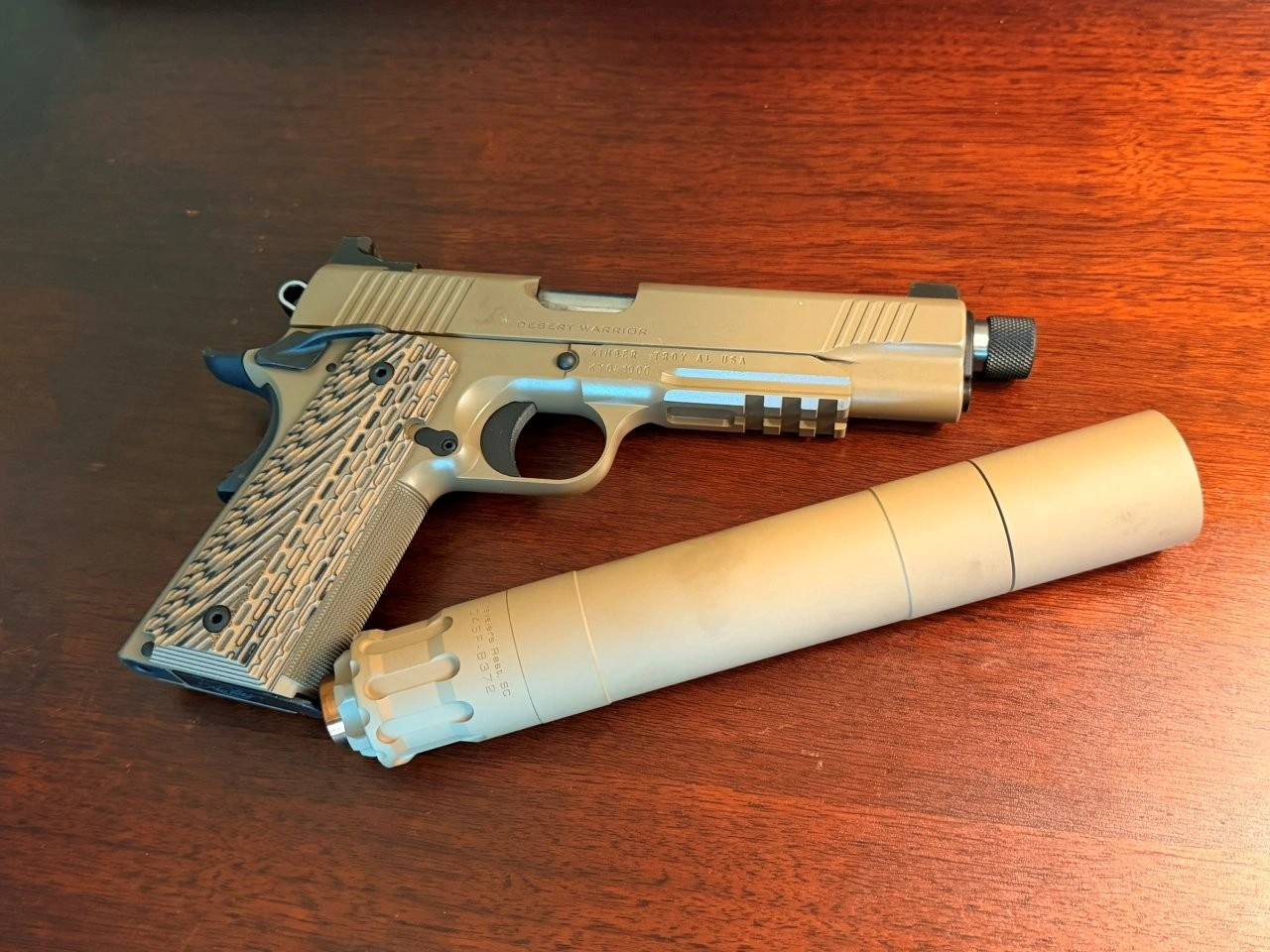
The Kimber Desert Warrior .45 ACP is a pistol with more than one story behind it. It is a modern fighting 1911. It is a suppressor-ready Government Model with desert-tone finish, aggressive grips, a rail, night sights, and the unmistakable feel of a full-size steel pistol. It is also a useful window into the modern history of Kimber, one of the companies most responsible for bringing custom-style 1911 features into the production market.
For me, the Desert Warrior carries an additional meaning. Kimber’s decision to establish its headquarters and major manufacturing operations in Troy, Alabama is what finally made me buy my first Kimber. I had admired Kimber pistols for years, but the Alabama connection changed the way I viewed the company. It gave the pistol a regional tie, a manufacturing story, and a reason to become part of my own collection.
That matters because collectors do not buy only steel, aluminum, checkering, and finish. We buy stories. We buy places. We buy company decisions, manufacturing eras, and the little details that make one example more personally meaningful than another. The Desert Warrior appealed to me first as a 1911, but it became compelling because Kimber had chosen Alabama.
Kimber Before the 1911 Boom
Kimber’s story did not begin with the Desert Warrior or even with the 1911 pistol. The company’s roots go back to Kimber of Oregon, a name associated with refined sporting rifles and a philosophy that blended modern production methods with traditional fit and finish. The early Kimber identity was not tactical. It was sporting, precise, and quality-conscious.
That background matters because Kimber’s later success with 1911 pistols was not built only on marketing. The company already understood the appeal of firearms that looked and felt carefully made. When Kimber entered the 1911 market, it brought that same sense of fit, finish, and upgraded presentation into a handgun category that was ready for reinvention.
By the 1990s, the commercial 1911 market was changing. Many shooters still loved the design, but they wanted factory pistols with features that had previously required a custom gunsmith. The classic Government Model remained beloved, but more serious users wanted beavertail grip safeties, better sights, lowered ejection ports, extended safeties, improved triggers, match barrels, and more refined ergonomics.
Kimber saw that demand and moved directly into it. The result was one of the most important production 1911 stories of the modern era.
How Kimber Helped Redefine the Production 1911
Before Kimber’s rise, a shooter who wanted a modernized 1911 often started with a basic pistol and then paid a gunsmith to make it right. That might mean new sights, a fitted beavertail, a trigger job, a match barrel, an extended thumb safety, a commander-style hammer, and cosmetic upgrades. The result could be excellent, but it required money, time, and knowledge.
Kimber helped make that path less necessary. The company offered pistols that came from the factory already equipped with many of the features serious shooters wanted. This was not a small shift. It changed customer expectations. Once buyers could get these features on a production gun, competing manufacturers had to respond.
Today, enhanced 1911s are common. In the 1990s and early 2000s, Kimber’s approach felt fresh. The company gave ordinary buyers access to a pistol that looked closer to a custom gun than a plain Government Model. It created a new middle ground between basic production pistols and high-dollar custom shop builds.
That is one reason Kimber remains important historically. Whether a collector personally prefers Kimber, Colt, Springfield Armory, Dan Wesson, Wilson Combat, Nighthawk, or another maker, Kimber’s influence on the modern 1911 market is impossible to ignore.
The Warrior Series and the Tactical 1911 Era
The Warrior line represents a different side of Kimber’s identity. These were not traditional presentation pistols with polished blue finish and double-diamond wood grips. The Warrior pistols belonged to the tactical era of the 1911, when rails, night sights, durable finishes, G10 grips, and hard-use configurations became part of the design language.
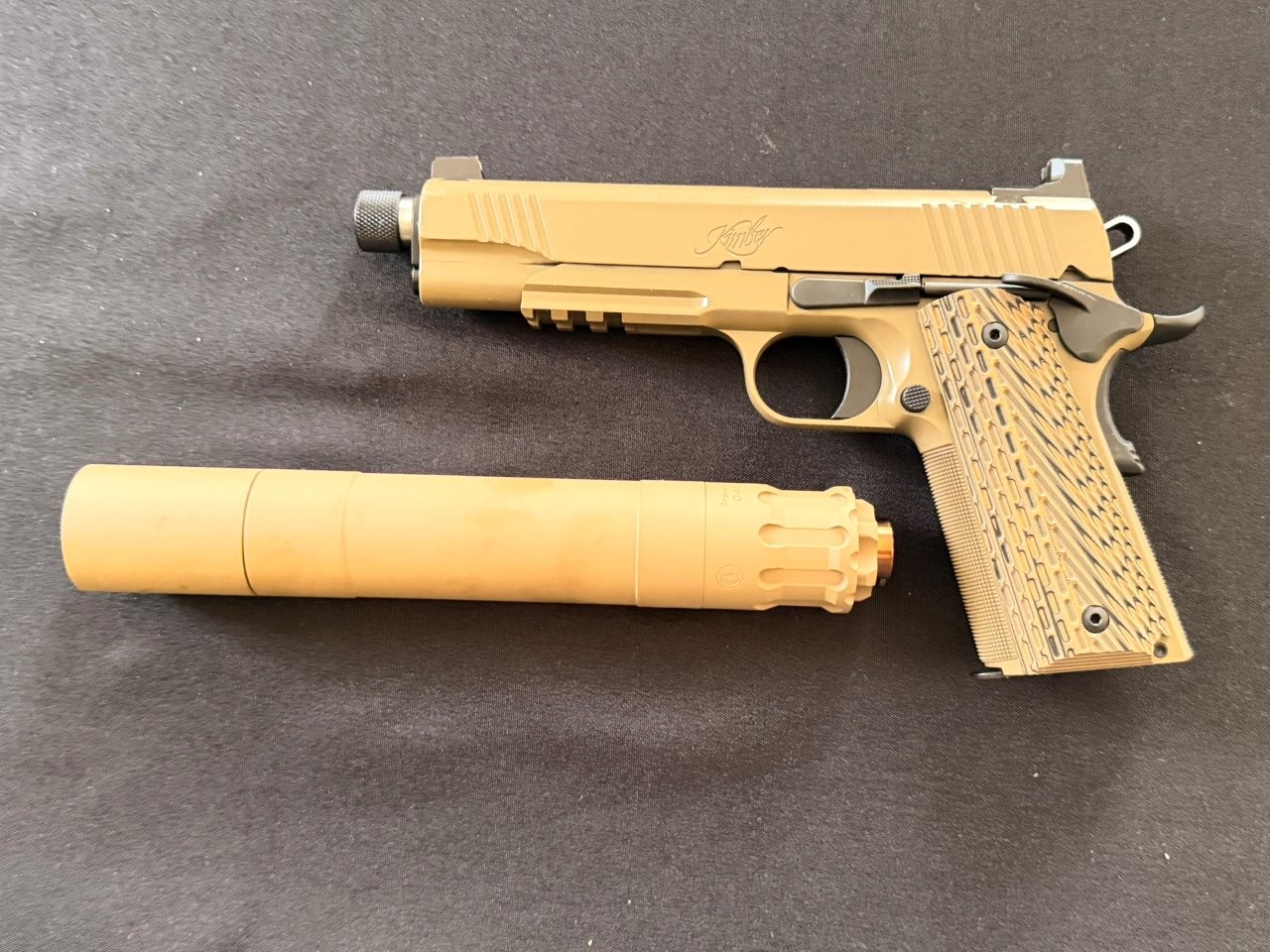
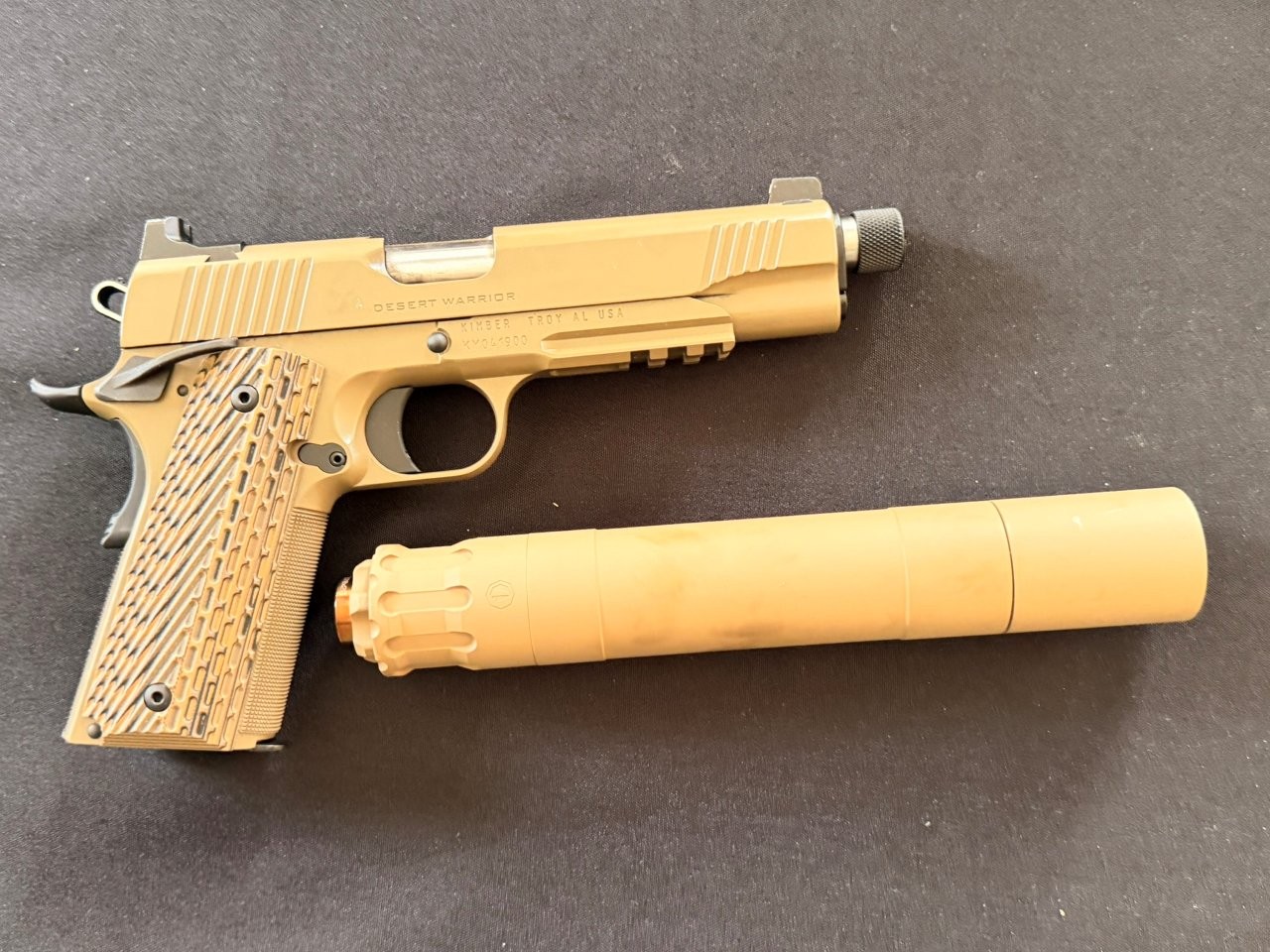
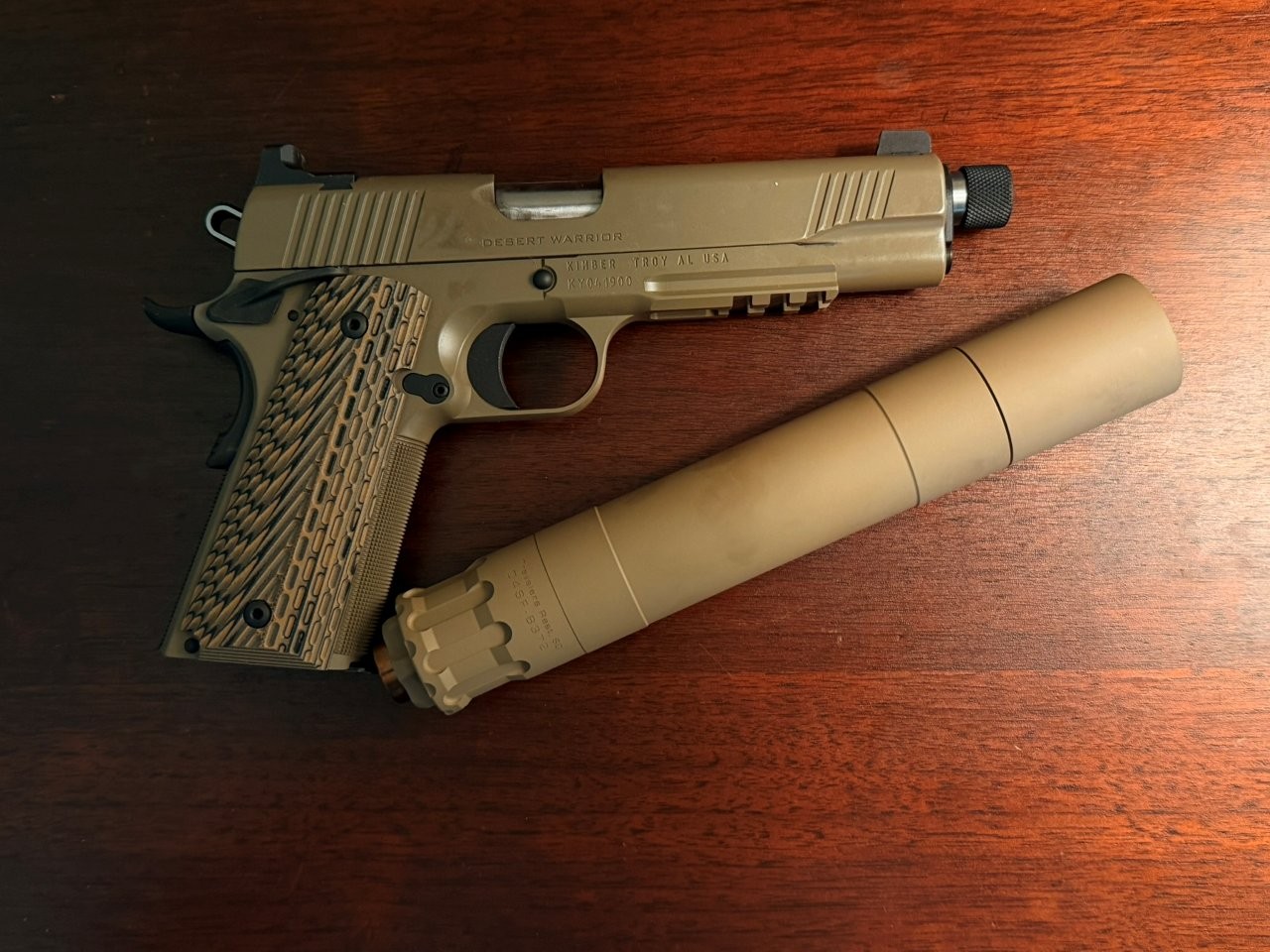
The Desert Warrior is one of the most recognizable examples. Its flat dark earth appearance, black controls, rail, threaded barrel, and aggressive grip pattern place it squarely in the post-9/11 tactical period. This is a 1911 that looks like it belongs with modern equipment rather than in a velvet-lined box.
That does not make it less collectible. In some ways, it makes it more interesting. Collectors often recognize the importance of military and police influence on earlier firearms, but the same principle applies to modern guns. The Desert Warrior reflects an era when civilian shooters, military imagery, law-enforcement equipment, suppressor ownership, and accessory-driven firearms culture began to overlap more visibly than ever before.
First Impressions of the Kimber Desert Warrior
The first thing the Desert Warrior communicates is purpose. The pistol does not look delicate. It does not look nostalgic. It looks like a fighting pistol built around a classic operating system.
The color is part of the appeal. The desert-tone finish gives the pistol a very different personality from a blued Colt or a stainless Gold Cup. The black controls break up the profile. The textured grips add visual depth. The threaded barrel gives the front of the pistol a modern mechanical presence even before a suppressor is attached.
In hand, the pistol still feels unmistakably like a 1911. That is important. Some modernized versions of classic designs lose too much of the original character. The Desert Warrior does not. It has tactical features, but the grip angle, trigger movement, thumb safety, slide profile, and natural pointability all remain pure 1911.
That combination is the heart of its appeal. It is modern without ceasing to be traditional.

The 1911 Platform
The 1911 survives because it continues to offer something shooters value. The design is old, but the experience remains compelling. The grip is slim. The trigger moves straight to the rear. The thumb safety is positive. The pistol points naturally. The .45 ACP chambering gives the gun a rhythm and character that feels different from polymer-framed 9mm pistols.
Modern handguns may be lighter, higher capacity, cheaper to manufacture, and easier to maintain. Those are real advantages. But a well-made 1911 still has a distinct mechanical feel. It is not merely a tool. It feels like a machine assembled around human hands.
The Desert Warrior preserves that feel while adding modern capability. The rail allows lights or accessories. The night sights make sense for defensive use. The threaded barrel opens the door to suppressor use. The aggressive grips help control the pistol under recoil. Yet beneath all of that, the pistol remains a single-action .45 built around one of the most enduring handgun designs in American history.
Suppressor-Ready Appeal
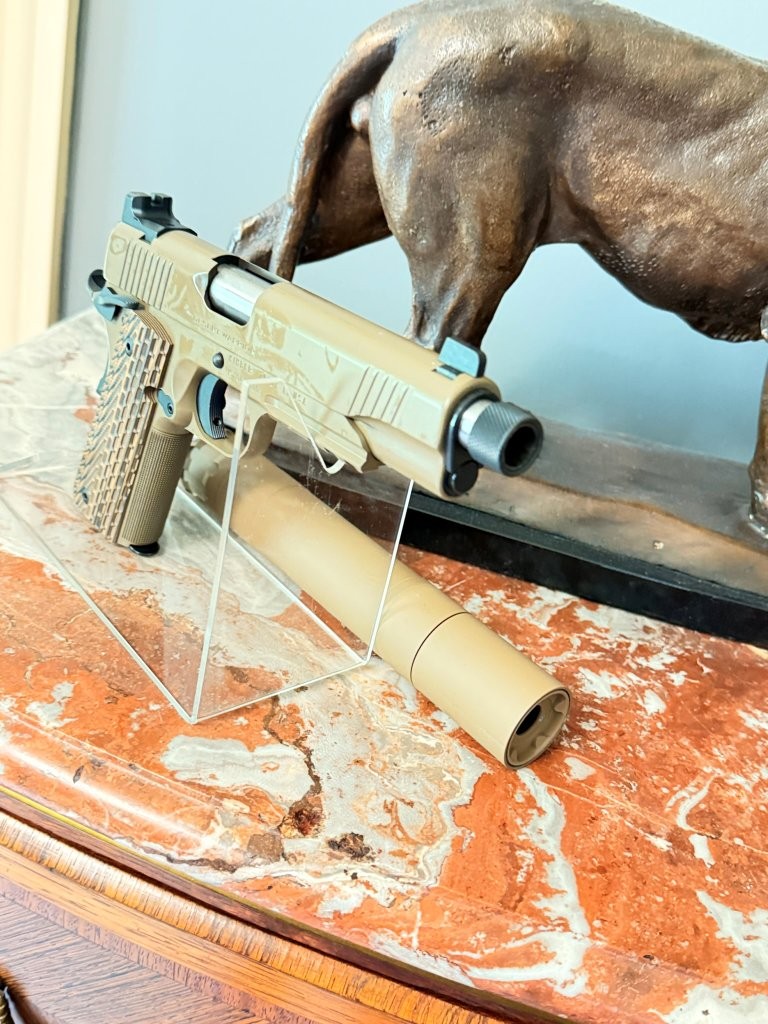
The threaded barrel may be the feature that most separates this pistol visually from a traditional Government Model. It changes the silhouette. It tells the viewer immediately that this is not simply a classic 1911 in a modern color.
Suppressor-ready pistols have become more common, but a threaded 1911 still has a particular charm. The .45 ACP cartridge has long been associated with suppressor use because standard-pressure loads are generally subsonic. That makes a suppressed .45 ACP pistol especially satisfying when properly configured.
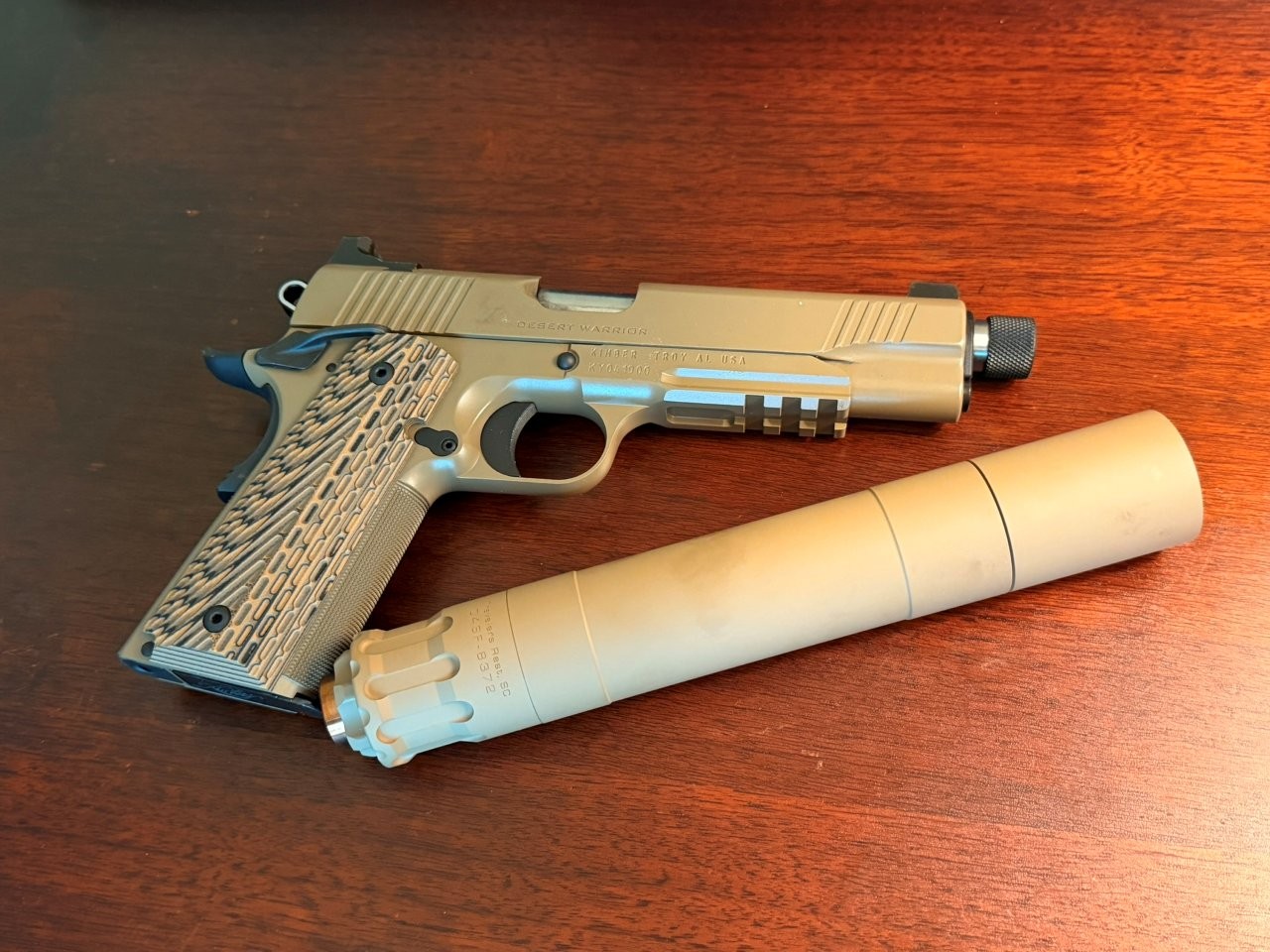
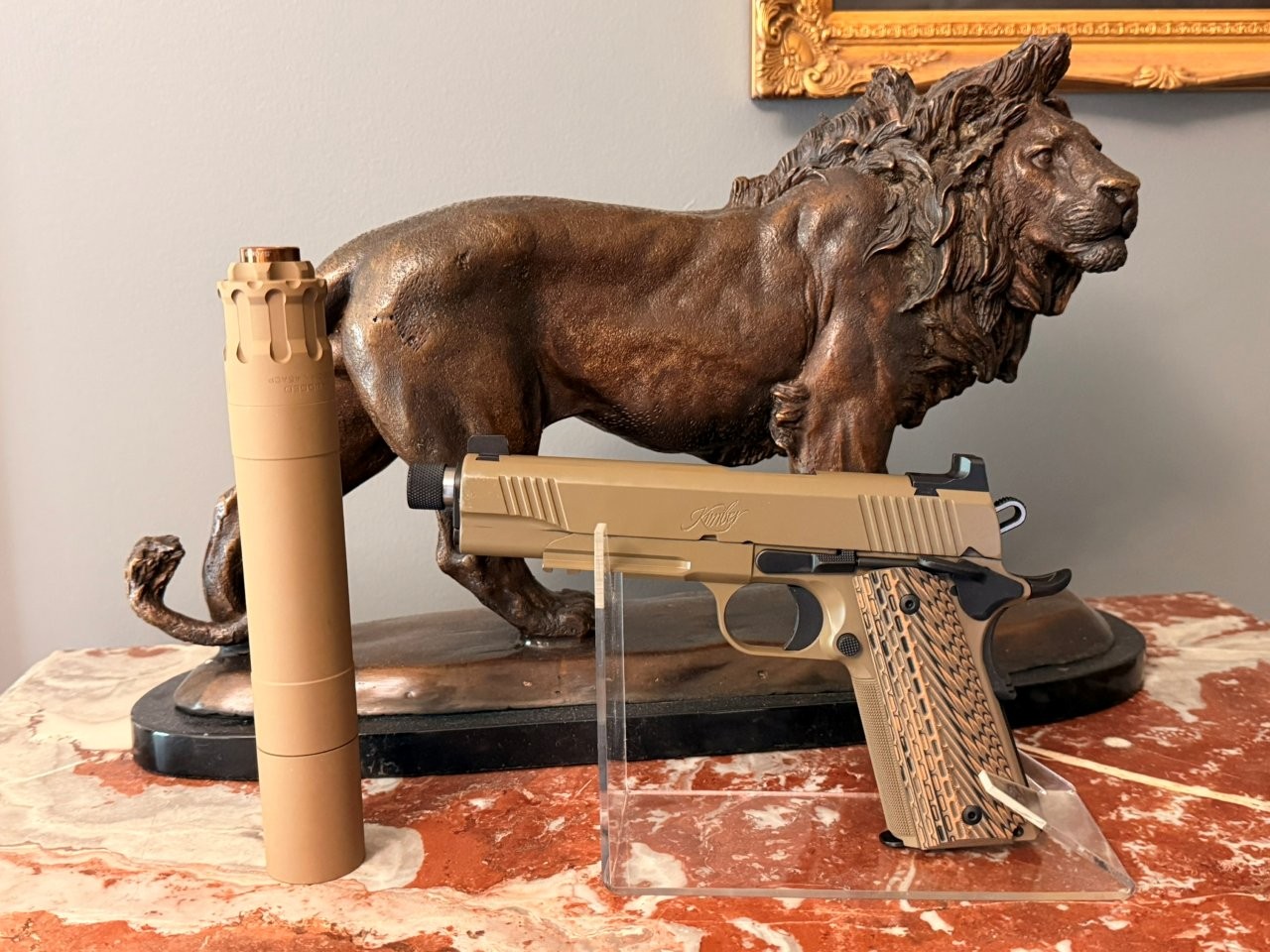
With the suppressor attached, the Desert Warrior takes on a different personality. The pistol becomes longer, more deliberate, and visually more specialized. Your photographs show that transformation well. The gun alone is handsome; the gun and suppressor together become a complete modern package.
The Rugged Obsidian Pairing
The suppressor shown with this Kimber gives the whole setup a coherent look. The tan finish complements the pistol rather than fighting it. The result looks intentional, almost like a matched system.
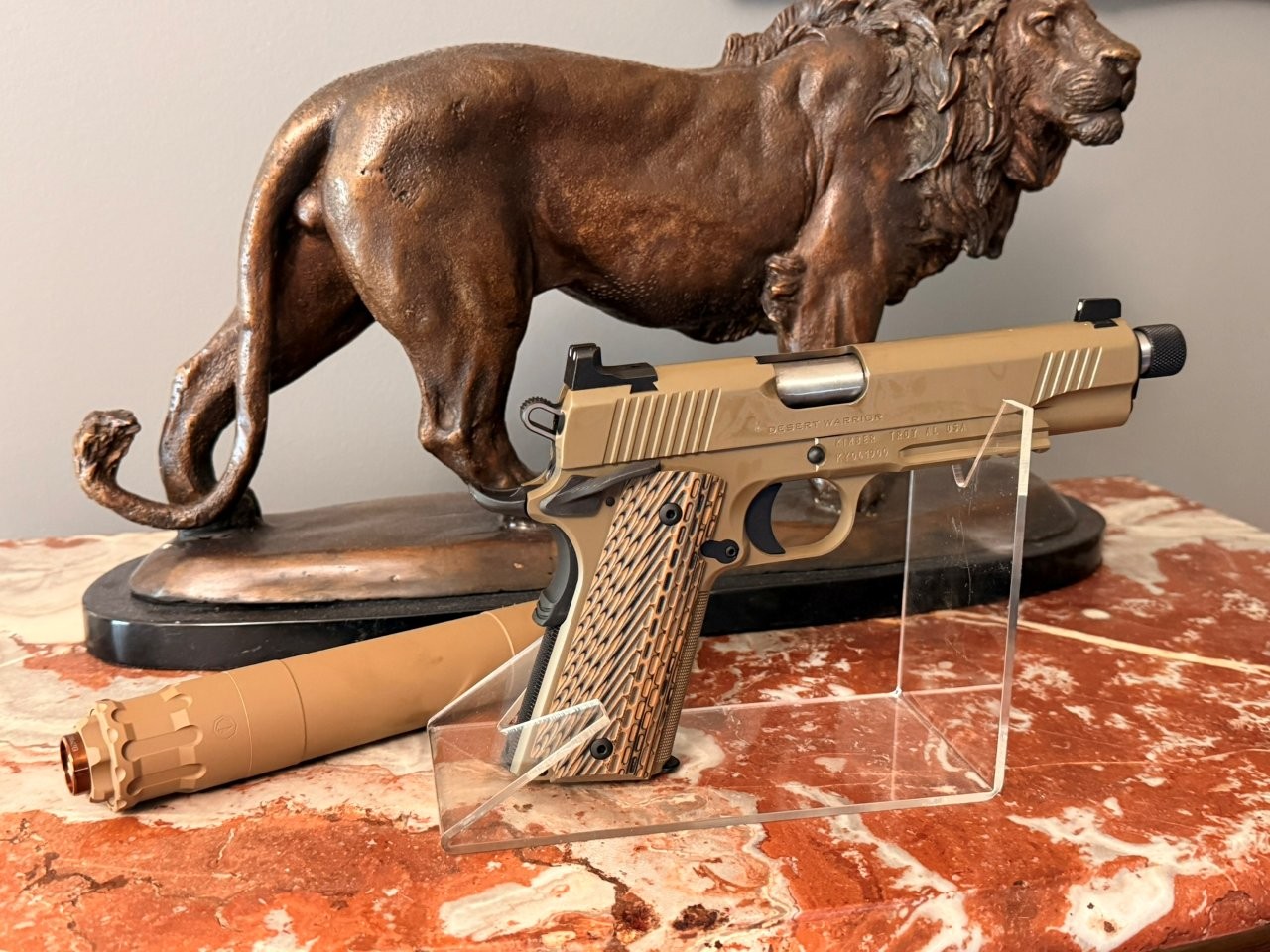
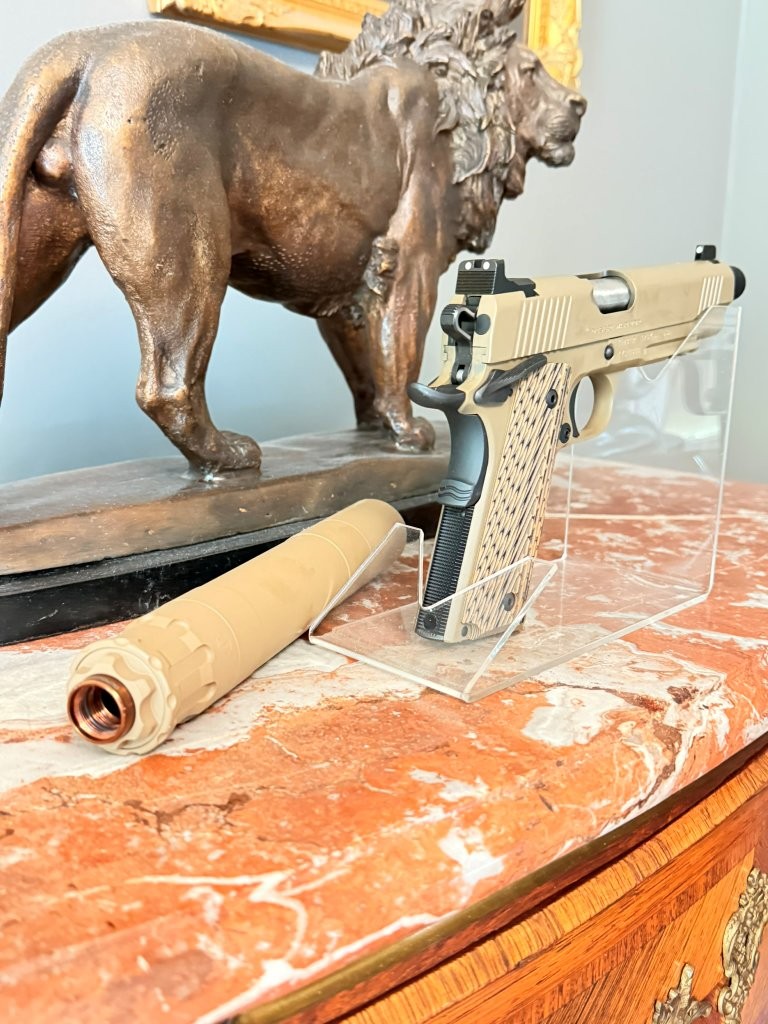
A suppressor changes more than sound. It changes balance, sight picture, handling, and presentation. It makes the pistol feel more specialized. On the display stand, the combination looks less like a simple handgun and more like a collector’s study of the modern tactical 1911 era.
That is one reason these images work well for a feature article. They do not simply document the pistol. They tell the reader what kind of pistol it is.
Kimber’s Move to Troy, Alabama
Kimber’s relocation to Troy, Alabama is one of the most important chapters in the company’s modern history. The move gave Kimber a new headquarters, a large manufacturing footprint, and a strong Southern identity. For Alabama collectors, that matters.
Firearms companies have always been tied to place. Colt belongs to Hartford in the public imagination. Winchester belongs to New Haven. Remington will always be linked with Ilion. Smith & Wesson is tied to Springfield. Those places become part of the collector story. Kimber’s identity now includes Troy, Alabama.
The company’s move also reflects a broader shift in the American firearms industry. Manufacturers have increasingly looked to states that offer friendlier business climates, stronger manufacturing recruitment, and cultural support for the firearms trade. Alabama fits that pattern well.
For me, Kimber’s Alabama move changed the brand from something distant into something local enough to matter. I live in Alabama. I write about American firearms. I care about the stories behind the companies. When Kimber chose Troy, the company became part of the same regional landscape that I live in and write from.
Why the Alabama Tie Made Me Buy This Pistol
I had looked at Kimbers before. I had considered them, compared them, admired them, and walked away. There was always another Colt, another Smith & Wesson, another historical piece, another older firearm with a deeper collecting hook.
The Desert Warrior changed that because the Alabama connection gave me a reason to care. This was not merely another production 1911. It was a Kimber at a time when Kimber’s center of gravity had moved to Troy. That made the pistol part of a larger story about Southern firearms manufacturing and modern American gunmaking.
Collectors often talk about “condition, rarity, and originality.” Those things matter. But personal connection matters too. Sometimes the right gun enters a collection because it intersects with place, timing, and identity.
That is what happened here.
Fit, Controls, and Handling
The Desert Warrior has the basic handling characteristics that make a Government-size 1911 so enduring. The grip is long enough to fill the hand. The slide has enough mass to give the recoil impulse a steady push rather than a sharp snap. The trigger is short, crisp, and familiar to anyone who appreciates single-action pistols.
The beavertail grip safety allows a high hold without hammer bite. The extended thumb safety is easy to find. The slide serrations provide useful traction without visually overpowering the pistol. The rail adds utility while also giving the dust cover a heavier, more modern appearance.
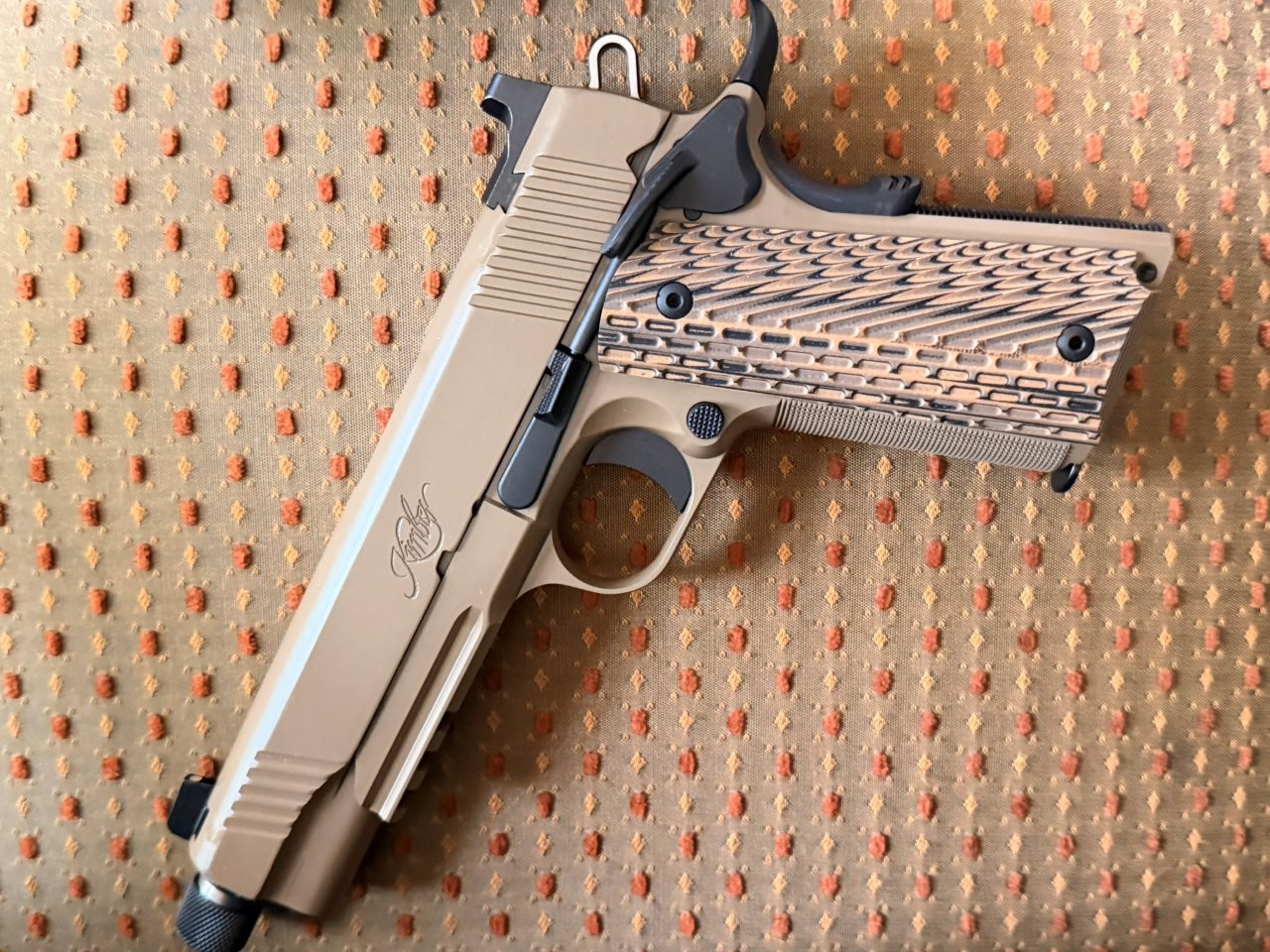
The grips are one of the strongest visual features of the pistol. Their texture looks aggressive and functional. They also help break up the broad fields of flat dark earth finish. On camera, the pattern photographs beautifully because it creates shadows and contrast.
The Desert Warrior as a Collector Piece
The Desert Warrior is not an antique, but it is collectible in the way many modern firearms become collectible. It represents a distinct period, a clear design philosophy, and a recognizable brand moment.
Collectors should not think only in terms of age. Some firearms become collectible because they define a category. Some become collectible because they represent a company’s peak influence. Some become collectible because they capture an era’s design language. The Desert Warrior has elements of all three.
It belongs to the tactical 1911 era. It shows Kimber’s role in feature-rich production pistols. It reflects the suppressor-ready market. And for Alabama collectors, it now sits inside the story of Kimber’s Troy headquarters.
How to Photograph a Modern Collector 1911
Your images demonstrate several useful lessons for collector photography. The best firearm photographs do more than show shape. They create context.
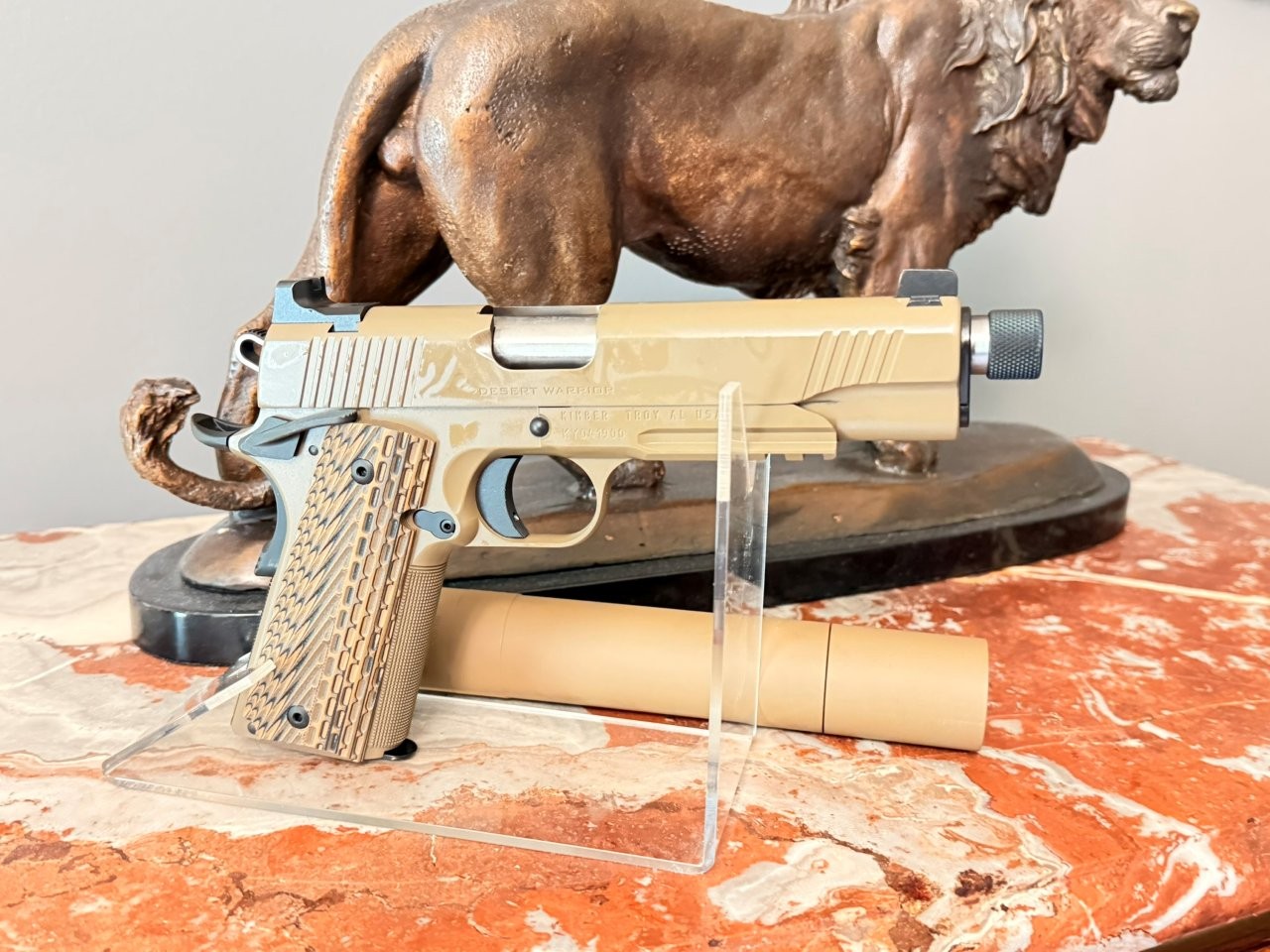
The marble top, acrylic stand, lion sculpture, and warm wood surface all help contrast the modern pistol with traditional materials. That contrast works especially well. The Desert Warrior is not visually soft, but the setting gives it depth and sophistication.
The black-cloth images are useful for documentation because they isolate the gun and suppressor. The lion-and-marble images are useful for editorial presentation because they tell a story. A complete article benefits from both.
The tall images are especially useful for mobile readers and social sharing. Most gun pages overuse horizontal images. A vertical image can create variety and give the page a more magazine-like rhythm.
What Makes This Kimber Worth Writing About
There are many Kimber 1911s. There are many .45 ACP pistols. There are many suppressor-ready handguns. The reason this one deserves a feature article is that it brings several themes together in one gun.
It connects Kimber’s modern 1911 history with the tactical 1911 movement. It connects the classic .45 ACP Government Model to suppressor-ready modern use. It connects a national firearms brand to Alabama manufacturing. And it connects my own collecting interest to a regional story that matters to me personally.
That is enough to make the Desert Warrior more than a range pistol. It becomes part of the Gun Collectors Club narrative.
Final Thoughts
The Kimber Desert Warrior is a pistol that respects the 1911 while refusing to remain trapped in 1911 nostalgia. It has the trigger, grip angle, and steel-frame confidence that made the platform famous. It also has the rail, threaded barrel, finish, and suppressor-ready attitude of a modern tactical handgun.
Kimber’s move to Troy, Alabama gave this pistol personal meaning for me. It turned Kimber from a brand I respected into a company I wanted represented in my own collection. That Alabama tie is the reason this became my first Kimber.
In the end, the Desert Warrior is not just a modern .45. It is a reminder that firearms collecting is about design, history, place, and personal connection. This pistol brings all of those together.
Collector Takeaway
The Desert Warrior works because it keeps the soul of the 1911 while capturing a very specific modern moment: tactical finishes, suppressor readiness, rail-equipped utility, and Kimber’s Alabama manufacturing identity.
Photo Set Preview
The Desert Warrior represents the modern tactical direction of the platform; for Colt’s classic precision-focused interpretation, compare it with the Gold Cup competition 1911.

About the Author
Greg Cook writes Gun Collectors Club from an Alabama collector’s perspective, focusing on firearm history, identification, preservation, and the stories that make individual guns worth remembering.