American firearms collecting is not just about owning old guns. At its best, it is a way of preserving mechanical history, family memory, military experience, hunting tradition, and the workmanship of an era when a rifle or revolver was expected to last for generations. A collectible firearm is a historical object that can be studied from several directions at once: design, metallurgy, wood, finish, markings, use, scarcity, and condition. That is why a well-worn hunting rifle can still matter, and why an unfired boxed revolver can create an entirely different kind of collector interest.
Collectors often begin with nostalgia. A man remembers the rifle his father carried in deer season, the shotgun behind a farmhouse door, the revolver in a police holster, or the military arm a grandfather brought home in stories if not in fact. From there, the hobby widens. A Savage 99 becomes a study in rotary magazines and lever-action engineering. A Colt Python becomes a lesson in premium double-action revolver production. A Browning shotgun becomes a doorway into John Moses Browning, Belgian manufacture, and the long arc of sporting arms. The gun is the starting point, but the real collection is knowledge.
Why classic guns still hold collector value
The collector market rewards firearms that combine story and substance. A gun does not become desirable merely because it is old. Age matters, but age by itself is not enough. Collectors look for originality, condition, mechanical integrity, identifiable variation, documented history, and a connection to a recognized model or maker. A common rifle in poor condition may have little premium, while a scarce configuration with its original finish, sights, box, papers, or factory letter can attract serious attention.
That is why the old phrase “buy the gun, not the story” remains useful. A good story should be supported by visible features, serial number research, factory records, provenance, or a known pattern of production. A seller may describe a firearm as rare, but a collector asks harder questions. Is the barrel correct? Are the sights right? Has the metal been refinished? Does the stock show sanding around the metal edges? Are the screws damaged? Are the markings sharp? Does the serial number fit the claimed period? Those details separate casual buying from collecting.
Craftsmanship as a reason to collect
One reason walnut-and-steel firearms remain appealing is that they carry the evidence of human and machine work in a way that modern mass production often hides. A hand-checkered stock, a polished blue finish, a finely timed revolver action, or a receiver with well-cut roll marks gives the collector something to examine slowly. The best firearms invite close inspection. Even a working-grade gun can show thoughtful design and honest workmanship.
The Roper target grips shown below are a good example of why classic-gun collecting extends beyond the firearm itself. Small accessories can carry the same evidence collectors study in the guns: handwork, design intent, period use, maker reputation, and originality. Walter F. Roper’s grip pattern, commonly associated with the hand work of Mathias Gagne, was not just a decorative upgrade. The thumb rest, finger grooves, palm-filling contour, checkering, wood choice, and frame fit all show how mid-century American shooting culture valued a grip shaped for the hand as much as for the eye.
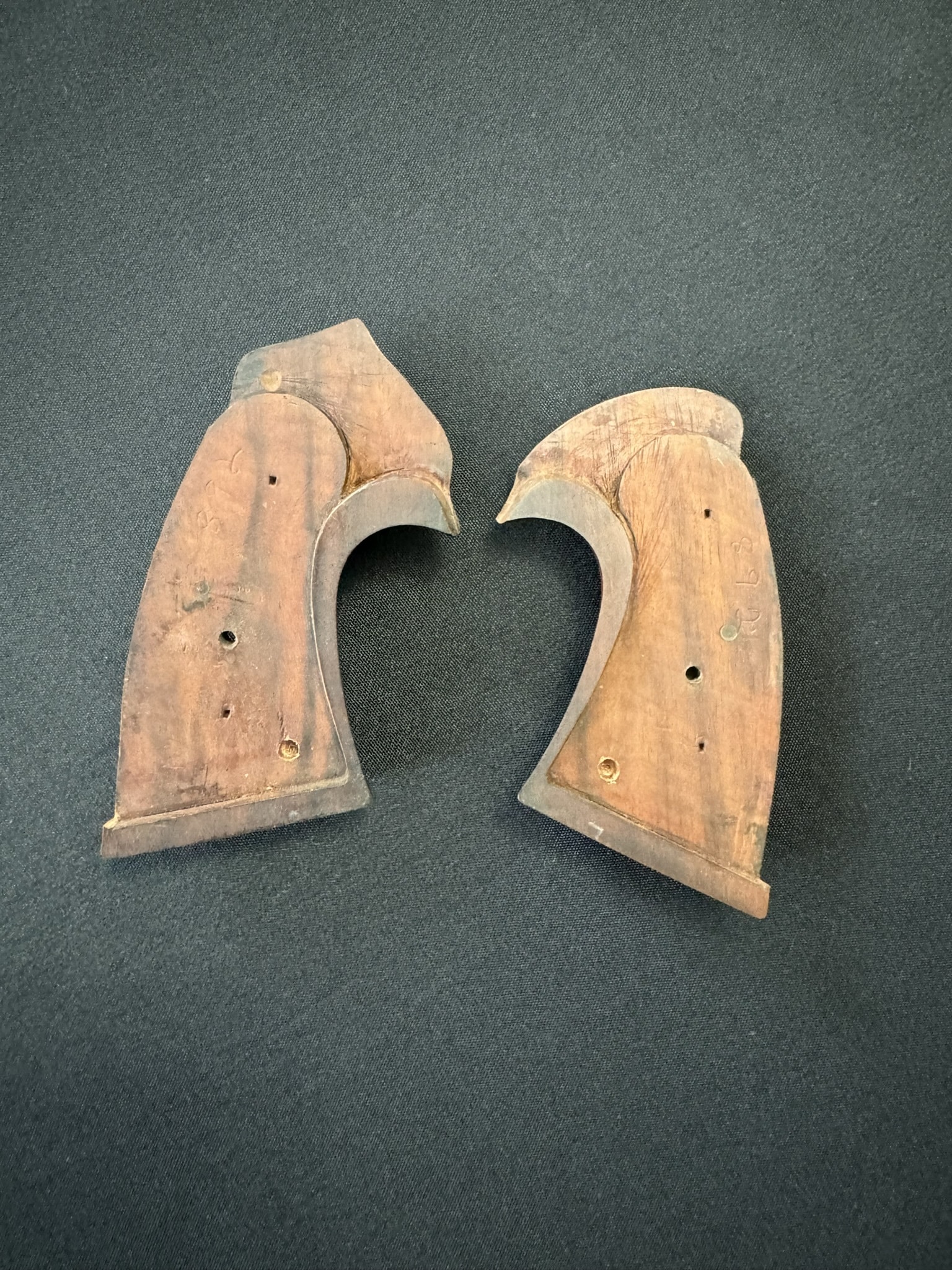
The reverse side of original Roper grips is especially important because collectors often look for the small square or rectangular jig holes left by the fixtures that held the panels during shaping and checkering. Those holes are not a stand-alone guarantee: fit, inletting, checkering, age, wood, hardware, and provenance still have to agree. But they are one of the details that can separate a collectible original from a later Roper-style copy. That distinction has real market weight: as a 2026 working estimate, a sound, authenticated set of original Roper grips commonly belongs in the $800 to $1,200 discussion, with unusual or especially desirable sets able to exceed that range, while good Roper-style copies or modern custom reproductions are more often a $200 to $400 item; basic commercial replicas may sell for less. The difference is significant enough that the back side of the grip deserves the same careful study as the show side.
Older American firearms also reflect a manufacturing culture that valued finish and feel. Many sporting arms were designed to be carried in the field, repaired by competent hands, and passed down. The wood was not just a handle. It was part of the gun’s identity. Grain, figure, fit, and finish mattered. A classic rifle with worn blue and honest handling marks can still have dignity because the wear tells a story of use rather than neglect.
The importance of model knowledge
Collectors are usually better served by learning a few models deeply than by buying broadly without a plan. A person who studies Winchester lever actions, Smith & Wesson revolvers, Colt Pythons, or Browning shotguns begins to recognize small differences that affect value. Barrel length, finish, chambering, grip style, production date, and original accessories can change the character of a firearm.
In that sense, a firearm collection becomes a library. Each gun is a chapter. A six-inch blue Python says something different from a stainless Python Hunter. A pre-64 Winchester Model 70 says something different from a later push-feed rifle. A military 1911A1 with arsenal rebuild marks tells a different story than a commercial Colt Government Model. The collector’s job is to understand those differences before money changes hands.
Condition, originality, and honest wear
Condition is one of the most misunderstood subjects in collecting. A gun can be worn and still be collectible if the wear is honest and the firearm remains original. Conversely, a gun can appear shiny and attractive but lose collector value if it has been heavily buffed, refinished, reblued, restocked, drilled, tapped, or assembled from incorrect parts. A new-looking old gun is not automatically better than an honest old gun.
Original finish tells a truth that refinishing often erases. Rounded edges, washed-out markings, mismatched blue, and softened screw slots are warning signs. Wood is equally revealing. Sanded stocks often sit proud or low against metal in ways the factory did not intend. Checkering may appear flat, recut, or blurred. Collectors should train themselves to study the transitions: metal to wood, barrel to receiver, screw head to surrounding surface, and sight base to barrel.
Firearms as American historical objects
American firearms also belong to a larger national story. The development of repeating rifles, service pistols, sporting shotguns, and military semiautomatics parallels settlement, industrialization, war, police work, hunting, and competitive shooting. Museums such as the Smithsonian and the Cody Firearms Museum preserve firearms because they are artifacts of design, production, conflict, sport, and identity. A serious private collector is working on a smaller scale, but the impulse is related: preserve the object, understand it, and pass along the story.
That is why a collection should not be treated merely as an accumulation. Good collectors keep notes. They save receipts, auction descriptions, photographs, factory letters, and repair history. They record what they know and what they do not know. That habit helps heirs, protects value, and prevents family history from being separated from the physical object.
Collecting with discipline
The most satisfying collections usually have boundaries. A person might collect Colt revolvers, American military pistols, Savage lever actions, Belgian Brownings, engraved firearms, or practical examples of guns that shaped American hunting. The boundaries can be personal, historical, or financial. What matters is that the collector knows why a gun belongs in the collection.
Discipline also means learning when not to buy. A gun with altered markings, suspicious provenance, mismatched parts, or a price based on excitement rather than evidence may be better left alone. There will always be another auction, another gun show, another estate sale, and another chance to buy. Patience is one of the collector’s best tools.
Preservation and responsibility
Collectors are temporary custodians. The goal is not to freeze every firearm as a museum piece, but to avoid careless damage. Proper humidity control, safe storage, gentle cleaning, and restraint with refinishing are important. A collectible firearm should not be aggressively polished, over-oiled, stored in a damp case, or handled without regard for fingerprints and finish. See the site’s storage and bench articles for practical collector gear and preservation ideas.
For related reading, see the collector guides, the Turnbull TAR-40 series, the revolver guides, the rifle guides, and the gear I actually use.
A good firearm collection is not measured only by the number of guns in the safe. It is measured by how well the owner understands what each gun is, why it matters, and what should be preserved for the next caretaker.
Collector takeaway
Classic guns still matter because they carry more than market value. They preserve design choices, manufacturing methods, military lessons, sporting traditions, and family memory. The best collectors learn to see all of that at once. They study markings, condition, variations, and provenance, but they also appreciate the human story behind the object. That balance of evidence and emotion is what keeps American firearms collecting alive.
From My Bench
If you are preserving a collection, keep humidity, documentation, lighting, and safe handling in mind. I maintain a curated list of books, tools, cleaning supplies, storage items, and bench gear that fit the collector workbench.
Browse My Gear ListAs an Amazon Associate I earn from qualifying purchases. I only link to products, books, tools, and accessories that fit the editorial purpose of Gun Collectors Club.

About Greg Cook
Greg Cook writes about firearms collecting, personal history, and the stories behind interesting guns. His Army MOS was 76Y, Unit Armorer, and he brings that practical background to his collector articles.
Sources & References
The following public references were consulted for historical framing, serial-number research, archive guidance, Roper-grip identification notes, and 2026 value context:
- Smithsonian / National Museum of American History firearms collections
- Cody Firearms Museum overview
- Library of Congress guide to American firearms and their makers
- Collector notes on original Roper grip jig holes
- Smith & Wesson Forum discussion of Gagne/Roper identification features and jig holes
- Poulin / Invaluable 2026 Roper grips auction estimate
- AuctionZip archive of Poulin’s February 2026 Roper grip results
- GUNS Magazine article on modern Roper-style custom grips
- Handgun Grips examples of commercial Roper-pattern reproduction pricing