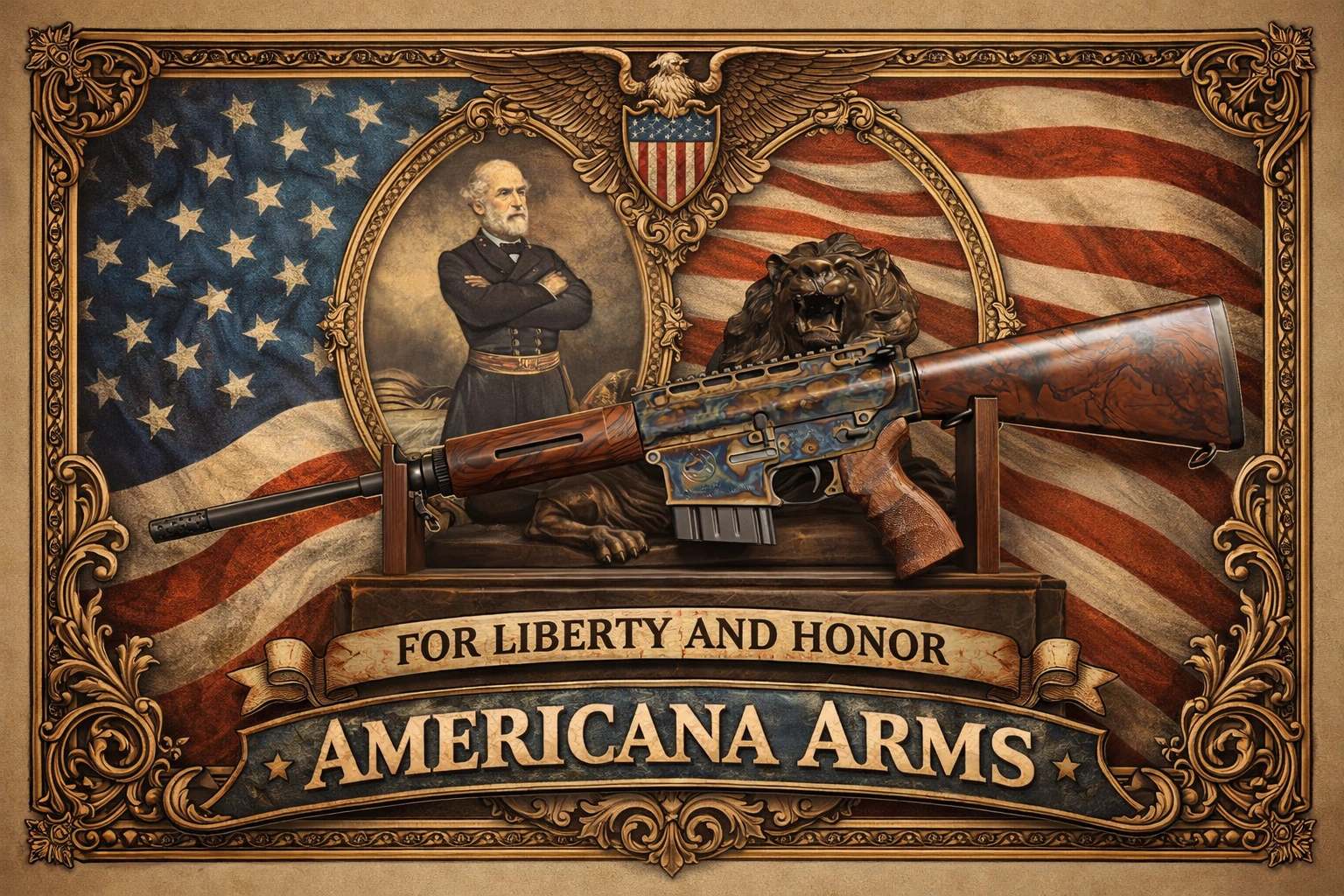
Americana arms are firearms that help tell the American story. They are not limited to battlefield weapons or famous museum pieces. They include frontier rifles, Civil War muskets, sporting shotguns, police revolvers, target pistols, military sidearms, hunting rifles, and the working guns that appeared in farmhouses, camps, patrol cars, ships, armories, and gun cabinets. Together they trace a history of invention, conflict, sport, industry, and personal responsibility.
Collectors are drawn to these firearms because they are tangible. A document can describe an era, but a firearm built in that era lets you study the machining, materials, markings, wear, and design assumptions of the time. You can see what the maker valued. You can see what the user needed. You can often see what later generations changed.
From early arms to industrial production
American firearms history begins before mass production, but the collector story becomes especially rich as arms making becomes an industrial force. Interchangeable parts, government armories, private contractors, and commercial makers all shaped the development of American manufacturing. Firearms were not the only products influenced by these methods, but they were among the most important early proving grounds for precision production.
Springfield Armory, Harpers Ferry, Colt, Winchester, Remington, Smith & Wesson, Marlin, Savage, and Browning all contributed to the larger mechanical culture. The same history that produced service rifles and revolvers also helped train machinists, engineers, inspectors, and designers. When a collector studies an old firearm, he is often studying American industry in miniature.
Civil War memory and collector interest
Civil War arms remain powerful artifacts because they connect directly to the most painful conflict in American history. Muskets, carbines, revolvers, swords, accoutrements, and cartridge boxes all carry historical weight. For collectors, originality and provenance are critical. A firearm associated with a regiment, soldier, battlefield, or documented family line can have meaning far beyond its mechanical features.
At the same time, Civil War collecting requires caution. The field has reproductions, altered items, replaced parts, and optimistic stories. Collectors should study markings, cartouches, inspector initials, patina, bore condition, and documentation. The older and more historically charged the object, the more important careful verification becomes.
The frontier and sporting tradition
Lever-action rifles, single-shot rifles, shotguns, and revolvers helped shape the American frontier image. Some of that image is history, some is literature, and some is Hollywood. Collectors should enjoy the romance but verify the artifact. A Winchester, Colt, Remington, Marlin, or Sharps may have a legitimate place in frontier history, but the specific gun in hand still has to be evaluated on its own evidence.
The sporting tradition is just as important. Hunting rifles and shotguns are part of American family history. A Savage 99 deer rifle, a Browning shotgun, a Winchester Model 12, or a Remington pump may not have battlefield fame, but it may represent generations of outdoor life. Those guns often survived with honest wear, and their collector value depends on originality, condition, configuration, and the story attached to them.
World War I, World War II, and military arms
American military firearms collecting is one of the deepest fields in the hobby. The 1903 Springfield, M1911 and M1911A1 pistols, M1 Garand, M1 Carbine, Thompson, Browning Automatic Rifle, and later Cold War weapons all carry design and service history. These guns are studied by serial number, maker, inspection mark, arsenal rebuild, part drawing number, finish, and configuration.
The M1 Garand deserves special mention because it represents a decisive shift in service rifle design. It gave American infantry a semiautomatic standard rifle when that was not yet common among major powers. Collectors value the Garand not only because of World War II memory, but because it is mechanically important. A correct Garand is a study in production, inspection, and wartime necessity.
Cold War arms and personal memory
For many living collectors, Cold War firearms are not ancient history. They are connected to training, service, news footage, allies, adversaries, and personal experience. A veteran who trained with NATO weapons, handled arms as a unit armorer, or qualified with foreign weapons may see these firearms differently than someone approaching them only through books.
That personal connection matters. A collection built around service memory can have depth if it is still researched carefully. The key is to combine personal narrative with documented facts. Memory gives the collection life. Research gives it structure.
Police, target, and civilian defensive arms
Americana arms also include revolvers and pistols carried by law enforcement, competitors, and private citizens. Colt and Smith & Wesson revolvers, 1911 pistols, rimfire target pistols, and compact defensive handguns all reflect changing ideas about protection, training, accuracy, and authority. A police trade-in revolver with holster wear may not be pristine, but it can be historically honest.
Collectors should distinguish between condition rarity and use history. A worn duty gun may have less finish but more story. A mint boxed example may have more monetary value but less visible life. Both can belong in a collection if the collector understands what each represents.
Firearms in museums and private collections
Major museums preserve firearms because they are part of American history, technology, and culture. Private collectors serve a related role when they document and care for their collections responsibly. A private collection does not need to be large to be meaningful. It needs to be organized, researched, and preserved.
That means keeping notes, photographing markings, preserving boxes and paperwork, resisting unnecessary refinishing, and making sure heirs understand what the objects are. Without documentation, even a valuable firearm can become “one of Dad’s old guns.” With documentation, it remains a historical object.
Internal paths for further study
Readers can continue through the site’s M1911A1 military article, TAR-40 series, classic American rifles guide, photo galleries, and collector guides. The goal is to connect individual firearms to the larger American story rather than treating each page as an isolated object.
Americana arms are not important only because they can be bought and sold. They are important because they preserve design, service, labor, memory, and national history in physical form.
Collector takeaway
The firearms that shaped American history are not limited to famous names or museum-grade rarities. They include the rifles carried by soldiers, the shotguns carried by hunters, the revolvers carried by officers, and the sporting arms passed through families. A collector who studies them carefully becomes a caretaker of more than metal and wood. He becomes a caretaker of memory.
From My Bench
If you are preserving a collection, keep humidity, documentation, lighting, and safe handling in mind. I maintain a curated list of books, tools, cleaning supplies, storage items, and bench gear that fit the collector workbench.
Browse My Gear ListAs an Amazon Associate I earn from qualifying purchases. I only link to products, books, tools, and accessories that fit the editorial purpose of Gun Collectors Club.

About Greg Cook
Greg Cook writes about firearms collecting, personal history, and the stories behind interesting guns. His Army MOS was 76Y, Unit Armorer, and he brings that practical background to his collector articles.
Research notes and further reading
The following public references were consulted for historical framing, serial-number research, and archive guidance: