Need the serial-number chart?
Use the Browning A5 Serial Number Lookup Page
This older Browning shotgun page now focuses on history, variations, Belgian production, receiver and barrel features, and collector notes. If you are trying to date a gun from its serial number, start with the dedicated lookup reference.
Open Browning A5 Serial Number LookupWhy the Auto-5 Still Matters to Collectors
The Browning Auto-5 is one of those shotguns that never really left the conversation. Its squared receiver, long-recoil action, and unmistakable humpback profile made it instantly recognizable in duck blinds, quail fields, farm trucks, and gun cabinets for much of the twentieth century.
John Moses Browning designed the Auto-5 at the turn of the century, and FN in Belgium turned that design into one of the most durable sporting shotguns ever made. For the collector, the attraction is not only that it was the first truly successful semi-automatic shotgun. It is the way nearly a century of production left behind a long trail of small changes, variations, markings, and regional differences.
Belgian FN Production and the Browning Connection
Early Auto-5 history is tied closely to Fabrique Nationale in Liège, Belgium. The Belgian guns carry much of the romance collectors associate with the model: old-world machining, distinctive proof marks, deep bluing on better examples, and the long Browning/FN relationship that shaped sporting firearms on both sides of the Atlantic.
Belgian production is not automatically superior in every practical sense, but it often carries stronger historical appeal. A clean Belgian Auto-5 with honest finish, crisp markings, correct wood, and the right barrel can draw more collector interest than a rougher example with the same serial-number period.
Production Eras at a Glance
| Era | Collector Meaning |
|---|---|
| Early Belgian FN | Historically important guns with strong appeal when condition and originality survive. |
| Interwar Belgian | Classic sporting examples from the period when the Auto-5 was becoming a field standard. |
| Wartime and Remington Interruption | World events affected production and availability, creating a useful dividing line for collectors. |
| Postwar Belgian | Highly familiar field guns from the Baby Boom hunting era, often with excellent fit and finish. |
| Late Belgian and Transitional | Important for stock-shape, rib, model-code, and configuration changes. |
| Japanese Miroku | Excellent using guns with a different collector lane from earlier Belgian production. |
Model Variations Collectors Watch
The Auto-5 family includes far more than one plain 12-gauge field gun. Collectors often separate examples by gauge, weight, chambering, barrel style, rib type, stock shape, and model designation.
Barrel and Receiver Features
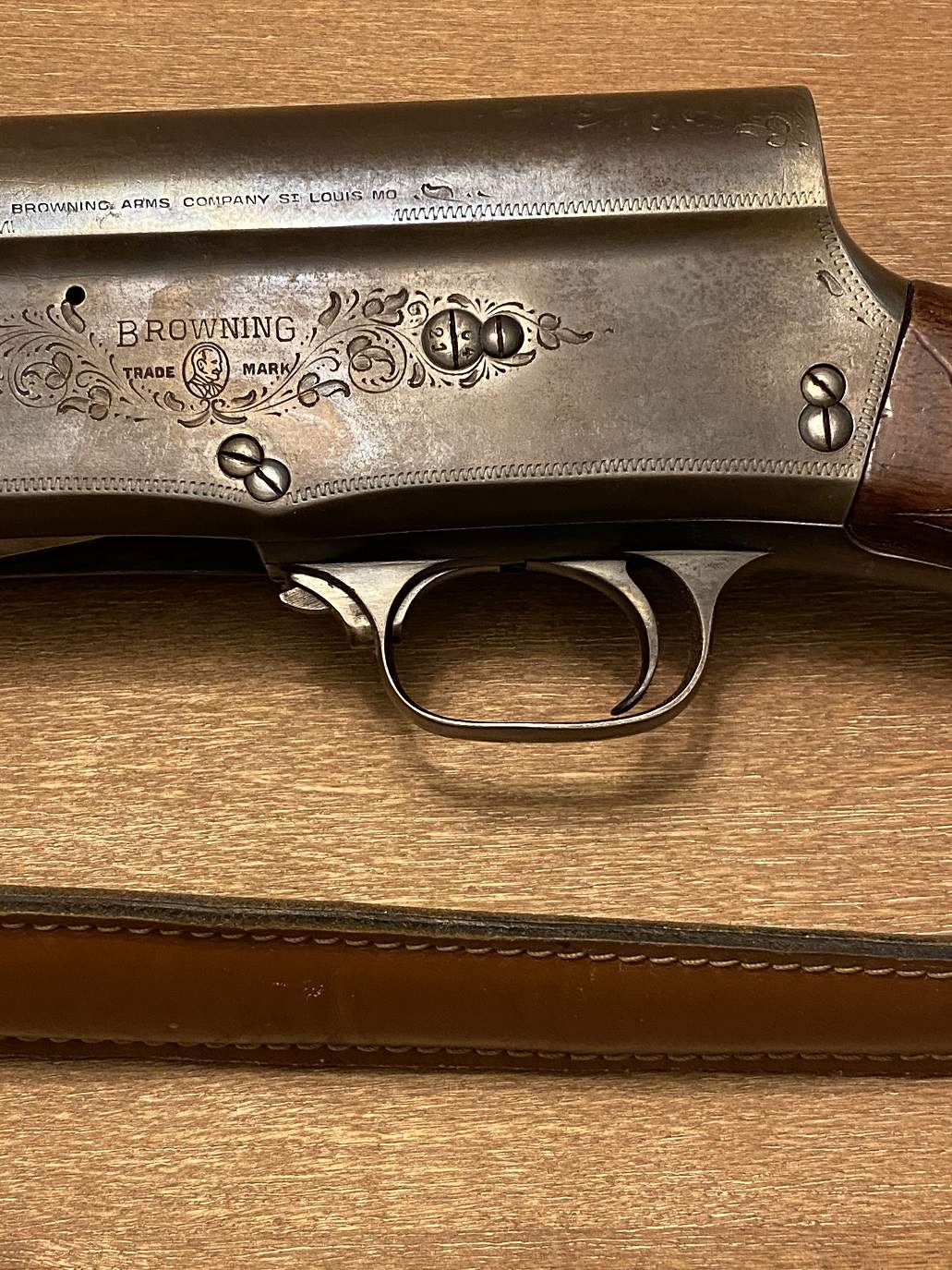
The Auto-5 receiver is its signature. The high rear profile, long-recoil operating system, and Browning markings give the gun a look that no rounded receiver shotgun can quite copy. But the barrel often tells just as much of the story as the receiver.
Collectors should look at the gauge and chamber marking, choke marking, rib style, barrel address, proof marks, and whether the barrel appears period-correct for the receiver. Replacement barrels are common because Auto-5s were used hard for decades. A replacement barrel can make a very good shooter, but it changes the collector conversation.
- Check the receiver serial number and record every letter or code exactly.
- Compare barrel markings to the receiver era.
- Look for Belgian proof marks on FN-made guns.
- Note plain, solid-rib, ventilated-rib, and choke configurations.
- Inspect the forearm carefully for cracks around the barrel ring and recoil area.
Round-Knob, Flat-Knob, and Stock Details
Stock shape is one of the details that helps place an Auto-5 in collector context. Many early and mid-century guns carry the classic round-knob grip. Later examples moved toward flat-knob and more modern stock contours. Recoil pads, shortened stocks, sanded wood, cracked forearms, and replacement buttplates can materially affect value.
A bright refinish may catch the eye, but collectors usually prefer honest original wood with sharp checkering and correct furniture. The Auto-5 was a working shotgun, so wear is expected. The question is whether the wear tells a good story or hides alterations.
Belgian Versus Japanese Auto-5s
Japanese Miroku-made Auto-5s deserve respect. They are often beautifully built, reliable, and excellent shooters. The collector market, however, tends to place Belgian FN production and Japanese Miroku production in different lanes.
Open the Belgian vs Japanese Browning A5 Identification Guide to compare origin legends, Liège proofs, serial formats, fixed and Invector chokes, rib styles, safeties, and finish details.
| Feature | Belgian FN Production | Japanese Miroku Production |
|---|---|---|
| Collector identity | Historical Browning/FN appeal | Late-production quality and strong shooter appeal |
| Markings | Belgian proofs and FN-related markings | Japanese/Miroku manufacture markings |
| Market perception | Often higher historical premium | Often valued for fit, finish, and usability |
| Best use | Collecting, display, careful field use | Excellent hunting and shooting examples |
Common Collector Mistakes
Most Auto-5 mistakes come from treating one detail as the whole answer. Serial numbers matter, but they do not replace a full inspection.
- Assuming the barrel is original just because it fits.
- Ignoring letter codes, model codes, or gauge designations.
- Calling every 16-gauge gun a Sweet Sixteen without checking features.
- Valuing Belgian production without considering refinishing, cracks, or replacement parts.
- Confusing later Japanese production with earlier Belgian production.
- Overlooking recoil-pad replacements and shortened stocks.
How I Evaluate an Auto-5 on the Bench
I start with the whole gun, not the number. The serial number gives me the dating path, but the shotgun itself tells me whether the story still holds together. I look at the receiver, barrel, wood, screws, rib, choke, forearm, buttplate, and proof marks before I decide how confident I am.
That is why this page is intentionally not another serial-number chart. It is the collector history and inspection companion to the main Browning A5 lookup page.
Serial-number research
Ready to Date Your Browning A5?
Use the dedicated lookup page for production-year tables, Belgian and Japanese serial conventions, Sweet Sixteen notes, and date-code guidance.
Go to Browning A5 Serial Number LookupRelated Browning Collector Pages
- Browning Firearms Hub
- Browning A5 Serial Number Lookup & Date Chart
- Browning Auto-5 Serial Number Guide
- Belgian vs Japanese Browning A5 Identification Guide
- Belgian Browning Serial Number Guide
- Browning Sweet Sixteen Collector Guide
- Sweet Sixteen Serial Number Lookup
- Browning Light Twelve Collector Guide
- Light Twelve Serial Number Lookup
- Miroku Firearms
- Shotgun Collector Guides

About Greg Cook
Greg Cook writes about firearms collecting, personal history, and the stories behind interesting guns. His Army MOS was 76Y, Unit Armorer, and he brings that practical background to his collector articles.