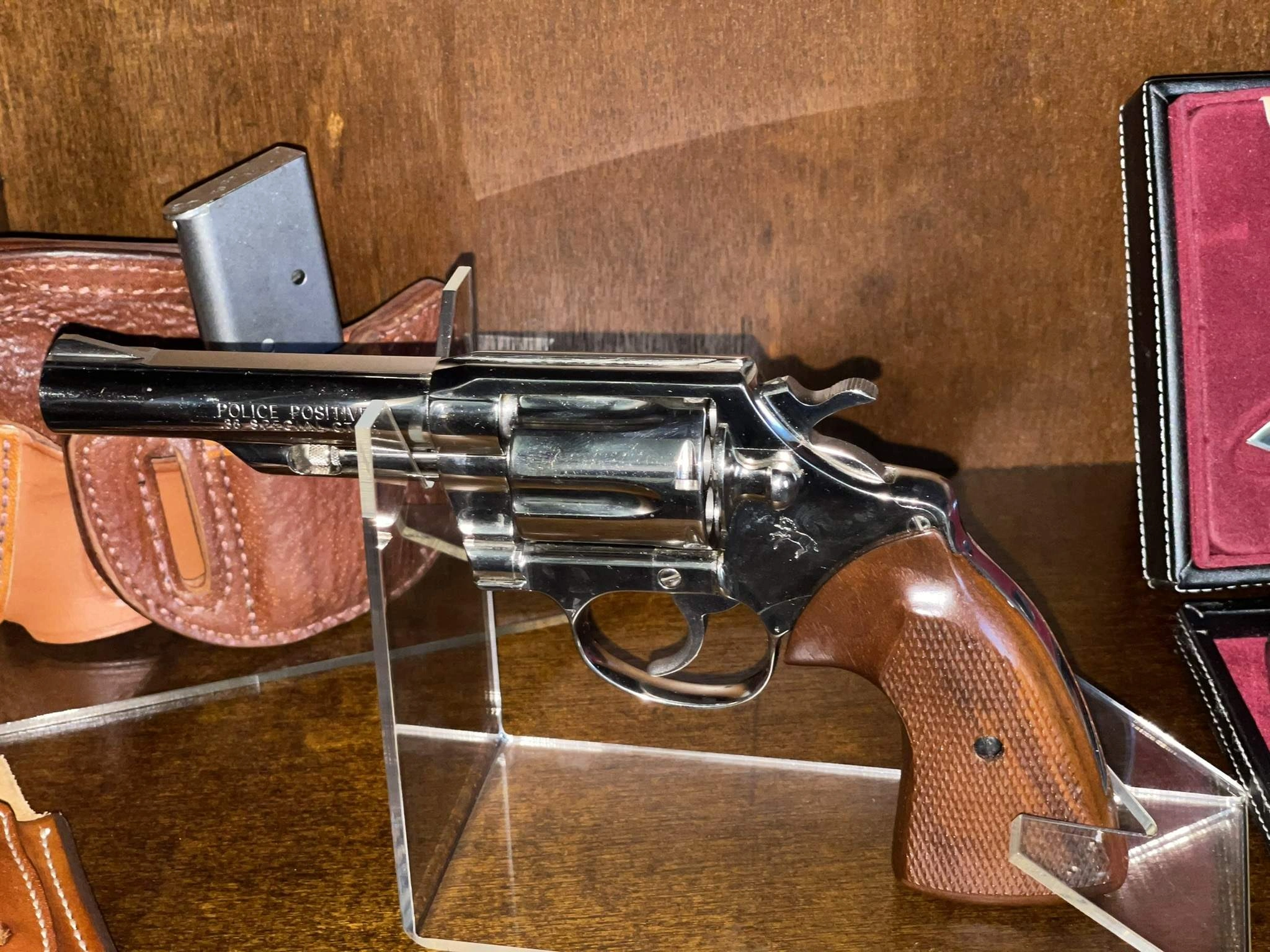
The hardest part of dating a Colt Police Positive is not reading the number. The hard part is choosing the right serial-number sequence before you start. Colt used separate ranges for different Police Positive branches, and a revolver marked simply “Police Positive” is not automatically a .38 Special Police Positive Special.
This guide is written for collectors who need a practical date-of-manufacture estimate from a serial number. It includes separate tables for the standard Police Positive .38 and Bankers Special sequence, the Police Positive .32 and Target sequence, the Police Positive Heavy Frame sequence, and the long Police Positive Special / Detective Special sequence. Use the tables as a starting point, not as a substitute for a Colt Archive Letter when provenance, value, originality, or a premium claim is at stake.
Important: These tables give approximate production anchors. Colt’s own serial-number lookup describes its result as an approximate date and points collectors to Colt’s Archive Department for complete firearm history. For a serious gun, an engraved gun, a police-marked gun, a rare shipment, or a sale listing that depends on a specific date, factory documentation is the better standard.
Collector Series
Colt Police Positive Series
The Police Positive pages now work as a single collector series: start with identification, follow the timeline, date the revolver, then evaluate value and provenance.
Start with Colt’s official serial-number lookup. Before comparing your revolver to the tables below, enter the serial number in Colt’s own database. It is the fastest first-pass check for a year-of-manufacture estimate, especially when a serial range overlaps more than one Colt model family.
Treat the result as an orientation tool. Colt notes that lookup results are approximate and that definitive documentation should come through Colt Archive Properties when the firearm’s history, value, or provenance matters.
Quick Answer: Which Colt Police Positive Table Should You Use?
If the revolver is a standard Police Positive chambered in .38 Colt New Police / .38 S&W, use the Police Positive .38 & Bankers Special table. If it is a .32 Police Positive or Police Positive Target, use the .32 & Target table. If it is a Police Positive Special, Detective Special, or related longer-cylinder D-frame in .38 Special or .32-20, use the Police Positive Special & Detective Special table.
Standard Police Positive .38
Usually .38 Colt New Police, Colt’s name for the .38 S&W-class chambering. Do not assume .38 Special merely because the barrel says .38.
Police Positive .32 / Target
Use this path for .32 Police Positive and the Target branch. Target revolvers can deserve special attention because sights and configuration affect collector value.
Police Positive Heavy Frame
A short production sequence from the mid-1920s into the mid-1930s. Heavy-frame guns belong in their own table.
Police Positive Special / Detective Special
The long D-frame sequence used for the Police Positive Special and Detective Special family. This is the table many collectors need for .38 Special guns.
Before You Date the Gun, Identify the Model Family
The Police Positive family is a trap for casual serial-number work because the words sound simple and the frames look related. The standard Police Positive, Police Positive Special, Police Positive Target, Bankers Special, and Detective Special share Colt history, but they do not all share the same serial sequence, chambering, cylinder length, or collector meaning.
Colt’s Police Positive story grows out of earlier double-action and police revolver work. Colt’s own timeline places the Model 1877 at the start of its double-action revolver legacy, the Model 1889 Navy as its first double-action swing-out-cylinder revolver, and the 1896 New Police .32 as the first standard-issue revolver selected for the NYPD by Theodore Roosevelt. The Police Positive sits downstream of that development, not apart from it.
American Rifleman describes the Police Positive debut in 1907 and explains that “Positive” refers to Colt’s internal hammer-block safety. The same article explains that the original Police Positive added .38 Colt New Police, while the 1908 Police Positive Special used a slightly lengthened frame for longer cartridges such as .32-20 WCF and .38 Special. That is the key serial-number lesson: the standard model and the Special are related, but they are not interchangeable.
Field rule: Read the complete barrel marking, confirm the chambering, record the serial number exactly as stamped, and then choose the table. A bare statement like “old Colt Police Positive .38” is not enough information.
Where Is the Serial Number on a Colt Police Positive?
On many Colt swing-out-cylinder revolvers, the serial number is found on the frame under the crane when the cylinder is opened. Related assembly numbers or inspector marks may also appear in the crane area, on the crane itself, or on other parts. Do not confuse every number you see with the firearm serial number.
For documentation, photograph the number straight on, with enough surrounding metal visible to show location. Also photograph the barrel marking, cylinder, butt, grips, sights, and any box label or shipping paperwork. When a revolver has a police department marking, retailer mark, engraving, unusual finish, or family provenance, keep those photos together with the serial-number research.
Colt Police Positive .38 & Bankers Special Serial Number Table
Use this table for the standard Police Positive .38 and Bankers Special sequence. This is not the Police Positive Special table.
| Year | Serial number shown / annual anchor | Collector use |
|---|---|---|
| 1905 | 1 | Use as an approximate annual anchor for the standard .38 Police Positive / Bankers Special sequence. |
| 1906 | 2,300 | Use as an approximate annual anchor for the standard .38 Police Positive / Bankers Special sequence. |
| 1907 | 10,400 | Use as an approximate annual anchor for the standard .38 Police Positive / Bankers Special sequence. |
| 1908 | 18,000 | Use as an approximate annual anchor for the standard .38 Police Positive / Bankers Special sequence. |
| 1909 | 27,000 | Use as an approximate annual anchor for the standard .38 Police Positive / Bankers Special sequence. |
| 1910 | 33,000 | Use as an approximate annual anchor for the standard .38 Police Positive / Bankers Special sequence. |
| 1911 | 40,000 | Use as an approximate annual anchor for the standard .38 Police Positive / Bankers Special sequence. |
| 1912 | 52,000 | Use as an approximate annual anchor for the standard .38 Police Positive / Bankers Special sequence. |
| 1913 | 62,000 | Use as an approximate annual anchor for the standard .38 Police Positive / Bankers Special sequence. |
| 1914 | 71,500 | Use as an approximate annual anchor for the standard .38 Police Positive / Bankers Special sequence. |
| 1915 | 78,000 | Use as an approximate annual anchor for the standard .38 Police Positive / Bankers Special sequence. |
| 1916 | 82,000 | Use as an approximate annual anchor for the standard .38 Police Positive / Bankers Special sequence. |
| 1917 | 89,000 | Use as an approximate annual anchor for the standard .38 Police Positive / Bankers Special sequence. |
| 1918 | 98,000 | Use as an approximate annual anchor for the standard .38 Police Positive / Bankers Special sequence. |
| 1919 | 100,000 | Use as an approximate annual anchor for the standard .38 Police Positive / Bankers Special sequence. |
| 1920 | 115,000 | Use as an approximate annual anchor for the standard .38 Police Positive / Bankers Special sequence. |
| 1921 | 129,000 | Use as an approximate annual anchor for the standard .38 Police Positive / Bankers Special sequence. |
| 1922 | 137,000 | Use as an approximate annual anchor for the standard .38 Police Positive / Bankers Special sequence. |
| 1923 | 150,000 | Use as an approximate annual anchor for the standard .38 Police Positive / Bankers Special sequence. |
| 1924 | 153,000 | Use as an approximate annual anchor for the standard .38 Police Positive / Bankers Special sequence. |
| 1925 | 165,000 | Use as an approximate annual anchor for the standard .38 Police Positive / Bankers Special sequence. |
| 1926 | 166,000 | Use as an approximate annual anchor for the standard .38 Police Positive / Bankers Special sequence. |
| 1927 | 176,000 | Use as an approximate annual anchor for the standard .38 Police Positive / Bankers Special sequence. |
| 1928 | 177,000 | Use as an approximate annual anchor for the standard .38 Police Positive / Bankers Special sequence. |
| 1929 | 185,000 | Use as an approximate annual anchor for the standard .38 Police Positive / Bankers Special sequence. |
| 1930 | 329,000 | Use as an approximate annual anchor for the standard .38 Police Positive / Bankers Special sequence. |
| 1931 | 342,000 | Use as an approximate annual anchor for the standard .38 Police Positive / Bankers Special sequence. |
| 1932 | 357,000 | Use as an approximate annual anchor for the standard .38 Police Positive / Bankers Special sequence. |
| 1933 | 360,000 | Use as an approximate annual anchor for the standard .38 Police Positive / Bankers Special sequence. |
| 1934 | 364,000 | Use as an approximate annual anchor for the standard .38 Police Positive / Bankers Special sequence. |
| 1935 | 370,000 | Use as an approximate annual anchor for the standard .38 Police Positive / Bankers Special sequence. |
| 1936 | 374,000 | Use as an approximate annual anchor for the standard .38 Police Positive / Bankers Special sequence. |
| 1937 | 375,000 | Use as an approximate annual anchor for the standard .38 Police Positive / Bankers Special sequence. |
| 1938 | 380,000 | Use as an approximate annual anchor for the standard .38 Police Positive / Bankers Special sequence. |
| 1939 | 383,000 | Use as an approximate annual anchor for the standard .38 Police Positive / Bankers Special sequence. |
| 1940 | 390,000 | Use as an approximate annual anchor for the standard .38 Police Positive / Bankers Special sequence. |
| 1941 | 395,000 | Use as an approximate annual anchor for the standard .38 Police Positive / Bankers Special sequence. |
| 1942 | 401,000 | Use as an approximate annual anchor for the standard .38 Police Positive / Bankers Special sequence. |
| 1943 | 406,725 | Use as an approximate annual anchor for the standard .38 Police Positive / Bankers Special sequence. |
Colt Police Positive .32 & Target Serial Number Table
Use this table for Police Positive .32 and Target revolvers. Missing years in a table do not mean a collector should invent a date; use the nearest anchors and confirm with Colt records when the date matters.
| Year | Serial number shown / annual anchor | Collector use |
|---|---|---|
| 1907 | 49,500 | Use as an approximate annual anchor for .32 Police Positive and Police Positive Target research. |
| 1908 | 61,500 | Use as an approximate annual anchor for .32 Police Positive and Police Positive Target research. |
| 1909 | 67,000 | Use as an approximate annual anchor for .32 Police Positive and Police Positive Target research. |
| 1910 | 74,000 | Use as an approximate annual anchor for .32 Police Positive and Police Positive Target research. |
| 1911 | 84,500 | Use as an approximate annual anchor for .32 Police Positive and Police Positive Target research. |
| 1912 | 94,000 | Use as an approximate annual anchor for .32 Police Positive and Police Positive Target research. |
| 1913 | 108,000 | Use as an approximate annual anchor for .32 Police Positive and Police Positive Target research. |
| 1914 | 112,000 | Use as an approximate annual anchor for .32 Police Positive and Police Positive Target research. |
| 1915 | 124,000 | Use as an approximate annual anchor for .32 Police Positive and Police Positive Target research. |
| 1916 | 129,000 | Use as an approximate annual anchor for .32 Police Positive and Police Positive Target research. |
| 1917 | 137,000 | Use as an approximate annual anchor for .32 Police Positive and Police Positive Target research. |
| 1918 | 142,000 | Use as an approximate annual anchor for .32 Police Positive and Police Positive Target research. |
| 1919 | 143,000 | Use as an approximate annual anchor for .32 Police Positive and Police Positive Target research. |
| 1920 | 158,000 | Use as an approximate annual anchor for .32 Police Positive and Police Positive Target research. |
| 1921 | 169,000 | Use as an approximate annual anchor for .32 Police Positive and Police Positive Target research. |
| 1922 | 179,000 | Use as an approximate annual anchor for .32 Police Positive and Police Positive Target research. |
| 1923 | 188,000 | Use as an approximate annual anchor for .32 Police Positive and Police Positive Target research. |
| 1924 | 199,000 | Use as an approximate annual anchor for .32 Police Positive and Police Positive Target research. |
| 1925 | 209,000 | Use as an approximate annual anchor for .32 Police Positive and Police Positive Target research. |
| 1926 | 217,000 | Use as an approximate annual anchor for .32 Police Positive and Police Positive Target research. |
| 1927 | 224,000 | Use as an approximate annual anchor for .32 Police Positive and Police Positive Target research. |
| 1933 | 228,000 | Use as an approximate annual anchor for .32 Police Positive and Police Positive Target research. |
| 1934 | 230,000 | Use as an approximate annual anchor for .32 Police Positive and Police Positive Target research. |
| 1935 | 231,000 | Use as an approximate annual anchor for .32 Police Positive and Police Positive Target research. |
| 1936 | 233,000 | Use as an approximate annual anchor for .32 Police Positive and Police Positive Target research. |
| 1937 | 234,000 | Use as an approximate annual anchor for .32 Police Positive and Police Positive Target research. |
| 1938 | 235,500 | Use as an approximate annual anchor for .32 Police Positive and Police Positive Target research. |
| 1939 | 238,100 | Use as an approximate annual anchor for .32 Police Positive and Police Positive Target research. |
| 1943 | 238,623 | Use as an approximate annual anchor for .32 Police Positive and Police Positive Target research. |
Colt Police Positive Heavy Frame Serial Number Table
Use this short sequence for the Heavy Frame branch. These ranges should not be folded into the standard .32 or standard .38 tables.
| Year | Serial number shown / annual anchor | Collector use |
|---|---|---|
| 1925 | 250,000 | Use for Police Positive Heavy Frame serial-number orientation. |
| 1926 | 250,100 | Use for Police Positive Heavy Frame serial-number orientation. |
| 1927 | 250,500 | Use for Police Positive Heavy Frame serial-number orientation. |
| 1928 | 250,800 | Use for Police Positive Heavy Frame serial-number orientation. |
| 1929 | 251,000 | Use for Police Positive Heavy Frame serial-number orientation. |
| 1930 | 251,300 | Use for Police Positive Heavy Frame serial-number orientation. |
| 1931 | 251,700 | Use for Police Positive Heavy Frame serial-number orientation. |
| 1932 | 251,900 | Use for Police Positive Heavy Frame serial-number orientation. |
| 1933 | 252,100 | Use for Police Positive Heavy Frame serial-number orientation. |
| 1934 | 252,400 | Use for Police Positive Heavy Frame serial-number orientation. |
| 1935 | 253,100–253,351 | Use for Police Positive Heavy Frame serial-number orientation. |
Colt Police Positive Special & Detective Special Serial Number Table
Use this table for the Police Positive Special and Detective Special family. It includes numeric ranges and later letter-prefix or letter-suffix ranges. Some published alphanumeric ranges are easy to misread because zeros, ones, and the letter I can look similar; the late ranges below are normalized into clear collector-readable form and should be verified with Colt when precision matters.
| Year | Serial number shown / annual anchor | Collector use |
|---|---|---|
| 1908 | 1 | Use as an approximate annual anchor for Police Positive Special / Detective Special family research. |
| 1909 | 13,000 | Use as an approximate annual anchor for Police Positive Special / Detective Special family research. |
| 1910 | 22,500 | Use as an approximate annual anchor for Police Positive Special / Detective Special family research. |
| 1911 | 35,500 | Use as an approximate annual anchor for Police Positive Special / Detective Special family research. |
| 1912 | 51,000 | Use as an approximate annual anchor for Police Positive Special / Detective Special family research. |
| 1913 | 65,000 | Use as an approximate annual anchor for Police Positive Special / Detective Special family research. |
| 1914 | 90,000 | Use as an approximate annual anchor for Police Positive Special / Detective Special family research. |
| 1915 | 110,000 | Use as an approximate annual anchor for Police Positive Special / Detective Special family research. |
| 1916 | 125,000 | Use as an approximate annual anchor for Police Positive Special / Detective Special family research. |
| 1917 | 143,000 | Use as an approximate annual anchor for Police Positive Special / Detective Special family research. |
| 1918 | 145,000 | Use as an approximate annual anchor for Police Positive Special / Detective Special family research. |
| 1919 | 162,000 | Use as an approximate annual anchor for Police Positive Special / Detective Special family research. |
| 1920 | 190,000 | Use as an approximate annual anchor for Police Positive Special / Detective Special family research. |
| 1921 | 225,000 | Use as an approximate annual anchor for Police Positive Special / Detective Special family research. |
| 1922 | 242,000 | Use as an approximate annual anchor for Police Positive Special / Detective Special family research. |
| 1923 | 270,000 | Use as an approximate annual anchor for Police Positive Special / Detective Special family research. |
| 1924 | 283,000 | Use as an approximate annual anchor for Police Positive Special / Detective Special family research. |
| 1925 | 309,000 | Use as an approximate annual anchor for Police Positive Special / Detective Special family research. |
| 1926 | 325,000 | Use as an approximate annual anchor for Police Positive Special / Detective Special family research. |
| 1927 | 331,000 | Use as an approximate annual anchor for Police Positive Special / Detective Special family research. |
| 1928 | 333,000 | Use as an approximate annual anchor for Police Positive Special / Detective Special family research. |
| 1929 | 373,000 | Use as an approximate annual anchor for Police Positive Special / Detective Special family research. |
| 1930 | 383,000 | Use as an approximate annual anchor for Police Positive Special / Detective Special family research. |
| 1931 | 400,000 | Use as an approximate annual anchor for Police Positive Special / Detective Special family research. |
| 1932 | 405,000 | Use as an approximate annual anchor for Police Positive Special / Detective Special family research. |
| 1933 | 412,000 | Use as an approximate annual anchor for Police Positive Special / Detective Special family research. |
| 1934 | 423,000 | Use as an approximate annual anchor for Police Positive Special / Detective Special family research. |
| 1935 | 435,000 | Use as an approximate annual anchor for Police Positive Special / Detective Special family research. |
| 1936 | 444,000 | Use as an approximate annual anchor for Police Positive Special / Detective Special family research. |
| 1937 | 452,000 | Use as an approximate annual anchor for Police Positive Special / Detective Special family research. |
| 1938 | 457,000 | Use as an approximate annual anchor for Police Positive Special / Detective Special family research. |
| 1939 | 467,000 | Use as an approximate annual anchor for Police Positive Special / Detective Special family research. |
| 1940 | 471,000 | Use as an approximate annual anchor for Police Positive Special / Detective Special family research. |
| 1941 | 474,000 | Use as an approximate annual anchor for Police Positive Special / Detective Special family research. |
| 1942 | 477,000 | Use as an approximate annual anchor for Police Positive Special / Detective Special family research. |
| 1943 | 479,000 | Use as an approximate annual anchor for Police Positive Special / Detective Special family research. |
| 1944 | 479,500 | Use as an approximate annual anchor for Police Positive Special / Detective Special family research. |
| 1945 | 480,000 | Use as an approximate annual anchor for Police Positive Special / Detective Special family research. |
| 1946 | 481,000 | Use as an approximate annual anchor for Police Positive Special / Detective Special family research. |
| 1947 | 490,001 | Use as an approximate annual anchor for Police Positive Special / Detective Special family research. |
| 1948 | 494,000 | Use as an approximate annual anchor for Police Positive Special / Detective Special family research. |
| 1948 | 510,001 | Use as an approximate annual anchor for Police Positive Special / Detective Special family research. |
| 1949 | 501,600–501,817 | Use as an approximate annual anchor for Police Positive Special / Detective Special family research. |
| 1949 | 515,051–519,410 | Use as an approximate annual anchor for Police Positive Special / Detective Special family research. |
| 1949 | 525,001 | Use as an approximate annual anchor for Police Positive Special / Detective Special family research. |
| 1950 | 542,400 | Use as an approximate annual anchor for Police Positive Special / Detective Special family research. |
| 1951 | 571,500 | Use as an approximate annual anchor for Police Positive Special / Detective Special family research. |
| 1952 | 607,400 | Use as an approximate annual anchor for Police Positive Special / Detective Special family research. |
| 1953 | 624,850 | Use as an approximate annual anchor for Police Positive Special / Detective Special family research. |
| 1954 | 648,900 | Use as an approximate annual anchor for Police Positive Special / Detective Special family research. |
| 1955 | 662,650 | Use as an approximate annual anchor for Police Positive Special / Detective Special family research. |
| 1956 | 672,050 | Use as an approximate annual anchor for Police Positive Special / Detective Special family research. |
| 1957 | 695,400 | Use as an approximate annual anchor for Police Positive Special / Detective Special family research. |
| 1958 | 710,600 | Use as an approximate annual anchor for Police Positive Special / Detective Special family research. |
| 1959 | 725,600 | Use as an approximate annual anchor for Police Positive Special / Detective Special family research. |
| 1960 | 750,000 | Use as an approximate annual anchor for Police Positive Special / Detective Special family research. |
| 1961 | 776,400 | Use as an approximate annual anchor for Police Positive Special / Detective Special family research. |
| 1962 | 797,500 | Use as an approximate annual anchor for Police Positive Special / Detective Special family research. |
| 1963 | 819,500 | Use as an approximate annual anchor for Police Positive Special / Detective Special family research. |
| 1964 | 839,500 | Use as an approximate annual anchor for Police Positive Special / Detective Special family research. |
| 1965 | 861,500 | Use as an approximate annual anchor for Police Positive Special / Detective Special family research. |
| 1966 | 890,800 | Use as an approximate annual anchor for Police Positive Special / Detective Special family research. |
| 1966 | D900101 | Use as an approximate annual anchor for Police Positive Special / Detective Special family research. |
| 1967 | D926000 | Use as an approximate annual anchor for Police Positive Special / Detective Special family research. |
| 1968 | D958500 | Use as an approximate annual anchor for Police Positive Special / Detective Special family research. |
| 1969 | D995000–D998715 | Use as an approximate annual anchor for Police Positive Special / Detective Special family research. |
| 1969 | A100000 | Use as an approximate annual anchor for Police Positive Special / Detective Special family research. |
| 1970 | A43500–A59999 | Use as an approximate annual anchor for Police Positive Special / Detective Special family research. |
| 1970 | B01001–B23000 | Use as an approximate annual anchor for Police Positive Special / Detective Special family research. |
| 1971 | B23001–B49000 | Use as an approximate annual anchor for Police Positive Special / Detective Special family research. |
| 1972 | B49001–B59999 | Use as an approximate annual anchor for Police Positive Special / Detective Special family research. |
| 1972 | C01001–C26000 | Use as an approximate annual anchor for Police Positive Special / Detective Special family research. |
| 1973 | C26001–C60000 | Use as an approximate annual anchor for Police Positive Special / Detective Special family research. |
| 1973 | F01001–F08800 | Use as an approximate annual anchor for Police Positive Special / Detective Special family research. |
| 1974 | F08801–F60000 | Use as an approximate annual anchor for Police Positive Special / Detective Special family research. |
| 1974 | H01001–H18100 | Use as an approximate annual anchor for Police Positive Special / Detective Special family research. |
| 1975 | H18101–H60000 | Use as an approximate annual anchor for Police Positive Special / Detective Special family research. |
| 1975 | M01001–M29600 | Use as an approximate annual anchor for Police Positive Special / Detective Special family research. |
| 1976 | M29601–M51999 | Use as an approximate annual anchor for Police Positive Special / Detective Special family research. |
| 1976 | 01001M–19200M | Use as an approximate annual anchor for Police Positive Special / Detective Special family research. |
| 1977 | 19201M–59999M | Use as an approximate annual anchor for Police Positive Special / Detective Special family research. |
| 1977 | 01001R–11700R | Use as an approximate annual anchor for Police Positive Special / Detective Special family research. |
| 1978 | 11701R–59999R | Use as an approximate annual anchor for Police Positive Special / Detective Special family research. |
| 1978 | S01001 | Use as an approximate annual anchor for Police Positive Special / Detective Special family research. |
How to Read the Tables Without Overstating the Date
Most serial-number tables are anchor tables. They usually show the first number, an annual starting number, or a representative production point for a year. That means the table helps you estimate where the gun falls, but it does not always prove the exact day, shipment date, retailer, destination, finish, barrel length, or configuration.
For example, a serial number that falls between the 1924 and 1925 anchors may be described as a mid-1920s gun or a likely 1924–1925 production range depending on the table structure. But if you are writing an insurance schedule, selling an expensive revolver, or documenting a department gun, the better phrase is “serial range suggests” until factory documentation confirms the shipment record.
Use the Colt database first, then use the tables as a cross-check. Colt’s lookup can quickly confirm whether your serial number appears in the company’s online records. The tables on this page are useful when you are comparing model families, checking older published ranges, or trying to understand why a number may appear in more than one context.
Better wording: “Serial range suggests 1920s production” is safer than “made on a specific date.” A Colt Archive Letter may give shipment date, original destination, barrel length, finish, stocks, and other recorded details when records are available.
Serial Numbers vs Issue Changes
Serial numbers help estimate year, but issue changes help explain the gun. The Police Positive and Police Positive Special evolved through grip changes, sight changes, topstrap treatment, frame changes, and late shrouded-ejector styling. A serial number that points to a year should agree with the visible features of the revolver.
Collectors often divide the Police Positive Special into broad issue periods: early pre-war guns, the 1928 Second Issue style, post-war production from 1947 into the 1970s, the short 1977–1978 late Fourth Issue period, and the final mid-1990s revival. Your existing Police Positive guide notes the Fourth Issue as a brief 1977–1978 production period with a shrouded ejector rod, and that detail is exactly the kind of visible clue that should match the serial research.
Police Positive vs Police Positive Special: The Common Mistake
The most common collector mistake is treating a standard Police Positive as a Police Positive Special, or the reverse. The standard Police Positive in .38 Colt New Police / .38 S&W-class chambering is not a .38 Special revolver merely because the model name contains “Police Positive.” The Police Positive Special was changed to accommodate longer cartridges such as .38 Special and .32-20 WCF.
That difference affects more than shooting. It affects the correct serial table, the correct collector caption, and sometimes value. If the chambering is unclear, have a qualified gunsmith inspect it rather than relying on internet shorthand. Never use ammunition assumptions as a dating method.
When a Colt Archive Letter Is Worth It
A serial table is enough for casual orientation, but it is not enough for every claim. A Colt Archive Letter becomes more attractive when the gun has unusual markings, unusually high condition, engraving, nonstandard barrel length, a scarce finish, a desirable shipment destination, a department story, or any claim that changes the price.
Colt describes its Archive Letter as a service where Colt historians search factory archives to provide documented details confirming original specifications and delivery information when records are available. That does not mean every letter will contain every fact a collector wants, but it is still the strongest path when the value depends on documented history.
Sample Collector Captions
A strong caption helps future readers understand what you know and what you are still verifying. Here are examples of better wording for collection notes, image captions, or auction-draft descriptions.
Standard Police Positive .38
Colt Police Positive, .38 Colt New Police / .38 S&W-class chambering, fixed sights, serial range suggests early twentieth-century production. Barrel marking, cylinder length, finish, and stocks should be reviewed before any originality claim.
Police Positive Special
Colt Police Positive Special, .38 Special, D-frame service revolver, serial range places it in the Police Positive Special / Detective Special sequence. Features, finish, stocks, and shipment history require separate verification.
Late Fourth Issue Police Positive
Late Colt Police Positive / Police Positive Special family revolver, .38 Special, shrouded ejector rod, serial range suggests 1977–1978 production. Useful as an end-of-era D-frame study piece; verify with Colt records for exact shipment details.
Serial Number Verification Checklist
- Record the serial exactly: Include prefixes, suffixes, spaces, and any letter characters.
- Photograph the location: Show the number in context so later readers know which marking you used.
- Read the barrel: Model and chambering markings determine which serial table applies.
- Check cylinder length: Standard Police Positive and Special-family guns are not the same path.
- Compare features: Grips, sights, topstrap, ejector-rod treatment, and finish should fit the estimated period.
- Watch replacement parts: Grips, barrels, cylinders, and sights may have been changed during a century of use.
- Use Colt records for premium claims: A table estimate is useful, but a factory letter is stronger evidence.
Collector Takeaway
The Colt Police Positive rewards careful research. The revolver looks simple, but the serial-number work is only reliable when the model branch is identified first. A standard .38 Police Positive, a .32 Target model, a Heavy Frame, and a Police Positive Special may all feel related in the hand, but they belong in different serial-number conversations.
Use the tables to orient the gun. Use the markings and features to test the table. Use Colt records when the story or money is serious. That three-step method will keep your captions more accurate and your collection records more useful.
From My Bench
For documenting a Police Positive or any other old Colt, I photograph the full revolver first, then take close-ups of the barrel marking, serial-number location, cylinder, crane area, stocks, sights, box label, and any department or owner markings. The table gives the date estimate; the photographs preserve the evidence.
Collector GearAs an Amazon Associate I earn from qualifying purchases. I only link to products, books, tools, and accessories that fit the editorial purpose of Gun Collectors Club.
Sources and References
Begin with Colt’s official serial-number lookup, then use these references with feature inspection and Colt documentation when a claim matters.
- ProofHouse: Police Positive .38 & Bankers Special serial numbers — used for the standard .38 Police Positive / Bankers Special annual anchors.
- ProofHouse: Police Positive .32 & Target serial numbers — used for the .32 and Target annual anchors.
- ProofHouse: Police Positive Heavy Frame serial numbers — used for the Heavy Frame annual anchors.
- ProofHouse: Police Positive Special & Detective Special serial numbers — used for the Police Positive Special / Detective Special sequence, including late letter-prefix and letter-suffix ranges.
- Colt Serial Number Lookup — recommended as the first stop for readers before using any third-party or historical table. Colt states that results are approximate and that definitive documentation should be handled through Colt Archive Properties.
- Colt Archive Services — used for factory-letter guidance and the limits of table-only research.
- Colt Timeline — used for official Colt background on the Model 1877, Model 1889 Navy, and 1896 Colt New Police / NYPD connection.
- American Rifleman: “The Colt Police Positive: A Look Back” — used for Police Positive debut, Positive Lock context, chamberings, Police Positive Special development, Target model, Detective Special lineage, and broad production history.
- American Rifleman: “I Have This Old Gun: Colt Police Positive” — used for Police Positive family context and historical description.
- American Rifleman: “What’s It Worth? Colt Police Positive Special” — used for Police Positive Special collecting context.
- Gun Collectors Club: Colt Police Positive Guide — related GCC pillar article for production years, issue changes, and Police Positive vs Detective Special discussion.
- Gun Collectors Club: Colt Police Positive Timeline — companion GCC timeline article for model-family context.