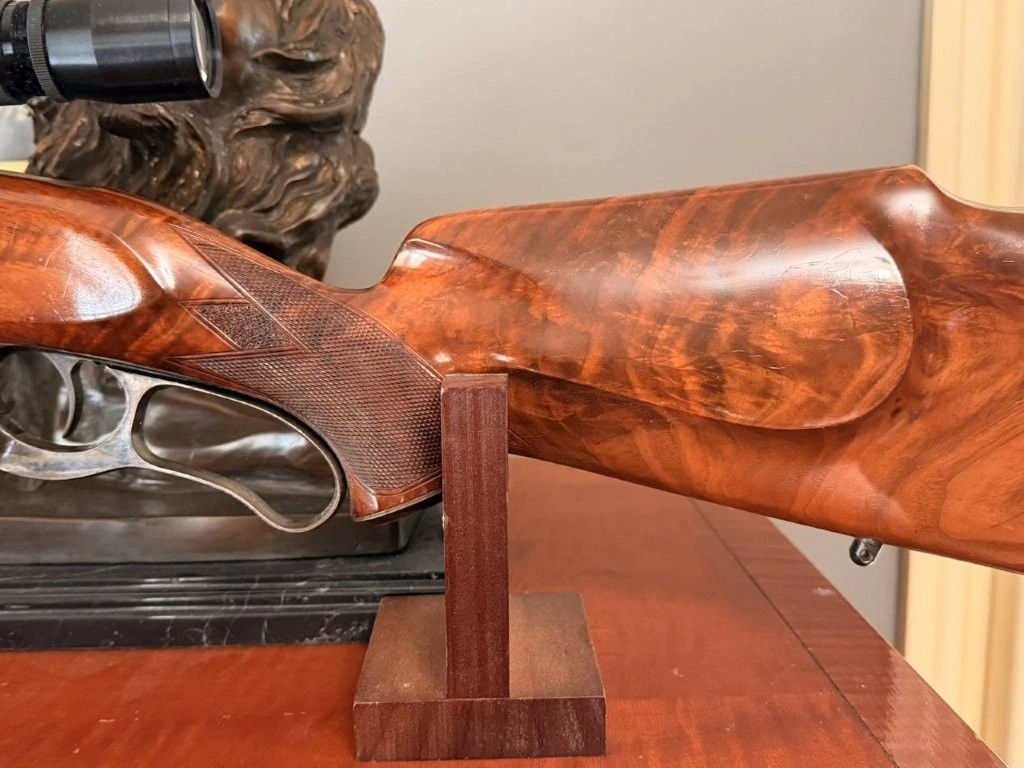
Identifying a Savage 99 is rarely as simple as reading one model stamp. Many rifles were marked primarily with company and cartridge information, model designations changed over time, and individual guns may have replacement stocks, barrels, sights, or refinished metal. The most reliable identification comes from comparing several features at once.
The First Six Things to Check
1. Serial number and date code
Use the serial number to establish the likely production period. For many 1949–1970 rifles, also inspect the front of the lever boss for an oval date code.
2. Rotary or detachable magazine
A brass cartridge counter generally indicates the classic rotary-magazine system. A removable box magazine immediately points toward later detachable-magazine variants such as the 99C.
3. Solid frame or takedown
Early rifles may have a takedown system allowing the barrel and forearm assembly to separate from the receiver. Matching assembly numbers and proper fit matter.
4. Safety location
Earlier rifles commonly use a lever-area safety, while later production may use a tang safety. The safety style helps establish the production family.
5. Stock and forearm
Straight grip, pistol grip, Schnabel forearm, rounded forearm, checkering, and buttplate style all provide important model clues.
6. Barrel and sights
Record barrel length, contour, caliber marking, front-sight base, rear sight, receiver sight, scope holes, and barrel address.

Savage 99 Model and Variation Comparison
This table is a practical starting point, not a substitute for a detailed reference book. Savage reused some letter designations, changed specifications within a model, and produced special-order or transition rifles that do not fit a simplified chart.
| Model or variation | General era | Primary identification clues |
|---|---|---|
| Model 1895 | 1895–1899 | Early predecessor built under contract by Marlin; exposed visual differences from later production and especially important to verify carefully. |
| Model 1899 | 1899–1920 | Immediate predecessor to the Model 99 name; many early variations, takedown configurations, and period-specific barrel markings. |
| 99A | Several eras | Basic solid-frame sporting rifle designation reused in different periods; exact identification depends heavily on serial range, barrel length, safety, and stock details. |
| 99B | Early 20th century | Often associated with takedown rifle configurations; verify barrel profile, forearm, sights, and matching assembly numbers. |
| 99C | Postwar | Detachable-box-magazine version. The removable magazine is its quickest identifying feature. |
| 99D / 99DL | Postwar | Deluxe-style variants generally associated with upgraded trim, checkering, stock treatment, and configuration details. |
| 99E | Postwar economy model | Plainer finish and stock treatment than higher-grade variants; frequently encountered as a practical hunting rifle. |
| 99EG | Prewar and postwar | One of the best-known solid-frame hunting configurations, commonly recognized by its pistol-grip stock and Schnabel-style forearm, though individual rifles can differ. |
| 99F | Postwar | Lightweight “Featherweight” configuration. Barrel contour, stock dimensions, and chambering help separate it from similar models. |
| 99G | Early 20th century | Deluxe takedown configuration commonly associated with pistol grip and higher trim level. |
| 99H | Early 20th century | Lightweight or carbine-style variation in several catalog periods; details changed over time. |
| 99R | Mid-20th century | Rifle configuration often identified by heavier forearm and pistol-grip stock; commonly drilled and tapped in later production. |
| 99RS | Mid-20th century | Factory sight-equipped variation related to the 99R, generally associated with receiver sight equipment. |
| 99T | 1930s | Target-oriented configuration with distinctive stock and forearm proportions; scarce and highly studied by collectors. |
| 99PE | Late production | Presentation-grade engraved model with premium wood and decorative treatment. |
| 99CD | Late production | Detachable-magazine model with higher-grade styling than basic economy versions. |
Physical Features That Separate Similar Savage 99 Models
Rotary magazine and cartridge counter
The classic spool-type rotary magazine is one of the defining features of the 1895, 1899, and most Model 99 rifles. Many examples have a brass counter visible through the receiver. Check that the counter advances correctly and that its markings and finish are appropriate for the rifle’s era.
Detachable magazine
A detachable box magazine changes the identification path immediately. Confirm that the magazine is a proper Savage unit for the rifle and that the receiver and stock inlet have not been altered.
Takedown versus solid frame
Takedown rifles have a barrel and forearm assembly intended to separate from the receiver. Look for the proper release arrangement, matching assembly numbers where applicable, and a tight joint. A loose or mismatched takedown assembly can affect both identification and collector value.
Lever shape and safety
Lever contours, lever finish, and safety placement changed during the long production life. A tang safety normally indicates a later configuration than the traditional lever-area safety, but it should still be evaluated alongside the serial range and model features.
Stock wrist and buttstock
A straight-grip stock, pistol-grip stock, Monte Carlo comb, checkering pattern, grip cap, sling hardware, and buttplate or recoil pad can all help—or mislead. Stocks are among the most frequently replaced or modified components.
Forearm shape
The Schnabel forearm is strongly associated with many familiar 99 configurations, but rounded and fuller forearms also appear. Compare the forearm profile, checkering, takedown hardware, and fit at the receiver.
Barrel length, contour, and markings
Measure the barrel correctly from the closed bolt face to the muzzle. Record the caliber marking and complete barrel address. A barrel whose markings or contour do not match the receiver era may be a replacement.

Markings to Photograph Before Researching
- Complete serial number and its exact location
- Barrel address and patent markings
- Caliber designation
- Any model designation
- Lever-boss oval and letter code
- Assembly numbers on takedown components
- Proof, inspector, or factory stamps
- Scope-base holes and receiver-sight holes
- Buttplate, grip cap, sling swivels, and stock markings
Common Alterations That Complicate Identification
Replacement wood, shortened barrels, aftermarket recoil pads, refinishing, added sling swivels, nonfactory checkering, drilled scope holes, replacement sights, and rechambering can make a rifle appear to be a different model. A beautifully modified rifle may still be desirable, but it should not be described as factory-original without supporting evidence.
A Reliable Identification Workflow
- Record the serial number and estimate the production era.
- Check for a lever-boss date code.
- Determine rotary magazine or detachable magazine.
- Determine solid frame or takedown.
- Identify lever safety or tang safety.
- Measure barrel length and record caliber and barrel address.
- Document stock, forearm, checkering, buttplate, sights, and scope holes.
- Compare the complete feature set with a specialized Savage 99 reference.
- Seek a factory record or expert review when originality materially affects value.
Related Savage 99 Research
Use the Savage 99 Serial Number Lookup Tool for an initial date estimate, then verify the result against the Savage 99 Manufacturing Date Tables. The upcoming guides on safety variations, rotary magazines, calibers, and collector value will provide additional identification layers.
For a collector example involving nonstandard features, read the customized Savage 99 collector article. For company history and related models, explore the Savage Arms collector hub.
Savage 99 Collector Series
Use the complete Savage 99 research series to confirm the rifle’s date, safety, magazine, caliber, originality, and collector context.

About Greg Cook
Greg Cook writes about firearms collecting, personal history, and the stories behind interesting guns. His Army MOS was 76Y, Unit Armorer, and he brings that practical background to his collector articles.
Sources Consulted
- David Royal, A Collector’s Guide to the Savage 99 Rifle and Its Predecessors, the Model 1895 and 1899.
- Douglas P. Murray, The Ninety-Nine: A History of the Savage Model 99 Rifle.
- Period Savage Arms catalogs and model descriptions for configuration terminology and production-era comparison.
- Savage99.com reference material covering models, serial numbers, and lever-boss date codes.
- Buffalo Bill Center of the West, Cody Firearms Records Office, for the scope and limitations of surviving Savage factory records.