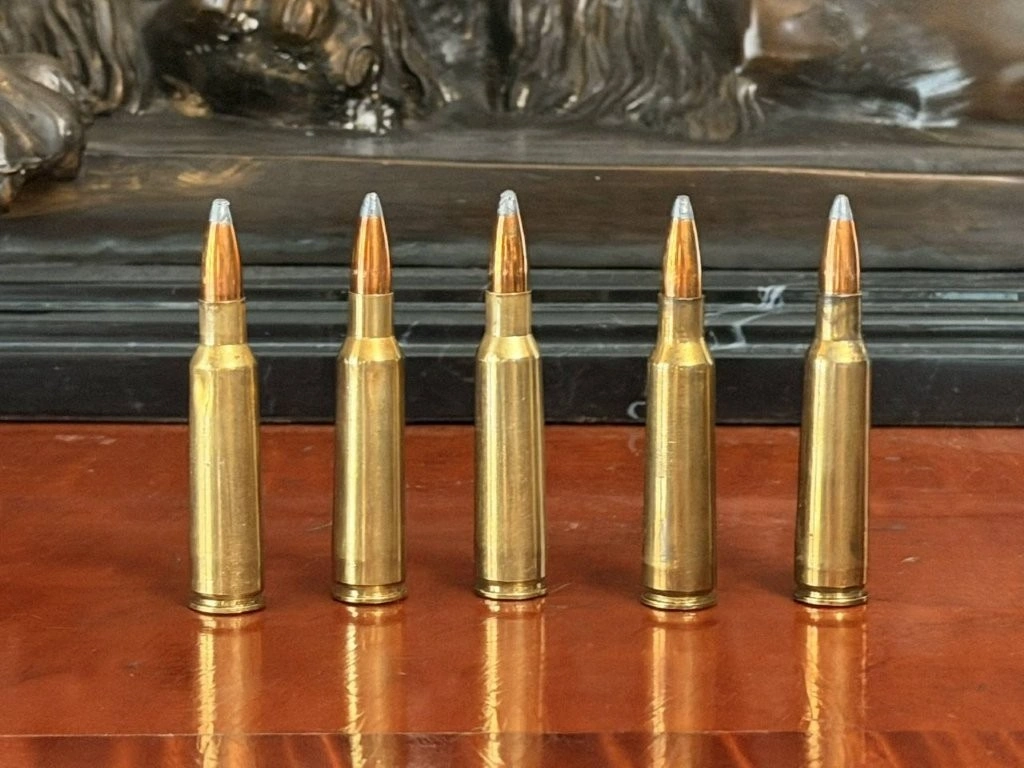
The caliber marking is one of the first details to record on any Savage 99. Chambering can help establish the production era, narrow the likely model, explain magazine and barrel differences, and substantially affect collector demand. Some chamberings are common and practical; others are scarce enough that originality must be verified carefully.
The Signature Savage 99 Chamberings
.303 Savage
The original proprietary chambering and a defining cartridge of the earliest Savage lever actions. It should not be confused with .303 British.
.250-3000 Savage
Introduced in 1915 and famously advertised at 3,000 feet per second with an 87-grain bullet. Later commonly called the .250 Savage.
.300 Savage
The classic all-around Model 99 chambering and one of the cartridges most closely associated with the rifle.
.22 Savage Hi-Power
A specialized early high-velocity .22 centerfire with unique ammunition considerations and strong period character.

Savage 1895, 1899, and Model 99 Chambering Guide
The table summarizes the major documented chamberings associated with the Savage lever-action family. Exact production years and model availability varied, and special-order, transition, and limited-production rifles require specialized references.
| Chambering | General introduction | Where encountered | Collector notes |
|---|---|---|---|
| .303 Savage | Original proprietary chambering | Early 1895/1899 and later rifles | Foundational Savage cartridge; often loaded with heavier bullets than the .30-30; ammunition availability is now a major collector and shooter concern. |
| .30-30 Winchester | Early addition | Model 1899 and later | Common, practical, and historically important. Usually less scarce than proprietary Savage chamberings. |
| .25-35 Winchester | Early 20th century | Model 1899 variations | Light-recoiling period chambering; originality and bore condition matter greatly. |
| .32-40 Winchester | Early 20th century | Early Model 1899 rifles | Traditional black-powder-era sporting cartridge carried into early smokeless years; comparatively scarce in Model 1899 rifles. |
| .38-55 Winchester | Early 20th century | Early Model 1899 rifles | Large-bore early chambering with strong collector interest; check bore dimensions and chamber condition carefully. |
| .22 Savage Hi-Power | Introduced in the early 1910s | Model 1899 and Model 99 | Distinctive high-velocity .22 centerfire designed for the Savage action; ammunition and correct bullet diameter require special attention. |
| .250-3000 Savage / .250 Savage | Introduced in 1915 | Model 1899 and Model 99 | Famous as the first commercial American cartridge advertised at 3,000 fps; one of the signature Savage chamberings. |
| .300 Savage | Introduced in the early 1920s | Model 99 | The dominant classic chambering for many collectors and hunters; intended to approach .30-06 performance in a shorter case. |
| .243 Winchester | Mid-1950s onward | Postwar Model 99 variations | Flat-shooting dual-purpose chambering; popular in later rifles and useful for separating postwar model families. |
| .308 Winchester | Mid-1950s onward | Postwar Model 99 variations | Powerful and widely available; one of the most practical later chamberings, but receiver and model condition remain important. |
| .358 Winchester | Mid-1950s onward | Postwar Model 99 variations | Large-bore short-action chambering with strong collector demand; often commands a premium when original. |
| .284 Winchester | Later postwar production | Selected Model 99 variations | Unusual rebated-rim cartridge offering near-long-action performance; scarce and closely watched by collectors. |
| .375 Winchester | Late production | Selected later Model 99 variations | Powerful late chambering associated with scarce production; verify model, barrel, and factory originality. |
| 7mm-08 Remington | Late production | Limited late Model 99 production | Modern short-action chambering found in relatively scarce late rifles. |
| .22-250 Remington | Late production | Limited late Model 99 production | High-velocity varmint chambering in uncommon later rifles; authenticity deserves careful verification. |
| .410 bore | Special configuration | Interchangeable or special-purpose barrel arrangements | Not a standard rifle cartridge chambering in the ordinary sense; encountered in special combinations and should be documented carefully. |
How Caliber Helps Identify a Savage 99
Match the chambering to the production era
An early proprietary cartridge such as .303 Savage belongs to a different production context than a late 7mm-08 or .375 Winchester rifle. When the serial number, safety, magazine, and barrel marking all point to the same period, identification becomes much stronger.
Read the barrel marking exactly
Photograph the complete caliber stamp, including punctuation and wording. “.250-3000 Savage” and “.250 Savage” describe the same basic cartridge family but can reflect different marking eras. “.303 Savage” is not interchangeable with “.303 British.”
Look for rebarreling or rechambering
Compare barrel finish, address style, proof marks, sight bases, contour, and fit to the receiver. A barrel may be a genuine Savage part but still be from a different rifle or period. Rechambered rifles may have altered or added markings.

Early Traditional Chamberings
The Model 1899 expanded beyond .303 Savage to include established sporting rounds such as .30-30 Winchester, .25-35 Winchester, .32-40 Winchester, and .38-55 Winchester. These rifles connect the Savage design to the transition from black-powder-era cartridges into smokeless sporting use.
Condition is especially important. Dark bores, altered chambers, replacement sights, shortened barrels, and refinishing are common on rifles that spent decades as working hunting arms.
Postwar and Late-Production Chamberings
The arrival of .243 Winchester, .308 Winchester, and .358 Winchester in the mid-1950s brought modern short-action cartridges to the Model 99. Later rifles appeared in less common chamberings including .284 Winchester, .375 Winchester, 7mm-08 Remington, and .22-250 Remington.
These later chamberings can bring substantial premiums, but scarcity also creates an incentive for incorrect descriptions and assembled rifles. Verify that the model, serial range, magazine, barrel address, and stock configuration are consistent.
How Caliber Affects Collector Value
- Scarcity: Less common factory chamberings often command premiums.
- Originality: A scarce caliber adds value only when the barrel and configuration are authentic.
- Ammunition availability: Common ammunition can increase shooter demand, while obsolete ammunition may restrict practical use.
- Model association: Some chamberings are strongly tied to particular models or periods.
- Condition: Bore condition matters especially on older, corrosive-ammunition-era rifles.
- Provenance: Factory records, period documentation, and an unbroken ownership history can support a rare configuration.
Ammunition and Shooting Considerations
Some classic Savage cartridges are intermittently available or require careful handloading. Old ammunition may be collectible rather than suitable for firing. Before shooting, inspect the rifle mechanically, verify headspace and bore condition where appropriate, and use ammunition loaded to suitable specifications for the firearm.
The .22 Savage Hi-Power deserves particular care because bullet diameter and loading practices differ from more familiar modern .22 centerfires. The .303 Savage must never be confused with .303 British. The .250-3000 and .300 Savage remain better supported, but availability can still vary.
Caliber Verification Checklist
- Verify the rifle is unloaded.
- Photograph the complete caliber marking.
- Record the complete serial number.
- Compare barrel address and proof marks with the receiver era.
- Inspect for added, altered, or double-struck markings.
- Measure barrel length and compare the contour with the claimed model.
- Check magazine type and cartridge-counter configuration.
- Confirm the chambering with a gunsmith before firing if anything is uncertain.
Related Savage 99 Research
Use the Savage 99 Model Identification Guide to compare caliber with the complete rifle configuration. The Rotary Magazine Guide explains why the action handled pointed bullets so effectively, while the Manufacturing Date Tables help place each chambering in its likely production era.
Savage 99 Collector Series
Confirm the chambering against the serial era, model configuration, and collector-value factors.

About Greg Cook
Greg Cook writes about firearms collecting, personal history, and the stories behind interesting guns. His Army MOS was 76Y, Unit Armorer, and he brings that practical background to his collector articles.
Sources Consulted
- David Royal, A Collector’s Guide to the Savage 99 Rifle and Its Predecessors, the Model 1895 and 1899.
- Douglas P. Murray, The Ninety-Nine: A History of the Savage Model 99 Rifle.
- Period Savage Arms catalogs, advertisements, owner literature, and cartridge listings.
- American Rifleman historical coverage of the Savage Model 99 and its major chamberings.
- Buffalo Bill Center of the West, Cody Firearms Records Office, for the scope and limitations of surviving Savage factory records.