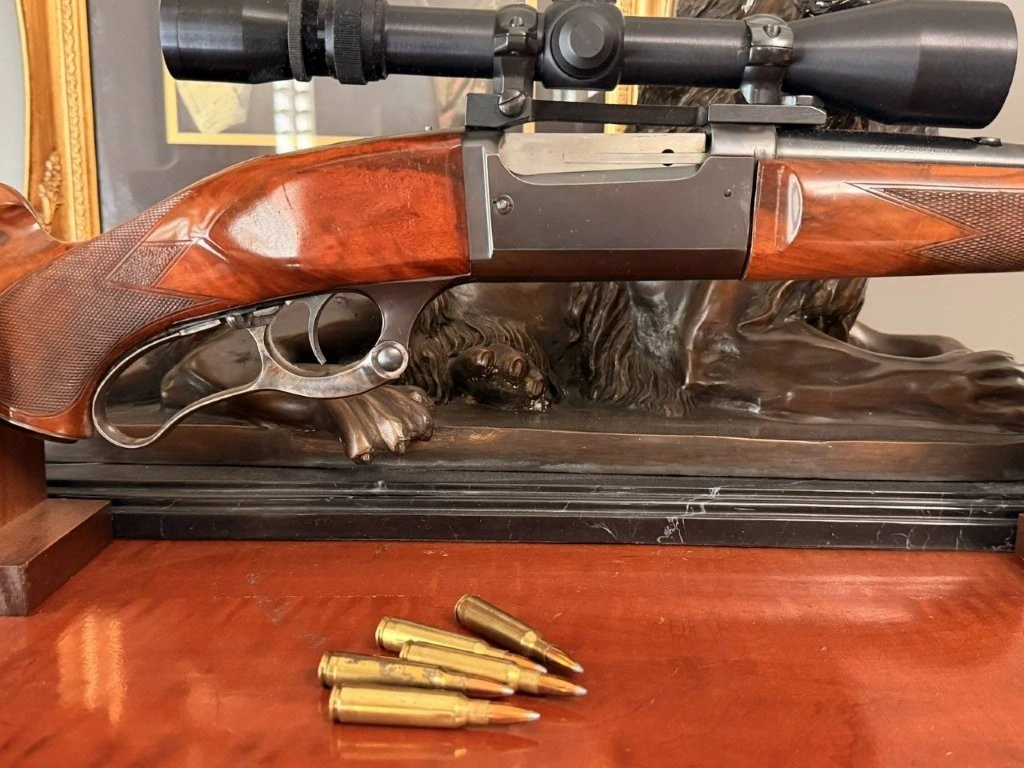
This lookup estimates when a Savage Model 1895, Model 1899, or Model 99 falls within published serial-number ranges. It is a collector research aid, not a factory letter. Savage rifles were not always completed or shipped in strict serial-number order, so the result should be treated as an informed estimate.
Look Up Your Savage 99
After you date it
Three things that help once you have a year: the Savage 99 book, a humidity gauge for the safe, and synthetic gun oil. Paid links. As an Amazon Associate, Gun Collectors Club earns from qualifying purchases.
- The Savage 99 Pocket Reference the first book with details of all of the significant models and variations of Savage 1895's, 1899's and 99's.
- TempPro TP50 hygrometer Same unit as the ThermoPro TP50 on the humidity guide. Cheap, and it tells you if the safe is wet.
- Birchwood Casey Synthetic Gun Oil 10-Ounce Aerosol Long-Lasting Gun Lubricant The natural solvency of Synthetic Gun Oil cleans as it oils while its low evaporation rate assures protection against rust.
Amazon does not sell firearms. More titles: Gun Collectors storefront. Guides hub: serial number guides.
How to Use the Savage 99 Serial Number Lookup
Record the complete receiver serial number exactly as stamped. Keep all letters in the serial-number field; spaces and commas are removed automatically. Numeric serials are compared with published year-end totals and production ranges. Letter-prefixed and other lettered serials require a separate reference and are never dated by discarding their letters.
If the rifle has an oval lever-boss stamp from the applicable period, record the letter separately and enter it as a second dating clue. The letter represents a year; the preceding number or numbers identify an inspector and are not part of the date code.
- Confirm that the firearm belongs to the Savage 1895, 1899, or Model 99 family.
- Enter the complete receiver serial number in the serial-number field.
- Add the lever-boss letter when it is present and legible.
- Compare the two results and note whether they agree on the likely period.
- Verify the barrel address, safety, magazine design, stock configuration, sights, caliber, and model features.
If the serial estimate and lever-boss code disagree, do not force an exact year. Recheck the stamp for a misread letter, consider whether a part was replaced, and describe the result as an approximate period until factory records or model-specific research resolve the conflict.
How the Lookup Works
For serial numbers through 1950, the tool compares the entered number with published year-end totals. For 1951–1968, it uses published numeric serial ranges. Letter-prefixed and other lettered serials are outside these tables; the result preserves the complete serial and links to the Savage Levers serial-number reference. Do not split a receiver serial into a number and a date code. A separate lever-boss letter code can provide an additional year indicator for many rifles from 1949 through 1970.

Lever-Boss Date Codes, 1949–1970
On many Model 99 rifles, the code appears on the front of the lever above the serial number. The letter indicates the year; one or two preceding numbers identify an inspector. Savage skipped the letters O and Q.
| Code | Year | Code | Year |
|---|---|---|---|
| A | 1949 | M | 1961 |
| B | 1950 | N | 1962 |
| C | 1951 | P | 1963 |
| D | 1952 | R | 1964 |
| E | 1953 | S | 1965 |
| F | 1954 | T | 1966 |
| G | 1955 | U | 1967 |
| H | 1956 | V | 1968 |
| I | 1957 | W | 1969 |
| J | 1958 | X | 1970 |
| K | 1959 | Y | Occasionally seen on 1971 rifles |
| L | 1960 | O/Q | Not used |
Why the Result Is an Estimate
Published dates can represent different manufacturing milestones depending on the era: factory acceptance, shipment, or the point when a receiver was numbered. Rifles were not always finished or shipped in numerical order, and uncommon configurations could remain in inventory longer than popular ones.

Confirming the Model and Date
After using the lookup, compare the result with the barrel address, safety type, magazine design, stock configuration, sights, chambering, and model markings. The supporting Savage 99 guides will separate those identification questions from the date estimate. For Savage company history and related models, visit the Savage Arms collector hub.
Savage 99 Serial Number Lookup FAQ
How do I use the Savage 99 serial number lookup?
Enter the complete receiver serial number, including any letters. Numeric serials are checked against the built-in tables; lettered serials are referred to a separate reference. Enter a lever-boss letter only if it comes from a separate oval stamp, not from the receiver serial. Compare the estimated period with the model features, barrel address, safety, magazine, caliber, and other markings before accepting the result.
Can a serial number confirm the exact manufacture year of a Savage 99?
A serial-number range normally estimates a production, acceptance, or shipping period rather than proving an exact manufacture date. Rifles were not always completed or shipped in strict serial order, so factory records are stronger documentation when available.
What markings should I check when the serial number alone is inconclusive?
Check the barrel address and model marking, lever-boss date code, safety style, rotary or detachable magazine, cartridge counter, stock and forearm shape, takedown or solid-frame construction, sights, and chambering. These features help distinguish Savage 1895, 1899, and Model 99 variations.
Where is the serial number on a Savage Model 99?
The serial number location varies with production era and configuration, but it is normally found on the receiver or nearby metal surfaces. Record the complete number without confusing it with an inspector mark or the separate lever-boss date stamp.
How do I perform a broader Savage serial number search?
First identify the firearm family and model because Savage used different numbering and date systems across rifles and shotguns. For an 1895, 1899, or Model 99, use the receiver serial range, lever-boss code when present, and model-specific physical features together.
Savage 99 Collector Series
Estimate the production period, then continue with the supporting identification, mechanical, caliber, value, and gallery references.

About Greg Cook
Greg Cook writes about firearms collecting, personal history, and the stories behind interesting guns. His Army MOS was 76Y, Unit Armorer, and he brings that practical background to his collector articles.
Sources Consulted
- Vintage Gun Scopes, “Savage Model Ninety-Nine Serialization,” year-end totals and 1951–1968 serial ranges.
- Savage Levers, “Savage Serial Numbers—What the Date Means,” dating limitations and lever-boss code guidance; serial-number reference for later letter-prefixed and special-production rifles.
- Buffalo Bill Center of the West, Savage factory-record availability and factory-letter information.
- David Royal, A Collector’s Guide to the Savage 99 Rifle and Its Predecessors, the Model 1895 and 1899.