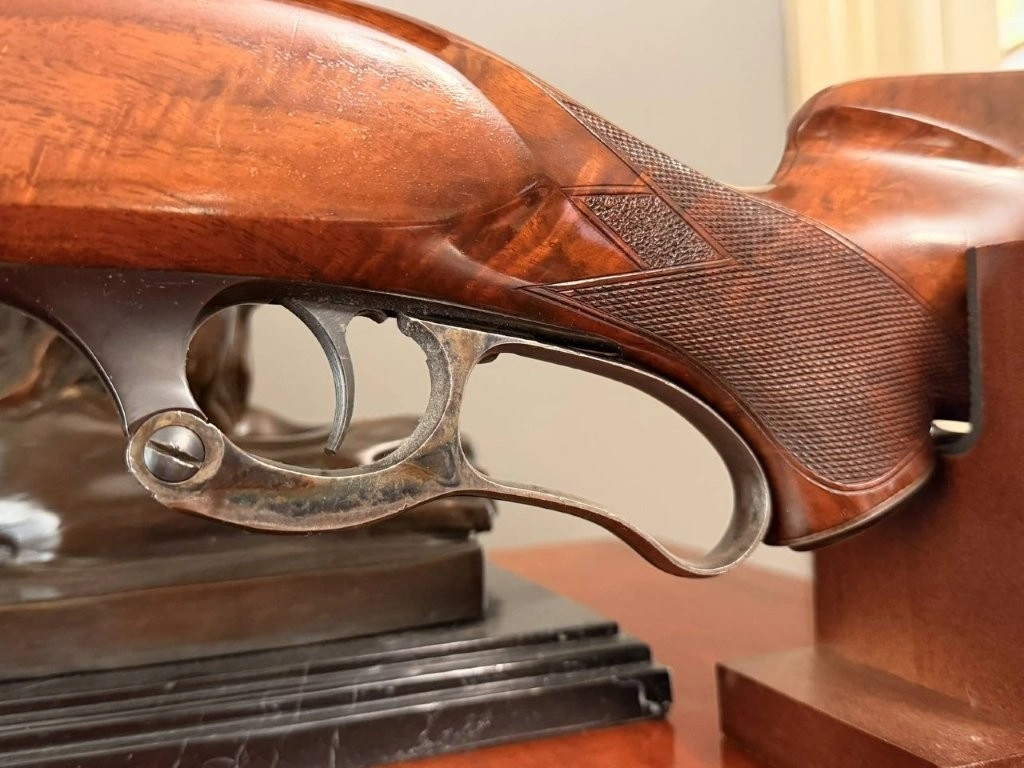
The safety system is one of the fastest ways to place a Savage 99 into the correct production family. Early and mid-production rifles generally use a safety associated with the lever and lower receiver area, while later rifles may use a tang-mounted safety. The safety should never be interpreted by itself, but it is a powerful identification clue when combined with serial number, model configuration, magazine type, and barrel markings.
Why the Safety Matters to Collectors
The Savage 99 remained in production for roughly a century, and its safety system changed along with the rifle. Because the safety is built into the receiver and operating system, it is generally more difficult to change casually than a sight, buttplate, or stock. That makes it more trustworthy than many cosmetic clues.
Even so, the safety must be evaluated in context. A later stock can be fitted to an earlier action, a lever can be replaced, and a refinished rifle can obscure inspection marks. The most reliable identification uses several independent clues that agree with one another.

Traditional Lever-Area Safety
Earlier and mid-production Savage 99 rifles commonly use a safety positioned in or near the lever and lower receiver area. Depending on the production period, the control may appear as a sliding or moving component that blocks operation until placed in the firing position.
What to inspect
- Exact location of the safety control
- Shape and finish of the lever
- Fit between lever and receiver
- Presence of wear consistent with the rifle
- Markings or arrows indicating safe and fire
What it usually suggests
A traditional lever-area safety generally points toward an earlier or middle production configuration rather than the final tang-safety period. The serial number and model details should confirm that conclusion.
Lever fit and lockup
The lever should close fully and fit the receiver without unusual gaps. Excessive movement, mismatched finish, altered geometry, or evidence of grinding may indicate replacement or repair. A safety that works only when the lever is forced tightly closed deserves careful mechanical inspection.
Finish consistency
Compare the lever finish with the receiver, screws, and adjacent parts. A case-colored lever on a rifle whose period and model normally used that treatment may be correct, while a freshly blued lever on a worn receiver may indicate replacement or refinishing.
Later Tang-Safety Variations
Later Savage 99 production moved the safety to the tang behind the receiver. This location is immediately visible from above and is one of the clearest signs that the rifle belongs to a later production family.
Advantages for identification
The tang safety is easy to see and difficult to confuse with the traditional lower safety. It also changes the stock inlet and tang area, so the surrounding wood should match the receiver design.
Questions to ask
- Does the serial range agree with late production?
- Does the stock fit the tang and safety correctly?
- Is the rifle rotary-magazine or detachable-magazine?
- Do the barrel address and model markings agree?
A tang-safety rifle should not be forced into an earlier model identification simply because its stock or forearm resembles an older configuration. Savage retained familiar styling while changing internal and receiver details.
Lever-Boss Date Codes and Inspector Marks
Many Savage 99 rifles made from 1949 through 1970 carry a small oval stamp on the front of the lever boss. The mark normally combines one or two inspector numbers with a letter identifying the year. The letters O and Q were skipped in the commonly used sequence.
The lever-boss code is not the safety itself, but collectors often examine both features at the same time because they occupy the same general area. A faint date code can be overlooked unless the lever is opened and the front surface of the boss is cleaned carefully and viewed under angled light.

How the Rotary Magazine Counter Fits the Identification
The brass cartridge counter is not a safety component, but it is an important companion clue. A classic rotary-magazine receiver with a visible counter usually belongs to a different production family than a later detachable-magazine rifle. When the counter, safety type, serial range, and stock configuration all agree, model identification becomes much stronger.
Check that the counter advances correctly, that its numbers are legible, and that its finish and wear match the rest of the receiver. A newly polished counter in an otherwise worn rifle may not be evidence of a different model, but it may indicate restoration or parts replacement.
Safety and Production-Clue Comparison
| Feature | General production implication | What else to verify |
|---|---|---|
| Lever-area safety | Earlier or middle production family | Serial range, lever finish, model configuration, barrel address |
| Tang safety | Later production family | Stock inlet, detachable or rotary magazine, late barrel markings |
| Lever-boss date code | Commonly useful for 1949–1970 rifles | Letter interpretation, serial range, inspector numbers |
| Brass cartridge counter | Classic rotary-magazine system | Function, finish, receiver type, model family |
| Detachable magazine | Later detachable-magazine variants | Magazine fit, model marking, stock and receiver configuration |
Alterations That Can Mislead You
- Replacement lever with a different finish or contour
- Replacement stock fitted around a tang safety
- Refinishing that softens or obscures markings
- Polished or replaced magazine counter
- Mixed parts from rifles of different production periods
- Modified safety components or gunsmith repairs
Savage 99 Safety Inspection Checklist
- Unload the rifle completely and verify the chamber and magazine are empty.
- Photograph the safety in both positions.
- Photograph the lever closed and open.
- Inspect the front of the lever boss for an oval date code.
- Record the complete serial number.
- Identify rotary magazine or detachable magazine.
- Compare lever and receiver finish.
- Inspect stock fit around the tang and lower receiver.
- Compare the result with the manufacturing-date and model-identification guides.
Related Savage 99 Guides
Use the Savage 99 Model Identification Guide to compare the safety with the rifle’s other physical features. Use the Manufacturing Date Tables and Serial Number Lookup Tool to establish the production period before assigning a model.
Savage 99 Collector Series
Use safety placement together with serial date, receiver details, and magazine features.

About Greg Cook
Greg Cook writes about firearms collecting, personal history, and the stories behind interesting guns. His Army MOS was 76Y, Unit Armorer, and he brings that practical background to his collector articles.
Sources Consulted
- David Royal, A Collector’s Guide to the Savage 99 Rifle and Its Predecessors, the Model 1895 and 1899.
- Douglas P. Murray, The Ninety-Nine: A History of the Savage Model 99 Rifle.
- Period Savage Arms catalogs and owner literature for safety placement, model descriptions, and operating terminology.
- Savage99.com reference material covering model variations, serial information, and lever-boss date codes.
- Buffalo Bill Center of the West, Cody Firearms Records Office, for the scope and limitations of surviving Savage factory records.