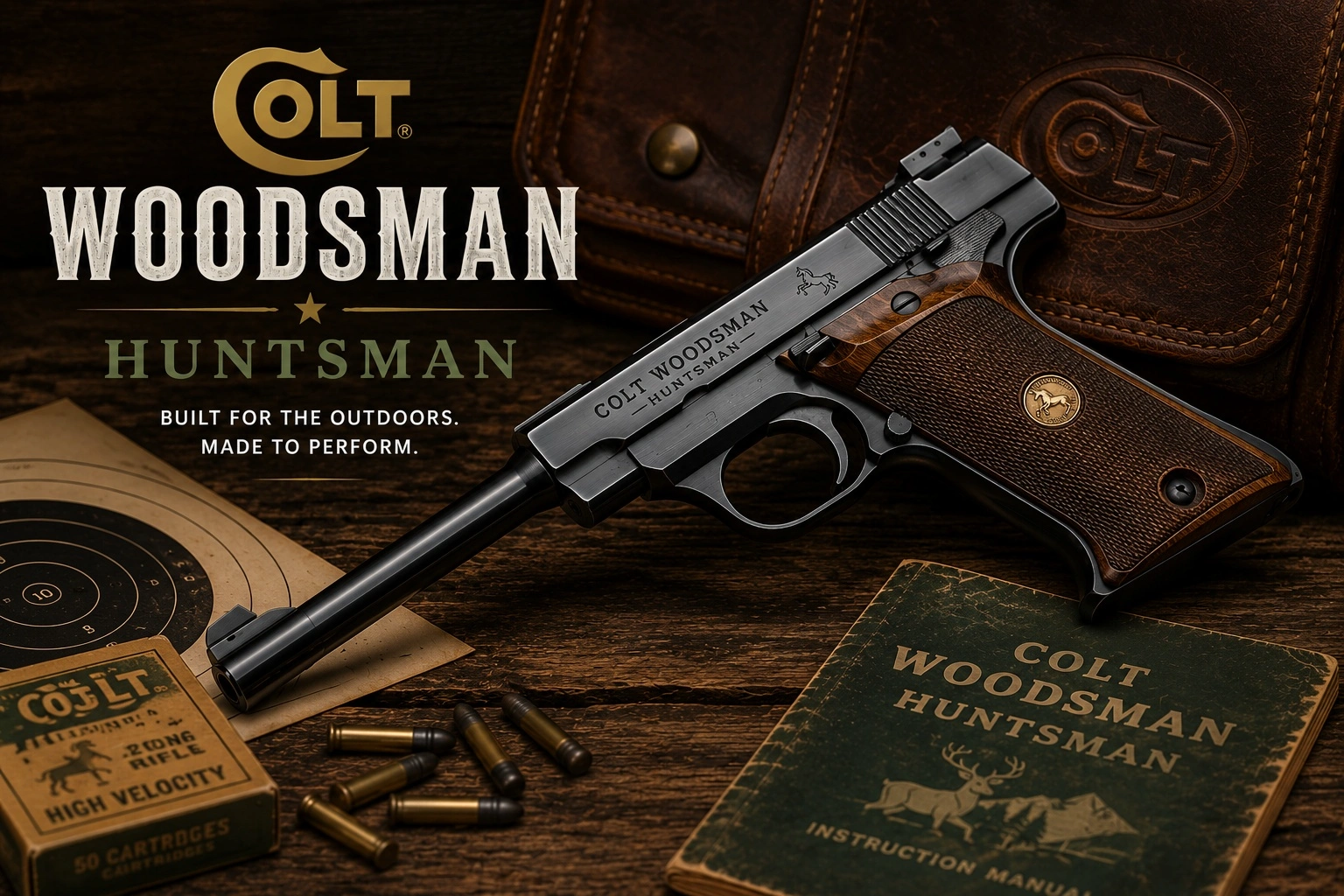
Cluster note: This Huntsman guide is part of the Colt Woodsman family cluster. For dating a pistol, use the Colt Woodsman serial number lookup, then confirm the production block in the Woodsman serial number master chart. For the big-picture model changes, start with the Woodsman generations guide.
For related date-of-manufacture research, use the Woodsman Huntsman research in the Colt serial-number lookup tool.
The Colt Woodsman Huntsman is one of those pistols that is easy to underestimate until you handle a good example. It was not the fanciest Woodsman. It was not the Match Target with the heavy barrel and target-grade reputation. It was not marketed as the premium version of Colt's rimfire line. The Huntsman was the practical one — the field pistol, the plinker, the trail companion, and the honest working member of the Woodsman family.
That practical identity is exactly why the Huntsman has become interesting to collectors. It represents Colt trying to keep the Woodsman concept alive for ordinary shooters in an era when price mattered, manufacturing costs were rising, and the American rimfire pistol market was becoming more competitive. The Huntsman carried the Woodsman feel into the field with fewer frills, fixed sights, and simplified trim, but it still belonged to the same broad family that began with the classic pre-war Colt Automatic .22 target pistols.
Quick Identification Summary
The Huntsman replaced the Challenger during the Third Series period. It generally belongs to the economical side of the Woodsman family, using fixed sights, plain field-pistol features, and a separate -C serial-number sequence before the late integrated serial block.
Where the Huntsman Fits in the Woodsman Family
The Woodsman line is best understood as a family rather than a single model. The First Series established the early Colt .22 automatic pistol design. The Second Series revised controls and introduced post-war changes. The Third Series made additional frame and magazine-catch changes and created the period in which the Huntsman belongs. The Huntsman is not merely a cheapened Woodsman; it is Colt's field-grade answer for shooters who wanted the dependable Colt rimfire experience without paying for adjustable sights or target-model extras.
Collectors sometimes place the Huntsman in the shadow of the Match Target, but that misses the point. The Huntsman was built to be carried, shot, and used. Its simplified sight arrangement reduced snagging and complexity. Its handling was familiar to Woodsman shooters. Its plainness made sense for woods, fields, and informal target shooting. A clean Huntsman today tells the story of practical Colt ownership as much as a Match Target tells the story of formal target competition.
Huntsman Versus Challenger
The Challenger came before the Huntsman and served a similar purpose: a lower-cost Woodsman-family pistol. The important difference is series and timing. The Challenger is associated with the Second Series period and its own -C serial-number block. The Huntsman replaced it in the Third Series period and began in the later -C sequence. That distinction matters because the pistols can look similar at a glance, and a quick serial-number reading without suffix context can lead to the wrong conclusion.
When identifying either model, never rely on the name alone. Check the serial format, the magazine catch, the sights, the slide marking, and the frame details. A Huntsman is part of the later Third Series story, and the physical features should support that conclusion. This is why the master chart and the generations guide belong together.

Major Identification Points
A proper Huntsman identification should begin with the pistol itself, not with a value chart. Look for the correct slide marking, fixed sight arrangement, grip style, magazine catch placement, and serial-number suffix. Original finish and unaltered parts matter, but model identification comes first.
| Feature | Collector Note |
|---|---|
| Model marking | The slide should support Huntsman identification; do not identify one from general Woodsman shape alone. |
| Sights | Fixed sights are a major practical-field feature and help distinguish the Huntsman from higher-grade target models. |
| Serial format | Early Huntsman examples use the Third Series -C suffix block; later production falls under integrated numbering. |
| Magazine catch | Third Series frame details are important; compare the catch location with the generations guide. |
| Condition | Original finish, correct grips, and unaltered sights have strong collector importance. |
Serial Numbers and Production Context
The Huntsman begins after the Challenger era and uses the Third Series -C suffix sequence. The related Targetsman later shared the same general sequence, which means the serial number alone may not always tell the full model story. Once the Targetsman appears, the slide marking and sights become essential. In early 1969 Colt moved into an integrated serial block for Woodsman-family production, so late guns require even more attention to physical features.
For that reason, the best research path is simple: use the lookup page for a fast estimate, then compare the result to the Huntsman and Targetsman table. If the pistol is valuable, unusual, or being purchased at a premium, confirm with factory records when practical.
Design Philosophy
The Huntsman is a reminder that not every collectible firearm started life as a deluxe item. Colt knew many shooters wanted a reliable .22 that could ride in a tackle box, travel to the farm, sit on a camp table, or handle an afternoon of informal shooting. The Huntsman answered that need. It retained the Woodsman character while avoiding features that raised cost or complicated use.
There is an honesty to the design. The fixed sights are not a flaw; they are part of the pistol's purpose. The plain finish and simpler presentation are not signs of failure; they are signs of a model built for use. A Huntsman in honest condition often feels more connected to the field than a pristine target pistol that spent its life in a box.
Barrel Lengths and Field Balance
Huntsman pistols are often encountered with practical barrel lengths that make sense for carry and informal shooting. The balance differs from the Match Target and from longer-barreled target-oriented Woodsman variants. The result is a pistol that points naturally and carries easily. For a collector, barrel length should be considered together with condition, originality, and serial range rather than as an isolated value factor.
Grips, Magazines, and Originality
Original grips matter on any Woodsman-family pistol, and the Huntsman is no exception. Worn but correct grips are often preferable to attractive replacements when collector value is the goal. Magazines are another common problem area. A pistol can be mechanically sound with a replacement magazine, but a correct magazine adds confidence and helps complete the package.
Refinishing is the great value destroyer. A bright reblue can look attractive in photographs, but collectors usually prefer honest original wear. Before paying a premium, examine screw slots, rollmark sharpness, edges, grip fit, and the overall consistency of the finish. A Huntsman should look like a Colt, even when it has been used.
Values and Buying Advice
The Huntsman often sits in a favorable value position. It is usually less expensive than the highest-grade Woodsman target models, but it still carries the Colt name and the Woodsman family connection. That makes it appealing for collectors who want a representative Woodsman without immediately stepping into Match Target pricing.
| Condition / Package | Collector Interpretation |
|---|---|
| Field-worn shooter | Best judged as a practical pistol; value depends on mechanical condition and originality. |
| Clean original example | The sweet spot for many collectors; attractive, usable, and still connected to honest field use. |
| Boxed example | More desirable, especially with correct papers, magazine, and accessories. |
| Refinished pistol | Often worth less to collectors, even if mechanically excellent. |
| Altered sights or grips | Usually a negative unless priced as a shooter. |
My own rule on a Huntsman is simple: buy originality first, condition second, and price third. A clean but ordinary Huntsman can be a very satisfying addition to a Woodsman group. A heavily altered one should be priced as a shooter, not as a collector-grade pistol.
Common Mistakes Collectors Make
The first mistake is treating every economy Woodsman as the same pistol. The Challenger and Huntsman are related in purpose, but they do not occupy the same production period. The second mistake is ignoring suffixes. On Woodsman pistols, the letters matter. The third mistake is assuming a fixed-sight pistol has no collector interest. In truth, the Huntsman represents an important part of Colt's rimfire strategy.
Another mistake is overpaying for cosmetics while ignoring originality. A polished refinish can erase edges and soften rollmarks. Replacement grips can make a pistol look better at a glance while reducing collector confidence. The best Huntsman is not necessarily the shiniest one; it is the one that still looks like itself.
Comparison with Other Woodsman Models
| Model | Role | Collector Difference |
|---|---|---|
| First Series | Original foundation model | Pre-war and early production appeal dominates. |
| Sport | Compact sporting pistol | Often more refined than the budget models. |
| Target | Target and range use | Adjustable sights and target features increase interest. |
| Match Target | Premium target model | Heavy barrel and Match Target identity create strong collector demand. |
| Challenger | Second Series economy model | Predecessor to the Huntsman in purpose. |
| Huntsman | Third Series field/economy model | Practical fixed-sight pistol with strong shooter appeal. |
Colt Woodsman Research Cluster
Use these pages together. The lookup page is the quick entry point, the master chart confirms serial blocks, and the generations guide explains the model changes. The Match Target guide is the only Woodsman page in this group using the .htm extension.
FAQ
Is the Colt Huntsman a real Woodsman?
Yes. It is part of the Woodsman family, but it is the simplified field/economy model rather than the premium target version.
Is the Huntsman less collectible than a Match Target?
Usually, yes in terms of price and demand. But it is still collectible, especially when original, clean, and correctly identified.
What is the best first step for dating one?
Use the Woodsman serial number lookup, then check the master chart for the proper serial block.
What should I watch for before buying?
Check originality, finish, grips, magazine, sight alterations, serial suffix, and whether the slide marking supports Huntsman identification.

About Greg Cook
Greg Cook writes about firearms collecting, personal history, and the stories behind interesting guns. His Army MOS was 76Y, Unit Armorer, and he brings that practical background to his collector articles.
Sources Consulted
- Colt factory catalogs, period advertising, and Woodsman family literature.
- Colt Woodsman serial-number production references and collector observations.
- Sutherland, R. Q. and Wilson, R. L. The Book of Colt Firearms.
- Wilson, R. L. The Colt Heritage.
- Gun Collectors Club Woodsman research notes and comparative model study.
Serial-number ranges and production notes should be treated as collector references, not factory letters. For a high-value pistol, confirm with Colt factory records when available.