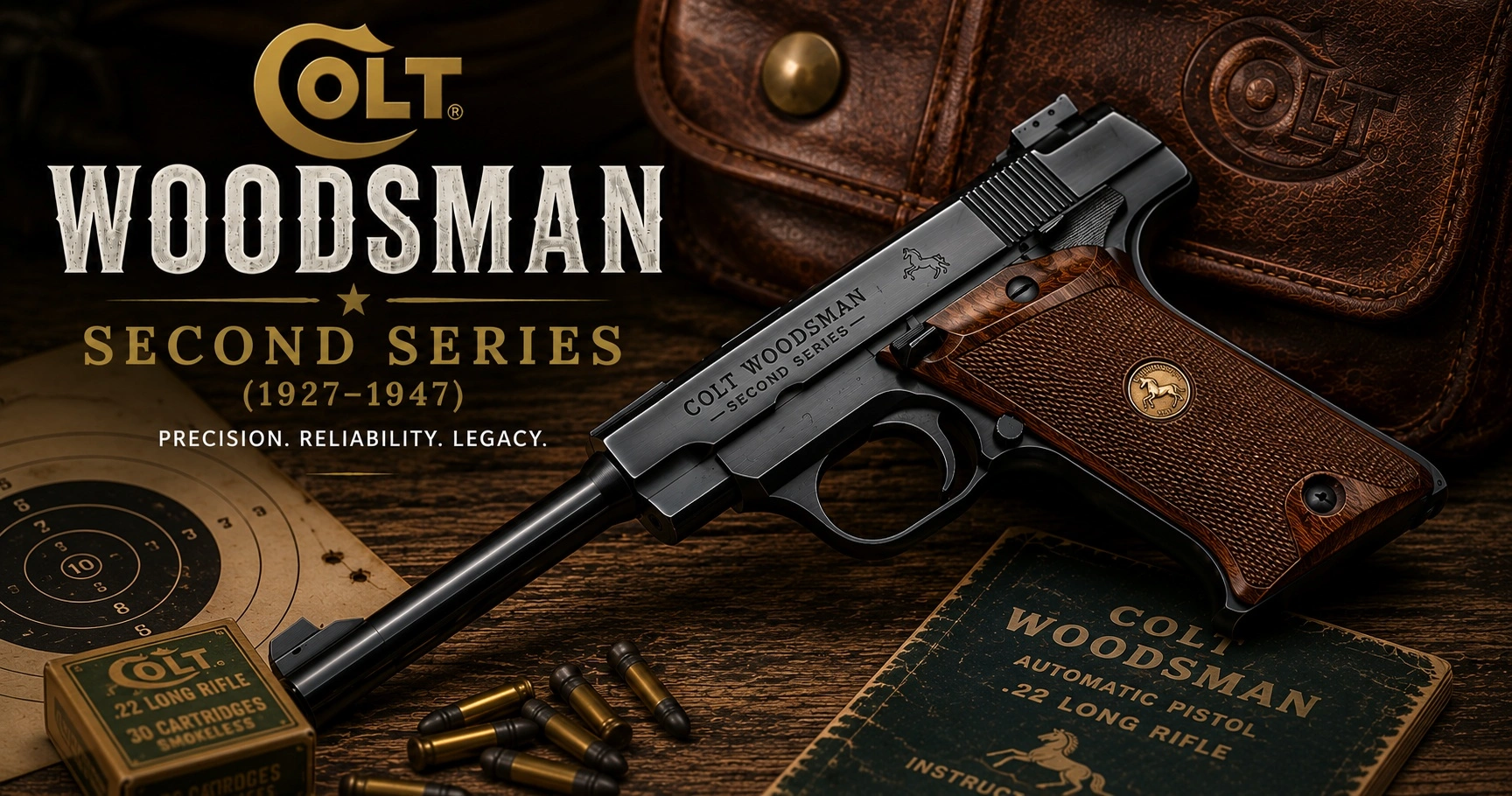
The Colt Woodsman Second Series is the post-war bridge in the Woodsman story. It is not the earliest Woodsman, and it is not the final Third Series pattern, but it may be the most interesting transition model for collectors who like mechanical evolution. It carried the Woodsman name into the late 1940s and early 1950s with a redesigned frame, a push-button magazine release, added safety features, and enough old Colt character to keep it firmly connected to the pre-war pistols.
To compare this firearm with Colt production records, use the Second Series Woodsman research in the Colt serial-number lookup tool.
Start With the Serial Number
The Second Series is easiest to identify when the serial number format and physical features agree. Sport, Target, and Match Target pistols use the hyphenated -S serial system, while the Challenger uses a separate hyphenated -C block.
For me, the Second Series is where the Woodsman becomes a post-war Colt without losing its soul. The lines are still graceful, the trigger still has the clean rimfire feel collectors expect, and the pistol still points naturally. But the details changed. Colt was no longer simply making the old First Series pistol. It was adapting the Woodsman for a new market, a new legal and safety climate, and a new generation of shooters who wanted an accurate .22 automatic for target work, informal practice, and field use.
The Second Series is the Woodsman in transition: old enough to feel like a classic Colt, modern enough to show where the line was headed.
On This Page
Post-War History of the Colt Woodsman Second Series
After World War II, Colt faced a familiar problem for established firearm makers: how to continue a successful pre-war design while responding to newer expectations. The First Series Woodsman had already built a strong reputation among target shooters, outdoorsmen, and rimfire enthusiasts. It was accurate, trim, and beautifully made. But the post-war market was different. Buyers expected safer handling features, easier magazine operation, and a pistol that reflected the practical improvements of the era.
The Second Series appeared in 1947 and remained in production through 1955. It kept the Woodsman identity intact, but it was not merely a continuation of the First Series. The frame was redesigned, the magazine release moved to a push-button arrangement behind the trigger guard, and a magazine safety was added. These changes make the Second Series immediately recognizable once you know what to look for.
Collectors sometimes overlook the Second Series because the First Series has the romance of the original design and the Third Series has a longer production span. That is a mistake. The Second Series is a compact, finite, post-war production window with several important model variations. It is also the period that includes the post-war Match Target and the introduction of the Challenger economy model.
How to Identify a Second Series Woodsman
The fastest field clue is the magazine release. Standard Second Series Sport, Target, and Match Target pistols use the push-button magazine release located behind the trigger guard. This separates them from First Series pistols and from later Third Series pistols with the heel-style magazine catch. If you see the push-button release, you are probably looking at a Second Series gun unless parts have been altered.
- Production period: 1947 through 1955.
- Serial suffix: generally -S for Sport, Target, and Match Target pistols.
- Magazine release: push-button release behind the trigger guard on the primary Second Series line.
- Safety system: magazine safety added during the redesign.
- Models: Sport, Target, Match Target, and the Challenger in its own -C suffix block.
- Collector clue: condition, correct magazine, original grips, and unaltered sights matter more than casual sellers realize.

Second Series Serial Number Format
Second Series Sport, Target, and Match Target pistols use a number followed by a hyphen and the letter S. A serial number such as 86200-S belongs in the Second Series -S table. The Challenger, introduced during this same era, uses a separate -C suffix block beginning in 1950.
Do not date a Second Series Woodsman by the numeric portion alone. A number with -S is not the same as the same number with -C, and neither should be confused with a First Series numeric-only pistol or a late Third Series six-digit number ending in S without a hyphen.
| Format | Typical Example | Model Family | Period |
|---|---|---|---|
| Number + hyphen-S | 1001-S | Second Series Sport, Target, Match Target | 1947–1955 |
| Number + hyphen-C | 1001-C | Second Series Challenger | 1950–1955 |
| Numeric only | 1001 | First Series Sport / Target | Not Second Series |
| Six digits + S, no hyphen | 001001S | Late Third Series integrated block | 1969–1977 |
For a fast date estimate, use the Colt Woodsman serial number lookup. For table confirmation, use the Woodsman serial number master chart.
Second Series Models and Variations
The Second Series was not one pistol. It was a family of related pistols, each aimed at a slightly different buyer. The Sport Model appealed to the field and trail user. The Target Model gave shooters a longer sight radius and adjustable-sight utility. The Match Target was the premium target pistol of the group. The Challenger gave Colt a lower-priced Woodsman-family pistol for buyers who wanted the Colt name and rimfire reliability without the full cost of the higher-grade models.
Second Series Sport Model
The Sport Model is the handier field pistol, generally associated with the shorter barrel and easy-carry proportions. It is the Woodsman I would expect to find in a tackle box, on a farm, or in the hands of someone who wanted a serious .22 that was still pleasant to carry.
Second Series Target Model
The Target Model is the more deliberate shooter. The longer barrel, sight radius, and adjustable sight arrangement make it better suited to paper targets, formal practice, and careful bench work.
Second Series Match Target
The Match Target is the high-interest collector model, especially when condition, box, papers, and correct magazine all line up. For dedicated Match Target details, use the separate Colt Woodsman Match Target guide. That page is intentionally the only Woodsman cluster page using the .htm extension.
Second Series Challenger
The Challenger belongs to the Second Series period, but it occupies its own economy-model lane and uses the -C serial suffix. It was built to lower the entry price while retaining Colt rimfire function. For the full model discussion, use the Colt Woodsman Challenger guide.
Second Series Comparison Table
| Model | Purpose | Serial Style | Collector Notes |
|---|---|---|---|
| Sport | Field and general use | -S suffix | Handy, practical, desirable when original. |
| Target | Target shooting | -S suffix | Longer barrel and sights usually drive interest. |
| Match Target | Premium target model | -S suffix | Highest collector attention in this group. |
| Challenger | Lower-priced Woodsman-family pistol | -C suffix | Important economy model; do not confuse with -S guns. |
Collector Values and What Drives Price
Second Series values depend heavily on originality. Refinish work, changed sights, incorrect grips, mismatched magazines, and buffed rollmarks can reduce collector interest quickly. Honest finish wear is one thing. A shiny refinish that erased the character of the pistol is another.
The best examples tend to have strong original blue, crisp markings, correct stocks, a correct magazine, clean bore, and ideally the box or paperwork. Match Target examples can bring a premium, but a clean Sport or Target Model should not be dismissed. The Second Series was made for a relatively short period, and collector attention tends to rise when a model combines short production, clear identification points, and real shooting quality.
Buying Advice
When inspecting a Second Series Woodsman, start with the serial suffix and magazine release. Then look at the slide markings, barrel length, sight type, grips, and overall finish. Cycle the action carefully, inspect the bore, and check the magazine for proper fit. If the pistol is represented as a high-condition collector piece, small details matter.
- Confirm the hyphenated suffix before using a serial chart.
- Check that the push-button magazine release is correct for the model being represented.
- Look closely for refinishing, especially softened rollmarks and rounded edges.
- Verify the correct grip style and magazine.
- Use the serial lookup and master chart together rather than relying on one source.
Colt Woodsman Research Cluster
Use these Woodsman references together. Start with the lookup page, confirm the serial block, then compare the physical features against the generation and model guides.
FAQ
What years were the Colt Woodsman Second Series made?
The Second Series production period is generally 1947 through 1955.
What is the easiest way to identify a Second Series Woodsman?
Look for the push-button magazine release behind the trigger guard on the standard Sport, Target, and Match Target line, then confirm the hyphenated -S serial suffix.
Is the Challenger a Second Series Woodsman?
The Challenger belongs to the Second Series era, but it uses its own -C suffix block and was positioned as a lower-priced Woodsman-family pistol.
Is the Match Target page .html or .htm?
The Match Target page is colt-woodsman-match-target.htm. It is the only Woodsman cluster page using the .htm extension.

About Greg Cook
Greg Cook writes Gun Collectors Club from a collector's perspective, with emphasis on identification, serial-number research, historical context, and practical buying notes for classic American firearms. His Army MOS was 76Y, Unit Armorer, and he brings that practical background to his collector articles.
Sources Consulted
- Colt factory catalogs, advertising literature, and period production references.
- Colt Woodsman serial-number observations and collector research notes.
- Rayburn, Bob. Colt Woodsman Online Guide & Pocket Guide, Colt22.com.
- Sutherland, R. Q. and Wilson, R. L. The Book of Colt Firearms.
- Wilson, R. L. The Colt Heritage.
- Gun Collectors Club comparative Woodsman model study.
Serial-number milestones and production notes should be treated as collector reference guidance. For definitive confirmation on a specific pistol, use Colt factory records or a Colt Archive letter.