Looking for a Quick Colt Woodsman Serial Number Lookup?
This page supports the main lookup page. If you are trying to identify one pistol, start with the Colt Woodsman Serial Number Lookup, then return here for the deeper chart, generation, or Match Target details.
To place this example within Colt’s wider numbering history, see the Woodsman generation research in the Colt serial-number lookup tool.
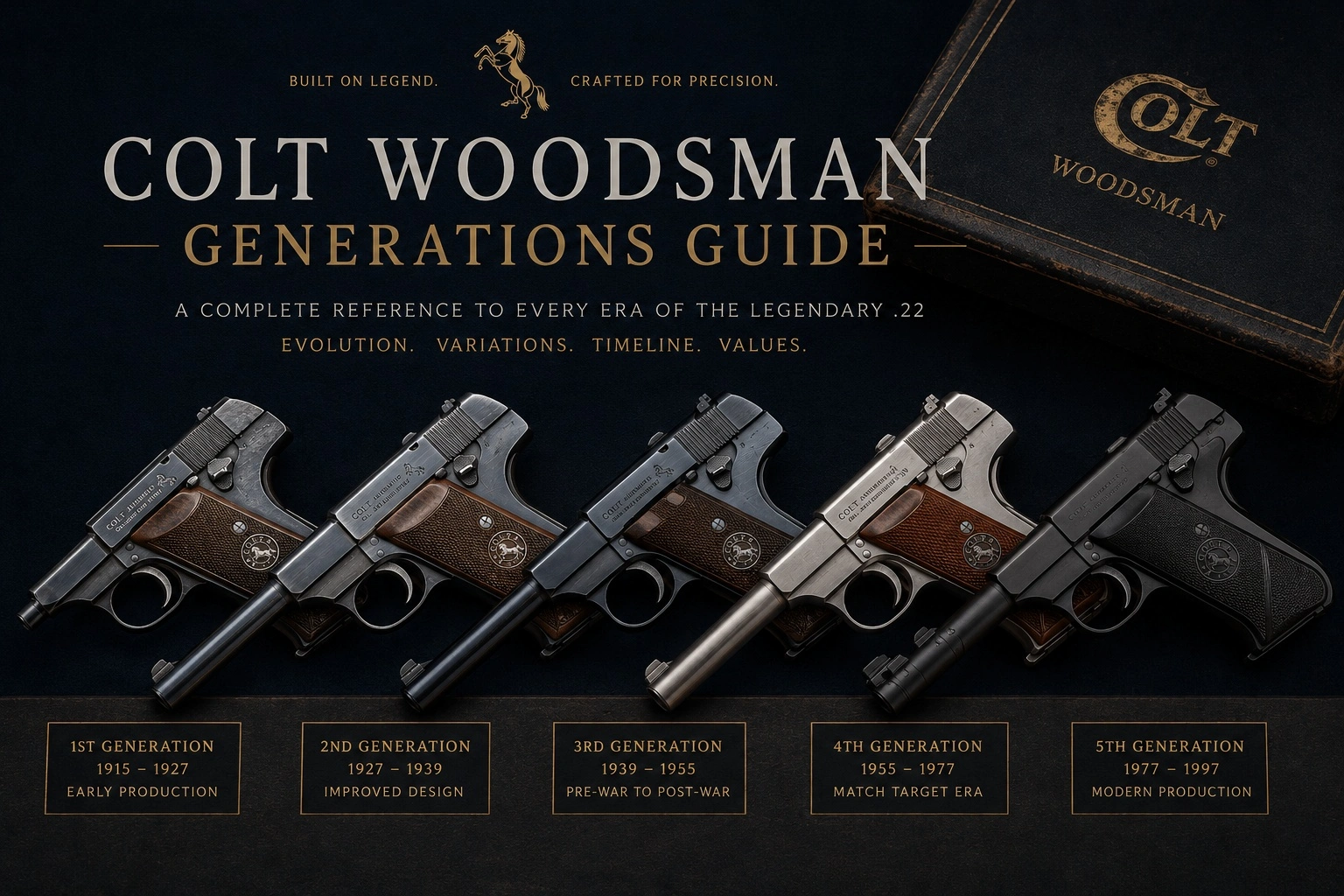
The Colt Woodsman generations are best understood as three major collector series. The pistol line began in 1915, returned after World War II with important post-war changes, and continued through the final Third Series until production ended in 1977.
When I look at a Woodsman, I do not start with value. I start with generation. The series tells me what magazine release I should expect, what grips belong on the pistol, whether the sights make sense, and whether the serial number agrees with the physical features in front of me.
The fastest way to avoid a bad Woodsman purchase is to compare the serial number, magazine release, grips, sights, and barrel style before assuming the pistol is original.

Quick Identification Checklist
Use this checklist before you spend time trying to value a Colt Woodsman. A clean serial number is helpful, but the pistol has to agree with the era.
- Serial number: note the full number and any prefix or suffix letters.
- Magazine release: look for either the Second Series frame button or the later heel-style release.
- Grip shape and material: wood, plastic, checkering, thumb rest, and Colt medallions all matter.
- Barrel and sights: Sport, Target, and Match Target pistols should not be judged from the serial number alone.
- Markings and finish: sharp rollmarks and even finish help separate original examples from refinished guns.
Colt Woodsman Series Comparison
| Collector Series | Years | Primary Identification Clues | Collector Notes |
|---|---|---|---|
| Series I | 1915–1941 | Pre-war production, early frame style, classic Colt finish, early magazine and grip configurations. | Condition, originality, correct magazine, and pre-war finish drive interest. |
| Series II | 1947–1955 | Post-war changes, frame-mounted magazine release behind the trigger guard, transitional handling features. | A short and important post-war period. Check controls carefully. |
| Series III | 1955–1977 | Later frame and control arrangement, heel magazine release on Match Target pistols, long final production run. | Includes many Baby Boom-era guns and later production variations. |
Series I Woodsman: 1915–1941
The first generation is the pre-war Colt Woodsman. These pistols established the long, low, graceful profile that made the Woodsman feel different from ordinary .22 pistols. Fit, finish, early grips, and correct magazines are the things collectors study closely.
Series I pistols can include Sport, Target, and Match Target examples. The Match Target branch is especially recognizable because of its heavy target barrel profile. On pre-war guns, be careful with replaced magazines, altered sights, and refinished surfaces. Those changes can make a good-looking pistol much less desirable to a collector.
Series II Woodsman: 1947–1955
The second generation is the short post-war period. This is where magazine-release location becomes one of the most useful field clues. A Second Series Match Target uses a magazine release button on the left side of the frame behind the trigger guard.
Because this period is short, small details matter. Check the serial number, release location, sights, grip style, and magazine before calling a pistol correct. The 1955 transition into the Third Series is especially important because collectors often run into guns that look similar at first glance but belong to different production eras.
Series III Woodsman: 1955–1977
The third generation is the final and longest post-war series. On Match Target pistols, the heel-style magazine release is one of the quickest clues. Third Series pistols also appear in the heart of the Baby Boom collecting period, which is why I like tying them back to year-by-year serial-number work.
For a collector, a 1955–1964 Woodsman has more than shooting appeal. It belongs to the same period that produced many classic post-war Colt, Smith & Wesson, Winchester, Browning, and Remington arms. That context helps explain why clean examples keep drawing attention.
Where the Match Target Fits
The Match Target is not a separate generation. It is a Woodsman variation that appears within the broader series structure. The heavy barrel, target sights, and target-shooting purpose make it one of the most recognizable Woodsman branches.
Collector Takeaway
Identify the series first, then identify the variation. A Match Target still needs to be judged by its correct series details: serial number, magazine release, grips, sights, magazine, finish, and barrel markings.
Serial Number Guidance
Serial numbers help narrow the production period, but they do not replace physical inspection. A Colt Archive Letter remains the stronger record when shipment history matters. The best collector approach is to use the serial number as the starting point, then verify that the pistol’s parts and features belong to that same era.
For detailed year-by-year work, use the dedicated Colt Woodsman Serial Number Lookup. For the heavy-barrel target branch, see the Colt Woodsman Match Target Guide.
Generation and Value
Generation affects value because it affects scarcity, originality, and buyer expectations. A high-condition pre-war Series I pistol attracts one kind of collector. A correct short-run Series II Match Target attracts another. A clean Baby Boom-era Series III pistol may appeal to someone who wants a post-war Colt that still shows classic workmanship.
Condition remains the real dividing line. Original finish, sharp markings, correct sights, correct grips, correct magazine, and clean mechanical condition usually matter more than a single year in the serial table.
Colt Woodsman Research Cluster
Use these Woodsman references in this order: start with the serial-number lookup, then use the master chart, generations guide, and Match Target guide to confirm originality, configuration, and value context.
Colt Woodsman Related Items
Books, parts references, storage, display, and related collecting tools can help document and preserve a classic Woodsman.
Shop Colt Woodsman Related ItemsAs an Amazon Associate I earn from qualifying purchases. I only link to products, books, tools, and accessories that fit the editorial purpose of Gun Collectors Club.

About Greg Cook
Greg Cook writes about firearms collecting, personal history, and the stories behind interesting guns. His Army MOS was 76Y, Unit Armorer, and he brings that practical background to his collector articles.
Sources Consulted
- Colt factory serial-number references and archive-letter practice.
- Colt Woodsman collector literature covering Series I, Series II, Series III, Match Target, Challenger, and Huntsman variations.
- Gun Collectors Club field notes, photographs, and prior Woodsman Match Target research.