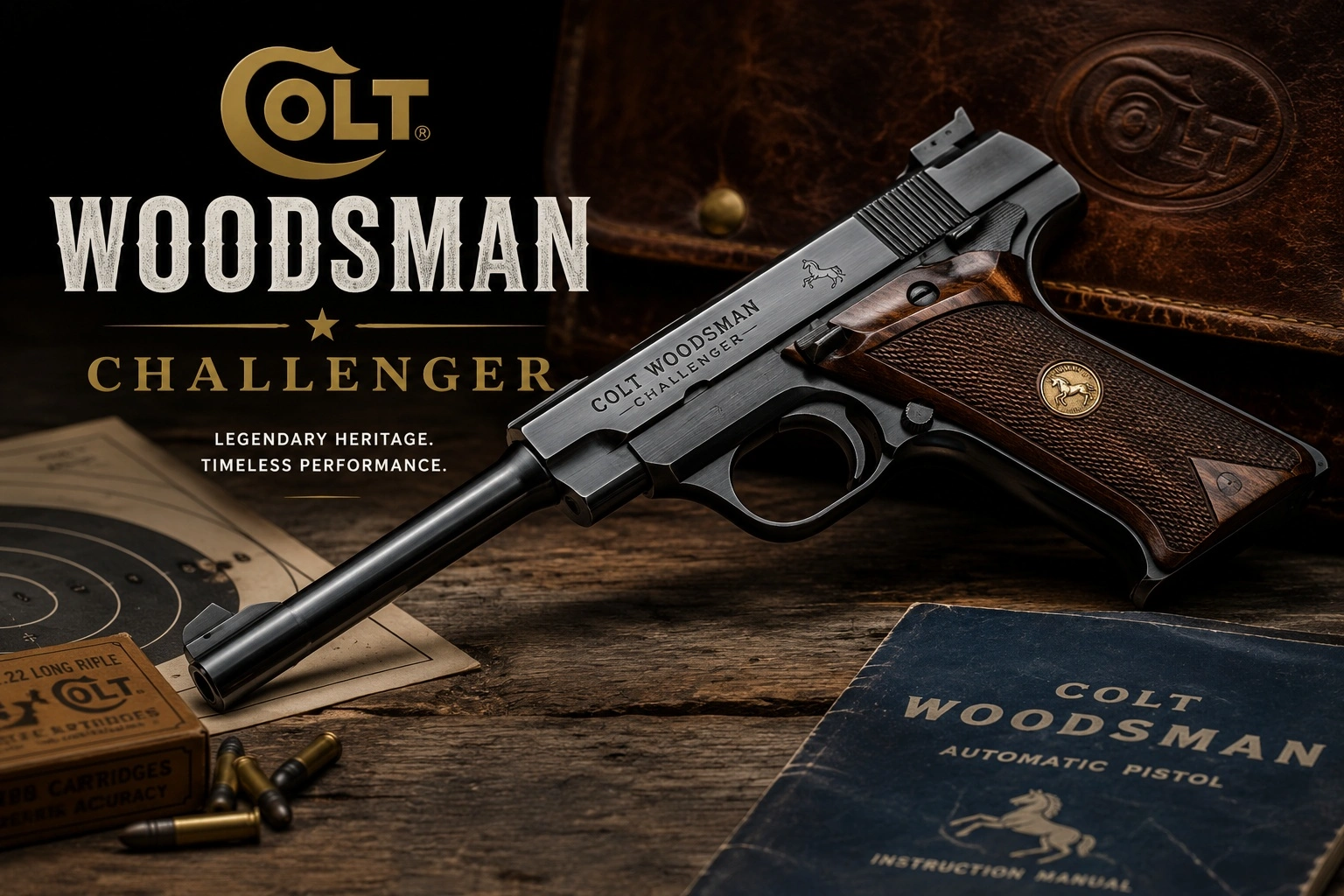
The Colt Woodsman Challenger is one of those pistols that tells a quieter story than the Match Target, but not a lesser one. It was built for the shooter who wanted Colt quality, Woodsman handling, and practical rimfire performance without paying for every target-grade refinement in the catalog.
When the serial number is available, continue with the Woodsman Challenger research in the Colt serial-number lookup tool.
Collectors often walk past the Challenger because the name does not carry the same glamour as Colt Woodsman Match Target. That is exactly why it deserves a dedicated page. The Challenger represents the working side of the Woodsman line: leaner, simpler, more affordable when new, and still unmistakably Colt. A good one has the balance, trigger feel, and pointability that made the Woodsman famous.
This guide is meant to sit inside the larger Woodsman cluster. For dating a pistol, start with the Colt Woodsman serial number lookup. For a full production-range overview, use the Woodsman serial number master chart. For the broad evolution of the model, read the Colt Woodsman generations guide.
The practical Woodsman
The Woodsman line began as one of the great American rimfire pistols: refined enough for serious target work, handy enough for field use, and attractive enough to become a collecting field of its own. Over time, Colt offered the basic idea in several forms. Some models emphasized adjustable sights and target accuracy. Others emphasized field carry and informal shooting. The Challenger belonged to the second group.
The Challenger was not a cheap pistol in the way that word is sometimes used today. It was a cost-conscious Colt. The savings came from simpler sights, fewer premium appointments, and a more utilitarian market position. It still belonged to the Woodsman family, still carried the Colt name, and still benefited from the underlying design that had already earned decades of loyalty from shooters.
That distinction matters. A Challenger should not be judged as a failed Match Target. It should be judged as a practical Woodsman variant that was intentionally built for buyers who wanted a dependable .22 automatic without paying for the top-shelf trim.

How to identify a Colt Woodsman Challenger
Most identification begins with the rollmark, frame style, sights, and serial number range. The slide marking should clearly identify the model. From there, compare the pistol with the features expected for its production period. Do not rely on one feature by itself. Pistols can have replaced grips, swapped magazines, refinished metal, or mixed small parts after decades of use.
Typical Challenger traits
- Simplified fixed sight arrangement compared with target-grade Woodsman models.
- Third Series styling and handling characteristics.
- Standard Colt blue finish on most surviving examples.
- Plain, practical configuration aimed at general shooting rather than formal competition.
- Woodsman-family ergonomics and trigger feel, even without the premium trim.
Challenger vs Sport, Target, Huntsman, and Match Target
The Woodsman family can be confusing because the names sound similar and the pistols share a common lineage. The Challenger is easiest to understand when placed beside the other models.
| Model | General role | Collector angle |
|---|---|---|
| Challenger | Practical fixed-sight Woodsman variant with simplified features. | Often undervalued; attractive when original and clean. |
| Huntsman | Economy successor conceptually close to the Challenger role. | Good shooter-grade collecting candidate. |
| Sport | Field and informal shooting model. | Popular with collectors who like carry-size rimfires. |
| Target | More accuracy-oriented Woodsman configuration. | Better fit for collectors seeking adjustable-sight target use. |
| Match Target | Premium target model and the most famous Woodsman variant. | Higher demand, stronger pricing, and more collector competition. |
Condition, originality, and what matters most
On a Challenger, condition can move the value more than rarity. Because many were bought to shoot, honest wear is common. That does not make a pistol undesirable. It simply means the buyer should separate a clean original example from a refinished or parts-mixed one.
Look closely at these areas
- Finish: check muzzle wear, grip straps, slide flats, and high edges.
- Rollmarks: soft or washed lettering may indicate refinish work.
- Grips: correct grips matter. Replacements are common and should be priced accordingly.
- Magazine: original or correct magazines add value and confidence.
- Bore: a clean bore matters on a .22 that may have fired a lot of inexpensive ammunition.
- Box and papers: original packaging can lift a Challenger from shooter-grade to collector-grade.
Collector values and market position
The Challenger’s value is tied to originality, condition, and completeness. It usually trails the Match Target and certain early Woodsman variants, but that lower price is part of its appeal. For a collector building a complete Woodsman shelf, the Challenger fills an important spot. For a shooter-collector, it may be the most sensible way to own a genuine Colt Woodsman without paying premium-model money.
Serial number research
Serial-number research should be handled as a two-step process. First, use the Colt Woodsman serial number lookup for a quick production estimate. Second, compare your pistol against the master chart and the generations guide. The date should make sense with the sights, frame, markings, grips, and magazine.
Buying checklist
- Confirm the model marking and serial number range.
- Verify that the sights and grips match the expected period.
- Inspect the bore, chamber, crown, and feed area.
- Check screw slots for damage from poor disassembly.
- Look for evidence of refinish work.
- Ask whether the magazine is correct and whether the box or papers are present.
- Compare price to condition, not just to the Colt name.
Where this page fits in the Woodsman cluster
This Challenger guide is one spoke in the broader Woodsman cluster. The core reference pages should link together so collectors can move from model identification to serial-number dating and then into the individual variant pages.
FAQ
Is the Colt Woodsman Challenger a real Woodsman?
Yes. It belongs in the Woodsman family, though it was positioned as a more affordable and simplified model.
Is the Challenger less collectible than the Match Target?
Usually, yes. The Match Target draws stronger collector demand. But clean original Challengers are still legitimate Colt collectibles and can be excellent values.
What is the first thing to check on a Challenger?
Start with the serial number and model marking, then verify whether the sights, grips, finish, and magazine match the expected production period.
Should I shoot a Colt Woodsman Challenger?
Many Challengers were bought for exactly that purpose. A pristine boxed example may be better preserved, but a sound shooter-grade pistol can still be enjoyed carefully with appropriate ammunition and maintenance.
Sources Consulted
Colt factory catalogs and period literature; surviving Woodsman examples; collector observations; serial-number research notes; and comparative study of Woodsman Sport, Target, Match Target, Challenger, and Huntsman variants.