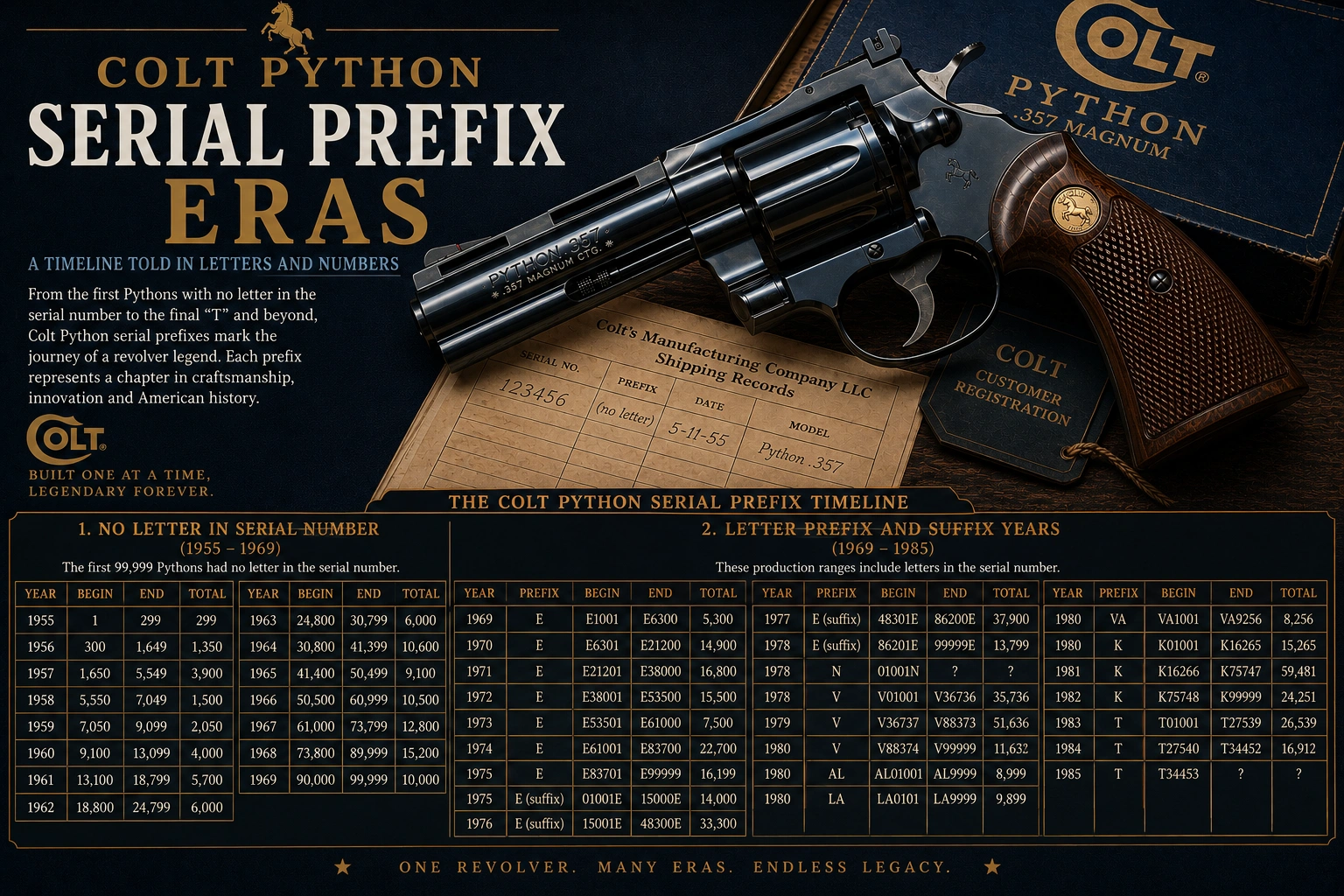
Colt Python Timeline
Updated September 19, 2026 · Collector reference reviewed by Greg Cook
Quick answer: Early Colt Pythons used numeric-only serial numbers from 1955 through 1969. Colt then used E-prefix, E-suffix, N/V transition, two-letter, K-prefix and T-prefix sequences through the mid-1980s. Preserve the letter position and leading zeros exactly because they determine which production-era table applies.
When the serial number is available, continue with the Python serial-prefix research in the Colt serial-number lookup tool.
Serial Prefix Eras: Collector Summary
The Colt Python serial number is usually the first clue collectors use to place a revolver within Python production history. The number can separate the classic 1955-1969 no-letter era from the E-prefix years, the E-suffix years, the crowded 1978-1980 transition, and the early 1980s K- and T-prefix period. It is a powerful dating aid, but it is not a complete originality test.
A Python's serial number should be read alongside its barrel length, finish, stocks, sights, barrel markings, box label, and any Colt Archive documentation. Colt's own serial-number lookup warns that online date information is approximate and that multiple vintage firearms can share serial-number patterns across models. For serious purchase, insurance, auction, or publication claims, a Colt Archive letter remains the stronger form of documentation.

How to Read Python Serial Eras
Python serial numbers are most useful when the letter placement is preserved exactly. A prefix comes before the number, such as E1001. A suffix comes after the number, such as 01001E. The letter placement matters because Colt moved from no-letter numbers to E-prefix numbers late in 1969, then to E-suffix numbers during 1975, and then to additional letter combinations in the late 1970s and early 1980s.
| Serial Era | Approximate Years | Collector Meaning |
|---|---|---|
| No-letter numbers | 1955-1969 | Classic early-production era. The first 99,999 published Python serials have no letter prefix or suffix, making these especially important for early Royal Blue, early sight, hollow-lug, and stock-style research. |
| E prefix | Late 1969-1975 | The first major lettered Python sequence. Examples read like E1001, E6301, or E83701, with the letter before the number. |
| E suffix | 1975-1978 | Colt continued the E series with the letter after the number. Examples read like 01001E or 86201E. This is a common place for listing mistakes because prefix and suffix numbers can be misread. |
| N and V transition | 1978-1980 | The published table shows an incomplete N-suffix line and then a V-prefix sequence. This is one of the most caution-heavy parts of the table. |
| Two-letter and K/T prefixes | 1980-1985 | 1980 contains several short letter-code sequences before the K-prefix run. K-prefix guns dominate 1981-1982, and T-prefix guns cover the 1983-1985 span shown in many collector tables. |
How to Date a Colt Python by Serial Number
- Open the cylinder and record the complete serial. Photograph the frame and crane markings and preserve every letter and leading zero.
- Identify letter placement. An E before the digits is an E-prefix serial; an E after the digits is an E-suffix serial. They belong to different production periods.
- Match the serial to the year table. Use the beginning and ending numbers as an approximate production-era bracket rather than an exact shipment date.
- Compare configuration details. Check barrel length, rollmarks, finish, stocks, sights and any box label against the likely era.
- Use Colt Archive documentation for definitive claims. A factory letter is stronger evidence when exact shipment date, original finish, barrel length or special configuration materially affects value.


Why the No-Letter Era Matters
The no-letter table covers the beginning of the Python story. It includes the 1955 introduction, the 1950s target-revolver identity, the early Royal Blue reputation, and the later 1960s growth years before Colt exhausted the numeric-only sequence. These early numbers do not automatically make a revolver rare in every configuration, but they put it in the period where finish, stocks, sights, hollow-lug details, and factory records receive especially close scrutiny.
American Rifleman reports that Colt Python Serial No. 1 was hand-built by Colt Master Gunsmith Alfred DeJohn and that the first public-shipped examples, serial numbers 4, 6, 7, and 10, left Colt on June 2, 1955. That illustrates why collectors should distinguish serial-number order from shipment date. A serial range points to the likely era; a factory letter can document how the individual revolver left Colt.
E Prefix, E Suffix, and the Late-1960s Changeover
When the no-letter sequence reached 99,999, Colt moved into lettered Python serial numbers. Collector references and Blue Book notes place the first letter prefix or suffix in the serial number in mid-to-late 1969 with the letter E. The E-prefix sequence continued through part of 1975, after which the E moved to the end of the serial number as a suffix.
For collectors, the E-era is important because it sits between the early classic production period and the later high-volume years. A 1970s Python may still have outstanding polish and fit, but the serial number alone will not answer questions about original barrel length, bright nickel versus Royal Blue, target stocks, later grip swaps, or whether a claimed rare configuration actually shipped that way.
The 1978-1980 Transition
The late 1970s table is not a smooth single-prefix story. Published collector tables show the end of the E-suffix range in 1978, an incomplete 01001N line, then V-prefix serials running through 1980. The year 1980 then shows several short letter-code sequences, including AL, LA, VA, and the beginning of the K-prefix run. That makes 1980 a major transition year for dating Python frames.
This also overlaps the period when Python configurations were broadening. The 8-inch Python appeared in 1980, followed by the scoped Python Hunter and later Silhouette-style packages. When a late-1970s or early-1980s serial number is attached to a special configuration, the serial table should be treated only as the first checkpoint. The case, optics, mounts, model markings, label, and paperwork are often just as important.
Colt Python Serial Number Tables
The following tables preserve the commonly published Gun Collectors Club serial ranges for the Python. They are best used as production-era brackets rather than absolute proof of manufacture date, shipment date, originality, or rarity.
Important table note: Rows with question marks are incomplete in the published table. The “Published Total” column is retained as a collector-reference field, but several historical serial tables have been copied for years with unresolved or apparently inconsistent production-count details. Use the begin/end range to place the likely era, and use Colt records when the exact claim matters.
No Letter in Serial Number
The first 99,999 Pythons had no letter in the serial number.
| Year | Begin | End | Published Total |
|---|---|---|---|
| 1955 | 1 | 299 | 299 |
| 1956 | 300 | 1649 | 1,350 |
| 1957 | 1650 | 5549 | 3,900 |
| 1958 | 5550 | 7049 | 1,500 |
| 1959 | 7050 | 9099 | 2,050 |
| 1960 | 9100 | 13099 | 4,000 |
| 1961 | 13100 | 18799 | 5,700 |
| 1962 | 18800 | 24799 | 6,000 |
| 1963 | 24800 | 30799 | 6,000 |
| 1964 | 30800 | 41399 | 10,600 |
| 1965 | 41400 | 50499 | 9,100 |
| 1966 | 50500 | 60999 | 10,500 |
| 1967 | 61000 | 73799 | 12,800 |
| 1968 | 73800 | 89999 | 15,200 |
| 1969 | 90000 | 99999 | 10,000 |
Letter Prefix and Suffix Years
These production ranges include letters in the serial number.
| Year | Begin | End | Published Total |
|---|---|---|---|
| 1969 | E1001 | E6300 | 5,300 |
| 1970 | E6301 | E21200 | 14,900 |
| 1971 | E21201 | E38000 | 16,800 |
| 1972 | E38001 | E53500 | 15,500 |
| 1973 | E53501 | E61000 | 7,500 |
| 1974 | E61001 | E83700 | 22,700 |
| 1975 | E83701 | E99999 | 16,199 |
| 1975 | 01001E | 15000E | 14,000 |
| 1976 | 15001E | 48300E | 33,300 |
| 1977 | 48301E | 86200E | 37,900 |
| 1978 | 86201E | 99999E | 13,799 |
| 1978 | 01001N | ? | ? |
| 1978 | V01001 | V36736 | 35,736 |
| 1979 | V36737 | V88373 | 51,636 |
| 1980 | V88374 | V99999 | 11,625 |
| 1980 | AL01001 | AL9999 | 8,999 |
| 1980 | LA0101 | LA9999 | 9,899 |
| 1980 | VA1001 | VA9256 | 8,256 |
| 1980 | K01001 | K16265 | 15,265 |
| 1981 | K16266 | K75747 | 59,481 |
| 1982 | K75748 | K99999 | 24,251 |
| 1983 | T01001 | T27539 | 26,539 |
| 1984 | T27540 | T34452 | 16,912 |
| 1985 | T34453 | ? | ? |
If you are trying to identify a specific revolver, see the complete Colt Python serial number and identification guide for production changes, barrel lengths, finish options, and collector notes.
Collector Notes by Prefix Era
Serial Numbers vs. Configuration
Serial numbers date the frame sequence; they do not prove the revolver's present configuration. A Python can be rebarreled, refinished, restocked, recased, or paired with later accessories. This matters most for short barrels, bright nickel, stainless, 8-inch target and hunting variants, engraved examples, presentation sets, and any gun advertised as rare or special-order.
For standard blue or nickel Pythons, the best first pass is to compare serial era, barrel length, rollmark, finish, sights, stocks, and box label. For specialty variants such as Hunter, Silhouette, Target, Stalker, and later Custom Shop examples, add the scope, mounts, case, tools, paperwork, and model markings to the checklist.
How to Document a Python for a Listing or Article
- Record the serial exactly. Preserve all letters, placement, and leading zeros. Do not normalize 01001E into E1001; those are different serial styles.
- Separate year range from shipment proof. Say “falls in the 1978 table range” when using a table, and reserve stronger language for Colt Archive documentation.
- Photograph the markings. Clear images of the frame serial, crane area, barrel rollmark, caliber marking, sights, stocks, and box label reduce ambiguity.
- Identify the finish carefully. Royal Blue, Bright Nickel, Coltguard, satin stainless, bright stainless, and later finishes can be confused in listings and photographs.
- Check the whole package. The more specialized the Python, the more the case, optic, mounts, label, and paperwork affect collector value.
Common Mistakes to Avoid
| Mistake | Better Collector Language |
|---|---|
| Calling every pre-1970 Python a “first-year” gun | Use the specific serial table row, and reserve “1955” or “first-year” for examples whose serial range and paperwork support it. |
| Ignoring prefix versus suffix placement | Record whether the letter is before or after the number. The E-prefix and E-suffix eras are separate table periods. |
| Treating the table as a factory letter | Use serial tables as screening references. Use Colt Archive records for definitive shipment and configuration claims. |
| Assuming a rare configuration from date alone | Verify barrel length, finish, stocks, sights, box label, case, optic, and paperwork before describing a Python as a scarce variant. |
| Dropping leading zeros | Keep leading zeros in entries such as 01001E, AL01001, LA0101, VA1001, and K01001 to preserve the serial format being researched. |
Try the New Lookup Tool
The serial-prefix page is the bridge between feature history and dating work. Earlier pages explain the 1955 introduction, hollow-lug construction, E/I-frame refinements, Royal Blue finish, and stock changes. Later pages use these serial eras to frame the 1980s expansion into stainless options, long barrels, scoped packages, and the later Custom Shop period. Python prefix changes are part of Colt's larger serial-number history. For other Colt models and year-by-year production ranges, see the Colt Serial Number Lookup by Model.
Frequently Asked Questions
How do I date a Colt Python by serial number?
Record the complete serial exactly as stamped, including every letter and leading zero, and compare it with the year-by-year table. Treat the result as a production-era bracket. Colt Archive records are stronger evidence for exact shipment date and original configuration.
What is the difference between an E-prefix and an E-suffix Python?
An E-prefix serial places the E before the digits, such as E21201. An E-suffix serial places the E after the digits, such as 15001E. The position of the letter determines which era applies.
Does the serial number prove that a Python is original?
No. It dates the frame sequence, but it does not prove that the barrel, finish, stocks, sights, case, optics, box or accessories are original to the gun.
What years used K-prefix and T-prefix serial numbers?
The table on this page places K-prefix Python serials from 1980 through 1982 and T-prefix serials from 1983 through the incomplete 1985 range.
Related Colt Python Research

Research Sources Used
This page was revised from a short launch draft into a serial-era reference page using the published Gun Collectors Club table, Colt serial-number cautions, Colt Archive guidance, and collector-history references. For final publication or a serious purchase, verify individual revolvers against Colt Archive letters and period literature whenever a claim involves exact date, rarity, original finish, or original configuration.
- Gun Collectors Club: Colt Python serial number tables
- Colt serial-number lookup and approximation caution
- Colt Archive Services: Archive Letter documentation
- American Rifleman: A Colt's Python Primer
- Blue Book of Gun Values: early Python serial-number summary
- Handguns Magazine: Colt Python complete history