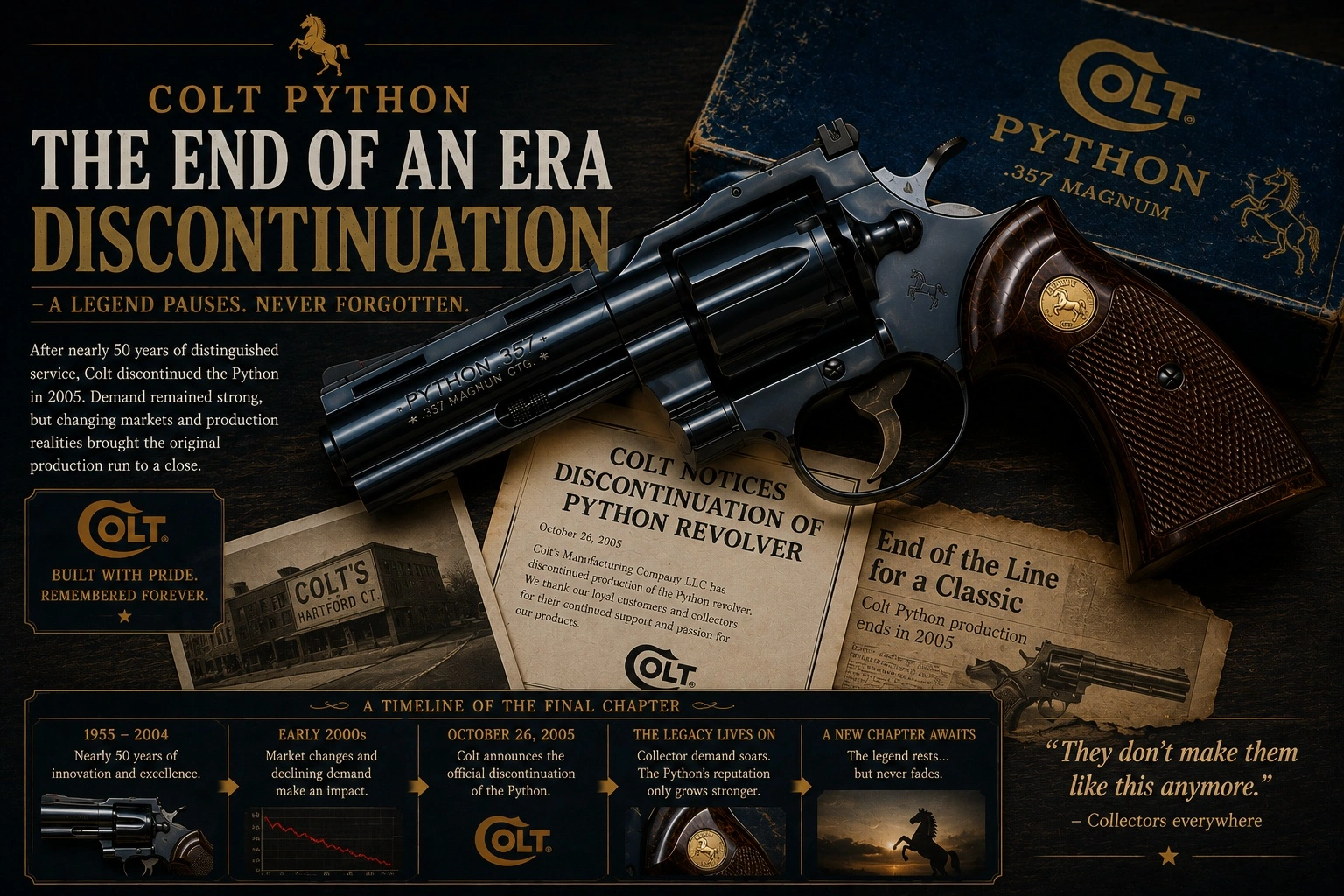
Colt Python Timeline • Updated September 19, 2026
When the serial number is available, continue with the late-production Python research in the Colt serial-number lookup tool.
Discontinuation: Collector Summary
The Colt Python did not disappear in one neat step. Its cessation is better understood as a staged wind-down. Regular production was already fading by the mid-to-late 1990s, the model shifted into a limited Colt Custom Shop / Python Elite context, Colt announced the termination of Python production in October 1999, and limited Custom Gun Shop or special-order work continued until the original first-generation line finally closed in the mid-2000s.
For collector writing, the most useful shorthand is: regular production ended around 1996, the Python entered the Custom Shop / Python Elite period in 1997, Colt announced termination in 1999, and 2005 is the commonly used endpoint for original first-generation Python production. The exact wording matters because a revolver described as a “late production Python,” a “Python Elite,” a “Custom Shop Python,” or a “2005 end-of-line Python” may require different proof.
End-Date Timeline
| Period / Date | What changed | Collector interpretation |
|---|---|---|
| 1996 | Several collector references identify 1996 as the point when the Python was dropped from regular production. | Use this for the end of ordinary production-line status, not as the final date a first-generation Python could be ordered or assembled. |
| 1997 | The Python moved into a Colt Custom Shop context and the Python Elite name became the visible late-era marker. | Python Elite rollmarks, late serial ranges, late cases, and factory records become especially important for authentication. |
| October 1999 | Colt announced termination of Python production. The NRA Museum summary attributes the decision to weak sales and rising production costs. | This is the formal public-discontinuation anchor, but not the last possible assembly date. |
| 2003–2004 | Some sources describe limited Custom Shop production as continuing off and on through 2004, with very small numbers still being made. | A 2004 date can be correct for limited late activity, but should be supported by paperwork and not treated as the only accepted endpoint. |
| 2005 | The Colt Custom Gun Shop special-order tail is commonly described as ending in 2005. | This is the cleanest collector endpoint for the original first-generation Python story before the long production gap. |
| 2020 | Colt brought back a redesigned Python generation after the original line had been absent from production. | Modern Pythons are historically important, but they should not be confused with 1955–2005 first-generation revolvers. |
What Actually Ended?
What ended was not merely a catalog entry. The disappearing first-generation Python represented a particular way of building Colt double-action revolvers: traditional lockwork, significant hand fitting, high-polish metal preparation, careful timing, premium stocks and sights, and an appearance that had become the visual standard for Colt’s snake-gun identity. The older Python action and finish work required specialized labor, and late sources repeatedly frame that labor as part of both the model’s appeal and the difficulty of keeping it economical.
The end also marked the close of Colt’s longest continuous run of the original .357 Magnum Python design. The revolver introduced in 1955 had gone from premium target revolver to law-enforcement prestige gun, then to high-end collector revolver. By the time production wound down, the market had changed around it: police agencies had moved heavily toward semi-automatic pistols, premium hand-fitted revolvers were expensive to build, and unfired or boxed Pythons were increasingly treated as collectible objects rather than working sidearms.
Why Colt Stopped Producing the Original Python
Published sources do not always use the same date because they are answering different questions. “Dropped from regular production,” “Custom Shop only,” “announced termination,” “limited production through 2004,” and “out of production in 2005” can all be accurate if the context is stated clearly. The safest collector language is to explain the stage rather than force all events into a single discontinuation date.
Regular Production vs. Custom Shop Tail
The late-1990s change matters because a regular-production Python and a Custom Shop / Python Elite-era revolver are evaluated differently. Late examples may share the familiar full underlug, ventilated rib, adjustable sights, and .357 Magnum chambering, but collectors will ask different questions: Is the barrel marked Python Elite? Does the serial range support the date? Is the finish original? Does the case match the label? Are the stocks correct for the period? Does the archive letter confirm shipment details or special features?

Do not call every late Python “one of the last” unless the documentation supports it. A late Custom Shop example can be desirable without being a final-production gun. Similarly, a 2005 claim should be treated as a documentation claim, not a decorative caption.
How Scarcity Changed the Python Market
Once the first-generation Python was no longer an active production revolver, its reputation changed. Earlier buyers remembered Pythons as expensive but obtainable premium revolvers. Later collectors began chasing boxed examples, unusual barrel lengths, Royal Blue finish, nickel and stainless variants, Python Elite examples, and factory-lettered special-order guns. Scarcity also changed behavior: many owners stopped shooting mint examples because the collectible premium outweighed the practical value of range use.
The discontinuation period is therefore a major value breakpoint. A collector documenting a late Python should describe both the physical revolver and the evidence trail. The revolver’s condition, original finish, correct stocks, case, manual, box label, hang tags, and Colt Archive letter can be more persuasive than a broad date label.
Collector Verification Checklist
- Serial number: Record the serial exactly as marked. Check it against Colt’s lookup only as a screening tool, because Colt warns that the online lookup is approximate and not comprehensive.
- Factory documentation: For high-value claims, order or cite a Colt Archive letter. Archive documentation can verify original configuration, shipping date, destination, and special features when records are available.
- Barrel marking: Photograph both sides of the barrel, especially if the revolver is described as a Python Elite or Custom Shop example.
- Finish: Distinguish Royal Blue, nickel, bright stainless, matte stainless, polished stainless, and refinished examples. Late-era finish terms are often misused in listings.
- Stocks and medallions: Confirm that the stocks fit the period and are not later replacements. Stocks can materially affect value.
- Case and label: Match the case, sleeve, manual, lock, label, and paperwork to the gun whenever possible.
- End-date wording: Use “regular production,” “Custom Shop period,” “special order,” “Python Elite,” and “first-generation endpoint” precisely.
Suggested Caption Language
For a general article caption, use language such as: “Late first-generation Colt Python from the discontinuation era; verify serial, finish, stocks, case, and Colt Archive details before treating it as a final-production example.” For a documented example, be more specific: “Colt Python Elite, 6-inch .357 Magnum, late Custom Shop period, with matching case label and Colt Archive letter.” Avoid unsupported phrases such as “last year Python,” “final run,” or “one of the last made” unless the records support the claim.
How This Page Fits the Timeline
This discontinuation page follows the Custom Shop-period page because the two topics overlap. The Custom Shop page explains how the Python narrowed into limited late production; this page explains how that limited production ended and why the end reshaped collector behavior. The next page in the series should separate the redesigned modern Python from the first-generation revolvers that ended in the 2000s.
While the original Python's discontinuation closed a remarkable chapter in Colt history, it remains only one part of the revolver's larger story. For a complete overview of production dates, serial-number ranges, engineering changes, and collector insights, visit the Colt Python serial number and identification guide.

Research Sources Used
This page was revised from a short launch draft into a collector reference page using cross-checked museum notes, firearm-history articles, collector references, and Colt documentation guidance. For publication or purchase decisions, verify individual revolvers against a Colt Archive letter, factory catalogs, case labels, and period-correct examples.
- NRA National Firearms Museum: Colt Python production-termination note
- American Rifleman: A Look Back at the Colt Python
- American Rifleman: Colt Python Review
- Handguns Magazine: Colt Python complete history
- Shooting Times: The Original Colt Python Revolver
- Guns & Ammo: The Colt Python Family
- Colt Fever: Python production and late-era notes
- Colt serial-number lookup caution
- Colt Archive Services
- Colt Archive Properties: Archive-letter details