Colt Python Timeline • Updated September 19, 2026
To place this example within Colt’s wider numbering history, see the early Python underlug research in the Colt serial-number lookup tool.
Collector Summary
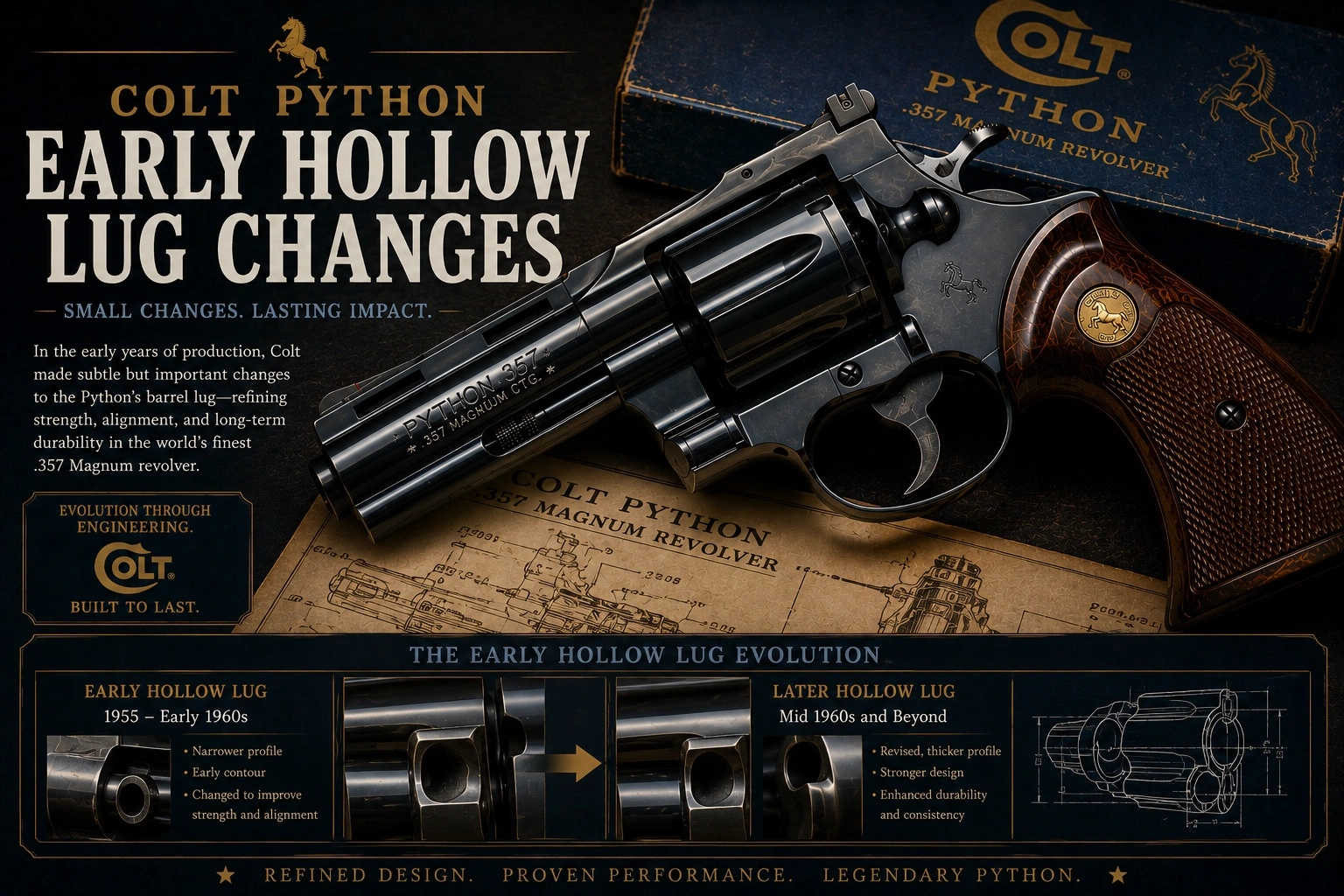
The early Colt Python is strongly associated with the hollow underlug, also described in auction language as a hollow or counter-bored barrel lug. The feature is most visible at the muzzle end of the full-length lug beneath the barrel: early examples show an open/counter-bored area rather than the filled-in lower lug profile that later collectors usually call the solid underlug.
As introduced in 1955, the Python was a six-inch .357 Magnum revolver with a ventilated rib, a full barrel underlug, Royal Blue finish, adjustable sights, and Colt target stocks. Collector references describe those first Pythons as having a hollow under-lug. Later production moved to a solid underlug that added stabilizing weight and became the familiar Python barrel profile.
Transition-Era Reference Table
| Period | Expected underlug pattern | Collector interpretation |
|---|---|---|
| 1955 launch | Hollow underlug on the original six-inch configuration. | This is the core launch-era feature. A first-year claim should still be supported by serial range, finish, stocks, sights, box, and ideally a Colt Archive letter. |
| 1956–1963 | Generally treated as the main hollow-lug era for early no-letter Pythons. | Most collector descriptions expect a hollow/counter-bored lug on honest early examples, but condition and originality matter more than the lug alone. |
| 1964 production period | Transition zone; inspect the individual revolver. | Published collector guidance often places the change around 1964, and a documented Rock Island Auction listing describes a 1964 Python with the early hollow counter-bored barrel lug. |
| Post-transition no-letter years | Solid underlug becomes the normal expectation. | No-letter serial numbers continued well beyond the hollow-lug period, so “no-letter” by itself does not prove an early hollow-lug barrel. |
| Later service or replaced-barrel examples | Configuration can be misleading. | A later revolver with an early-looking barrel, or an early frame with a later barrel, should be documented by photos, markings, wear consistency, and factory or gunsmith records where available. |
What “Hollow Underlug” Means
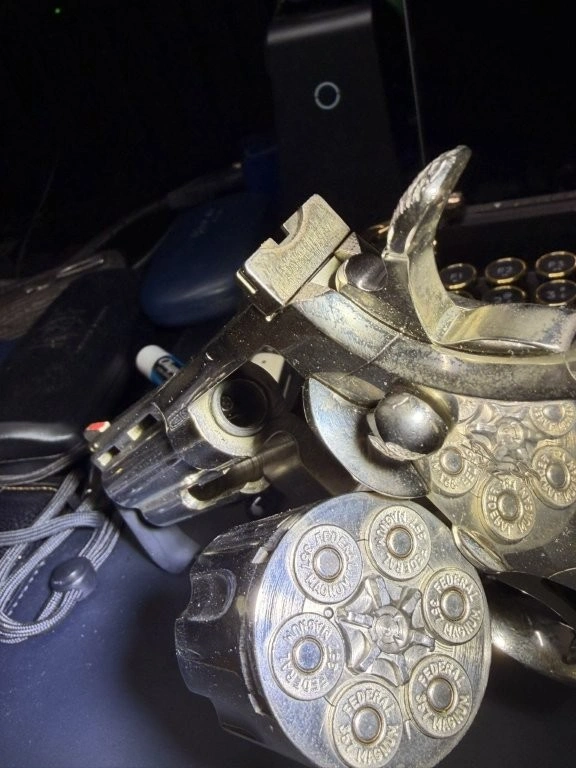
The Python’s visual identity comes from the rib above the barrel and the full-length lug below it. On early barrels, the lower lug was not left fully solid all the way to the muzzle face. Collectors usually identify the feature by looking directly at the front of the barrel assembly and checking whether the underlug area is open/counter-bored or filled.
That inspection should be handled as a documentation step, not a shortcut. Photograph the muzzle face square-on, then photograph the underside of the barrel, both barrel rollmarks, the front sight, the rib vents, and the revolver’s serial number location with the cylinder open. A listing that simply says “hollow lug” without clear photographs leaves too much room for misunderstanding.
Why Colt Moved to the Solid Lug
The later solid lug is generally understood as a balance and stability change. Museum and firearm-history summaries describe the solid underlug as added stabilizing barrel weight, while modern explanations of the Python emphasize that the full underlug and ventilated rib helped define the revolver’s balance, appearance, and target-gun character. From a collector standpoint, the change matters because it is a visible production cue: it helps separate early-production barrels from the later, more familiar Python barrel profile.
The hollow lug reduced front-end mass while keeping the dramatic full-underlug look that made the Python immediately recognizable.
The solid lug added forward weight, giving the revolver the muzzle-heavy steadiness many shooters associate with classic Pythons.
The lug pattern is useful only when combined with serial range, barrel markings, finish, stocks, and documentation.
The 1964 Caution
Collectors often use “pre-1964” as shorthand for the early hollow-lug period, but that phrase can be too blunt. A common Python serial table places 1964 in the no-letter serial range beginning at 30,800 and ending at 41,399, and Gun Collectors Club’s Python reference describes the hollow underlug as lasting until the 1964 production period. Rock Island Auction has also described a 1964-manufactured Python as having the early pattern hollow counter-bored barrel lug.
The practical result is simple: a 1964 Python should not be judged by the calendar year alone. Inspect the actual barrel. A shipped date, a serial-year table, and a physical barrel feature may not answer the same question. For expensive examples, document the gun with a Colt Archive letter and high-resolution photos before using phrases like “last hollow-lug year,” “transitional barrel,” or “factory original hollow lug.”
No-Letter Serial Numbers Are Not Enough
The first 99,999 Pythons used no letter in the serial number, but that no-letter era continued into 1969. The hollow-lug feature is therefore a narrower early-production clue inside a longer no-letter serial period. A late no-letter Python can still be highly collectible, but it should not automatically be described as a hollow-lug example without photographic proof.
For the surrounding timeline pages, this distinction is important. The 1955 introduction page explains the launch configuration; this page explains the early barrel-lug change; the serial-prefix page explains why serial format must be used carefully; and the later production-change pages cover finishes, barrel lengths, and Custom Shop context that belong to different collecting questions.
Verification Checklist for Listings and Captions
- Muzzle face: Include a straight-on photo showing whether the underlug is hollow/counter-bored or solid.
- Barrel length: Record whether the revolver is 6-inch, 4-inch, or another configuration; early 6-inch guns are central to the hollow-lug discussion.
- Serial number: Record the number exactly, but remember that published tables are a starting point rather than definitive proof.
- Factory documentation: Use Colt’s online lookup only as a screening tool; Colt warns that it is approximate and not comprehensive. For higher-value claims, use a Colt Archive letter where records are available.
- Wear consistency: Compare finish wear on barrel, frame, cylinder, ejector rod, and muzzle. Mismatched wear can suggest a replaced barrel or refinishing.
- Rollmarks and sights: Photograph both sides of the barrel, the top rib, front sight, and proof marks to help confirm period-correct configuration.
- Stocks and box: Early stocks, medallions, box labels, manuals, and hang tags can reinforce originality but should not be used to prove the lug by themselves.
Suggested Collector Language
Use careful wording when publishing or selling an example. A strong caption might read: “Early Colt Python .357 Magnum with hollow/counter-bored underlug; serial range, finish, stocks, and factory documentation should be reviewed before making originality claims.” For a 1964 gun, use: “1964 transition-period Colt Python with early-pattern hollow lug, subject to verification by photos and factory records.” Avoid unsupported phrases such as “last hollow lug,” “guaranteed pre-64 barrel,” or “factory original transition gun” unless the proof is included.
How This Page Fits the Timeline
This page follows the 1955 introduction because the hollow lug was part of the Python’s early identity, and it comes before the frame-refinement and finish-evolution pages because the lug change is one of the first visible production cues collectors learn to check. It also connects directly to the serial-prefix page: serial numbers help frame the period, but the physical barrel must still be examined.
The early hollow-underlug variations are among the most interesting identifying features found on first-generation Pythons, but they represent only one aspect of Colt Python production. For serial-number dating, production history, engineering changes, barrel configurations, and collector identification details, see the complete Colt Python serial number and identification guide.

Research Sources Used
This page was revised from a launch draft into a collector reference page using Colt-history summaries, auction descriptions, serial-reference context, and Colt documentation guidance. For a purchase, appraisal, or publication claim, verify the individual revolver against factory records, period-correct examples, and clear photographs.
- Colt Fever: early Python configuration and hollow under-lug note
- NRA National Firearms Museum: Python design and hollow-to-solid underlug note
- Rock Island Auction: 1964 Python with early hollow counter-bored barrel lug
- Gun Collectors Club: Python serial number tables and 1964 hollow-lug transition note
- Handguns Magazine: Colt Python complete history and early design context
- Guns & Ammo: Colt Python family overview and first-shipment context
- Shooting Times: Original Colt Python history and full-underlug balance context
- Colt serial-number lookup caution
- Colt Archive Services