Colt Python Timeline • Updated September 19, 2026
For a second step in confirming production history, open the Python E/I-frame research in the Colt serial-number lookup tool.
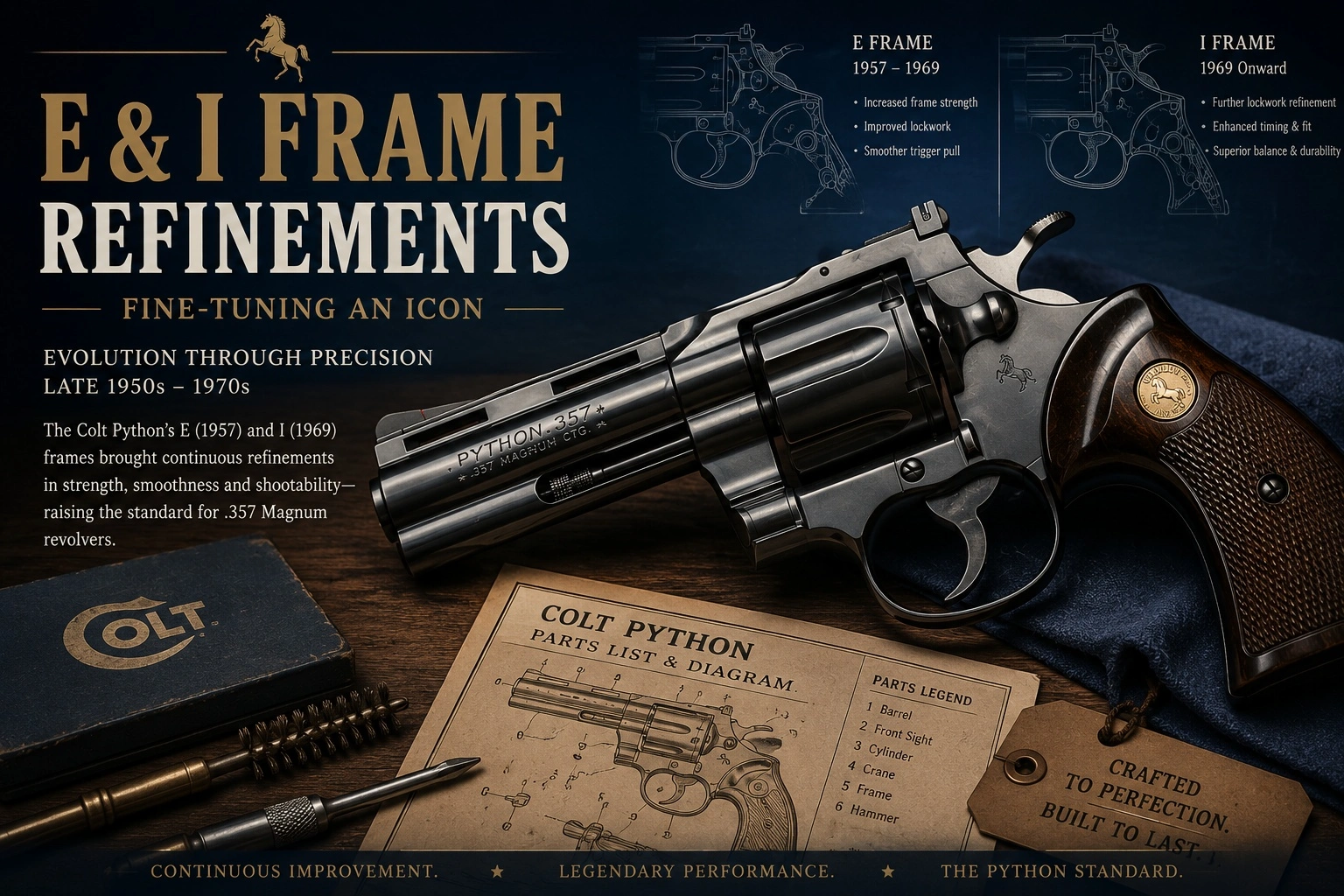
E/I Frame Refinements: Collector Summary
The E/I-frame story is not a single-year cosmetic update. It is the mechanical foundation behind the classic Python’s reputation for a smooth double-action pull, crisp single-action release, and tight cylinder lockup. For collectors, this page explains why the original Python is usually discussed as an I-frame revolver, why many references also use the broader E&I-frame shorthand, and why internal originality can be as important as finish, barrel length, stocks, or box.
In broad terms, Colt’s medium-frame double-action line began long before the Python. After World War II, Colt’s frame-letter terminology sorted that older medium-frame family into the E frame and the later I-frame variant. The Python inherited that old-style Colt mechanical lineage, but Colt elevated it with .357 Magnum strengthening, target features, unusually careful polishing, and more hand work than ordinary production revolvers received.
Collectors often say E&I frame because the E and I frames are closely related.
The original Python is generally treated as a Colt I-frame revolver.
The I frame moved the firing pin into the frame instead of retaining the E-frame hammer-mounted firing pin.
Poor action work, timing problems, and forced disassembly can reduce desirability even on visually attractive examples.
Why “E/I Frame” Matters
Colt collectors use frame letters to distinguish mechanical families. The Army Special and Official Police medium frame became known as the E frame in postwar terminology. The I frame was essentially a strengthened variation of that same medium-frame architecture, with a frame-mounted firing pin and .357 Magnum application. That is why Python listings and parts discussions often use the combined phrase E/I frame, even though the Python itself is more precisely an I-frame revolver.
This distinction helps prevent a common confusion: a classic Python is not a Mark III, Mark V, King Cobra, Boa, or Anaconda action wearing a Python barrel. Those later Colt families have their own frame systems and internal layouts. They may be collectible, but they should not be described as original-series Python E/I lockwork.
From Army Special to Officer’s Model Match to Python
The Python’s mechanical personality grew out of Colt’s earlier medium-frame double-action revolvers. The Army Special of 1908, later renamed the Official Police, established a durable medium-frame platform. Colt’s Officer’s Model target revolvers added the precision-shooting side of the family. By the early 1950s, Colt had the building blocks for a premium .357 Magnum revolver: a target-oriented action, a medium frame that could be strengthened, and a market that wanted adjustable sights and magnum performance.
Colt’s 1953 model named simply Colt .357 is a key bridge. It used a modified and strengthened medium frame, moved the firing pin into the frame, and helped establish the I-frame concept for Colt’s .357 Magnum double-action revolvers. The Python then arrived in 1955 as the luxury, target-grade expression of that idea: more polish, more visual drama, more hand fitting, and a distinct barrel profile.

What Colt Strengthened for Magnum Use
Period accounts of Python development consistently describe Colt working from the Officer’s Model Match concept and reinforcing it for .357 Magnum use. The refinements included a stronger cylinder and frame, a beefed-up topstrap, a stronger crane, and the elimination of the separate recoil plate by placing the firing-pin hole directly in the frame. These changes are important because the Python was not merely a fancy .38 target revolver with a new name. It was adapted for the higher-pressure magnum cartridge while keeping the target-gun action feel Colt wanted to market.
For collectors, that means the frame and action should be evaluated as part of the gun’s identity. A replacement barrel may be obvious; altered lockwork is often less obvious. A Python that has been tuned too light, allowed to wear out of time, or fitted with mismatched internal parts may look correct in photographs but perform unlike a sound original example.
Hand Fitting and the Python Feel
The original Python’s smoothness was not just marketing language. Colt gave the model unusual bench attention: internal polishing, hand fitting, and final testing were central to its reputation. Accounts from Colt personnel describe honing parts, polishing internal surfaces, and assigning Python work to highly skilled assemblers. That extra labor is one reason collectors talk about pre-2020 Pythons differently from modern reintroduced Pythons, even when the newer guns are mechanically improved in other ways.
That hand work also explains why no two original Pythons feel exactly alike. A little end-of-pull “stacking” in double action can be part of the old Colt action character, while a gritty pull, weak reset, inconsistent cylinder carry-up, or obvious parts drag may indicate wear or poor service work. The goal for collecting is not to make every Python feel identical. It is to identify whether the feel remains honest, safe, and period-correct for the individual revolver.
Lockup, Timing, and Mechanical Originality
The Python’s celebrated lockup depends on the relationship between the hand, ratchet, bolt, trigger, hammer, cylinder, and frame. As the trigger stroke completes, the cylinder is brought into its final locked position for the hammer fall. That tight lockup is a major part of the Python legend, but it also means timing and wear matter. A gun that was heavily fired, especially with frequent full-power .357 Magnum loads, may need careful professional evaluation.
For a collector page or sales listing, avoid vague claims such as “perfect action” unless the revolver has been examined by someone competent with old Colt double-action lockwork. Better language is specific: “timing and lockup appear correct on visual inspection,” “mechanical condition should be verified by a qualified Colt revolver specialist,” or “Colt Archive letter confirms configuration, but internal condition must be evaluated separately.”
The 1969 Mark III Context
In 1969, Colt’s Mark III series introduced a newer medium-frame family designed around machine fitting and a transfer-bar safety system. That new family replaced most of Colt’s older E/I medium-frame revolvers, but not the Python. The Python remained the prestige revolver that retained the older hand-fitted action lineage. This is why collectors often treat the Python as a mechanical holdout: it carried forward the old Colt action feel while other Colt revolvers moved into newer production systems.
This context is useful when comparing a Python to a Trooper Mark III, Trooper Mark V, Lawman, Boa, King Cobra, or Anaconda. These revolvers can be excellent collector subjects in their own right, but their internal systems should not be collapsed into the Python’s E/I-frame story.
Collector Inspection Points
Use these points as a documentation checklist, not as repair instructions. A valuable Python should be inspected unloaded, handled carefully, and evaluated by a qualified specialist when mechanical questions affect value or safety.
- Frame terminology: describe classic Pythons as I-frame or E/I-frame shorthand, but explain the usage if writing for collectors.
- Sideplate condition: damaged screw slots, pry marks, or uneven fit can suggest past internal work.
- Timing and carry-up: inconsistent cylinder alignment, late bolt engagement, or obvious overtravel should be treated as value concerns.
- Lockup feel: tight lockup at the correct point is part of the Python’s appeal; excessive movement should be documented rather than ignored.
- Trigger work: very light pulls, weak ignition, or an action that feels “too slick” may indicate altered parts or a reduced mainspring.
- Finish versus mechanics: a high-polish refinish can hide surface history but cannot restore original action fitting.
- Documentation: a Colt Archive letter can support original shipment details, but it does not prove that all internal parts remain untouched today.
E/I-Frame Collector Reference Table
| Topic | Collector Meaning | Documentation Cue |
|---|---|---|
| E frame | Postwar name for Colt’s older medium-frame family used by models such as the Official Police and Officer’s Model line. | Use as lineage context, especially when discussing the Python’s roots in Colt target and police revolvers. |
| I frame | Closely related to the E frame but using a frame-mounted firing pin; used by the Colt .357, later Trooper .357, and Python. | Best precise term for original-series Python frame discussion. |
| Python refinement | Magnum-strengthened frame/cylinder/crane, full underlug, vent rib, target sights, high polish, and extensive hand fitting. | Photograph barrel markings, sights, sideplate, stocks, serial range, finish, and box label together. |
| Old Colt action feel | Smooth but mechanically complex action; hand fitting can make individual examples feel slightly different. | Describe actual condition rather than relying on generic “bank vault” language. |
| Timing sensitivity | The classic Python’s tight lockup is part of its appeal, but heavy use or poor tuning can create timing concerns. | Have questionable examples evaluated before assigning premium collector value. |
| Mark III and later lines | Newer Colt revolver families moved to different frame/action systems and machine-fitting concepts. | Do not describe Mark III, Mark V, King Cobra, Boa, or Anaconda lockwork as Python E/I-frame lockwork. |
Listing and Caption Language
Good collector wording is precise without overpromising. Use “original-series Colt Python, I-frame, old-style Colt action” when the page is focused on the mechanical lineage. Use “E/I-frame Python” when writing for readers who recognize that common shorthand, but clarify that the Python is technically an I-frame revolver. Avoid “factory tuned” unless a factory document supports the statement, and avoid “unfired perfect action” when only a visual inspection has been done.
When a revolver has a Colt Archive letter, describe what the letter actually confirms: model, caliber, finish, barrel length, stocks or features if recorded, shipping date, and destination as available. Do not let the letter stand in for present-day mechanical inspection.
How This Page Fits the Timeline
This segment sits between the visible early barrel-lug discussion and the Royal Blue finish discussion because it explains the mechanical core under the famous Python appearance. The early hollow underlug helps identify certain barrel periods, and Royal Blue defines the exterior presentation, but the E/I-frame refinement story explains why collectors handle an original Python and immediately focus on action feel, lockup, timing, and whether the revolver still has its original mechanical character.
The refinements made to Colt's E- and I-frame designs helped shape the Python into one of the finest double-action revolvers ever produced. For serial-number dating, production history, engineering changes, barrel configurations, and collector identification details, see the complete Colt Python serial number and identification guide.
Research Note
This page distinguishes the precise I-frame designation from the common E/I-frame collector shorthand. Sources consulted include Colt’s own archive and serial-number guidance, historical accounts of Python development and hand fitting, collector frame guides, museum descriptions, and modern comparisons of original versus reintroduced Python lockwork.
- Handguns Magazine: Colt Python: A Complete History
- Colt Fever: Colt Model Guide and E/I frame terminology
- Colt Fever: The Colt .357 I-Frame Revolver
- Colt Fever: Mark III machine-fitted action context
- NRA National Firearms Museum: Colt Python
- Autry Museum: Python Model Revolver Pair
- Colt Archive Services and Colt Serial Number Lookup