Colt Python Timeline • Updated September 19, 2026
To compare this firearm with Colt production records, use the 1980s Python production research in the Colt serial-number lookup tool.
1980s Production Changes: Collector Summary
The 1980s were a transition decade for the original Colt Python. The classic Royal Blue and Bright Nickel revolvers still defined the model’s reputation, but Colt also pushed the Python into specialized roles: longer barrels for target and field use, factory-scoped hunting packages, weather-resistant plated finishes, stainless steel production, and limited-edition variants that now require careful documentation.
For collectors, the decade is important because many 1980s Pythons look similar at first glance but differ sharply in originality, packaging, sights, stocks, finish, and factory intent. A standard 6-inch blue revolver, an 8-inch Python Target, a scoped Python Hunter, a Coltguard example, and a stainless Stalker may all share the same Python identity, but they should not be evaluated as the same collecting problem.
How to Identify a 1980 Colt Python .357
A 1980 Colt Python .357 should be identified from the complete revolver rather than the year claim alone. Record the full receiver serial number and its prefix, then confirm the .357 Magnum barrel marking, barrel length, finish, front and rear sights, stocks, and any box label or factory paperwork.
The 1980 model year sits within a serial-prefix transition and the growing eight-inch target and hunting market. A number that falls in a published 1980 range establishes a likely production period, but it does not prove that a scope, case, barrel, finish, or named package was factory-original.
- Standard configurations: verify Royal Blue or nickel finish, barrel length, sights, and period-correct stocks.
- Eight-inch revolvers: confirm caliber before distinguishing a .357 Magnum field configuration from the .38 Special Python Target.
- Scoped packages: identify the scope, mounts, case, accessories, and paperwork before using the Python Hunter name.
- Date claims: use the serial range as a starting point and factory records for an exact shipping date or original configuration.
1980s Colt Python Change Timeline
| Period | Documented change | Collector verification points |
|---|---|---|
| 1980 | Eight-inch Python production becomes a major 1980s theme. The long barrel supported target, silhouette, and hunting configurations, including the .38 Special Python Target and the scoped .357 Magnum Python Hunter package. | Confirm caliber marking, barrel rollmark, front sight, rear sight, stock type, and whether the gun belongs to a standard 8-inch configuration or a named package. |
| 1980-1981 | The Python Hunter appears as Colt’s factory-ready scoped field package, generally seen with an 8-inch barrel, rubber/Pachmayr-style stocks, a Colt/Leupold extended-eye-relief scope, cleaning accessories, and a Halliburton or Zero Halliburton aluminum case. | Check for original scope, mounts, aluminum case, keys, cartridge box, cleaning rod, papers, and matching factory documentation. Missing accessories can change collector value significantly. |
| 1981 | Coltguard, Colt’s electroless weather-resistant plating, becomes part of the Python finish conversation. It should be distinguished from stainless steel, nickel, and later bright-polished stainless treatments. | Do not label a pale or matte Python as stainless without confirming the finish. Coltguard/electroless nickel, nickel, and stainless can be confused in photos and casual listings. |
| 1982-1983 | The Python Silhouette follows the Hunter idea for metallic silhouette and scoped revolver shooting. It used an 8-inch .357 Magnum barrel, a Leupold 2X scope, a rearward scope position, and a black luggage-style case. | Look for the Silhouette barrel rollmark, correct scope placement, black case, paperwork, and accessories. A scoped 8-inch Python is not automatically a Silhouette. |
| Mid-1980s | Stainless steel Pythons become one of the defining 1980s changes. Secondary sources and collector examples vary on exact first-year wording, so first-year stainless claims should be treated carefully. | Document serial range, box label, finish description, sights, stocks, and Colt records. Stainless, bright stainless, and later Custom Shop “Ultimate” terminology should not be mixed together loosely. |
| 1985-1986 | Special runs and presentation sets continued to make the Python more than a standard catalog revolver. The decade includes stainless special editions, commemorative work, and paired presentation concepts. | Verify edition name, quantity claims, case, medallions, engraving, finish, and factory paperwork. Many special-edition claims depend on the completeness of the package. |
| 1988 | The Colt Stalker is reported as a very limited stainless 8-inch scoped Python variant, often associated with an unfluted cylinder and a small production total. | Because the Stalker is a less straightforward model in some collector references, documentation is especially important: serial, factory letter, scope, holster/case contents, and cylinder style all matter. |
| Late 1980s | By the end of the decade, the Python’s identity had expanded from a premium service/target revolver into a collector-driven platform with finish, package, and limited-run significance. | Evaluate late-1980s examples against both standard Python criteria and special-package criteria. Condition alone is not enough if the package is incomplete or misidentified. |
Finish Changes: Blue, Nickel, Coltguard, and Stainless
The traditional Python finishes remained central to the model’s appeal, especially Royal Blue. The 1980s added more finish complexity. Coltguard brought an electroless, weather-resistant plated option into the collector vocabulary, while stainless steel created a very different collecting lane. Stainless Pythons are often associated with rubber stocks, satin or bright-polished surfaces, and later “Ultimate” language, but the name, finish, and date should be verified before publication.
A careful inspection should separate four ideas that are often blended together: standard Bright Nickel, Coltguard/electroless nickel, satin stainless, and mirror-bright stainless. Photographs can mislead, and lighting can make nickel, Coltguard, and stainless appear closer than they are in hand. When a seller or caption says “stainless,” the serial number and Colt documentation should still be checked.
Eight-Inch Barrels and the Hunting/Silhouette Market
The eight-inch barrel is the visual signature of many 1980s Python changes. It made the revolver more appealing for target work, metallic silhouette competition, and handgun hunting, while also giving Colt room to build named packages around optics and cases. The Hunter and Silhouette packages are especially important because collectors are not just evaluating a revolver; they are evaluating a revolver, scope, mount system, case, and accessory group.
Stocks, Sights, and Packaging Cues
Stocks and sights are useful but not final proof. Some 1980s Pythons wore checkered wood stocks with Colt medallions, while scoped and stainless-era guns are frequently seen with rubber or neoprene stocks. Red-ramp front sights, white-outline rear sights, Elliason-style target sight references, and optic mounts all show up in the period discussion. These parts can be changed, so the box label and factory letter carry more weight than appearance alone.
Packaging is particularly important in this decade. A Python Hunter without its aluminum case and accessories is still interesting, but it is not the same collector package as a complete cased example. The same principle applies to Silhouette cases, limited-edition pouches, presentation cases, and paperwork. The more specialized the variant, the more the surrounding material matters.
Serial Number and Date Cautions
Serial ranges are a starting point, not the final word. The 1980 model year crosses multiple prefixes, including late V-prefix and several two-letter prefixes before the K-prefix sequence. The K-prefix range dominates 1981 and 1982 production, while T-prefix examples appear in the 1983-1985 period covered by many published tables. This makes the early 1980s a serial-prefix transition period as well as a model-configuration transition period.
Colt’s own serial-number lookup cautions that its online data is approximate and not a substitute for definitive documentation. For a serious purchase, article caption, or rarity claim, use the serial lookup as a screening tool and then rely on a Colt Archive letter or other primary documentation when the configuration matters.
What Changed for Collectors
- The Python became more package-driven. A named 1980s variant may depend on the correct scope, case, papers, and accessories as much as the revolver itself.
- Finish identification became harder. Bright Nickel, Coltguard, satin stainless, and bright stainless can be confused without close inspection and documentation.
- Eight-inch barrels became a major branch of the Python story. They connect target shooting, silhouette shooting, and handgun hunting in a way earlier standard barrel lengths did not.
- Limited editions multiplied. Special runs, state or agency themes, engraved examples, and presentation sets make the 1980s a decade where factory letters are especially useful.
- Originality became a package question. A revolver can be mechanically excellent and still be incomplete as a collector example if the case, optics, stocks, or paperwork are wrong or missing.
How to Inspect a 1980s Python
Start with the basics: serial number, barrel length, caliber, finish, stocks, front sight, rear sight, and barrel rollmark. Then move outward to the box, label, case, optics, mounts, instruction papers, tools, and any archive documentation. A standard Python can usually be evaluated around condition and originality; a Hunter, Silhouette, Target, Stalker, or special edition needs a broader checklist.
When publishing photos or writing a listing, avoid vague phrases such as “rare 1980s stainless Python” unless the supporting details are present. Better captions identify the exact configuration: “1983-era stainless 6-inch Python,” “8-inch .38 Special Python Target,” or “Python Hunter package with Colt/Leupold scope and Halliburton case.” That precision helps future collectors and prevents one 1980s variant from being mistaken for another.
1980s Colt Python FAQ
What is historically important about 1980s Colt Python production changes?
The 1980s expanded the Colt Python beyond standard blue and nickel service and target revolvers. Eight-inch barrels, scoped Hunter and Silhouette packages, Coltguard, stainless steel, and limited variants made configuration and package originality increasingly important to collectors.
Which major 1980s Colt Python variants should collectors know?
Important variants include the eight-inch Python Target in .38 Special, the scoped .357 Magnum Python Hunter, the Python Silhouette package, Coltguard-finished examples, stainless Pythons, and the limited late-1980s Stalker. Each should be verified by markings, finish, sights, stocks, packaging, and factory documentation.
Which identifying features distinguish important 1980s Colt Python versions?
Check the complete serial number, caliber and barrel rollmark, barrel length, finish, front and rear sights, stocks, scope and mounts, case, box label, accessories, and factory paperwork. An eight-inch or scoped Python is not automatically a Hunter, Silhouette, Target, or Stalker.
How do I identify a 1980 Colt Python .357?
Record the full serial number and confirm that its prefix range is consistent with 1980, then inspect the .357 Magnum barrel marking, barrel length, finish, sights, stocks, and box label. Because 1980 crossed serial-prefix and configuration changes, use factory documentation before claiming an exact shipping date or rare package.
Was every 1980 Colt Python a standard blue revolver?
No. Royal Blue remained important, but 1980 also belongs to the period when eight-inch target and hunting configurations broadened the line. Finish, caliber, barrel length, optics, case, and accessories must be evaluated together to identify a specific example.
How This Page Fits the Timeline
This topic connects directly to the surrounding timeline pages because 1980s changes were cumulative. A finish discussion may require knowledge of serial-prefix eras; a grip or medallion claim may overlap a change in packaging; and late Custom Shop examples should be evaluated differently from early production guns. The 1980s page is the bridge between classic high-polish production and the later Custom Shop/discontinuation era.
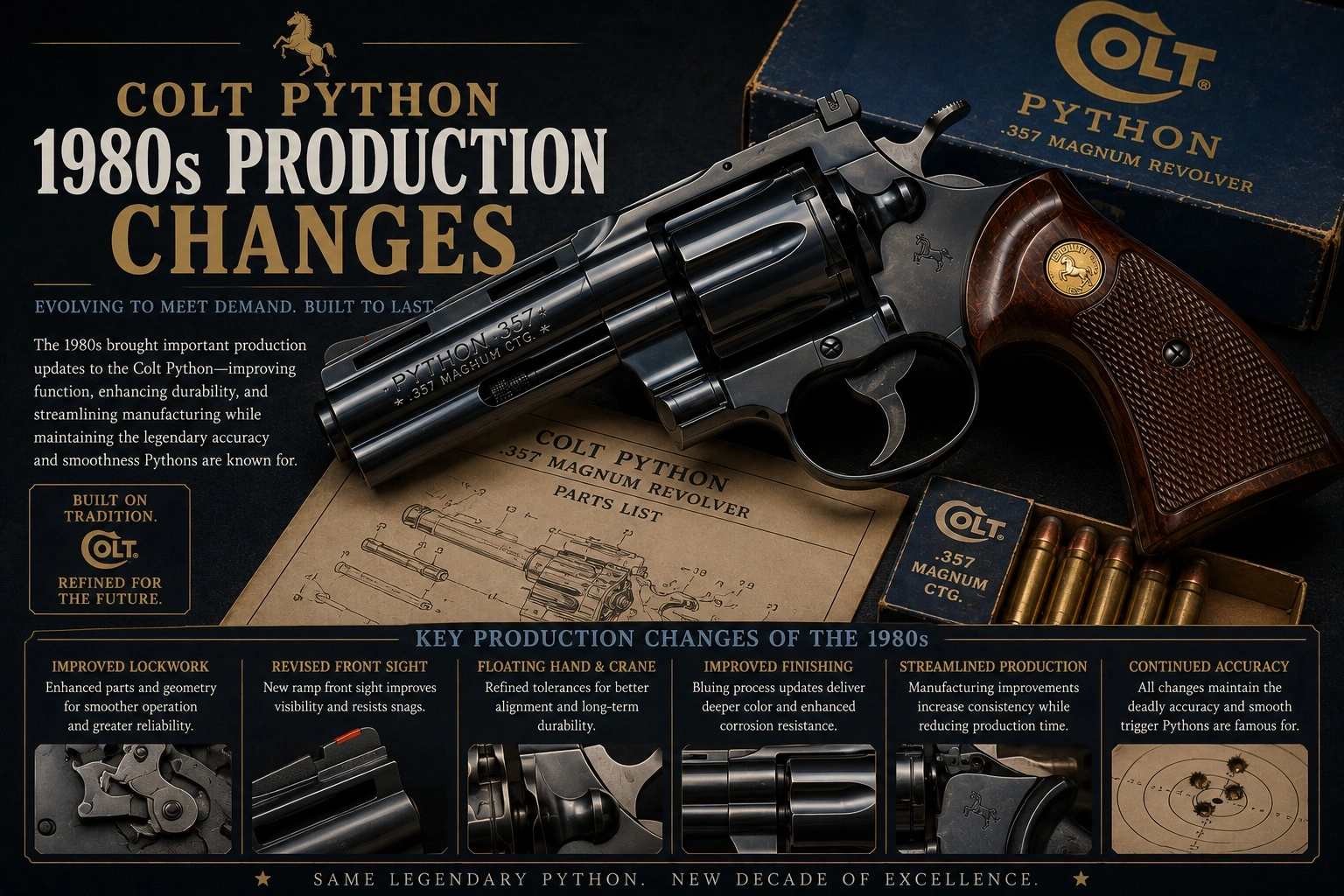
The 1980s brought important production changes to the Colt Python as manufacturing costs, market demand, and collector expectations continued to shift. For serial-number dating, production history, engineering changes, barrel configurations, and collector identification details across all Python eras, see the complete Colt Python serial number and identification guide.

Research Sources Used
This page was revised from a short launch draft into a collector reference page using cross-checked secondary references, museum collection data, auction documentation, and serial-number cautions. For final publication, verify individual revolvers against Colt Archive letters and period Colt catalogs whenever a claim involves rarity, first-year production, factory finish, or complete package originality.
- Handguns Magazine: Colt Python complete history
- Autry Museum collection record: Cased Python Hunter Model Revolver
- Rock Island Auction: Python Hunter with scope and case
- Blue Book of Gun Values: Colt Python Silhouette description
- Colt Fever: Python variants and special editions
- Colt serial-number lookup and documentation caution
- Gun Collectors Club: Colt Python serial number tables