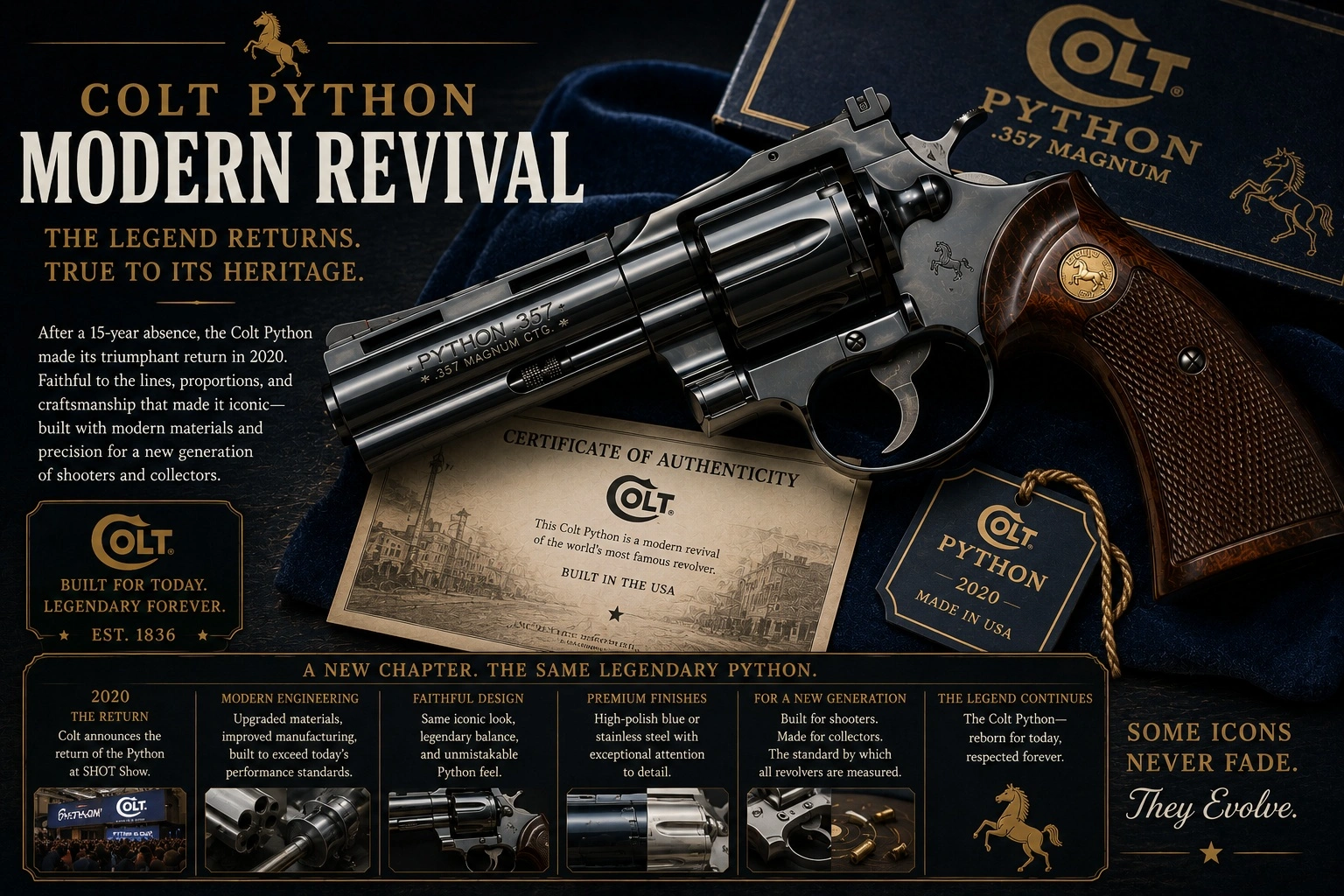
Colt Python Timeline • Updated September 19, 2026
To compare this firearm with Colt production records, use the revived Python production research in the Colt serial-number lookup tool.
Modern Revival: Collector Summary
Colt’s 2020 Python revival should be treated as a new production generation, not as a simple continuation of 1955–2005 manufacture. It intentionally preserved the visual cues that make a Python instantly recognizable—the ventilated rib, full underlug, six-shot .357 Magnum cylinder, adjustable sights, walnut stocks, and Colt medallions—but it changed the way the revolver was engineered and manufactured.
The modern Python matters because it marks Colt’s return to the premium double-action revolver market after the original Python had become a high-priced collector gun. In January 2020, the reintroduced revolver returned in stainless steel with 4.25-inch and 6-inch barrels. Colt and contemporary reviewers emphasized a redesigned rear-sight area, more steel in the top strap, stronger modern materials, a simplified action, a recessed target crown, and user-interchangeable front sight system.
Why Colt Brought the Python Back
By the late 2010s the Python name had become bigger than the original production run. Original Pythons were sought by collectors, seen in movies and television, and priced increasingly as out-of-production premium revolvers rather than ordinary used handguns. Colt had already restarted parts of its double-action revolver line with the Cobra and King Cobra, so the Python was the obvious high-profile return.
The 2020 launch was framed around the idea that Colt had taken time to redesign the revolver rather than merely recreate the old lockwork. Guns & Ammo’s January 2020 launch coverage described the new Python as returning in stainless steel in 4.25-inch and 6-inch lengths, with Colt’s product team emphasizing research, development, testing, and the need to live up to the Python name. The most important collector takeaway is that the new revolver was designed to be shot and supported as a current-production model, while the old revolver remained a finite collector artifact.
2020 launch
Initial modern production centered on polished stainless-steel Pythons with 4.25-inch and 6-inch barrels.
Engineering focus
Colt highlighted a stronger rear-sight/top-strap area, modern alloys, a simplified action, and improved serviceability.
Catalog expansion
Later modern production expanded into additional barrel lengths, short-barrel variants, blued production, matte-blue options, and special Python-family models.
Collector split
Old and new Pythons share the name and silhouette, but collectors should evaluate them under separate originality standards.
Launch Configuration: What the 2020 Python Was
The first modern Python was a six-shot, double-action/single-action .357 Magnum revolver that also accepted .38 Special ammunition. Its public launch configuration returned the Python in stainless steel and in two barrel lengths: 4.25 inches and 6 inches. The 4.25-inch number is one of the easiest modern-era identifiers because many vintage comparisons loosely say “four inch,” while Colt’s modern catalog language uses 4.25 inches.
Externally, Colt kept the elements that make the Python visually distinct: a full-length ventilated rib, full underlug, fluted cylinder, rearward-pull cylinder latch, and target-style sights. Contemporary reviews also noted the one-piece forged barrel, protected or recessed muzzle crown, user-changeable front sight, and polished stainless finish with matte surfaces on the top rib and sighting plane.
That means a 2020 Python looks familiar at a glance but should not be judged by the exact finish, stock, sight, and action standards used for a 1950s, 1960s, 1970s, 1980s, or Custom Shop-period gun. The new gun is a modern production revolver designed around current manufacturing methods, modern materials, and current catalog support.
Not a Restart of the Old Hand-Fitted Action
The deepest differences are under the sideplate. Original Pythons earned their reputation through hand fitting, polishing, and the classic Colt double-action feel. That work also made the old revolver expensive to build and comparatively demanding to service. Guns & Ammo’s 2020 full review states that Colt simplified the new Python’s internals and removed nine parts from the original lockwork while retaining a leaf mainspring rather than switching to a coil mainspring. Handguns made the same basic point in its three-inch Python review, describing a simplified action with nine eliminated components and retained leaf-mainspring architecture.
For collectors, this means the new Python is not a parts-for-parts reproduction. The old action is part of the old gun’s collector identity; the modern action is part of the new gun’s shooter identity. A modern Python may have an excellent trigger, but it should not be sold or captioned as having the exact same hand-fitted internal system as a 1950s–1990s Python.
Strength, Top Strap, and Magnum Use
Colt’s launch message and later reviews consistently centered on durability. The new rear sight arrangement allowed more steel in the top-strap area. Colt’s public launch language described a 30 percent increase in the relevant top-strap cross-section beneath the rear adjustable target sight; later reviews summarized the same point as more steel above the cylinder than on original guns.
This design change responded to an old Python talking point. Vintage Pythons were accurate and beautifully fitted, but heavy volumes of full-power .357 Magnum ammunition could be harder on timing and lockup than the kind of light .38 Special target use common in the Bullseye era. The modern Python’s frame and sight-area changes were intended to make the revived revolver more robust for ordinary contemporary shooting. That is a major difference between evaluating an original Python as a collectible artifact and evaluating a modern Python as a current-production shooter.
| Area | Original-Series Python | 2020-and-Newer Python | Collector Meaning |
|---|---|---|---|
| Production identity | 1955 introduction through late Custom Shop / special-order era, with original production ending in the mid-2000s. | Modern production generation introduced in 2020 after a long gap in regular catalog availability. | Do not use “original Python” language for modern examples unless the context is a comparison. |
| Action and fitting | Classic Colt lockwork, heavy hand fitting, and traditional Python action feel. | Redesigned and simplified action with fewer components, current manufacturing methods, and retained leaf-mainspring concept. | Excellent modern triggers do not make the action mechanically identical to vintage lockwork. |
| Frame/top strap | Classic I-frame Python construction; old guns can be sensitive to wear, timing, and hard magnum use. | Redesigned rear sight/top-strap area with more steel and stronger modern material emphasis. | Modern guns are generally documented as more robust shooters, while vintage guns demand more condition-sensitive inspection. |
| Launch finish | Early identity centered on Royal Blue; later options included nickel, stainless, Coltguard, and bright-polish stainless variants. | 2020 launch centered on polished stainless steel; modern blued carbon-steel examples followed in the 2020s. | Modern blued production is not the same artifact as vintage Royal Blue production. |
| Barrel lengths | Classic barrel-length story includes 6-inch launch, 4-inch, 2.5-inch, 3-inch special runs, 8-inch hunting/silhouette-era guns, and Custom Shop variations. | Launch in 4.25 and 6 inches; current catalog pages list a broader modern lineup including 2.5, 3, 4.25, 5, 6, and 8-inch variants. | 4.25-inch wording is a useful modern cue; do not force modern lengths into vintage terminology. |
| Sights and muzzle | Vintage target sights and front ramp systems vary by period and configuration. | Redesigned adjustable rear sight, user-interchangeable front sight, and protected/recessed target crown. | Modern sight parts and muzzle details are useful identifiers in photographs and listings. |
| Stocks | Period-correct stocks and medallions are a major originality issue on old guns. | Modern walnut or laminate-style stocks with medallions, plus later catalog/special variants. | Do not install vintage-stock assumptions onto modern guns without checking fit and provenance. |
| Documentation | Colt Archive letters, period boxes, labels, catalogs, and factory records are central to originality claims. | Modern box labels, SKU, owner manual, receipt, catalog page, and serial lookup help document model configuration. | Different documentation standards apply: archive letters matter most for old guns, while modern packaging and SKU data matter for current production. |
External Similarities That Colt Kept
The modern Python succeeded visually because Colt did not abandon the old silhouette. The revived gun still reads as a Python from across the room: ribbed barrel, full underlug, high-polish metal, Colt medallion stocks, and a target revolver stance. Reviews noted that holsters and speed loaders made for old Pythons generally fit the current version, and that the new gun’s overall lines closely mirror the original.
Those similarities are important for the series because they explain why the revival worked. Colt did not bring back merely the name; it brought back the visual grammar. The difference is that the visual grammar rides on modern internals and modern production methods.
Visible Differences to Document
When photographing or listing a modern Python, document the features that distinguish it from an original-series revolver. Good listing photographs should include the barrel marking, right-side manufacturer markings, rear sight, front sight attachment, muzzle crown, cylinder face, stocks, medallions, frame logo, box label, and any catalog-specific SKU or special-edition marking.

- Barrel marking: modern markings intentionally echo older Python language but are machine-applied and accompanied by more contemporary right-side information.
- Rear sight: the modern rear sight area is part of the strengthened top-strap redesign and is not the same as an old sight installation.
- Front sight: modern user-interchangeable front sights are an immediate cue on many examples.
- Muzzle crown: the protected/recessed target crown is a modern feature that should be photographed directly.
- Stocks: modern walnut or laminate walnut stocks with medallions should be distinguished from vintage service, target, or Custom Shop stocks.
- Finish: polished stainless, modern blued, matte blued, and special variants should be identified precisely rather than described with vintage shorthand.
Modern Stainless Finish vs. Vintage Stainless and Royal Blue
The first modern Python was not a Royal Blue revival. It was a stainless-steel revolver with a polished finish, paired with matte sighting surfaces. That finish choice gave Colt a durable, current-production look while avoiding an immediate promise that the old Royal Blue finish had been duplicated.
This distinction matters because many collectors use “Python blue” or “Royal Blue” as shorthand for the old gun’s finish identity. A 2020 stainless Python should be captioned as a modern polished stainless example. It can be compared to earlier stainless Pythons or to bright-polish stainless variants, but it should not be blended into the Royal Blue narrative unless the page is explicitly making a historical comparison.
The Modern Blued Python
Colt later answered demand for a blued modern Python. In 2024, Guns & Ammo reported new blued Pythons in 4.25-inch and 6-inch configurations, built from forged carbon steel with a polished blue finish and matte blued topstrap. Colt’s current Blued Python product page now lists additional barrel-length variants, including 2.5, 3, 4.25, 5, 6, and 8-inch options.
The modern blued gun is visually important because it reconnects the current catalog to the classic Python image. Still, it is not the same collector object as an original Royal Blue Python. The correct caption is “modern blued Python,” “2020s blued Python,” or a more exact SKU/barrel-length description. Use “Royal Blue” only when referring to original-series history or when Colt’s current product literature uses a specific term that can be quoted and verified for that exact model.
Catalog Growth After the Launch
The modern Python line did not stop at the original two launch lengths. Colt’s current Python Family page groups many modern Python-family entries and filters them by .357 Magnum chambering, six-round capacity, and double-action/single-action operation. Colt’s current standard Python product page lists polished stainless variants that include 3, 4.25, 6, Classic 2.5, 5, and 8-inch choices. The separate Blued Python page lists blued variants in 2.5, 3, 4.25, 5, 6, and 8-inch choices, while the Matte Blued Python page lists a smaller matte-blue subset.
For timeline purposes, this matters because the 2020 revival became a platform rather than a single nostalgic model. Short-barrel, long-barrel, polished stainless, blued, matte, target, and special variants should be documented as part of the modern Python family, not retroactively read into the 2020 launch.
| Modern Period | What Changed | Collector Documentation Point |
|---|---|---|
| 2020 launch | Python returns in stainless steel with 4.25-inch and 6-inch barrels, redesigned top strap/rear sight area, simplified action, recessed crown, and interchangeable front sight. | State “2020 reintroduced Python” or “modern production Python” rather than “vintage Python.” |
| Early production review period | Writers compared new lockwork, trigger pull, finish, muzzle crown, and sight design against old Python expectations. | For early examples, inspect action, cylinder latch, screws, timing, sight fit, and box/manual completeness like any first-year production gun. |
| Three-inch modern examples | The modern line expanded into the short-barrel niche that had been rare and highly collectible in original-series production. | Do not transfer original three-inch rarity values onto modern three-inch guns; document modern SKU and date. |
| 2024 blued revival | Blued carbon-steel modern Pythons reconnected the current line to the old Royal Blue visual legacy. | Distinguish modern blued finish from original Royal Blue finish; both can be collectible, but they are different eras. |
| Current expanded catalog | Colt lists multiple modern barrel lengths and Python-family variants across polished stainless, blued, matte, and specialty entries. | Use the box label and current catalog/SKU language; do not rely on barrel length alone. |
Old Python Value vs. New Python Value
The revival did not erase original Python collecting. It created a split market. Original Pythons still trade on period finish, first-year or early serial range, no-letter or letter-prefix era, barrel length, factory stocks, boxes, ship-to records, Custom Shop features, and Colt Archive documentation. Modern Pythons trade more like current and recent production revolvers, with value influenced by condition, barrel length, finish, discontinued variants, low early serials, special editions, box completeness, and collector demand for particular modern configurations.
A modern Python can be collectible, but its evidence package is different. Save the box, manual, hang tags, sales receipt, factory label, and any paperwork. Photograph the revolver before use if it is being preserved as a new-in-box example. For a shooter, document round count honestly when known and describe visible condition clearly.
How to Identify a Modern Python in a Listing
Accurate listing language helps prevent confusion between old and new generations. A strong modern listing might read: “Colt Python, modern production, polished stainless, 4.25-inch barrel, .357 Magnum, six-shot, original box and paperwork.” A blued modern example might read: “2020s Colt Blued Python, 6-inch barrel, forged carbon steel, walnut target stocks, modern production box.”
Avoid language such as “Custom Shop Python,” “Royal Blue original,” “pre-lock vintage,” or “first generation” unless the firearm actually belongs to that era and the documentation supports it. The modern Python deserves its own vocabulary.
Modern Python Inspection Checklist
- Generation: confirm whether the revolver is original-series, Custom Shop/Elite-era, or 2020-and-newer modern production.
- Finish: describe polished stainless, modern blued, matte blued, or special finish precisely.
- Barrel length: use the exact modern catalog length, especially 4.25 inches rather than old “four inch” shorthand.
- Sights: photograph the rear sight, front sight, and muzzle crown; these are important modern-generation cues.
- Stocks: photograph both sides, medallions, backstrap fit, and box label; do not assume vintage-stock interchange.
- Action and lockup: check smooth operation, cylinder rotation, ejector function, and timing with ordinary revolver inspection standards.
- Box and paperwork: retain the modern box, label, manual, tags, and receipt because they support exact configuration.
- Serial documentation: use Colt’s serial lookup cautiously and prefer factory documentation when a high-value or unusual claim depends on it.
Where the Modern Revival Fits in the Python Timeline
The Modern Revival page closes the timeline because it connects every earlier segment to a current-production object. The 1955 introduction explains the premium identity Colt tried to protect. The hollow-lug, E/I-frame, Royal Blue, grip, serial-prefix, 1980s, Custom Shop, and discontinuation pages explain why original Pythons became collectible. The 2020 revival explains how Colt translated that identity into a revolver that could be produced, sold, and serviced in the modern market.
The simplest way to summarize the difference is this: the old Python is valuable because of the way Colt built it then; the new Python is significant because Colt chose not to build it exactly that way again. It kept the shape, caliber, balance, and prestige, but changed the internals, materials, and production philosophy.
The modern Colt Python reintroduced the legendary revolver to a new generation of shooters and collectors. For serial-number information, production history, barrel lengths, engineering changes, and collector identification details spanning both classic and modern production, see the complete Colt Python serial number and identification guide.
Research Note
This page was researched against 2020 launch coverage, hands-on 2020 and 2022 reviews, Colt’s current Python product pages, Colt documentation guidance, and collector-history sources on the original Python. Product lineups are current as of May 22, 2026 and should be rechecked before publishing price, availability, or SKU-specific claims.
- Guns & Ammo: 2020 launch coverage for the refined and upgraded Colt Python
- Guns & Ammo: full 2020 Colt Python review and old/new comparison details
- Handguns Magazine: modern three-inch Python review and vintage-vs-new notes
- RevolverGuy: field report on the 2020 Colt Python
- Handguns Magazine: Colt Python complete history through the Custom Shop era
- Guns & Ammo: 2024 blued Python coverage
- Colt: current Python product page, current Blued Python product page, and Python Family listing
- Colt Archive Services and Colt Serial Number Lookup