Colt Python Timeline • Updated September 19, 2026
For a broader factory-date check, consult the 1955 Python production research in the Colt serial-number lookup tool.
1955 Introduction: Collector Summary
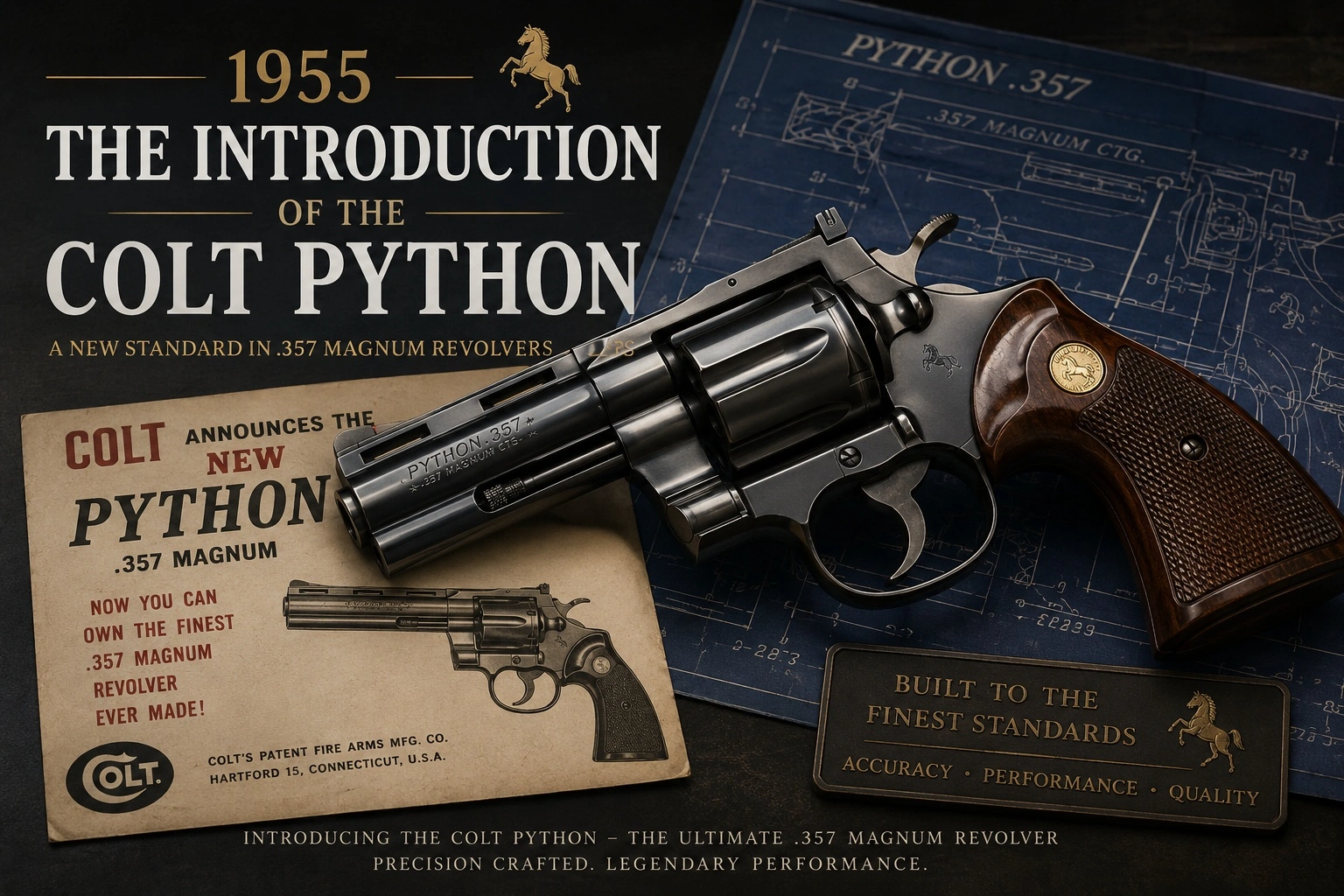
The Colt Python arrived in 1955 as Colt's premium double-action .357 Magnum revolver. It was not simply another service revolver chambered for a powerful cartridge. It was built and promoted as an upper-tier target-grade model, combining a hand-fitted Colt action, high-polish finish work, adjustable sights, target stocks, and a visually distinctive vent-rib barrel with a full underlug.
For collectors, the 1955 release matters because the first-year guns sit at the beginning of every later Python discussion: Royal Blue polish, early Accro sights, hollow-underlug barrels, fully checkered walnut target stocks, no-letter serial numbers, and the importance of factory records. A 1955 Python should be evaluated as an early-production artifact, not just as an older example of a famous model.
Why Colt Released the Python in 1955
By the early 1950s, the .357 Magnum had become an important performance cartridge, and Colt was working to reassert itself in the modern double-action magnum market. Colt had already offered the postwar Colt .357 Magnum and then the .357 Magnum Trooper, but the Python was the dramatic premium model: the revolver meant to stand above standard service offerings in accuracy, polish, balance, and prestige.
The project grew from target-revolver thinking. Period accounts describe Colt personnel experimenting with strengthened target-revolver concepts and existing Colt parts before the Python became a production model. That background explains why the first Python reads like a factory custom: carefully fitted lockwork, a sighting system aimed at precision shooting, target stocks, and a barrel profile that was both functional and instantly recognizable.
| Collector Topic | 1955 Release Detail | Why It Matters |
|---|---|---|
| Factory debut | First public shipments are reported in June 1955, with the first four public-shipped examples leaving Colt on June 2, 1955. | Shipping date and serial number should be checked together. Early serial number alone is not the same as documented first-year shipment. |
| Serial range | Common collector tables place 1955 production in the no-letter serial range 1 through 299. | These guns are scarce and highly scrutinized. Serial tables are a starting point, not a substitute for factory records. |
| Initial barrel length | The Python was initially available as a 6-inch revolver before later 4-inch, 2.5-inch, 3-inch, and 8-inch configurations became part of Python history. | A claimed 1955 gun should normally be checked against the early 6-inch pattern unless factory documentation supports something unusual. |
| Signature barrel | Ventilated rib, full underlug, and early hollow-underlug construction defined the first-generation profile. | Barrel originality is central. Rebarreled or later-barrel examples can look convincing at a glance. |
| Launch price | Contemporary and collector references place the original price at about $125. | That was expensive for the period and reinforces that the Python was positioned as a premium revolver from the beginning. |
Launch Features Collectors Should Know
The early Python combined Colt's traditional double-action lockwork with presentation-level exterior finishing. The 6-inch barrel, ventilated rib, underlug, adjustable rear sight, pinned ramp front sight, wide checkered hammer spur, and grooved trigger created the pattern later collectors would use as the baseline for judging early examples.
The finish is especially important. The Python's high-polish blue became one of the model's most famous traits and is central to first-year collector value. On an honest early revolver, sharp edges, lettering, flats, screw slots, muzzle wear, cylinder flutes, and the junctions around the frame should tell a consistent story. A beautiful reblue may still be attractive, but it is not the same collector object as an original early Royal Blue example.
Serial No. 1 and the First Public Shipments
American Rifleman identifies Colt Python Serial No. 1 as hand-built by Colt Master Gunsmith Alfred DeJohn and reports that the first four public-shipped Pythons, serial numbers 4, 6, 7, and 10, left the Hartford factory on June 2, 1955. That detail is useful for collectors because it separates three ideas that are often blurred together: serial number order, assembly date, and shipment date.
A very low serial number is not, by itself, proof of a specific ship date or original configuration. Colt and Colt Archive sources caution that serial-number lookups and tables use approximations, and that factory records may show shipment details different from what a simple serial range suggests. For a 1955 Python, the safest language is documented first-year production only when the paperwork supports it.
How to Identify an Honest 1955-Era Python
- Start with the serial number. A 1955 candidate should fall in the early no-letter range and should be checked against Colt's records or a Colt Archive letter.
- Confirm the barrel. Look for a period-correct 6-inch Python barrel with early features, correct rollmark quality, and no evidence that the barrel was replaced later.
- Study the finish. Original high-polish blue should preserve crisp lettering and edges. Rounded corners, washed markings, and inconsistent color can suggest refinishing.
- Examine the stocks. Early fully checkered walnut target stocks with gold Rampant Colt medallions are a major originality cue, but grips are easy to swap.
- Check sights and small parts. Rear sight style, front sight configuration, hammer, trigger, screws, and wear patterns should agree with the claimed production period.
- Document the paper trail. Box, label, paperwork, prior sale history, and a Colt Archive letter can change the confidence level dramatically.
Collector Value of the 1955 Release
First-year Pythons command special attention because production was small and because the Python later became Colt's most famous premium revolver. Rock Island Auction notes only 299 Pythons manufactured in 1955 in its collector-market discussion, and it separately cited a documented first-year 1955 example, serial number 69, achieving $34,500 in a December 2021 Premier Auction. Those figures are market examples, not a universal valuation, but they show why documentation and originality matter so much.
Condition still controls the conversation. A correct first-year Python with original finish, correct stocks, clean mechanics, and factory documentation is a different collector proposition from a refinished or rebarreled revolver with the same approximate serial-year range. When describing one for publication or sale, it is better to write narrowly and precisely: "1955 serial range," "factory-lettered first-year shipment," or "documented 1955 Python" depending on what the evidence actually proves.
How This Page Fits the Timeline
The 1955 introduction page is the starting point for the rest of the Python timeline. The next subjects—early hollow-lug changes, frame refinements, Royal Blue evolution, grip and medallion changes, and serial-prefix eras—are easier to understand once the launch configuration is clear. The original 1955 pattern established the visual vocabulary that later changes either preserved, refined, or departed from.
The 1955 debut of the Colt Python established a standard for craftsmanship and performance that continues to influence collectors today. Readers seeking a complete reference covering serial numbers, production changes, finishes, barrel lengths, and identification details should visit the Colt Python serial number and identification guide.

Research Sources Used
This page was revised from a short launch draft into a collector reference page using cross-checked collector-history articles, auction-market documentation, Colt serial-number cautions, and Colt Archive letter guidance. For final publication, verify individual revolvers against Colt Archive letters and period Colt catalogs whenever a claim involves first-year shipment, finish originality, barrel configuration, stocks, or rarity.
- American Rifleman: A Colt's Python Primer
- Guns & Ammo: The Colt Python Family
- Handguns Magazine: Colt Python complete history
- Gun Digest: Colt Python, the Cadillac of revolvers
- Rock Island Auction: Colt Python prices, values, and trends
- Colt serial-number lookup and documentation caution
- Colt Archive Services: Archive Letter overview
- Colt Archive Properties: Archive Letter details and serial-lookup cautions
- Gun Collectors Club: Colt Python serial number tables