Colt Python Timeline • Updated September 19, 2026
For additional model and manufacture-year context, visit the Royal Blue Python research in the Colt serial-number lookup tool.
Royal Blue Evolution: Collector Summary
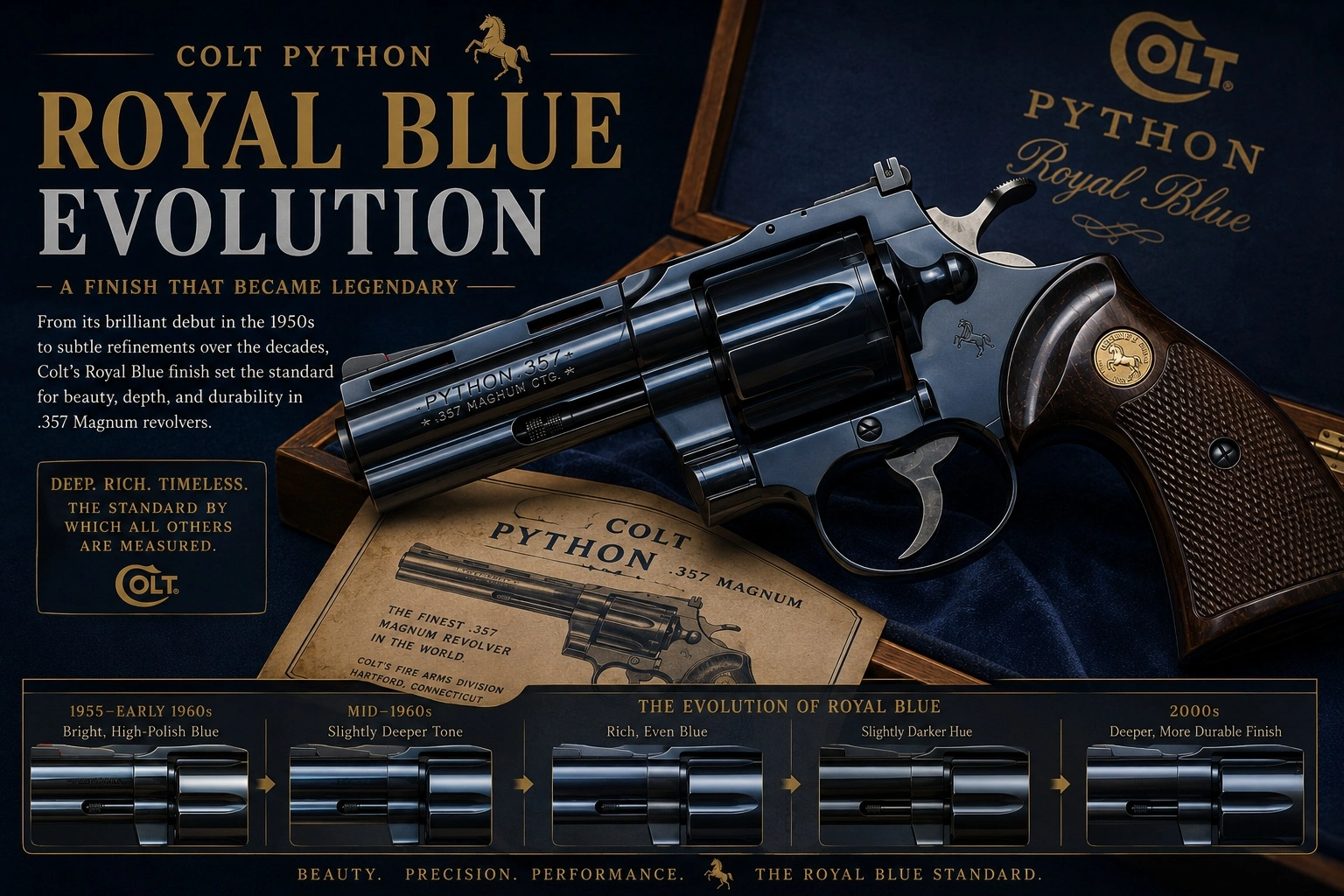
Colt Royal Blue is one of the defining features of the original-series Python. The term describes more than a dark blue-black color. On a Python, the effect came from an unusually careful polish before bluing, leaving flat surfaces mirror-like while preserving the revolver’s crisp barrel rib, underlug edges, rollmarks, cylinder flutes, screw holes, sideplate border, and frame contours.
For collectors, Royal Blue condition is often as important as barrel length or serial range. A high-condition original finish can tell a story about careful storage and low handling. A refinished gun may still be attractive and valuable as a shooter or display piece, but it should be described differently from a revolver that still retains factory-applied finish from its original shipment.
Why Royal Blue Became the Python Signature
The Python arrived in 1955 as Colt’s premium .357 Magnum revolver, and its finish was part of the sales message from the beginning. Colt Fever describes the introductory six-inch Python as having a brilliant, mirror-like blue and states that the Python’s super-polished blue finish became known as Colt Royal Blue inside and outside collector circles. The same account emphasizes that the visible difference between ordinary satin blue and the Python’s deep mirror blue was the extent and quality of the polishing before bluing.
That point matters because bluing does not hide poor metal preparation. It follows the surface underneath it. On an original Python, Royal Blue reflects the labor that took place before the chemical bluing step: progressive polishing, skilled edge control, and final preparation good enough to produce depth without washing out the gun’s details.
Depth
The best examples show a deep blue-black surface that changes tone with light angle rather than looking flat or painted.
Crispness
Royal Blue should not erase detail. Sharp rib edges, vent edges, rollmarks, Rampant Colt marks, and cylinder flutes help support originality.
Continuity
Factory finish should appear consistent across frame, barrel, crane, cylinder, and sideplate, allowing for honest handling wear.
Documentation
A Colt Archive letter may confirm finish, barrel length, caliber, shipment date, and destination when factory records contain those details.
What Royal Blue Was Not
Royal Blue was not a separate coating added on top of the gun in the way plating or paint is added. It was a polished blued finish on carbon steel. That distinction explains why wear patterns are so revealing. Holster rub, muzzle wear, sharp-edge thinning, cylinder drag, and backstrap handling marks remove or thin the blued surface; they do not peel like plating. Pits, buffed markings, rounded corners, or dished screw holes can remain visible under a refinish because bluing follows the metal surface that exists at the time it is applied.
It is also useful to separate factory Royal Blue from later bright nickel, Royal Coltguard electroless nickel, satin stainless, bright-polish stainless, and modern blued Python finishes. Handguns Magazine notes that nickel was added soon after the Python’s introduction, that Royal Blue and nickel became the two primary factory finishes, and that later finish options included Coltguard in 1981, stainless in 1984, and the super-polished stainless Ultimate Python in 1985.
Original Royal Blue vs. Refinished Blue
The most common collector mistake is to judge a Python only by how glossy it appears. A refinished Python can look extremely bright, but factory originality is judged by the metal underneath the shine. Over-polishing can soften the upper rib, flatten lettering, round the muzzle crown edge, blur the Rampant Colt logo, dish the sideplate screw holes, and reduce the crisp line where the sideplate meets the frame. The more mirror-like the surface, the more carefully these details should be inspected.
Factory letters and auction documentation show why precise wording matters. Rock Island Auction listings regularly distinguish factory-letter-confirmed Royal Blue finish from general “blue” catalog descriptions, including examples where the letter verifies original Royal Blue finish, barrel length, and shipment details. That kind of documentation is especially important for rare barrel lengths, special-order guns, engraved Pythons, Python Hunter packages, and high-condition early examples.
Era-by-Era Collector Context
1955 and the early no-letter guns
Early Python collecting begins with the six-inch, no-letter serial-number period. The Royal Blue discussion belongs here because the finish was one of the features that made the Python look unlike a routine service revolver. On early examples, inspect the barrel rib, hollow-lug period details, fully checkered stocks, early Accro sight configuration, and the relationship between serial number range and factory-letter data.
1960s and 1970s production
Royal Blue remained central to the Python’s identity through the main production decades. The finish should be evaluated together with stocks, medallions, sights, serial prefix, box label, and any factory letter. Do not assume that all glossy Pythons are original or that all finish differences prove refinishing; individual polishing, lighting, handling, storage, and age can create visual differences.
1980s finish expansion
The 1980s broadened the Python finish story. Coltguard, stainless steel, and bright-polish stainless options gave buyers alternatives to Royal Blue, but Royal Blue still appeared on important cataloged and special packages. Factory-lettered Python Hunter and short-barrel examples from this era show Royal Blue finish verification as part of the collector record.
1990s and late Custom Shop context
Late-production Pythons and Custom Shop-period guns should be described carefully. The finish may be factory-applied, factory-custom, refinished, or later restored. The more unusual the configuration, the more important it is to state exactly what the factory letter confirms and what is simply visible on the revolver today.
Modern blued Python note
Colt returned a blued Python to the modern line in the 2020s. Colt’s current Blued Python product page describes the modern revolver separately from the original-series guns, and recent reviews note that modern blued examples use a high-polish black-oxide style finish over carbon steel. A modern blued Python can be an attractive tribute to the old look, but it should not be captioned as original 1955–2005 Royal Blue unless the page is clearly discussing the historical finish by analogy.
Collector Inspection Points
- Rollmarks: check the barrel address, caliber marking, Rampant Colt, proof marks, and serial-number area for washed lettering or uneven polish.
- Edges: inspect the muzzle, rib, vents, underlug, cylinder flutes, crane cut, trigger guard, backstrap, and sideplate border for rounded surfaces that suggest aggressive buffing.
- Finish breaks: note honest high-edge wear, cylinder drag, muzzle thinning, and grip-frame handling marks separately from pitting, cold blue, or touched-up areas.
- Color consistency: compare the barrel, frame, cylinder, crane, ejector rod housing, and sideplate under neutral light; mismatched color may indicate parts replacement, refinishing, or different polishing history.
- Stocks and box: Royal Blue value is strengthened when the correct stocks, medallions, box label, papers, and accessories support the revolver’s date and configuration.
- Factory letter: use the letter to support original shipment information, but remember that it does not prove present-day condition or rule out later refinishing.
Finish Reference Table
| Finish Term | Collector Meaning | Documentation Cue |
|---|---|---|
| Royal Blue / Python Blue | High-polish factory blue associated with the original-series Python and its premium identity. | Look for crisp original metal preparation and factory-letter confirmation when finish originality affects value. |
| Blue | May be used generically in catalogs, listings, and tags; on many Pythons this can refer to Royal Blue-style factory finish. | Do not rely on a seller’s shorthand. Compare the gun, box, serial range, and letter. |
| Bright Nickel | Polished plated finish offered alongside Royal Blue on many earlier-production Pythons. | Evaluate plating condition, flaking, edge wear, and whether the finish is lettered. |
| Royal Coltguard / Electroless Nickel | Weather-resistant satin nickel-style finish associated with early-1980s options. | Do not confuse it with Royal Blue or bright nickel; special finish verification matters. |
| Stainless / Bright Polish Stainless | 1980s stainless options, including very bright-polished stainless variants. | Bright stainless can be mirror-like but is not Royal Blue; describe the material and finish accurately. |
| Modern Blued Python | Modern production blued carbon-steel Python finish, visually inspired by the classic look. | Caption as modern blued production unless discussing the old Royal Blue finish historically. |
| Reblue / Refinish | Later-applied finish after original production, possibly attractive but different from factory original finish. | Document as refinished when known; avoid calling it original Royal Blue without evidence. |
How to Write Accurate Captions and Listings
Good collector wording is specific. Use phrases such as “factory-lettered Royal Blue finish,” “appears to retain original Royal Blue with handling wear,” or “refinished in a high-polish blue style” depending on the evidence. Avoid broad claims like “all original mint Royal Blue” unless the revolver, accessories, condition, and documentation support that language.
When a Colt Archive letter is available, state what it actually confirms: model, caliber, barrel length, finish, stocks if listed, shipment date, and destination. Colt’s own serial-number lookup cautions that online serial data is approximate and not comprehensive, while Colt Archive Services explains that an Archive Letter can document original specifications and delivery details when the records contain them. That makes the letter the better support for finish claims than an online date estimate alone.
How This Page Fits the Timeline
This segment follows the E/I-frame refinement discussion because Royal Blue is the visible counterpart to the Python’s mechanical reputation. The old action, full underlug, ventilated rib, walnut stocks, target sights, and Royal Blue finish worked together to create the Python’s identity. Later pages on grips, serial-prefix eras, 1980s options, and the Custom Shop period all rely on the same principle: a Python is most valuable when its configuration, finish, condition, and documentation tell a consistent story.
The Royal Blue finish is one of the defining characteristics of the classic Python, but it is only one part of the revolver's story. For production history, serial-number dating, barrel lengths, engineering changes, and collector identification details, see the complete Colt Python serial number and identification guide.
Research Note
This page was researched against collector-history sources, factory documentation guidance, auction examples with factory letters, and current descriptions of modern blued Python production. Treat finish claims as evidence-based: the more valuable or unusual the gun, the more important it is to compare the revolver to Colt records and period-correct examples.
- Colt Fever: Colt Python history and Royal Blue polishing notes
- Handguns Magazine: Colt Python complete history and finish-option chronology
- Guns & Ammo: Colt Python family review and modern blued finish comparison
- Rock Island Auction: factory-lettered early-production Royal Blue Python example
- Rock Island Auction: factory-lettered three-inch Royal Blue Python example
- Colt Archive Services and Colt Serial Number Lookup
- Colt: current Blued Python product page