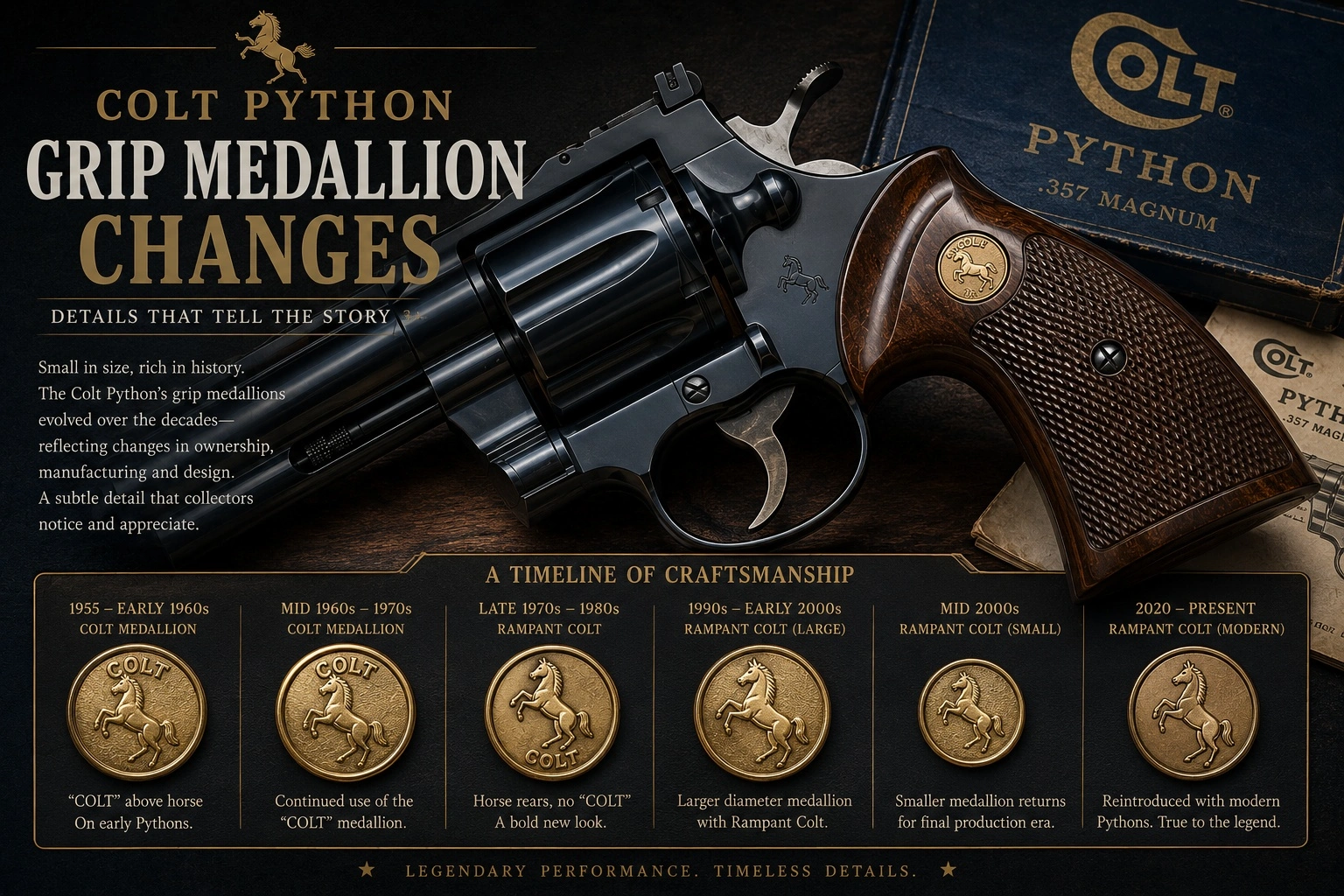
Colt Python Timeline
For related date-of-manufacture research, use the Python grip-era research in the Colt serial-number lookup tool.
Colt Python Grip & Medallion Changes, 1955-2005
The Colt Python is a double-action revolver, although many collectors casually group it with classic handguns and pistols. This page focuses on the original Python production period from the 1955 introduction through the end of limited Custom Shop production in 2005. In Colt language, the wooden handle panels are often called stocks; collectors commonly say grips. Both terms are used here.
Grip identification matters because original Python stocks can represent a meaningful part of the revolver's collector value. The correct pattern should line up with the approximate year, barrel length, finish, box label, factory letter, and overall condition story. These date ranges are practical collector ranges, not hard factory cutoffs. Colt used existing parts, owners swapped stocks, and high-value walnut target stocks were often removed from guns later in life.
Factory Grip Timeline at a Glance
| Approximate period | Factory / collector pattern | Main visual cues | Collector notes |
|---|---|---|---|
| 1955-c. 1960/1961 | First-style fully checkered American walnut target stocks | Full checkering across the face with only a narrow smooth border; oil-finished walnut; gold Rampant Colt medallions; target profile on 6-inch guns. | The most recognizable early Python stock. Best evaluated against early serial range, early sight/barrel details, and period finish. Later reproductions exist and can look convincing. |
| c. 1960/1961 transition | Second-style target-stock transition | Early changeover examples may overlap first-style visual language and later second-style layout. Oil finish and gold medallions remain key cues. | Use caution with strict date claims. Transitional guns and later stock swaps make this a comparison-and-documentation issue. |
| c. 1961/1962-1973 | Second-style checkered walnut target stocks | Checkered walnut with smooth upper panels; gold medallions; visible screw head on the left panel; left-panel thumb rest in the early version. | A common correct pattern for many 1960s and early 1970s Pythons. Later versions added thumb-rest treatment on both panels and changed the checkering layout. |
| 2½-inch barrel exceptions | Service-style walnut stocks | Smaller fully checkered service profile; narrow borders; gold medallions. | Do not automatically expect large target stocks on every short-barrel Python. Early 2½-inch examples are often associated with service-style stocks. |
| 1974-1978 | Early third-style walnut target stocks | Checkered target stocks with gold medallions; changed upper shape/checkering compared with second-style stocks. | Collector shorthand often calls these early third generation Python target stocks. Compare the thumb cuts, checkering border, and fit to known period examples. |
| 1979-1990 | Late third-style walnut target stocks | Later checkering pattern and target profile; gold medallions standard on factory Python target stocks; color can range from light to darker walnut. | This is the classic late blue/nickel/stainless-era walnut look. Many guns from this era later lost their factory walnut stocks to rubber shooting grips or separate resale. |
| 1980s-early 1990s | Walnut stocks plus factory rubber-stock options on some late and special models | Pachmayr Presentation or Gripper rubber stocks with gold Colt medallions; some black neoprene stocks; some smooth laminated rosewood stocks. | Rubber is not automatically aftermarket on late-production Pythons, especially stainless, Electroless Nickel/Royal Coltguard, hunting, silhouette, or package-gun examples. |
| 1990s-2005 Custom Shop / Python Elite era | Custom Shop late-production stocks | Mixture of smooth laminated rosewood, black neoprene, Pachmayr rubber stocks, limited Hogue use, and Custom Shop special-order furniture. | By the late 1990s the Python was primarily a Custom Gun Shop / Python Elite catalog item. Originality is best supported by the box label, paperwork, and Colt archive documentation. |
1955 to About 1960/1961: First-Type Full-Checkered Walnut Stocks
The 1955 Python was introduced as Colt's premium .357 Magnum revolver and, in its early 6-inch form, used fully checkered American walnut target stocks with gold Rampant Colt medallions. These first-type stocks are among the most desirable Python furniture because they belong to the earliest production identity: Royal Blue finish, early Accro sight, early barrel details, and hand-fitted presentation-grade character.
Look for checkering that covers nearly the entire face of each panel, with only a thin smooth border. The finish should look more like an oil-finished walnut surface than a later heavy gloss. Wear should make sense with the gun: an early revolver with mint stocks and a heavily handled frame deserves extra scrutiny, as does a high-condition early Python wearing later third-style stocks.
1961/1962 to 1973: Smooth-Top Second-Style Target Stocks
The next major pattern kept the walnut target-stock identity but changed the face layout. Instead of full checkering up to the top of the panel, the second-style stocks used smooth upper sections, visible screw hardware on the left panel, gold medallions, and a thumb-rest profile. Early examples are often described with a left-side thumb rest; later development added thumb-rest treatment to both panels with a slightly different checkering pattern.
For a 1960s Python, this is often the expected target-stock look. The smooth-top section is the visual cue most readers notice first. As with all Python stocks, check the fit at the frame, the age of the screw and escutcheon, medallion placement, wood color, and whether the stock wear matches the revolver's finish wear.
Short-Barrel Pythons and Service-Style Stocks
The 2½-inch Python creates one of the common collector mistakes. Not every original Python left Colt with large target stocks. Short-barrel guns originally shipped with service-style stocks in at least some early factory configurations. These were smaller, fully checkered walnut stocks with narrow borders and gold Rampant Colt medallions.
That means a short-barrel Python wearing service stocks may be more correct than a buyer first assumes. Conversely, a 2½-inch gun with target stocks may still be legitimate depending on shipping date, owner history, and factory or distributor configuration. The correct conclusion comes from records and context rather than a blanket rule.
1974 to 1990: Early and Late Third-Style Walnut Target Stocks
Collectors commonly divide later walnut Python target stocks into early third-style and late third-style patterns. The early third-style pattern is generally associated with the mid-to-late 1970s, while the late third-style pattern is commonly associated with the late 1970s through about 1990. Both are checkered walnut target stocks with gold medallions, but their checkering borders, upper shape, and thumb-cut treatment differ from the 1960s pattern.
The 1974-1978 range is a useful working range for early third-style identification. The 1979-1990 range is a useful working range for late third-style identification. These ranges should be treated as practical collector guideposts, especially because Colt's parts use, late shipments, and later owner changes can blur exact transition points.
Wood color is not a standalone dating tool. Late third-style walnut can appear lighter, darker, or streaked depending on the wood blank, finish, storage, and later cleaning. Gold medallions remained the expected Python look for factory target stocks, but medallions can be replaced and modern reproductions can be ordered with different medallion colors.
1980s and Early 1990s: Rubber Stocks, Package Guns, and Special Models
By the 1980s, Python collectors begin seeing more legitimate factory variety. Standard blue and nickel guns continued to appear with walnut target stocks, but late-production stainless and Electroless Nickel/Royal Coltguard examples, hunting packages, silhouette-oriented guns, and other special configurations may be encountered with rubber stocks.
Pachmayr Presentation and Gripper rubber stocks with gold Colt medallions were used on Python examples, and black neoprene stocks appear in late-production discussion. Hogue Monogrips with molded Colt markings were also used briefly. For a collector, the point is not that rubber is always original; it is that rubber is not always disqualifying. The box label, paperwork, factory letter, and model variation matter.
1990s to 2005: Custom Shop, Python Elite, and Late Furniture
In the late 1990s, the Python moved into a more limited Custom Gun Shop / Python Elite identity. During this late period, smooth laminated rosewood stocks, black neoprene stocks, Pachmayr rubber stocks, and short-run Hogue or special-order furniture may be encountered. Some guns are best evaluated as Custom Shop products rather than ordinary main-line production revolvers.
The original-production Python story ends in 2005 with limited Custom Shop production, including the 50th-anniversary context. For these late guns, collector confidence should come from documentation. A late stainless Python with rubber stocks and the right box/papers can be much more convincing than a gun wearing attractive walnut that does not match the label or shipment record.
Medallion and Hardware Notes
- Gold medallions are the classic Python identifier for factory walnut target stocks and many rubber-stock variants.
- Visible left screw head is expected on the walnut stocks discussed here; examine screw finish, escutcheon wear, and whether the screw looks newer than the wood.
- Medallion replacement is common. A correct-color medallion does not prove the stocks are original to the gun.
- Fit matters because original Colt stocks were not always perfect, but obvious gaps, proud edges, fresh sanding, or finish mismatch should be documented.
- Reproductions can be excellent and useful, but they should be disclosed as replacements in a sale or collection record.
Originality Checklist for a Python Grip Claim
- Record the serial number range, barrel length, finish, sight configuration, and any factory-letter data before judging the grips.
- Compare the grip style to the approximate date range, but allow reasonable overlap at transition points.
- Check whether the box label or papers name rubber stocks, Custom Shop configuration, Python Elite, Hunter, Silhouette, or other package details.
- Look for consistent aging: wood finish, checkering wear, screw-slot wear, medallion toning, and frame finish should tell a believable story.
- Be suspicious of vague claims such as "all original" when the grips are far cleaner than the revolver or belong to a different pattern era.
- Photograph both sides of the stocks, the screw, medallions, butt fit, frame fit, box label, and any paperwork before selling, insuring, or publishing the gun.
Practical Collector Takeaway
For 1955-2005 Pythons, the broad grip story is straightforward: early full-checkered walnut, then smooth-top second-style walnut, then third-style walnut, with short-barrel service-stock exceptions and more rubber/laminated late-production variety as the Python moved into stainless, package-gun, and Custom Shop territory. The hard part is not naming the pattern; it is proving that the specific stocks belong with the specific revolver.
A careful collector should write the claim conservatively. Instead of "factory original grips" without support, use language such as "period-correct first-style Python target stocks," "correct-appearing second-style stocks for the serial range," or "documented factory-shipped Pachmayr stocks per box label/factory letter." That approach protects accuracy and keeps the page useful for serious readers.
Changes in Colt Python grip medallions can help collectors estimate production periods and identify replacement stocks, but they represent only one aspect of authentication. For serial-number dating, engineering changes, barrel configurations, and a complete overview of Python production, see the Colt Python serial number and identification guide.
Research Sources and Verification Notes
This page uses collector-history sources to establish the practical grip-pattern timeline. Commercial reproduction listings are used only as secondary cross-checks for commonly accepted collector date ranges and visible pattern labels. Exact originality for an individual revolver should be verified against Colt archive records, period catalogs, box labels, and clear photographs of known original examples.
- American Rifleman, “A Colt's Python Primer” — summarized early full-checkered walnut stocks, smooth-top second-style stocks, service stocks for 2½-inch guns, Pachmayr rubber stocks, laminated rosewood, black neoprene, and brief Hogue use.
- Colt Fever Python history — used for introduction context, early 1955 configuration, broad Python production-change context, and the 2005 endpoint.
- Deer Hollow Colt grip listings — used as a collector-pattern cross-check for first-, second-, early-third-, and late-third-style Python stock date ranges.
- Deer Hollow second-style Python stocks — cross-check for the 1961-1973 collector range and gold-medallion convention.
- Deer Hollow early third-style Python stocks and late third-style Python stocks — cross-checks for 1974-1978 and 1979-1990 collector pattern ranges.