The Winchester Model 94 is not just a lever‑action rifle; it is one of the clearest collector stories in American arms. It bridges black‑powder roots, smokeless‑powder hunting culture, saddle‑ring carbines, deer camps, commemoratives, and the emotional divide between pre‑64 and post‑64 production.
For collectors, the attraction is the range. A plain post‑64 carbine can still be an affordable heirloom piece. A clean pre‑64 .30‑30 can be the center of a working collection. A factory‑lettered antique rifle, short carbine, special‑order configuration, or untouched boxed commemorative can become a serious investment-grade acquisition.
In This Guide
Collector Quick Read
A clean, original pre‑64 .30‑30 carbine with strong bore, sharp markings, and no refinish.
Late New Haven AE and Trapper models in high condition, especially with box and paperwork.
Rebluing, sanded stocks, swapped sights, altered barrels, and missing commemorative boxes.
Record the serial number, barrel address, caliber marking, proof marks, sights, buttplate, and provenance before discussing value.
Why the Model 94 is Gold
The Model 94 is gold because it made the modern sporting lever‑action feel personal. It was light enough to carry all day, powerful enough for generations of deer hunters, and familiar enough to become part of family memory. The same rifle that sat behind a farmhouse kitchen door also sat in hardware‑store racks, hunting cabins, commemorative boxes, and eventually auction catalogs.
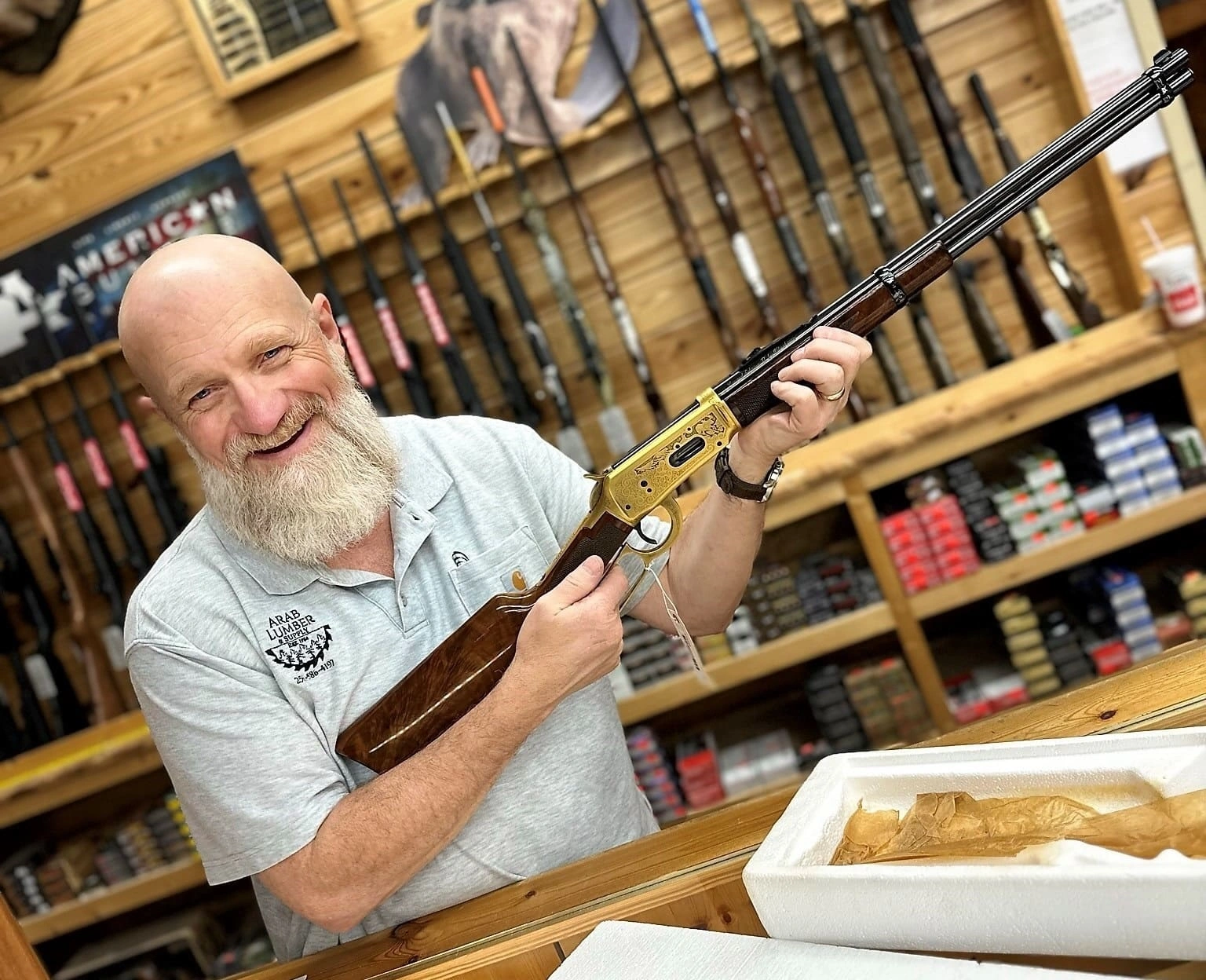
My FFL guy never smiled so big!
For the wider family of rifles and shotguns, explore the Winchester model guides. Its collector appeal comes from evolution. Early black‑powder chamberings, .30 WCF/.30‑30 dominance, rifle versus carbine demand, World War I contract examples, pre‑64 craftsmanship, the 1964 manufacturing change, Angle Eject utility, Big Bore experiments, commemoratives, and the 2006 end of New Haven production all create separate lanes for collectors.
Think of the Model 94 as a century‑long ledger: every barrel address, screw slot, proof mark, and stock finish tells you where that rifle sits in the American story.
Historical Timeline
Fletcher, my 4-year old grandson took over the drawing of the depiction of this timeline. At first I thought I might have to redo it, but after looking at it a second time, I realized Fletcher got it just right.
- 1894
Model 1894 launch
Winchester introduces John Browning’s new lever‑action design, first associated with black‑powder cartridges such as .32‑40 and .38‑55.
- 1895
The smokeless turning point
The .30 WCF, later known as .30‑30 Winchester, becomes the chambering most collectors and hunters associate with the Model 94.
- 1920s
Carbine popularity builds
As hunting culture changes, the handier carbine configuration becomes the common Model 94 image in American memory.
- 1964
The pre‑64 versus post‑64 divide
Collectors draw a hard line at the 1964 manufacturing change. Pre‑64 rifles generally receive a premium when original and high condition. The bolt-action side of that transition is covered in how to distinguish an original Pre-64 Model 70.
- 1983
Angle Eject arrives
Angle Eject makes conventional receiver‑mounted scopes easier to use, creating a practical hunting advantage and a separate collector category.
- 2006
New Haven production ends
U.S. Repeating Arms announces the shutdown of the New Haven facility, ending domestic production of the Model 94, Model 70, and Model 1300 there.
- 2010
Miroku revival
Winchester brings the Model 94 back through Miroku production in Japan, creating a modern revival lane separate from New Haven collecting.
Variants & Configurations: Collector Gold
The fastest way to understand a Model 94 is to identify its configuration before assigning value. A “Winchester 94” can mean a common post‑64 carbine, a scarce short rifle, a factory commemorative, a Big Bore, a late AE Trapper, or an early special‑order antique.
Rifles vs. Carbines
- Typical years
- 1894 forward, with early rifles and later carbines both important.
- Key identifiers
- Rifles often show longer barrels, rifle forearms, and crescent buttplates; carbines commonly show 20-inch barrels, barrel bands, and carbine buttplates.
- Desirability
- Early rifles with special‑order features can be very desirable; standard carbines dominate the family-heirloom market.
- Watch for
- Cut barrels, replaced sights, non-factory sling swivels, and mismatched wood.
Pre‑64 vs. Post‑64
- Typical years
- Pre‑64: before the 1964 change. Post‑64: 1964 forward.
- Key identifiers
- Collector conversation centers on machining, receiver finish, small parts, and traditional feel.
- Desirability
- Original pre‑64 carbines usually carry the strongest mainstream premium.
- Watch for
- Refinished receivers, polished proof marks, swapped wood, and “almost pre‑64” claims without serial verification.
Angle Eject (AE)
- Typical years
- Introduced for the Model 94 in 1983.
- Key identifiers
- Receiver geometry directs fired brass away from a scope mounted over the receiver.
- Desirability
- Less “old Winchester” romance than pre‑64, but useful and increasingly collectible in high condition.
- Watch for
- Scope holes, missing rear sights, scratched receiver tops, and late safety variations.
Trapper Models
- Typical years
- Most collector-visible examples are late 20th-century factory Trappers; early short carbines are a specialized field.
- Key identifiers
- Short barrel, compact handling, often seen in AE-era variants and commemorative/special runs.
- Desirability
- Strong when factory documented, original, legal, and high condition.
- Watch for
- Cut-down barrels passed off as factory Trappers. Always verify barrel length, markings, sight placement, and legal status.
Commemoratives
- Typical years
- Factory commemoratives begin in 1964 and run through many themes and special issues.
- Key identifiers
- Special serial prefixes, plated or embellished receivers, decorated boxes, paperwork, medallions, or cases.
- Desirability
- Best when unfired, untouched, and complete with box, sleeve, paperwork, hang tags, and matching accessories.
- Watch for
- Handling marks. Many commemoratives were produced in large numbers, so “rare looking” is not the same as rare.
Big Bore 94 / XTR
- Typical years
- Late 1970s into later production, with chamberings such as .375 Win, .307 Win, .356 Win, and others.
- Key identifiers
- Heavier receiver treatment, “Big Bore” or XTR markings, and chamberings outside the ordinary .30‑30 lane.
- Desirability
- Strong among hunters and collectors who want something less common than a standard .30‑30 carbine.
- Watch for
- Ammunition availability, recoil wear, cracked stocks, and non-original recoil pads.
Legacy, Ranger & Wrangler
- Typical years
- Mostly later New Haven/USRAC production.
- Key identifiers
- Model names may signal upgraded wood, economy trim, large-loop styling, or special catalog positioning.
- Desirability
- Condition and completeness matter more than the name alone.
- Watch for
- Assuming every named variation is scarce. Verify catalog year, box label, and configuration.
Miroku Revival
- Typical years
- 2010 forward, after the 2006 New Haven closure.
- Key identifiers
- Modern Winchester-branded production from Japan, often with tang safety and high fit-and-finish.
- Desirability
- Excellent modern rifles, but they belong in a separate collector lane from New Haven production.
- Watch for
- Mixing New Haven values and Miroku values without noting country of manufacture and configuration.
Serial Number Ranges
Serial numbers are where most Model 94 research begins, but they should never be where it ends. If you have a number in hand, start with the Winchester 94 serial-number lookup and production-year guide, then return here to compare the rifle’s configuration, condition, and originality. Winchester’s own serial-number reference explains that historic records are incomplete and that many public year tables are approximate. The table below follows the familiar end‑of‑calendar‑year format through the publicly published early‑1990s data.
| Year | Approx. last serial assigned | Year | Approx. last serial assigned | Year | Approx. last serial assigned |
|---|---|---|---|---|---|
| 1894 | 1–14,579 | 1895 | 44,359 | 1896 | 76,464 |
| 1897 | 111,453 | 1898 | 147,684 | 1899 | 183,371 |
| 1900 | 204,427 | 1901 | 233,975 | 1902 | 273,854 |
| 1903 | 291,506 | 1904 | 311,363 | 1905 | 337,557 |
| 1906 | 378,878 | 1907 | 430,985 | 1908 | 474,241 |
| 1909 | 505,831 | 1910 | 553,062 | 1911 | 599,263 |
| 1912 | 646,114 | 1913 | 703,701 | 1914 | 756,066 |
| 1915 | 784,052 | 1916 | 807,741 | 1917 | 821,972 |
| 1918 | 838,175 | 1919 | 870,762 | 1920 | 880,627 |
| 1921 | 908,318 | 1922 | 919,583 | 1923 | 938,539 |
| 1924 | 953,198 | 1925 | 978,523 | 1926 | 997,603 |
| 1927 | 1,027,571 | 1928 | 1,054,465 | 1929 | 1,077,097 |
| 1930 | 1,081,755 | 1931 | 1,084,156 | 1932 | 1,087,836 |
| 1933 | 1,089,270 | 1934 | 1,091,190 | 1935 | 1,099,605 |
| 1936 | 1,100,065 | 1937 | 1,100,679 | 1938 | 1,100,915 |
| 1939 | 1,101,051 | 1940 | 1,142,423 | 1941 | 1,191,307 |
| 1942 | 1,221,289 | 1943 | No record | 1944 | No record |
| 1945 | No record | 1946 | No record | 1947 | No record |
| 1948 | 1,500,000 | 1949 | 1,626,100 | 1950 | 1,724,295 |
| 1951 | 1,819,800 | 1952 | 1,910,000 | 1953 | 2,000,000 |
| 1954 | 2,071,100 | 1955 | 2,145,296 | 1956 | 2,225,000 |
| 1957 | 2,290,296 | 1958 | 2,365,887 | 1959 | 2,410,555 |
| 1960 | 2,469,821 | 1961 | 2,500,000 | 1962 | 2,551,921 |
| 1963 | 2,586,000 | 1964 | 2,700,000–2,797,428 | 1965 | 2,894,428 |
| 1966 | 2,991,927 | 1967 | 3,088,458 | 1968 | 3,185,691 |
| 1969 | 3,284,570 | 1970 | 3,381,299 | 1971 | 3,557,385 |
| 1972 | 3,806,499 | 1973 | 3,929,364 | 1974 | 4,111,426 |
| 1975 | 4,277,926 | 1976 | 4,463,553 | 1977 | 4,565,925 |
| 1978 | 4,662,210 | 1979 | 4,826,596 | 1980 | 4,892,951 |
| 1981 | 5,024,957 | 1982 | 5,103,248 | 1983 | N/A / not published |
| 1984 | 5,309,432 | 1985 | 5,362,944 | 1986 | 5,409,249 |
| 1987 | 5,463,790 | 1988 | 5,517,897 | 1989 | 5,574,822 |
| 1990 | 5,615,397 | 1991 | 6,008,296 |
Research habit: On any Model 94, record the serial number exactly as stamped, then photograph the serial, barrel address, caliber marking, Winchester proofs, sights, buttplate, receiver top, receiver sides, and all box labels before asking for a value opinion.
Collector Grades & Condition Guide
A Model 94’s grade is not just finish percentage. Collectors care about originality, mechanical integrity, bore condition, wood-to-metal fit, untouched markings, correct sights, and whether the rifle still presents as a factory gun. For Pre-64 examples, the broader Winchester originality and alteration checks provide additional guidance.
| Grade | Collector meaning | What to look for |
|---|---|---|
| A / Investment | Exceptional originality, high finish, sharp markings, correct parts, strong bore, strong documentation. | Factory letter or box where applicable; crisp screws; no refinish; no extra holes; matching configuration. |
| B / Collector | Original rifle with honest light wear and strong eye appeal. | Wear on carry points, loading gate, receiver edges, and muzzle, but no major alterations. |
| C / Honest Field | Used but respectable, with original character and serviceable condition. | Common deer rifle wear, moderate blue loss, handling marks, sound stock, readable markings. |
| D / Altered | Collectible mainly as a shooter, parts gun, or family heirloom. | Reblued, drilled, sanded stock, changed sights, recoil pad, replacement wood, or non-factory sling work. |
| F / Project | Major condition or authenticity issues. | Cut barrel, structural cracks, deep corrosion, unsafe mechanics, missing parts, or questionable legal configuration. |
Common Wear Points
- Loading gate: honest wear is normal; aggressive polishing or fresh blue around it is a red flag.
- Receiver finish: pre‑64 receiver wear should look natural at edges and carry points; “too shiny” can mean refinish.
- Wood fit: sanded stocks often sit below the metal or have softened edges near tangs and bands.
- Screws: buggered slots suggest amateur disassembly or repeated parts swapping.
- Sights: replacement rear sights, missing elevator pieces, and modern fiber-optic sights affect originality.
- Barrel address: washed lettering, bluing in pits, and rounded proof marks point toward refinishing.
Value Guide: What Drives Model 94 Prices
Values move with condition, originality, rarity, regional demand, and documentation. Treat these ranges as planning numbers for research, insurance conversation, and pre‑purchase triage — not as an appraisal. A factory‑lettered antique or truly rare carbine can break every ordinary range.
| Category | Low | Average | High | What pushes it up or down |
|---|---|---|---|---|
| Pre‑64 standard carbine | $650–$900 | $900–$1,400 | $1,500–$2,500+ | Original finish, .30‑30 or .32 Special demand, sharp wood, correct sights, early features, box/provenance. |
| Post‑64 standard carbine | $450–$650 | $700–$900 | $1,000–$1,250+ | Condition, bore, common hunting wear, later safety features, and whether it has been altered for optics. |
| Angle Eject / 94AE | $650–$900 | $900–$1,200 | $1,300–$1,700+ | High condition, useful chambering, box, and scope-ready utility. Extra holes or missing sights reduce value. |
| Trapper models | $650–$1,000 | $1,000–$1,400 | $1,500–$2,500+ | Factory documentation, barrel length, caliber, box, special issue status, and confirmed legal configuration. |
| Big Bore 94 / XTR | $800–$1,000 | $1,100–$1,400 | $1,500–$2,500+ | Chambering, ammunition interest, condition, and stock integrity. Scarcer calibers can bring premiums. |
| Commemoratives | $600–$900 | $900–$1,300 | $1,500–$4,000+ | NIB condition, full paperwork, decorated box, case, low production, desirable theme, and no handling marks. |
| Rare antique / special order | $1,200–$2,500 | $3,000–$7,500 | $10,000–$100,000+ | Factory letter, scarce chambering, deluxe wood, octagon barrel, takedown, early serial, provenance, and untouched condition. |
Relative Value Trend Snapshot
This chart is intentionally directional. It shows how collector demand tends to reward originality and documented rarity more than ordinary utility condition.
Price Drivers That Matter Most
- Originality: factory finish, sights, wood, buttplate, and markings.
- Condition: finish, bore, mechanics, wood cracks, and screw damage.
- Configuration: carbine, rifle, takedown, octagon barrel, special-order features, Trapper, Big Bore, or commemorative.
- Documentation: factory letter, box label, receipts, photographs, family provenance, and auction history.
- Completeness: commemorative boxes, sleeves, paperwork, medallions, and cases.
How to Authenticate a Model 94
Authentication is a pattern-matching exercise. One feature rarely proves everything; the goal is to see whether the serial number, markings, configuration, condition, and provenance all agree.
Model 94 Authentication Checklist
- Start with the serial: determine approximate era before making any claim about pre‑64, post‑64, AE, or commemorative status.
- Read the barrel address: compare address style, caliber marking, nickel steel markings, and proof placement with the claimed era.
- Inspect receiver machining: pre‑64 claims should be consistent with receiver style, small parts, screws, and finish behavior.
- Check proof marks: soft, dished, or polished proof marks can indicate refinishing.
- Study the wood: factory wood should fit the metal correctly; sanded stocks often sit proud or low in the wrong places.
- Evaluate sights: original sights and elevators matter. Modern replacements should be disclosed and priced accordingly.
- Look for extra holes: drilled receivers, scope bases, sling studs, and tang sight holes can be legitimate for a user rifle but matter to collectors.
- Verify Trappers carefully: a short barrel is not proof of factory Trapper status. Sight placement, markings, crown, magazine length, documentation, and legal compliance matter.
- For commemoratives: box, sleeve, paperwork, hang tags, and matching serial prefixes can matter as much as the gun.
Common Red Flags
- Bright blue over pitting, rounded lettering, or softened screw holes.
- Stock finish on metal edges, sanded checkering, or wood sitting below the receiver tang.
- “Rare” claims based only on a seller’s memory, with no serial, factory letter, box, or catalog support.
- Modern recoil pads on guns represented as untouched originals.
- Mismatched features, such as late safety characteristics described as pre‑64 originality.
Maintenance & Preservation
The collector rule is simple: preserve history before making it shine. A century‑old Model 94 does not need to look new; it needs to remain stable, honest, documented, and safe.
How to Clean a 100‑Year‑Old Model 94 Without Hurting Value
- Verify unloaded status every time the firearm is handled.
- Photograph the rifle before cleaning so original condition is documented.
- Use a clean soft cloth first; avoid abrasive pads, harsh scrubbing, and steel wool on collector pieces.
- Treat wood and metal as different materials. Do not soak the stock with gun oil.
- Do not sand, refinish, reblue, polish markings, or “improve” patina on a collector‑grade rifle.
- Consult a qualified gunsmith before firing any vintage firearm with unknown history.
Long‑Term Storage
Store the rifle in a stable environment. Avoid long-term storage in leather cases, foam cases, damp basements, hot attics, or any container that traps moisture. For vertical long-gun storage, reduce pressure on the wooden stock and inspect regularly for rust, mold, checking, and stock movement.
Insurance & Sale Photography Checklist
- Full left and right side images.
- Close-up of serial number, barrel address, caliber marking, and proof marks.
- Receiver top, receiver sides, tang, lever, hammer, sights, buttplate, muzzle, and crown.
- Any cracks, replaced parts, extra holes, altered sights, or wear points.
- Box labels, paperwork, factory letters, receipts, cases, and family provenance.
The Model 94 in American Culture
The Model 94 became part of America because it traveled well: in saddle scabbards, trucks, farmhouses, deer camps, hardware stores, estate inventories, and family stories. It is one of those rifles that collectors often inherit before they ever intentionally buy one.
In movies and television, the broader Winchester lever‑action silhouette became visual shorthand for the West. Collectors should remember that screen guns were often chosen for blank reliability and camera presence, so the rifle on screen may not be a Model 94 even when audiences call it a “Winchester.” That distinction is part of the fun: the Model 94 belongs to history, hunting, and myth at the same time.

Greg holding a Winchester Model 94 rifle
What keeps it relevant is not nostalgia alone. The 94 is understandable. You can hold one and immediately see why a light, flat-sided, fast-handling lever gun became a companion to generations of hunters and collectors. In a collection, it adds both mechanical interest and emotional weight.
Model 94 Collector FAQ
Is every pre‑64 Model 94 valuable?
No. Pre‑64 status helps, but condition and originality control the final number. A refinished pre‑64 with altered sights can be worth less than a cleaner, later rifle.
Are post‑64 Model 94s collectible?
Yes, selectively. Ordinary post‑64 carbines are common, but high-condition examples, AE variants, Trappers, Big Bores, named models, special runs, and complete boxed rifles have collector interest.
Should I shoot my old Model 94?
Only after it has been inspected by a qualified gunsmith, especially if the rifle is antique, has unknown history, has visible corrosion, or has been stored for decades.
Should I get a factory letter?
For early rifles and higher-value configurations, yes. A factory letter or records search can support originality, date information, and configuration, which can materially affect value.
From My Bench
If you are setting up your own workspace or maintaining a collection, I keep a curated list of tools, books, cleaning gear, and bench items that fit the way I work.
Collector GearAs an Amazon Associate I earn from qualifying purchases. I only link to products, books, tools, and accessories that fit the editorial purpose of Gun Collectors Club.

About Greg Cook
Greg Cook writes about firearms collecting, personal history, and the stories behind interesting guns. His Army MOS was 76Y, Unit Armorer, and he brings that practical background to his collector articles.
Sources & Research Notes
This page is built as a collector field guide, so source quality matters. The serial-number table and historical caveats should always be checked against the best available factory and collector records.
- Winchester Repeating Arms: Date Your Firearm / serial-number reference
- Winchester Firearms Manufacturing Dates by Serial Number and Year PDF
- Winchester Arms Collectors Association date lookup notes
- Winchester Repeating Arms: New Haven factory closure FAQ
- Winchester Repeating Arms: historic-design production and Miroku revival
- Winchester Repeating Arms: Angle Eject FAQ
- Winchester Arms Collectors Association: commemorative production list
- Rock Island Auction: Model 94 collector history and notable auction results
- True Gun Value: current Winchester 94 market averages
- NRA National Firearms Museum: caring for collectible firearms
- National Park Service: caring for historic longarms
- History Nebraska: caring for historic firearms