Research checked • U.S. civilian-market focus
The market in one view
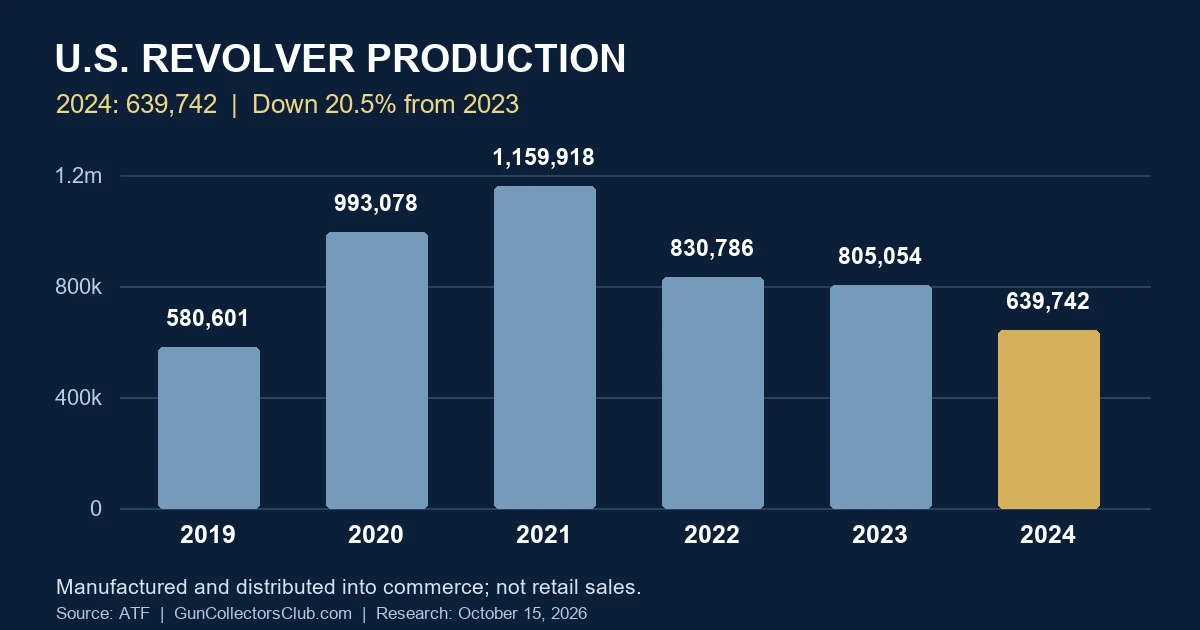
U.S. makers reported 639,742 revolvers in 2024, the latest final ATF year available as of October 15, 2026. Output fell 20.5% from 2023 and roughly 45% from the 2021 peak. It was the lowest annual total since 2019. Meanwhile, current catalogs and marketplace reports show an active mix of inexpensive rimfires, carry revolvers, sporting models and collector favorites.[1],[2],[3]
A production count, a manufacturer’s revenue and a retail ranking answer different questions. This report keeps each measure tied to its own period and scope.
Production: revolvers declined while pistols edged higher
The manufacturing comparison is uneven. Revolver output dropped from 805,054 in 2023 to 639,742 in 2024, while pistol output rose from 3,939,517 to 4,025,829, an increase of about 2.2%. The revolver category was 44.8% below its 2021 high but still 10.2% above 2019.[1],[2]
| Calendar year | Revolvers | Pistols |
|---|---|---|
| 2019 | 580,601 | 3,046,013 |
| 2020 | 993,078 | 5,509,183 |
| 2021 | 1,159,918 | 6,751,919 |
| 2022 | 830,786 | 6,150,667 |
| 2023 | 805,054 | 3,939,517 |
| 2024 | 639,742 | 4,025,829 |
ATF manufacturing and distribution into commerce, not consumer purchases. The 2021–2024 comparison is shown with 2019–2020 context. [1],[2]
What ATF counts: firearms manufactured and disposed of in commerce during the reporting year. This is broader than a factory assembly count and different from a retail sale to an individual. The series includes exports and domestic law-enforcement purchases, excludes U.S. military production, and does not include imported firearms.[1],[2]
Who is making revolvers?
Heritage led reported domestic unit volume. Nearly all of its 2024 total fell in the .22 group, reflecting its substantial rimfire business. Heritage is owned by Taurus, but the Heritage production line should not be confused with imported Taurus-branded revolvers.[1],[4]
| Manufacturer | Revolvers | Current emphasis and examples |
|---|---|---|
| Heritage Manufacturing | 170,705 | Rough Rider and Barkeep rimfire single-actions; Roscoe double-action line. |
| Smith & Wesson | 151,369 | Compact carry revolvers, 686/629 families, Classics and Performance Center models. |
| Ruger | 114,711 | Wrangler, Blackhawk, Vaquero, LCR, SP101 and GP100, among others. |
| Colt | 94,875 | Python, Anaconda, King Cobra, Cobra, Viper, Grizzly, Kodiak and Single Action Army. |
| North American Arms | 41,096 | Small rimfire revolvers and specialty variants. |
| Charter Arms / Charco 2000 | 25,603 | Compact double-action revolvers; Charco 2000 is the ATF reporting name. |
| Kimber | 12,754 | K6s family, also represented in the February 2026 marketplace report. |
| Henry | 11,050 | Big Boy and Golden Boy families, including 2026 Deadeye variants. |
Manufacturer totals combine reporting locations where applicable. Catalog examples describe current brand offerings, not the model mix of the 2024 total. [1],[4],[10],[12]
North American Arms and Charter Arms belong in this comparison: both reported more revolvers than Kimber or Henry. The table is a manufacturing comparison and cannot establish which brand earned the most revenue or sold the most revolvers to U.S. consumers.
Imports and specialist manufacturers broaden the field
Taurus offers compact, sporting and larger-frame revolvers. Rossi lists the RP63, RM64 and RM66. Imported models help explain why domestic-production rankings alone do not describe the full U.S. civilian market.
Uberti and Pietta serve the historical-reproduction and Western-style market. Importer and brand labels deserve attention: Cimarron identifies Uberti, Pietta and other supplying manufacturers in its own documentation. A brand name in a sales table is not necessarily a separate factory.
Specialist choices include Freedom Arms’ Models 83 and 97, Magnum Research’s BFR and Standard Manufacturing’s revolvers. Diamondback, Chiappa and Armscor/Rock Island Armory also appear in the February 2026 new-revolver marketplace report.[10]
New products continue to arrive. Henry introduced Golden Boy and Big Boy Deadeye variants in February 2026, while Smith & Wesson’s current catalog includes Bodyguard 38 2.0 and additional carry and traditional-style offerings. Product investment is visible; the sales performance of those introductions requires separate evidence.[12]
Almost half of domestic production was in the .22 group
| Reported group | Revolvers | Share of total |
|---|---|---|
| .22 and under | 309,702 | 48.4% |
| .357 Magnum | 146,707 | 22.9% |
| .38 Special | 87,805 | 13.7% |
| .44 Magnum | 53,732 | 8.4% |
| Largest band: to .50 | 32,867 | 5.1% |
| .32 | 8,929 | 1.4% |
Uses the AFMER summary labels and totals. Broad reporting groups are not exact cartridge-level retail sales; rounded percentages may not total 100%. [1]
This mix matters. A unit-volume report can be heavily influenced by inexpensive rimfire revolvers, while premium centerfire models can contribute more revenue per unit. It would be misleading to treat the entire category as a market for .357 Magnum carry guns or expensive collector revolvers.
U.S. manufacturers reported 10,000 revolvers exported in 2024, approximately 1.6% of reported production. Subtracting exports still does not produce a civilian retail-sales total: inventories, reporting timing and non-civilian customers remain relevant.[1],[2]
Revolver sales revenue: Ruger provides a direct measure
There is no complete public national revolver retail-sales census in the sources reviewed. That does not mean revolver sales are never reported separately. Ruger discloses revolver net sales, and marketplace providers publish revolver-specific rankings.
| Calendar year | Revolver net sales |
|---|---|
| 2023 | $72.5 million |
| 2024 | $54.8 million |
| 2025 | $39.2 million |
Ruger’s 2025 revolver revenue declined about 28.5% from 2024. This is manufacturer revenue, principally through distributors, rather than consumers’ retail spending. It establishes a decline for Ruger’s revolver business; it does not measure the sales trend for every maker or isolate U.S. civilian purchases.[8]
Smith & Wesson reports handgun revenue as a combined category. Its fiscal 2026 handgun result therefore cannot be presented as revolver revenue or proof of revolver-specific growth.[9]
New and used marketplace activity
Outdoor Analytics’ February 2026 GunBroker snapshot provides a narrower retail view. Smith & Wesson led the reported new-revolver brand shares, followed by Ruger, Colt and Taurus.[10]
| Brand | Reported unit share | Reported median price |
|---|---|---|
| Smith & Wesson | 21.7% | $1,090 |
| Ruger | 20.0% | $747 |
| Colt | 14.5% | $2,258 |
| Taurus | 10.8% | $514 |
| Heritage | 4.6% | $178 |
| North American Arms | 3.6% | $316 |
Outdoor Analytics’ one-month GunBroker snapshot. Absolute unit counts and geographic coverage are not specified; these are not national market shares or October 2026 price quotations. [10]
Median prices depend on the mix of models and variants sold. Colt’s $2,258 brand median is not a quotation for a standard Python. The leading model families in that report were Taurus Small Frame Revolvers, Colt Python, Ruger Blackhawk, Heritage Rough Rider and Ruger Vaquero.[10]
GunBroker’s September 2026 used-revolver ranking is more recent:
| Rank | Model |
|---|---|
| 1 | Ruger New Model Blackhawk |
| 2 | Ruger Single-Six |
| 3 | Colt Python |
| 4 | Smith & Wesson 686 |
| 5 | Ruger Vaquero |
Positions within GunBroker’s used-revolver category, not manufacturer shares of the national used market. [11]
Ruger occupied three of these five positions. This demonstrates representation in that ranking, not a national share. The used market also trades firearms produced over many decades; its transactions do not create new manufacturing revenue.[11]
September 2026 background checks add broader context
| Period | Adjusted checks | Comparison | Change |
|---|---|---|---|
| September 2026 | 1,152,077 | September 2025: 1,179,424 | −2.3% |
| Q3 2026 | 3,329,270 | Q3 2025: 3,249,497 | +2.5% |
| Full year 2025 | 14,612,314 | Full year 2024: 15,239,011 | −4.1% |
These figures cover broader firearm-transfer activity. None is a revolver-specific count. [5],[6]
The latest month and quarter point in different directions: September was below the same month in 2025, while the full third quarter was above its year-earlier comparison. Neither result identifies the direction of revolver sales.[5]
NSSF removes permit checks and permit rechecks to make the measure more useful for assessing firearm-market activity. One check can cover multiple guns; some transfers use qualifying permits without a new point-of-sale check; and the data include transactions involving new and used firearms. Adjusted checks are neither guns sold nor sales dollars.[5],[6]
The FBI publishes handgun, long-gun, other and multiple-type categories, among additional transaction types. It does not separate revolvers from pistols within its handgun category. Applying a revolver production percentage to all NICS checks would not yield a defensible revolver-sales estimate.[7]
Imports, reporting delays and the limits of the evidence
The ATF commerce report’s import tables combine pistols and revolvers as handguns. They do not provide the revolver-only brand breakdown needed to add Brazilian-made Taurus revolvers or other imports to the domestic manufacturer table.[2]
As of October 15, 2026, ATF’s public index lists 2024 as its latest final AFMER year. RocketFFL dates that release to May 2026, roughly 16 months after year-end; the PDF itself is marked prepared January 30, 2026. Those dates describe different steps. The 2025 final report is expected in 2027, subject to ATF publication timing, rather than a guaranteed release date.[1],[3],[4]
Data note: ATF’s 2024 summary gives 639,742 revolvers; the detailed listing’s subtotal is one firearm higher. This report follows the published summary and commerce-series total. Percentage changes are calculated from the cited figures and rounded.
What the figures mean for collectors
The evidence supports an established market operating below its recent production peak, with several different sources of demand. Inexpensive rimfires account for substantial factory volume; larger makers offer broad carry and sporting lines; premium models and older revolvers remain visible in marketplace activity.
A lower annual production total does not establish that a particular model is scarce or that its value will rise. For an individual revolver, condition, originality, configuration, documentation and comparable completed sales remain more useful than a broad national production figure. This report provides market context, not an appraisal or a price forecast.
Questions about revolver market data
Who was the largest U.S. revolver manufacturer in 2024?
Heritage Manufacturing reported 170,705 revolvers, ahead of Smith & Wesson at 151,369 and Ruger at 114,711. This compares domestic manufacturing output, not retail sales or revenue.
How many revolvers were sold in the United States in 2026?
The public sources reviewed do not establish a complete 2026 U.S. civilian revolver retail-sales total. ATF reports manufacturing, Ruger discloses its own revolver revenue, and GunBroker reports marketplace-specific activity.
Can NICS background checks be used to count revolver sales?
No. The public FBI tables group revolvers and pistols as handguns. Adjusted checks also cover broader firearm activity, and a background check does not correspond one-for-one to a firearm sold.
Why does a 2026 market report use 2024 production figures?
Calendar 2024 was the latest final AFMER year listed by ATF when this report was checked on October 15, 2026. Manufacturing reports are released with a lag; the 2025 final report is expected in 2027, subject to ATF publication timing.

About Greg Cook
Greg Cook writes about firearms collecting, personal history, and the stories behind interesting guns. His Army MOS was 76Y, Unit Armorer, and he brings that practical background to his collector articles.
Sources & References
Research checked October 15, 2026. Manufacturer links in the article identify product-line sources; they are not availability or price guarantees.
- ATF: 2024 Annual Firearms Manufacturing and Export Report, Final. Summary, caliber groups and manufacturer records; report prepared January 30, 2026.
- ATF: Firearms Commerce in the United States, Statistical Update 2025. Historical production, export and import series through calendar 2024.
- ATF: Data & Statistics. Latest available annual report and reporting-lag explanation; checked October 15, 2026.
- RocketFFL: U.S. Firearms Industry Statistics. Compilation updated September 24, 2026; identifies the 2024 release as May 2026.
- NSSF: September 2026 adjusted NICS release, via The Shooting Wire. Published October 7, 2026; September and third-quarter comparisons and methodology.
- NSSF: December, fourth-quarter and annual 2025 adjusted NICS release. Annual 2025 and 2024 comparison, via The Outdoor Wire.
- FBI: NICS Firearm Checks, Year by State and Type. Handgun, long-gun, other and multiple-type reporting; checks are not firearm sales.
- Ruger: 2025 Form 10-K. Revolver net sales for 2023–2025 and distribution-channel disclosures.
- Smith & Wesson: fiscal 2026 Form 10-K. Handgun revenue includes pistols and revolvers.
- Outdoor Analytics: February 2026 new-revolver sales snapshot. GunBroker brand unit shares, median selling prices and model-family rankings.
- GunBroker: September 2026 used-revolver ranking. The five leading models within GunBroker’s used-revolver category.
- Henry: Deadeye revolver introduction. February 11, 2026 announcement of Golden Boy and Big Boy Deadeye variants.