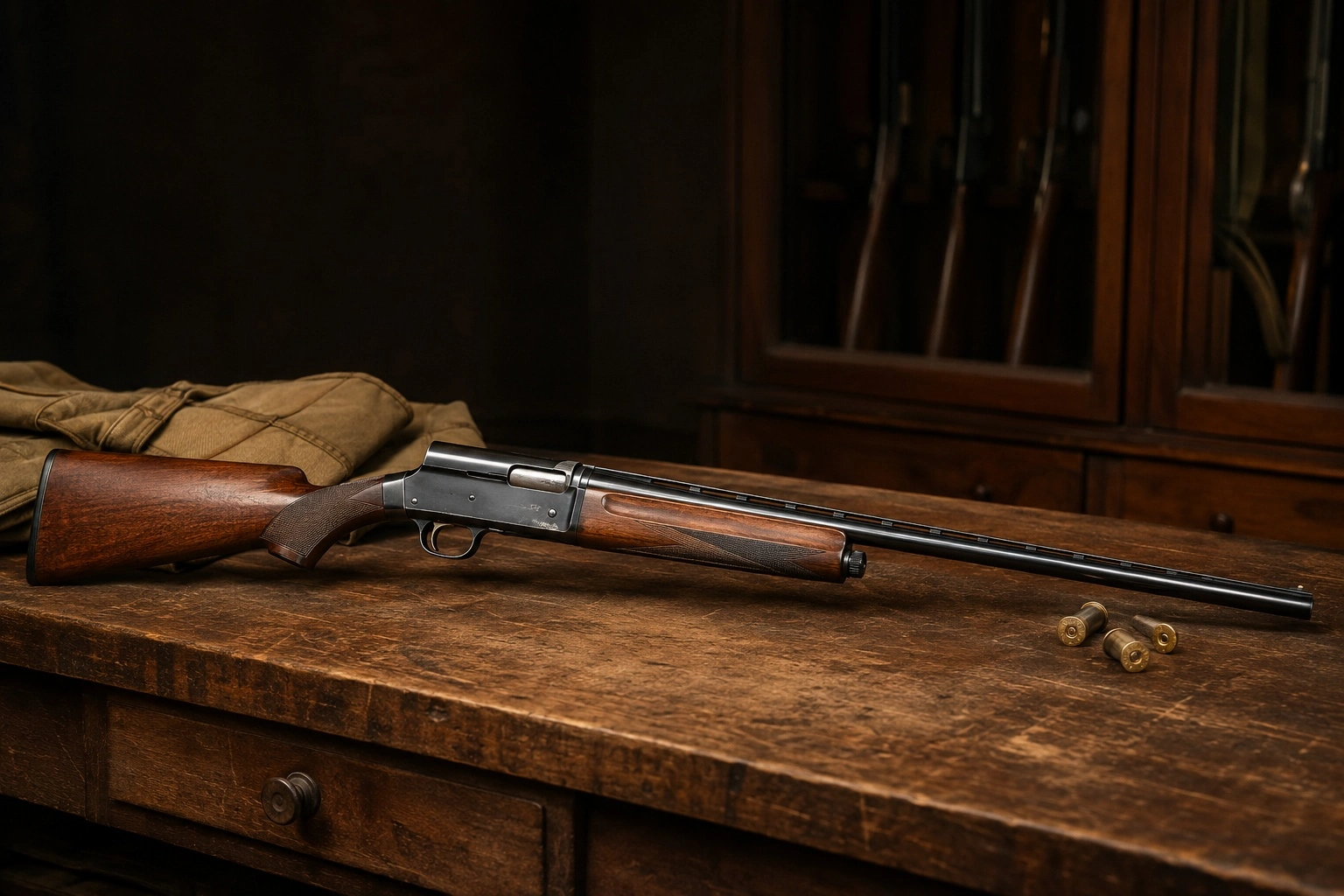
The Browning Light Twelve occupies a particularly satisfying place in the Auto-5 family. It keeps the unmistakable humpback receiver, long-recoil action, and old Browning character, but packages those qualities in the lighter 12-gauge configuration hunters carried through fields, duck blinds, gun clubs, and family collections for decades.
This is not simply a lighter shotgun with a famous name stamped on the receiver. The Light Twelve has its own production story, serial-number clues, country-of-origin changes, barrel questions, and collector traps. Browning introduced the Light 12 Auto-5 in June 1948, and the model remained part of the larger Auto-5 story through the Belgian FN years and the later Miroku production era in Japan.
Look Up a Browning Light Twelve Serial Number
Enter the complete serial number exactly as marked. The prefix, date code, and model code can be just as important as the digits.
Open the Light Twelve Lookup ToolWhy the Light Twelve Still Matters
The Auto-5 is one of those designs that can be identified from across a room. The squared receiver carries the sighting plane back toward the shooter, while the barrel and bolt movement give the gun a mechanical rhythm unlike a modern gas-operated autoloader. The Light Twelve preserves that identity without feeling like the heaviest version of the old twelve-gauge platform.
For collectors, the appeal is layered. Some want an early Belgian gun with polished blue and carefully cut checkering. Others prefer a later Japanese example as a high-quality shooter. Some are looking for the same model a father or grandfather carried. The Light Twelve can satisfy all three interests, but only when the buyer slows down and identifies the specific gun rather than buying the name alone.
On an old Auto-5, the receiver tells you what the gun is supposed to be. The barrel, serial number, markings, wood, and friction system tell you what is actually on the table.
For general Auto-5 dating before checking Light Twelve prefixes, start with the Auto-5 serial number lookup and date chart.
From John Browning’s Auto-5 to the Light Twelve
The larger story begins with John Moses Browning’s long-recoil autoloading shotgun and its early manufacture by Fabrique Nationale in Belgium. Auto-5 production began in 1902. Wartime disruption later moved Browning-branded production to Remington for a period, and FN resumed Auto-5 production after World War II.
Browning’s own historical timeline places the Light 12 introduction in June 1948. That date matters because it positions the model squarely in the postwar sporting-gun boom. American hunters were returning to the fields, manufacturing was shifting back to civilian products, and Browning had a proven autoloading design with decades of reputation behind it.
The Light Twelve did not replace the standard-weight or magnum configurations. It gave the buyer another lane: a 12-gauge Auto-5 intended to carry and handle with less burden while retaining the familiar action and receiver profile. Barrel length, rib, wood density, pad or buttplate, and later alterations can all affect the weight of an individual gun, so a bathroom scale is not a substitute for markings and serial-number research.
The long-recoil action
When an original Auto-5 fires, the barrel and bolt move rearward together. The barrel then returns forward, followed by the bolt as the action completes its cycle and chambers the next shell. That barrel movement is central to the Auto-5 experience and explains why the magazine-tube friction components matter so much.
Reading Light Twelve Serial Numbers
Auto-5 serial numbers changed format several times, and the meaning of a letter depends on the period. A prefix should never be separated from the rest of the number when recording or researching the shotgun.
| Production system | Light Twelve clue | Collector interpretation |
|---|---|---|
| 1954–1955 | L designated Light Weight | Use the complete L-prefix number and compare it with Browning’s period table. |
| 1956 | Designation changed to G | Do not assume every G-format number uses the same year structure. |
| 1958–1967 | Year digit followed by G | Example structure combines a date indicator, model letter, and sequence. |
| Late 1960s–1976 | Two-digit year with G | Record every character; dropped digits create incorrect dates. |
| 1976–1997 system | Type code 211 identifies Light 12 | The serial combines sequence, coded year, and Auto-5 type. |
These formats are why a dedicated lookup is useful. The Browning Light Twelve serial-number app keeps the lightweight sequence separate from the standard Auto-5, Sweet Sixteen, and later model codes. For a broader view, compare the Browning Auto-5 master guide and the Belgian Browning serial-number guide.
Belgian FN and Japanese Miroku Production
Traditional collectors often begin with the words “Made in Belgium.” That preference is understandable. The FN-made guns connect directly to the classic European production story, and high-condition examples can show the polished metal and walnut character many people picture when they hear the Browning name.
Production origin changed in the 1970s. Browning’s historical material states that Auto-5 production moved to Japan in the latter part of 1976, with Miroku becoming the production partner. The later guns should not be dismissed as lesser copies. Miroku earned a strong reputation for fit, machining, heat treatment, and consistent production, and many Japanese Light Twelves are excellent working collector guns.
The best comparison is not “Belgium good, Japan bad.” It is more useful to ask what kind of collector you are:
- Historical collector: may favor FN markings, earlier features, period finish, and documented Belgian production.
- Shooter-collector: may prefer a clean Miroku gun with a useful barrel and later choke configuration.
- Family-history collector: may value provenance and honest wear more than country of manufacture.
- Condition collector: should compare originality, finish, wood, screws, barrel, and bore before paying for a country name.
For the production partnership behind the later guns, see the Miroku history page. The broader Browning Firearms Hub connects the Auto-5 story with the Citori, BPS, X-Bolt, and other Browning families.
How to Identify an Honest Light Twelve
Start with the receiver and serial number, but do not stop there. Auto-5 barrels and other components have been swapped over many decades. A useful inspection treats the shotgun as a complete assembly.
- Record the entire serial number. Photograph it and preserve every letter, digit, and suffix in order.
- Confirm the receiver marking. Look for the Light Twelve designation and compare engraving style with the expected period.
- Read the country marking. “Made in Belgium” and “Made in Japan” place the gun in different manufacturing eras.
- Inspect the barrel. Record gauge, chamber length, choke, rib, proof marks, country, and any evidence of alteration.
- Examine the wood. Look for a shortened stock, added pad, cracks behind the receiver, refinishing, softened checkering, or mismatched color.
- Check screws and pins. Damaged slots can reveal repeated disassembly or careless repair.
- Inspect the bore and muzzle. Pitting, dents, bulges, and altered choke affect safety, use, and value.
- Verify the friction components. Missing or incorrectly arranged parts can cause excessive recoil and mechanical damage.
Barrel originality and practical use
A replacement barrel does not automatically make a Light Twelve undesirable. It changes how the gun should be described and valued. A Belgian receiver with a later Japanese barrel may be a practical shooter, but it is not the same collector proposition as a period-correct example. The honest listing identifies that combination rather than hiding it.
Choke markings deserve special attention. Do not assume an older fixed-choke barrel is suitable for modern steel shot, and do not assume every later barrel uses the same Browning choke system. Read the barrel, identify the actual choke arrangement, and consult Browning or a qualified gunsmith before changing ammunition.
Friction Rings, Recoil, and Preservation
The Auto-5’s friction system is not an optional collection of spare washers. Browning warns that the bronze friction piece must remain in place and that incorrect component arrangement can produce unnecessary recoil and pound the mechanism. The correct setting depends on the gun and the intended load.
A collector who buys an Auto-5 should not trust the previous owner’s setup without checking it. Clean the magazine tube appropriately, confirm the parts are present, and follow the correct Browning instructions for the specific model. The 2¾-inch Light Twelve is not set up like a 3-inch Magnum Twelve.
Condition, Originality, and Collector Value
Light Twelve values move with condition, configuration, production origin, barrel, and buyer preference. A clean Belgian gun may bring a traditional collector premium. A later Japanese example with excellent metal, attractive wood, and a useful choke system may be more desirable to a shooter. A worn family gun can still have enormous personal value even when the market treats it as ordinary.
I would rank the value factors in this order:
- Mechanical condition and safe function
- Originality of receiver finish, wood, barrel, and hardware
- Overall condition, including bore and checkering
- Production era and country of manufacture
- Barrel length, rib, choke, and practical desirability
- Original box, papers, accessories, and provenance
Refinishing is the great divider. A glossy reblue can look attractive across a table, but softened lettering, rounded edges, dished screw holes, and polished engraving usually matter to a collector. The same is true of heavily refinished wood. Honest wear is often easier to accept than restoration presented as original condition.
Questions to ask before buying
- Does the serial number decode as a Light Twelve for the claimed year?
- Do receiver, barrel, and country markings make sense together?
- Has the stock been cut or fitted with a replacement recoil pad?
- Is the barrel original, period-correct, or a later replacement?
- Are the friction parts complete and correctly arranged?
- Does the seller disclose refinishing, repairs, cracks, or replaced parts?
- Are box labels and paperwork actually numbered to the gun?
From My Bench
The Light Twelve appeals to me for the same reason many old guns do: it sits between pure utility and craftsmanship. It was made to be carried, and most surviving examples show that life. A little edge wear or a few honest hunting marks do not bother me. What matters is whether the gun is still honest—whether its finish, wood, barrel, and markings tell one consistent story.
I would rather own a carefully used Light Twelve with its history intact than a polished-up example trying to look younger than it is. Collectors eventually learn that condition can be measured, but character has to be recognized.
Complete Browning Research Cluster
Use these companion pages to move from the Light Twelve into the complete Browning collector library. The links include the Auto-5 family, serial-number tools, Belgian production, Sweet Sixteen research, Miroku history, pump and over-under shotguns, rifles, and photo galleries.

About Greg Cook
Greg Cook writes about firearms collecting, personal history, and the stories behind interesting guns. His Army MOS was 76Y, Unit Armorer, and he brings that practical background to his collector articles.
Sources Consulted
- Browning Historic Timeline — Light 12 introduction and Auto-5 production milestones.
- Browning Auto-5 Date Your Firearm Guide — lightweight prefix systems and later Auto-5 type codes.
- Browning Auto-5 Friction Ring Instructions — component arrangement and recoil-system cautions.
- Browning Firearm Manufacturing FAQ — FN and Miroku production context.
- Browning Citori and Miroku History — development of the Browning–Miroku production relationship.