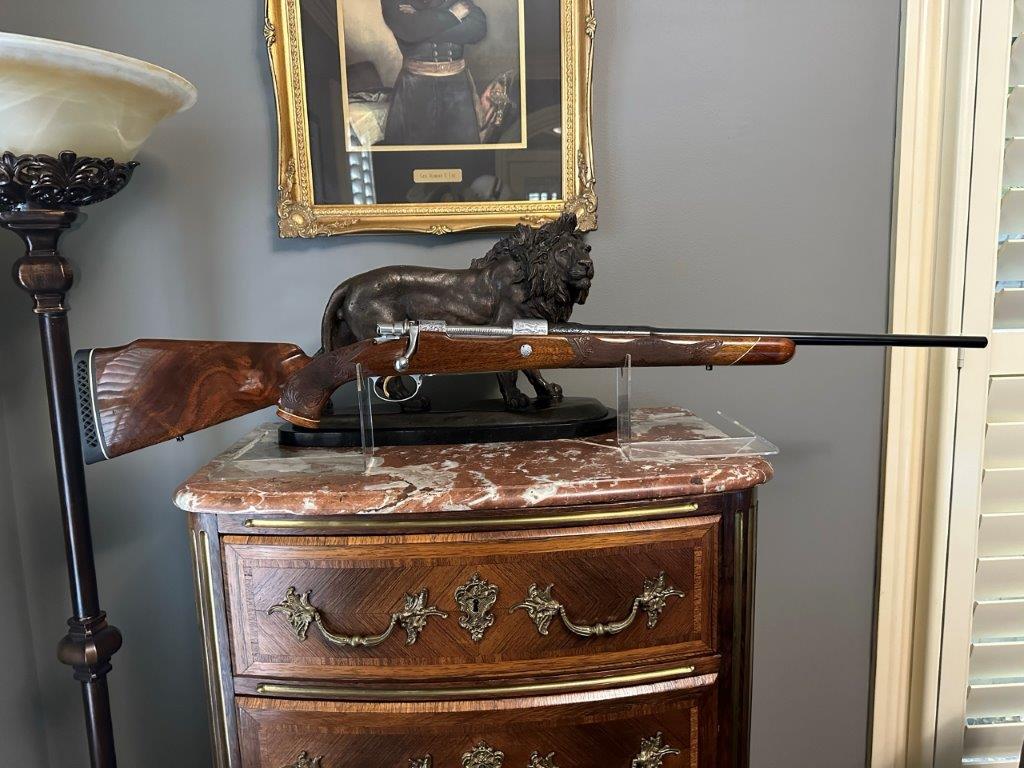
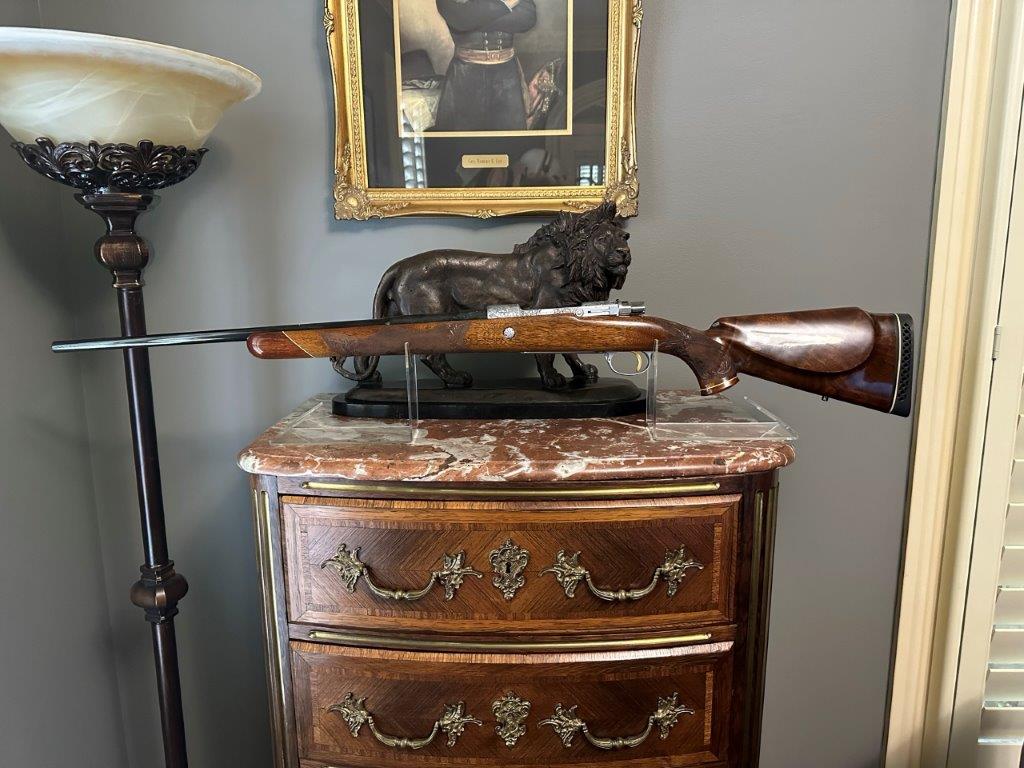
The Browning Olympian Grade rifle was the top presentation-grade version of Browning's Belgian FN High-Power bolt-action rifle line. A 1969 .270 Winchester example sits at the center of this page because it captures the model's appeal: FN engineering, Browning styling, hand engraving, carved walnut, and the kind of custom-shop labor that is rarely duplicated in regular production rifles today.
Fabrique Nationale d'Armes de Guerre, located in Liège and Herstal, Belgium, manufactured these rifles for Browning Arms Company. The model name can be confusing because Browning also sold the famous Hi-Power pistol, but the rifle discussed here is the bolt-action Browning High-Power rifle built around commercial FN Mauser and related Sako-action variations.
Production Years
Browning's High-Power bolt-action sporting rifle line was introduced around 1959, and Browning began bringing the FN-made rifle into the American market by 1960. For U.S. collectors, the core Belgian Browning/FN High-Power period is generally treated as 1960 through 1974, with final U.S. import and catalog references often extending into 1974-1975. Some sources note that related FN sales continued in Europe after Browning's U.S. import era ended.
There is no true pre-war Browning Olympian Grade rifle. The useful pre-war vs post-war differences discussion belongs to the Mauser foundation beneath it: FN was already making post-World War II commercial Mauser 98-pattern sporting actions before Browning adopted the platform for the High-Power rifle. Browning's version added American-market stock styling, Browning grade structure, and a cleaner bolt-stop treatment to the commercial FN action.
The phrase transition years matters with this rifle. A late-1960s or early-1970s Olympian should be evaluated by more than a date alone: action type, extractor style, stock condition, salt-wood signs, factory sights, caliber, engraving signature, and documentation all affect collector confidence.
Another major production-change issue is the action and extractor. Collector references often distinguish earlier long-extractor FN Mauser-action rifles from later FN Supreme short-extractor rifles, while noting that some .30-06 and .270 rifles continued with the long-extractor Mauser action. Because this page centers on a .270 example, document the actual action features rather than assuming them from year alone.

Variants
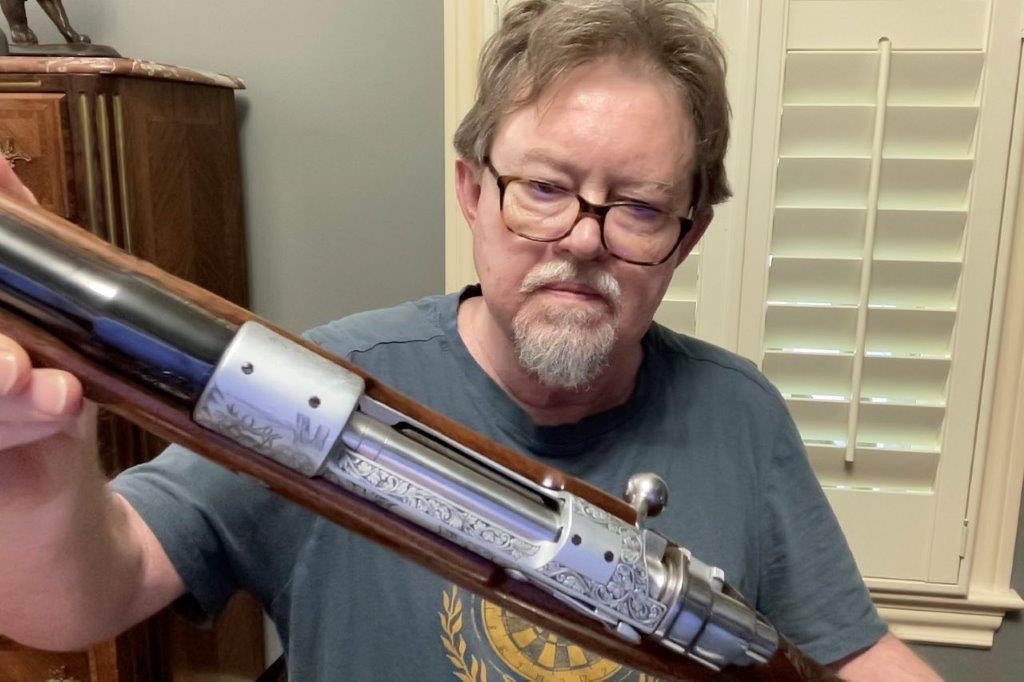
The Olympian is best understood as the highest grade within the Browning High-Power rifle family rather than as a separate mechanical model. The basic line included Safari, Medallion, and Olympian grades. The Safari was the plainer working rifle, the Medallion added upgraded wood and more engraving, and the Olympian received extensive custom-shop work: high-grade walnut, carved floral stock treatment, full-coverage game-scene engraving, and often a signed master engraver's mark.
| Feature | Collector notes |
|---|---|
| Grades | Safari, Medallion, and Olympian. The Olympian was the top presentation grade and is the primary subject of this page. |
| Actions | Most long-action Olympian rifles are associated with Belgian FN commercial Mauser lineage. Short and medium-action chamberings may involve Sako-action Browning High-Power variations, so identify action type before assigning value. |
| Barrel lengths | Collectors commonly encounter 22-inch barrels on many standard chamberings and 24-inch barrels on several magnum or larger-game chamberings. Verify the specific rifle because caliber, action, and special-order features can change the answer. |
| Finishes | Expect polished blue barrel and small parts with a satin or French-gray style engraved receiver on many Olympian examples. Condition at the wood line matters as much as the visible exterior. |
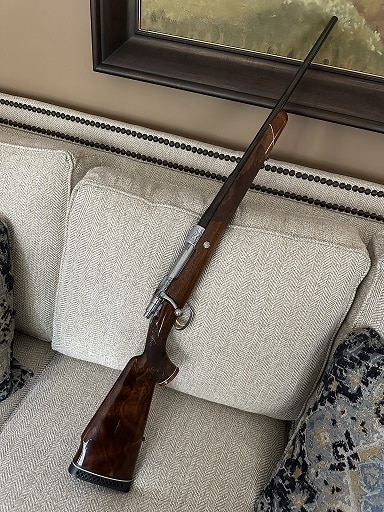
| Stock and grip treatment | High-grade walnut, Monte Carlo sporting stock profile, hand-cut checkering, carved floral treatment, recoil pad, and contrasting trim details are major value clues. Replacement or refinished wood changes the collector story dramatically. |
| Chamberings | Known High-Power chamberings run from small varmint cartridges up through dangerous-game cartridges. For Olympian collectors, rare calibers such as .257 Roberts, .284 Winchester, .300 H&H, and .308 Norma Magnum deserve extra documentation. |
| Sights and mounts | Barrel-mounted iron sights were common, but some rifles were ordered without sights. Factory sight configuration, scope holes, claw mounts, and later alterations should be documented before valuation. |
| Special editions and contracts | This was a civilian sporting and presentation rifle rather than a law-enforcement or military contract arm. Special value comes from caliber rarity, engraver signature, factory letter, original box, and provenance such as a named-owner collection. |
How can you top this? Perhaps a custom-made rifle in the price range of $25,000 today could touch it.
The FN Commercial Mauser Foundation
When Browning Arms contracted with FN to produce the High-Power rifle line, the Browning version had a subtle mechanical and cosmetic improvement over the earlier commercial FN Mauser: a cleaner bolt-stop treatment that eliminated the more obvious protruding housing. That detail helped give the rifle its refined side profile.
The Mauser 98 influence is a large part of the rifle's collector appeal. Controlled-round feeding, a claw extractor on the classic FN Mauser versions, strong locking-lug design, and refined commercial machining made the platform attractive to hunters who wanted a premium sporting rifle rather than a surplus conversion.
Serial Number Ranges
Complete factory serial-number charts for every Browning FN and Sako High-Power rifle variation are not as simple as many collectors would like. The practical approach is to combine the serial number, date code, action type, grade code, caliber, physical features, and a Browning Historical Letter when a rifle is valuable or unusual.
For post-1958 Browning firearms, collector date-code references generally describe a one-digit year code for much of the 1958-1968 period and a two-digit year code for much of the 1968-1975 period. The caution is that model and grade letters can shift by year and action family. Do not assume that one letter has one fixed meaning across all Browning High-Power rifles.
| Anchor | How to use it |
|---|---|
| 1959 introduction | Useful starting point for FN and Sako High-Power code tables. Earliest rifles should be reviewed with special care because early grade/action codes can be misread. |
| 1958-1968 code pattern | Many Browning references use the final digit of the year plus a model code and sequence number. The duplicated 8 for 1958 and 1968 is a known source of confusion. |
| 1968-1975 code pattern | Many Browning references use the last two digits of the year, followed by a model or grade code and serial sequence. A 1969 rifle should usually be approached with this two-digit date-code framework in mind. |
| FN vs Sako action codes | High-Power code references separate FN Mauser-action rifles from Sako short or medium-action rifles. That difference matters when comparing caliber rarity and price. |
| Browning Historical Letter | A factory historical letter can add date of manufacture, invoice number, date of sale, shipping destination, and basic firearm description when Browning can research the serial number. |
Dating tip: use online serial references as starting points, not the final word. For an Olympian Grade rifle, especially one with rare caliber, signed engraving, unusual sights, or a possible salt-wood issue, the best file should include clear photos, serial/date-code notes, and a Browning historical letter.
Collector Notes
Collector interest in the Olympian is driven by the combination of engineering and art. A clean example is not valuable only because it is a Browning. It is valuable because the package includes the FN action, Browning import history, high-grade walnut, hand engraving, stock carving, and a level of hand labor that sits closer to custom-gun work than ordinary production.
- Fit and finish: look for crisp engraving, even satin receiver color, clean roll marks, and blue that has not been rounded by polishing.
- Engraver signatures: signed factory engraving adds confidence and can materially improve desirability, especially when the signature is tied to known FN master engravers.
- Caliber-specific game scenes: animal scenes were often selected to match the chambering's intended game. A mismatch may signal restocking, parts swapping, or special-order history worth documenting.
- Accuracy reputation: the FN Mauser-based High-Power rifles have a strong reputation as practical hunting rifles, not just showpieces. Bore condition, bedding, crown, mounts, and previous use still matter on any individual rifle.
- Original accessories: box, Browning paperwork, hang tags, original sights, period mounts, and old receipts can push a rifle from "nice example" to well-documented collector piece.
- Desirable years: early classic long-extractor FN Mauser examples, documented rare calibers, and carefully preserved pre-salt or salt-free rifles receive special attention.
Because many Olympian rifles were purchased by serious hunters rather than just display collectors, honest field wear is not unusual. The key is whether the wear is honest and documented or whether the rifle has been refinished, restocked, drilled, polished, or altered in a way that obscures its factory configuration.
Known Issues
The most important known issue for late-1960s and early-1970s Browning collectors is the salt wood problem. Browning used salt-cured walnut blanks during part of this period to speed drying. Some stocks retained salt, and that salt could promote corrosion where wood met metal. Higher-grade guns with premium wood are especially important to inspect because a beautiful exterior can hide trouble beneath the stock line.
| Issue | What to watch |
|---|---|
| Salt wood corrosion | Inspect the receiver, barrel, tang, recoil-lug area, screws, and hidden wood-to-metal contact points. Dark staining, pitting, or rust at the wood line should be taken seriously. |
| Replacement wood | A replacement stock may solve corrosion but can reduce collector originality, especially if carving, checkering, finish, or fit differs from factory work. |
| Refinished metal | Rounded engraving, soft lettering, mismatched sheen, or polished edges can indicate refinishing. On engraved rifles, lost detail is expensive to recover and affects value. |
| Stock cracks and pad aging | Look at the tang, wrist, recoil lug area, butt pad, and white-line spacer. Heavy-recoiling chamberings deserve extra attention. |
| Scope and sight alterations | Extra holes, missing sights, non-factory bases, and filled dovetails can affect value. Some period mounts add charm; careless later work does not. |
| Parts availability | Factory replacement stocks and grade-specific small parts are limited. A high-grade rifle with missing original components may be difficult and expensive to correct. |
Preservation note: expensive engraved Browning rifles deserve conservative handling. For salt-wood testing, hidden corrosion inspection, or disassembly around carved walnut, use a qualified gunsmith or Browning specialist rather than risking finish damage.
Value Trends
Olympian values do not move like ordinary hunting-rifle values. Broad "Browning High-Power" averages can understate the worth of a true Olympian because the grade, engraving, caliber, and documentation dominate the price. Recent public value data show ordinary High-Power rifle averages far below documented Olympian sales, while specific Olympian examples can move from the mid-four figures into five figures depending on condition and rarity.
Condition is still the first filter. A salt-free rifle with original finish, sharp engraving, correct stock, factory letter, original sights, and box or paperwork will be viewed very differently from a refinished or salt-damaged rifle. Rare chamberings, known engraver signatures, and provenance can change the value more than a small difference in percentage condition.
These numbers are not an appraisal. They are market context. The right way to value an Olympian is to document the rifle, identify the action and chambering, verify the serial/date code, photograph the engraving and stock, inspect for salt wood, and compare it against recent sold examples with similar caliber and documentation.
A Legacy of Precision and Craftsmanship
The collaboration between FN and Browning Arms Company in the manufacturing of the High-Power rifle is a significant chapter in sporting rifle history. It brought together the strength of the FN commercial Mauser action with Browning's market position and sense of American sporting style.
The rifle's design foundation offered controlled-round feeding on classic FN Mauser examples, robust locking lugs, and a reputation for durability. The Olympian Grade then layered engraving, carved walnut, and custom-shop attention on top of that practical platform.
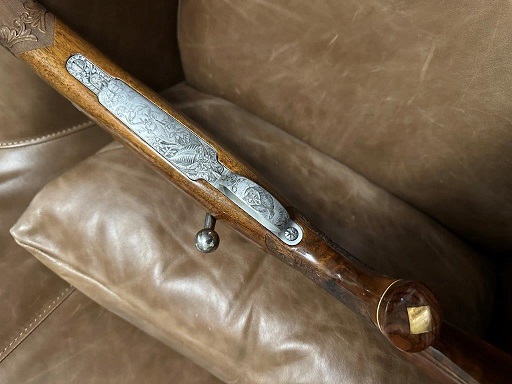
During its production years, the High-Power rifle was available in a broad range of calibers, catering to varmints, deer, elk, mountain game, and dangerous-game hunting. Its versatility made the basic rifle line respected, while the Olympian Grade became the version that collectors remember as Browning's Belgian custom-shop showcase.
Why the Olympian Still Matters
The end of Browning's Belgian High-Power import era marked the conclusion of a remarkable period in sporting rifles. The FN-Browning High-Power remains a symbol of a time when precision engineering and artistic craftsmanship could meet in a catalog rifle that still felt personal.
For collectors and enthusiasts, an Olympian Grade rifle is not just a tool. It is a piece of Browning and FN history, a reminder of Belgian manufacturing, Browning taste, FN engineering, and the hand labor that gives older sporting arms their character.
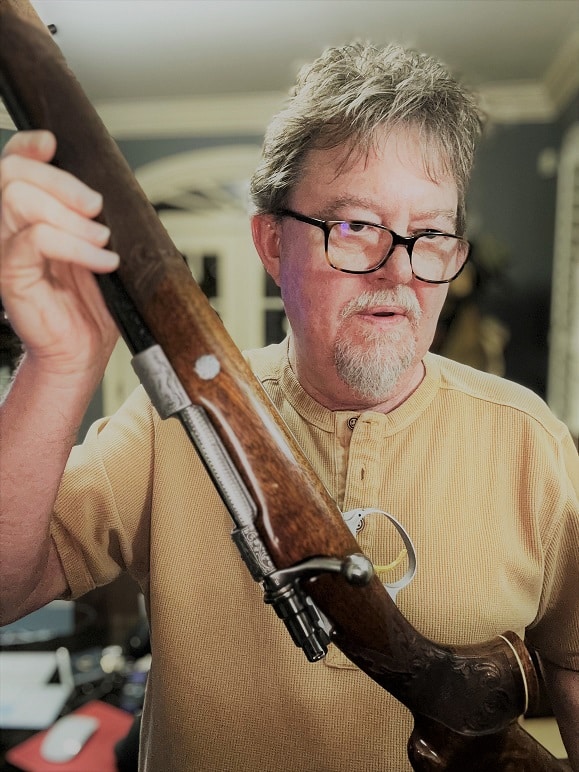
Browning Olympian Photo Gallery
From My Bench
Fine rifles deserve careful storage, documentation, cleaning supplies, and reference material. I keep a curated list of books, tools, and bench items that fit the way I maintain a collection.
Browse My Gear ListAs an Amazon Associate I earn from qualifying purchases.

About Greg Cook
Greg Cook writes about firearms collecting, personal history, and the stories behind interesting guns. His Army MOS was 76Y, Unit Armorer, and he brings that practical background to his collector articles.
Research Sources Consulted
For this update, I cross-checked the collector sections against Browning, FN/Browning serial-code references, salt-wood references, and recent market data. The most useful sources were:
- Rifle Magazine - The Browning High-Power Bolt Action
- Browning - Date Your Firearm and Browning support and historical information
- ProofHouse - Browning F.N. & Sako High Power Rifles
- American Rifleman - Browning Salt Wood Stocks
- Gun Digest - Browning High-Power Bolt-Action Rifle value notes
- TrueGunValue - Olympian rifle price and historical value
- Rock Island Auction - .270 Winchester and Browning Olympian market context