| 1962 Python Feature | Description |
|---|---|
| Serial Format | Numeric only (no letter prefix or suffix) |
| Underlug | Early hollow underlug style |
| Finish | Royal Blue or Bright Nickel |
| Frame | Colt "I" Frame |
| Stocks | Checkered walnut target stocks with gold Colt medallions |
| Collector Interest | Pre-1964 production is highly sought after by many Python collectors |
The 1962 Colt Python belongs to a special period in American firearms collecting. By the early 1960s, Colt's premium double-action revolver had already earned a reputation for polish, balance, and precision. A Python from this period is not merely another .357 Magnum; it is a snapshot of the postwar craftsmanship era when fit, finish, and hand work still defined the top end of the Colt catalog.
This page began as a photo gallery, but a revolver like this deserves more than a list of images. The pictures help document condition, finish, grips, barrel profile, serial-number context, and general presentation. The added sections below follow the collector research plan from the Word document: production years, variants, serial-number ranges, collector notes, known issues, and value trends.
Why a 1962 Colt Python Matters
Collectors often date a firearm by serial number and production range, but the year itself can add meaning. A 1962 Python sits in the early no-letter serial-number era of the model, before the revolver became a later cultural icon and long before Colt's modern reintroduction brought renewed attention to the name. For many collectors, the attraction is the combination of classic Royal Blue finish (see this 1968 Colt Python Royal Blue example), old-style craftsmanship, and the unmistakable Python silhouette: ventilated rib, full underlug, adjustable sights, and a reputation for a remarkably smooth action.
The early 1960s were also a high-water mark for several American firearms makers. Colt, Smith & Wesson, Winchester, Remington, and Browning-related sporting arms all occupied a world where fit and finish were still selling points, not afterthoughts. That is one reason mid-century examples appeal to collectors who care about machining, polish, roll marks, wood, bluing, and originality.
A 1962 Python is more than a handsome revolver. It is a physical artifact from the same year Americans watched John Glenn orbit the Earth, followed the Cuban Missile Crisis, and saw James Bond appear on the big screen in Dr. No.
Production Years
Colt introduced the Python in 1955 as a premium .357 Magnum revolver built on Colt's large I-frame. There are no true pre-war Python examples: the model is a post-World War II revolver from the beginning. For collector purposes, the useful comparison is not pre-war versus post-war; it is early postwar hand-fitted production versus later mass-production, Custom Shop, and modern CNC-era production.
The main original-production arc runs from 1955 through the end of regular catalog production in the mid-1990s. Colt then continued limited Custom Shop and Python Elite-style availability into the early 2000s before the classic line ended. The modern Python returned in 2020 with revised internal parts, stainless construction, more steel in the topstrap area, and a growing family of barrel lengths and finishes. That modern revival renewed interest in the classic guns, but it did not replace the collector premium attached to early Royal Blue examples.
| Era | Collector meaning | Notes |
|---|---|---|
| 1955 | First-year production | Extremely desirable when documented. Early serial numbers, original finish, box, papers, and a Colt Archive Letter can create a major premium. |
| 1956-1963 | Early no-letter serial era | Classic Royal Blue and bright nickel period. Many collectors pay special attention to hollow-underlug examples and early stocks. |
| 1964 | Transition year | Collectors study underlug style, barrel markings, serial range, and finish carefully because early-to-late features can overlap around production changes. |
| 1965-1969 | Late no-letter production | Still highly collectible, with the no-letter serial range ending as E-prefix serial numbers appear in 1969. |
| 1970s | High-recognition classic era | Strong commercial and law-enforcement period; condition, barrel length, original stocks, and box label are major value drivers. |
| 1980s | Stainless and specialty variants | Stainless steel, bright stainless, 8-inch and special-purpose packages, and scarce configurations broadened the Python collecting field. |
| 1990s-2005 | Late regular and Custom Shop period | Regular production ended in the 1990s, while limited Custom Shop/Elite-era guns continued into the 2000s. |
| 2020-present | Modern revival | Second-generation Pythons use modern materials and revised lockwork. They are important, but should be valued separately from classic hand-fitted examples. |
Major production changes and transition years
- 1955 introduction: The Python entered Colt's catalog as a premium .357 Magnum with ventilated rib, full underlug, adjustable sights, and high-polish finish work.
- Early hollow underlug period: Early Pythons are often examined for the hollow-underlug feature before the solid-underlug change. This is one reason 1955-1964 guns draw close inspection.
- 1969 serial transition: No-letter serial numbers gave way to E-prefix serial numbers, creating an easy collector dividing line.
- 1983 stainless introduction: Stainless steel expanded the Python line and eventually reduced demand for bright nickel as a durable high-shine option.
- 1989/1994 stainless changes: Later stainless barrel offerings shifted, including 8-inch stainless availability and the eventual discontinuance of the 2.5-inch stainless configuration.
- 1996-2005 wind-down: Regular production ended, but Custom Shop availability and Python Elite variants kept the name alive for a limited period.
- 2020 revival: Colt relaunched the Python with modern production methods, revised internals, and stronger construction, creating a separate modern collector category.
Variants
The Python is best understood as a family of premium .357 Magnum revolvers rather than a single fixed configuration. Barrel length, finish, stocks, era, serial style, box, papers, and any factory letter all matter. A shooter-grade 6-inch modern stainless Python is a very different market object from a 1962 Royal Blue no-letter gun with original stocks and documentation.
Barrel lengths
Classic Python barrel lengths include 2.5-inch, 3-inch, 4-inch, 6-inch, and 8-inch versions. The 6-inch and 4-inch guns are the classic visual standards most people recognize. The 2.5-inch snubnose has strong collector appeal, especially in high condition. The 3-inch Combat Python is famously scarce and often brings outsized attention. The 8-inch guns appeal to target and hunting-package collectors, especially when the case, optics, and paperwork are present.
Finishes
Royal Blue is the finish most closely associated with early Colt Python collecting. It is valued for its deep polish and color, but it also reveals handling marks and polishing mistakes. Bright nickel is another classic finish and can bring a premium when original, sharp, and free from flaking or cloudy areas. Later stainless, bright stainless, and matte stainless finishes created a different late-production and modern market. The modern blued Python is visually important, but it should not be confused with original Royal Blue production.
Grips and stocks
Original walnut target stocks with Colt medallions are a key part of the Python look. Stock style changed over time, and replacement grips are common. Correct grips can add value; incorrect, damaged, sanded, or mismatched stocks can lower collector confidence. On a high-condition early gun, collectors usually want the stocks to match the revolver's production period and the wear pattern of the rest of the gun.
Special editions, contracts, and rare configurations
Special Python variations include Python Target models, 8-inch hunting packages, Python Elite and Custom Shop guns, scarce 3-inch examples, electroless nickel/Royal Coltguard-style finishes, and rare prototype or unusual chambering references that should be treated carefully. American Rifleman notes that the Python also saw law-enforcement use with agencies such as the Colorado State Highway Patrol, Florida Highway Patrol, and Georgia State Patrol. Documented agency history can add interest, but undocumented stories should not be priced as provenance.
Serial Number Ranges
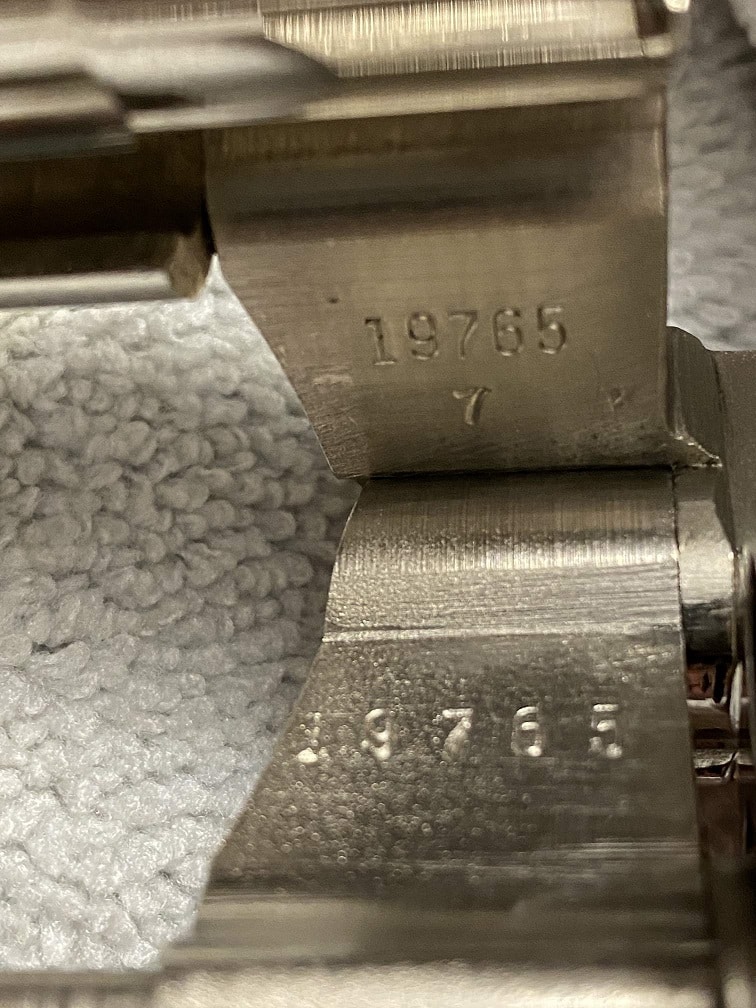
Serial-number tables are useful, but Colt's own serial-number lookup warns that online results can be approximate and incomplete. The most reliable documentation for a valuable Python remains a Colt Archive Letter, which can confirm original shipping information when records are available. For a 1962 Python, the commonly used collector-observed range is 18800-24799, placing it squarely in the early no-letter period.
| Year or era | Common collector-observed range | Collector note |
|---|---|---|
| 1955 | 1-299 | First-year production; extremely desirable when documented. |
| 1956 | 300-1649 | Second-year examples are scarce compared with later production. |
| 1957-1961 | 1650-18799 | Early no-letter serial period; strong Royal Blue collector interest. |
| 1962 | 18800-24799 | The key range for the revolver featured on this page. |
| 1963 | 24800-30799 | Final full year before the commonly discussed 1964 transition period. |
| 1964 | 30800-41399 | Important transition year; study underlug, configuration, and serial data carefully. |
| 1965-1968 | 41400-89999 | Late no-letter serial production remains desirable in original condition. |
| 1969 | 90000-99999 and E1001-E6300 | End of no-letter range and beginning of E-prefix production. |
| 1970s-1980s | E, suffix-E, V, AL, LA, VA, K, T, and later prefixes | Use a Colt lookup, a detailed serial table, and preferably a Colt Archive Letter for confirmation. |
| 2020-present | Modern Python serial formats | Modern guns should be separated from classic production for value and collector description. |
For deeper serial research, use the site's Colt Python Serial Number Tables and compare any estimate against Colt's official lookup and archive services. A serial range can estimate a production year, but a factory letter can document shipment details, destination, barrel length, finish, and sometimes special-order features.
Collector Notes
A 1962 Colt Python should be approached as an originality puzzle. The big questions are simple: Is the finish original? Are the barrel, frame, cylinder, sights, stocks, and small parts consistent with the serial range? Are the markings sharp? Does the wear pattern make sense? Is there a box, label, paperwork, test target, receipt, or Colt Archive Letter?
What collectors look for
- Fit and finish quality: Early Royal Blue Pythons are prized for hand polish and deep color. Soft rollmarks, rounded edges, or uneven polish can signal refinishing.
- Known accuracy characteristics: The Python's barrel, lock-up, trigger reputation, and sight picture helped create its prestige. A tight, properly timed revolver usually inspires more confidence than a pretty but mechanically tired gun.
- Desirable years: First-year 1955 guns, early no-letter guns, and pre-1964/hollow-underlug examples often receive special attention.
- Desirable barrel lengths: The 6-inch and 4-inch guns define the classic profile, while 2.5-inch and 3-inch guns can command strong premiums. The 3-inch Combat Python is especially scarce.
- Rare markings and configurations: Unusual chamberings, Python Target markings, agency marks, factory engraving, and special finishes require documentation before assigning a premium.
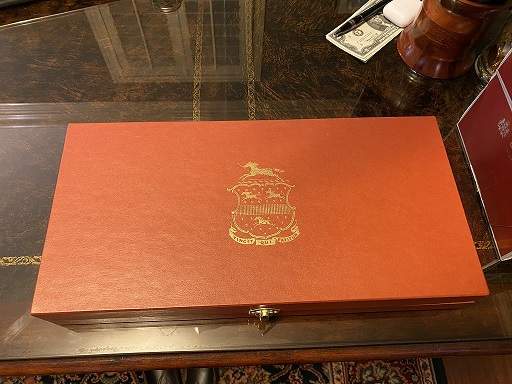
- Packaging differences: Correct box, end label, paperwork, tools, hang tags, and test target can dramatically increase confidence and value.
- Factory errors or oddities: Treat unusual features cautiously. Some are legitimate factory anomalies; others are later alterations or misdescribed parts.
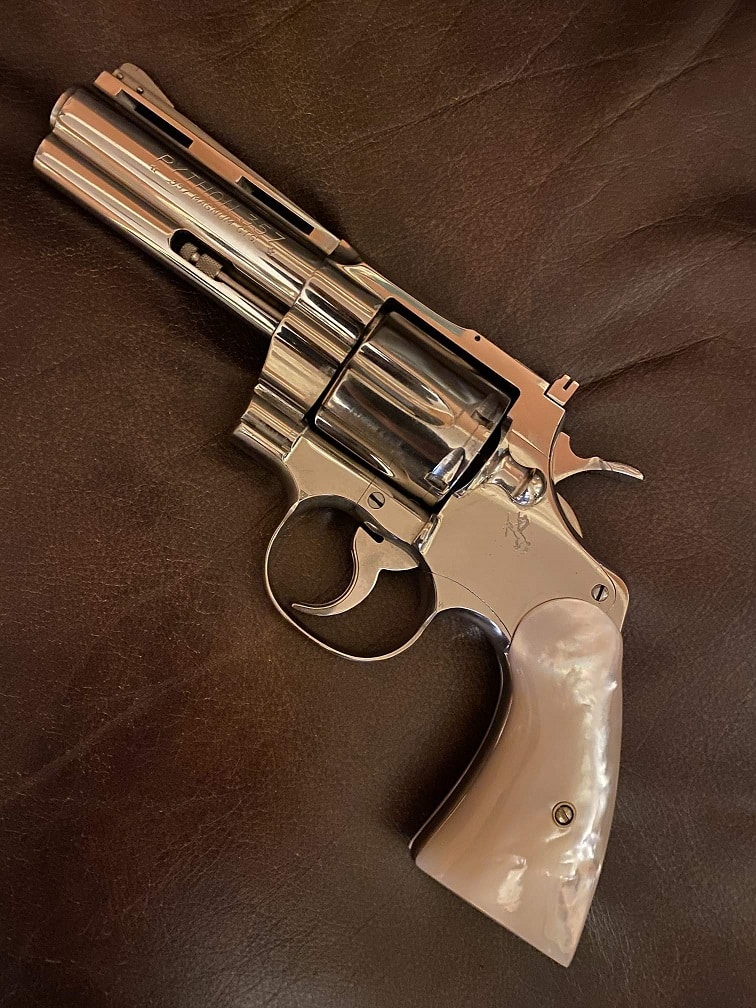
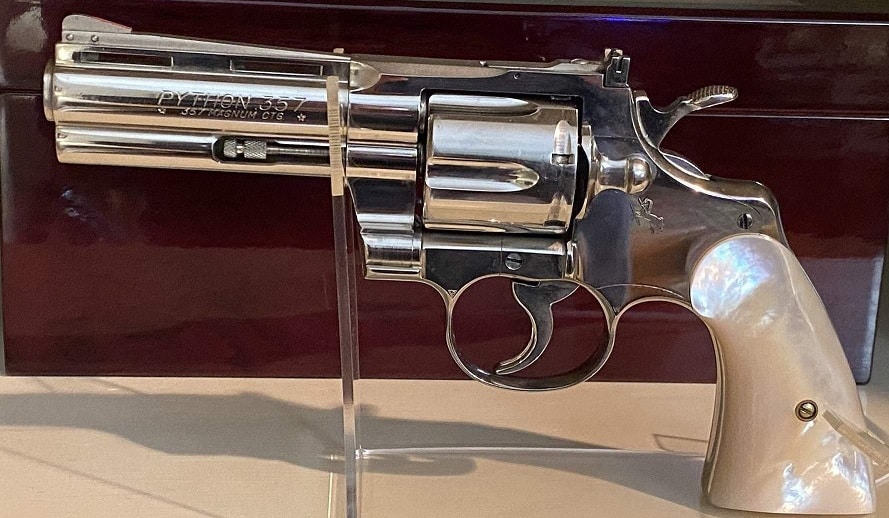
The photographs on this page are useful because they document more than beauty. They show the revolver's surfaces, serial-number area, underlug, muzzle, screw heads, stocks, and general handling history. A collector should photograph those same areas before cleaning, changing grips, or sending the gun for appraisal.
Known Issues
The Python's reputation is excellent, but it is not magic. The classic Colt double-action system is precise and can be expensive to correct when worn or incorrectly repaired. American Rifleman specifically discusses the old Colt double-action timing problem: if a chamber does not line up correctly as the action cycles, accuracy and safety can suffer, and proper repair requires a knowledgeable revolversmith.
- Timing and carry-up: Check that each chamber locks before the hammer falls in both single-action and double-action operation. Slow carry-up is a serious collector and shooter concern.
- Cylinder lock-up: Colt lock-up can feel tight, but each chamber still needs careful inspection. Excess play, uneven lock-up, or inconsistent rotation should be evaluated by a qualified revolversmith.
- Forcing cone and muzzle crown: Damage, erosion, or careless cleaning can reduce accuracy and collector value.
- Finish wear patterns: Royal Blue shows high-edge wear, wipe marks, cylinder turn lines, muzzle wear, and polishing damage readily. Nickel examples should be checked for lifting or flaking.
- Sideplate and screw damage: Buggered screws, lifted sideplates, or tool marks suggest prior disassembly. Because Colt lockwork is specialized, amateur work can hurt both function and value.
- Parts availability: Original classic Python parts and skilled Colt double-action specialists are not as easy to find as common service-revolver parts. That scarcity matters in valuation.
- Known 2020 revival issues: Early modern Pythons drew reports of light primer strikes, cylinder-rotation trouble tied to sideplate screws, and muzzle-crown damage. Colt addressed those issues, but they apply to the modern revival rather than a 1962 revolver.
I did not find a broad classic-era Colt Python recall in the sources consulted for this update. For a vintage Python, the best practice is a conservative inspection by a qualified revolversmith before firing if timing, lock-up, cylinder gap, forcing-cone condition, prior disassembly, or ammunition history is uncertain.
Value Trends
Colt Python values have been pulled in two directions. Modern production gives shooters a new option at a lower price than many pristine classic guns, while early Royal Blue, first-year, scarce barrel-length, boxed, documented, and high-condition vintage examples continue to attract collector premiums. The result is a split market: ordinary modern or shooter-grade Pythons can trade near current retail-market averages, while documented vintage examples often sit in a much higher auction-driven collector tier.
Recent market data shows why a single value number can mislead. TrueGunValue's current 2026 page shows average new and used Python prices in the mid-$1,500 range, which reflects a broad market that includes modern guns and ordinary used examples. Rock Island Auction's 2025 collector-market analysis, by contrast, reports that typical very-good-to-excellent Pythons in its auction dataset have averaged more than $3,300 over the last four years, with first-year and rare examples reaching far higher. A 1962 Royal Blue gun should be evaluated closer to the vintage collector market than to a generic modern-stainless average, assuming originality and condition support it.
- Early models command a premium: First-year, second-year, no-letter, and pre-1964/hollow-underlug guns are watched closely.
- Condition matters more than age alone: Sharp markings, original finish, correct stocks, clean screw slots, and strong mechanics separate collector guns from shooters.
- Nickel and rare finishes can bring more: Original bright nickel, electroless nickel, and special finishes can add value, but finish originality must be documented.
- Barrel length can change the market: Common 4-inch and 6-inch guns are easier to compare; 2.5-inch, 3-inch, and cased 8-inch packages can move into specialty pricing.
- Box and papers dramatically increase value: Correct packaging, tools, paperwork, test target, and a Colt Archive Letter strengthen the story and reduce buyer uncertainty.
- Refinishing usually reduces collector value: A beautiful refinish can make a nice display gun, but original high-condition Royal Blue is the premium category.
1962: The Year Around This Python
In February 1962, John Glenn became the first American to orbit the Earth aboard Friendship 7, a defining moment in the Space Race. That summer, Telstar relayed the first live transatlantic television signals, giving the public a glimpse of the communications future. The Seattle World's Fair opened with a futuristic theme and introduced the Space Needle as a symbol of American optimism.
The same year also carried real danger. In October 1962, the Cuban Missile Crisis brought the United States and the Soviet Union to the edge of nuclear war. President John F. Kennedy's administration, Cold War anxieties, civil defense planning, and the Space Race shaped the national mood. A revolver made in that year carries some of that atmosphere with it, especially for collectors who enjoy tying firearms to the broader American timeline.
Popular culture was shifting as well. Dr. No introduced Sean Connery's James Bond to movie audiences, and the Bond image would soon become inseparable from stylish suits, exotic locations, and memorable firearms. Marilyn Monroe died in August 1962, the Beatles released their first single in the United Kingdom, and a new decade of music, film, politics, and design was beginning to take shape.
Photo Gallery and Collector Observations
The photographs below document the revolver's overall presentation. For collector purposes, images like these should be used to study finish condition, screw heads, sight configuration, stocks, muzzle wear, cylinder drag line, sideplate fit, underlug style, and any signs of over-cleaning or refinishing. A Python can look impressive at first glance, but collector value often turns on smaller details.
Preservation and Cleaning Notes
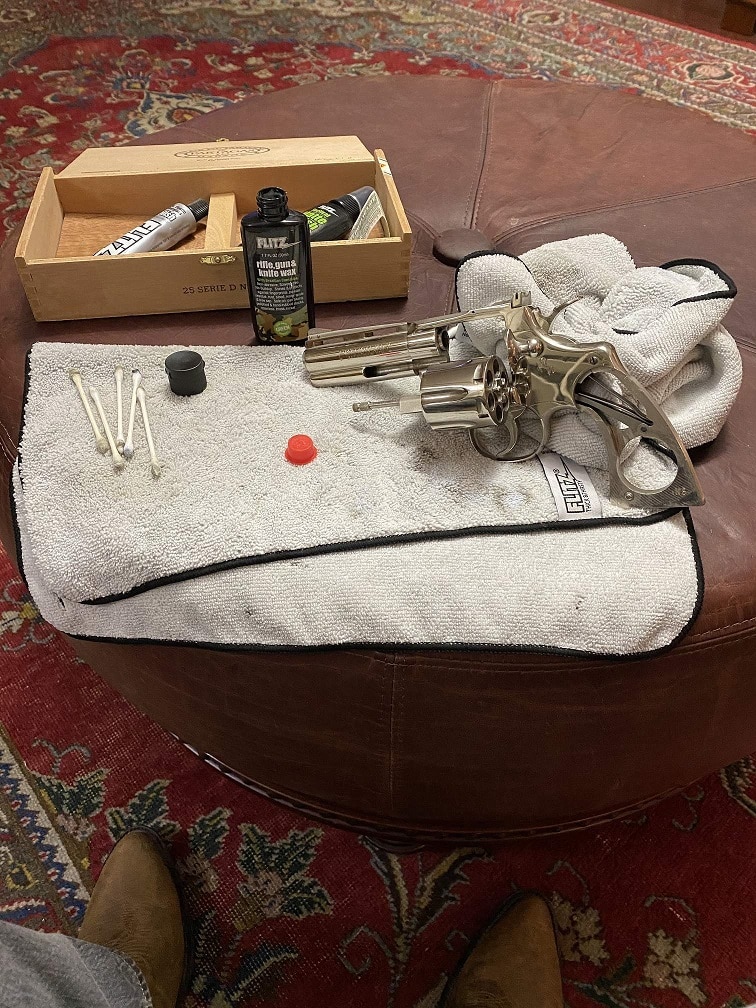
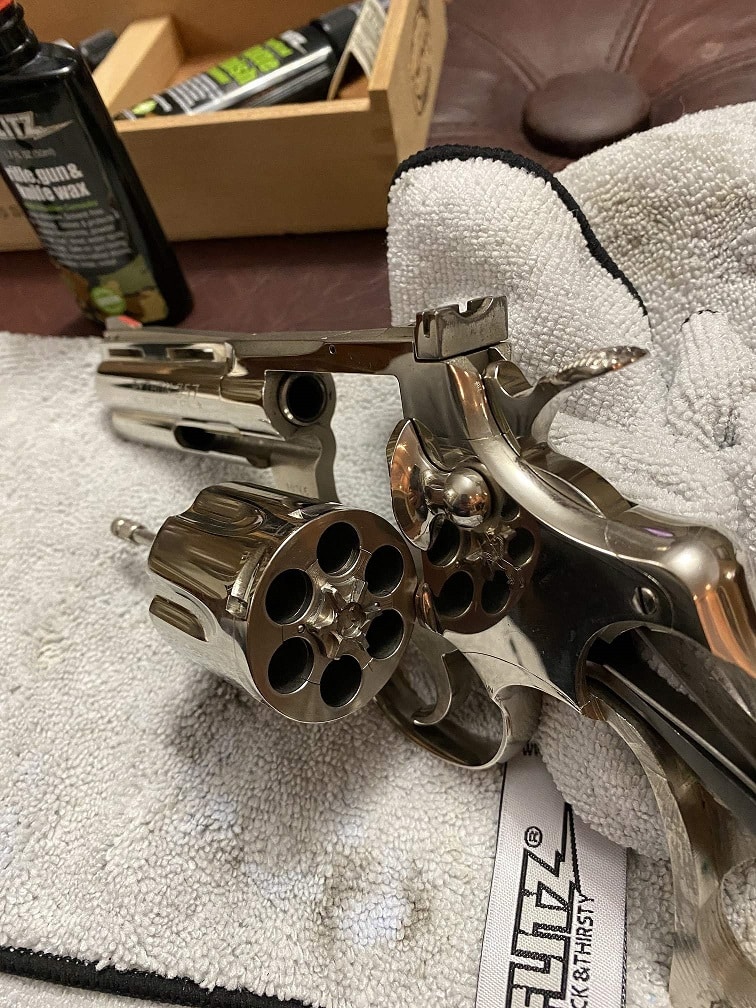
When it comes to cleaning old guns, restraint matters. A vintage Colt finish can be damaged by the wrong cloth, excessive rubbing, harsh compounds, or well-intentioned polishing. The goal is preservation, not making the revolver look newly manufactured. Fingerprints, moisture, and residue should be removed, but aggressive polishing can reduce originality and collector appeal.
For protective waxes or cloths, I use caution before anything touches an older blued firearm. Some products are useful when applied sparingly, but the cloth and technique matter as much as the product itself. I have seen otherwise attractive guns covered with tiny wipe marks because they were handled with the wrong material or cleaned too aggressively.
Collector Takeaway
A 1962 Colt Python has appeal on several levels: it is a desirable model, a no-letter serial-number example, a mid-century production revolver, a beautifully styled American firearm, and an artifact tied to a year rich with historical context. For collectors, the best approach is to preserve originality, document condition carefully, and let the revolver's age remain part of the story.
That is also why I enjoy connecting this page to the broader 1962 theme. The same year that produced this Python also produced a turning point in American culture, Cold War history, space exploration, and cinema. A firearm does not have to be famous by itself to become more interesting when placed back into the world that made it.
From My Bench
For older blued revolvers, I favor careful handling, soft cloths, good lighting, documentation photos, and conservative preservation over aggressive polishing. My collector gear list focuses on practical bench tools, books, storage, and preservation items.
Shop My Amazon StorefrontAs an Amazon Associate I earn from qualifying purchases. I only link to products, books, tools, and accessories that fit the editorial purpose of Gun Collectors Club.

About Greg Cook
Greg Cook writes about firearms collecting, personal history, and the stories behind interesting guns. His Army MOS was 76Y, Unit Armorer, and he brings that practical background to his collector articles.
Research Sources Consulted
This update merged the Word-document section plan with additional Colt Python research. The most useful external references for this page were:
- American Rifleman: A Look Back at the Colt Python for production history, finishes, barrel lengths, stainless introduction, law-enforcement use, and the Custom Shop wind-down.
- American Rifleman: Colt Python Review for the 1955 craftsmanship context, timing discussion, 2020 lockwork changes, and added topstrap steel.
- American Rifleman: A Colt's Python Primer for Python Target notes and rare/prototype chambering cautions.
- American Rifleman: Colt Addresses Python Issues for early 2020 revival issues such as light primer strikes, cylinder rotation, and muzzle-crown concerns.
- Colt Serial Number Lookup for Colt's warning that lookup data is approximate and incomplete.
- Colt Archive Services for factory-letter documentation and original shipping information.
- ProofHouse Colt Python serial table for a quick cross-check of collector-observed production-year ranges.
- Rock Island Auction: Colt Python Prices, Values and Trends for vintage collector-market value trends.
- TrueGunValue Colt Python market data for current 2026 broad-market pricing context.