This article is part of the TAR-40 Series. View full series →
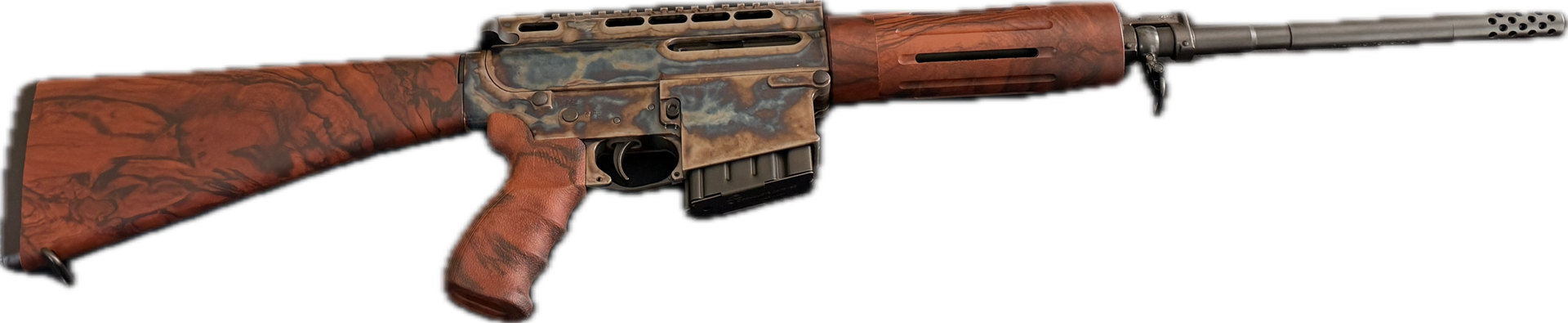
The Turnbull TAR-40 is not interesting merely because it is scarce, expensive, or visually dramatic. It is interesting because it attempts something very few modern semi-automatic rifles even try to do. It takes the large-frame AR pattern and subjects it to an old-world finishing philosophy: steel treated as a canvas, wood treated as furniture rather than mere hardware, or the synthetic hydrographic stock, grip, and foregrip made exclusively for Turnbull and the whole rifle presented as an object that should satisfy the eye as much as the trigger finger.
That combination is what gives the TAR-40 its peculiar place in the modern rifle market. It was never meant to compete head-on with mass-produced black rifles sold on pure utility. It was conceived as a premium .308 self-loader for buyers who appreciated craftsmanship, individuality, and visual authority. In practical terms, that means the TAR-40 sits on a proven LR-308 type foundation while distinguishing itself through materials, finishing, and configuration choices that are far outside the ordinary.
Origins and Design Intent
Public descriptions from Turnbull Restoration consistently present the TAR-40 as a top-quality semi-automatic .308 built for the person who wanted a one-of-a-kind AR and intended to add his own optics. In the same material, Turnbull described the rifle as being based on the DPMS LR-308 platform, with upper and lower receivers made from 8620 carbon steel and finished using the company’s bone-charcoal color case-hardening process. That alone tells you the rifle’s central idea: take a modern, familiar action pattern and clothe it in a finish vocabulary more commonly associated with vintage American gunmaking.

That intent matters because the TAR-40 was never a random styling exercise. It was a deliberate counterpoint to the prevailing aesthetic of the AR market. Most manufacturers emphasized hard anodizing, rails, polymer, and tactical anonymity. Turnbull took the opposite road and asked what would happen if a modern .308 autoloader were treated almost like a custom sporting arm.
Platform, Action, and Mechanical Layout
The core of the TAR-40 is large-frame AR architecture. Factory descriptions tied it to the DPMS LR-308 pattern, and Turnbull also acknowledged the use of DPMS and Bushmaster barrels and other components in the rifle. In practical terms, that places the TAR-40 in the familiar family of .308 AR rifles using a rotating bolt, detachable box magazine, and optics-ready flat-top upper. The rifle was intended to be scoped rather than shipped with iron sights, which matches both its receiver format and its premium positioning.
Publicly documented examples suggest more than one gas-system and barrel configuration existed. Turnbull’s past-product pages emphasized a 16-inch 4150 chrome moly-vanadium barrel, chrome-lined bore and chamber, and a carbine gas system. By contrast, the Athlon/Tactical Life review evaluated a more tactical variant with a mid-length gas port, 18-inch Lothar Walther stainless target barrel, melonite treatment, aluminum free-float handguard, and A2 stock. That does not read like contradiction so much as evidence that Turnbull offered the rifle in multiple customer-specified builds.
What that means in plain English
The TAR-40 should be understood as a boutique large-frame AR line rather than one frozen, single-spec catalog item. The platform stayed recognizable. The furniture, barrel, gas system, and finish package could vary.
Receiver Construction and Case Hardening
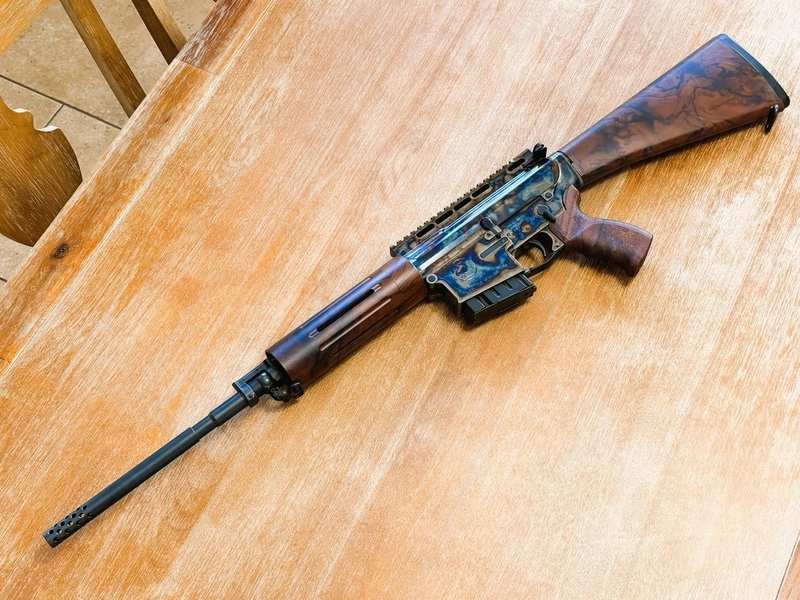
The receiver set is what separates the TAR-40 most sharply from the crowd. Turnbull described both upper and lower as 8620 carbon steel, then color case hardened with the firm’s bone-charcoal process. Mechanically, steel receivers bring weight; aesthetically, they bring depth, warmth, and visual individuality that aluminum receivers simply do not. Case colors are never perfectly uniform, which means each rifle carries its own personality.
That choice also signals what the builder thought the rifle was for. Aluminum would have been lighter and far more common. Steel was heavier, costlier, and more labor intensive, but it made the TAR-40 feel substantial and visually distinct. The receiver itself becomes part of the appeal instead of merely the structure that holds the parts together.
Barrel, Muzzle, and Gas System
Turnbull’s standard past-product description listed a 16-inch 4150 chrome moly-vanadium barrel with a screw-on muzzle brake, chrome-lined bore and chamber, and carbine gas system. Those are sensible choices for a hard-use .308 autoloader. Chrome lining improves service life and eases cleaning, while a muzzle brake helps tame recoil impulse in a rifle chambered for a full-power cartridge.
The Athlon-reviewed rifle expanded the picture by showing that the TAR-40 also existed in a more accuracy-oriented form. That sample wore an 18-inch Lothar Walther stainless target barrel with melonite coating and a mid-length gas port. It also delivered very strong range results, including repeated sub-inch groups at 100 yards and sub-MOA performance with Black Hills Match ammunition. A rifle built this way shifts the emphasis from dramatic appearance alone to genuine shooting performance.
Technical takeaway
- Documented barrels include both 16-inch chrome-lined CMV and 18-inch stainless target-barrel examples.
- Documented gas systems include carbine and mid-length setups.
- The muzzle brake was part of the factory feature set on publicly described rifles.
Furniture, Ergonomics, and Exterior Character
If the case-hardened receiver is the TAR-40’s mechanical signature, the furniture is its emotional signature. Turnbull’s documented examples show at least two clear aesthetic directions. One used synthetic hydrographic stock, grip, and foregrip made exclusively for Turnbull. Another used premium American walnut forend and pistol grip. The Athlon review, meanwhile, covered a tactical variant with an aluminum free-float handguard and A2 stock.
That matters because it confirms the TAR-40 was not locked into one costume. It could lean toward classic sporting elegance, toward a more flamboyant custom presentation, or toward a more conventional precision-AR layout. The example shown in this article, with richly figured wood and dramatic case colors, represents the version most likely to stop a collector in his tracks.
Ergonomically, the rifle remains AR-like enough that experienced users will find it familiar. The Athlon review did note one practical quirk: the left-side bolt-release button was inset under the upper receiver, which made it less natural for anyone accustomed to slapping a more exposed release on fast reloads. That is a minor operational note, but it is the sort of detail technical readers want to know.
Weight, Balance, and Shootability
No honest technical article about the TAR-40 can pretend the rifle is light. Turnbull’s engraved product page listed weight as just over 11 pounds, and the Athlon test rifle reportedly came in around 16 pounds once equipped with scope and loaded magazine. Even allowing for differences in exact configuration and optics, the message is plain enough: the TAR-40 is a substantial rifle.
That weight cuts two ways. It makes the rifle slower and less attractive as a general-purpose field gun carried all day. But it also helps the rifle settle on target and absorb recoil. The Athlon reviewer described recoil as virtually unnoticeable, which is exactly what one would expect from a heavy .308 with brake, good stock geometry, and AR-pattern action.
Accuracy and Real-World Performance
The strongest publicly available shooting report on the TAR-40 comes from Athlon/Tactical Life, and it is favorable. In that evaluation, the rifle turned in multiple groups under one inch at 100 yards, with a couple of .75-inch groups during zeroing and even a reported .5-inch group from another shooter. At 200 yards, groups generally stayed under two inches, and Black Hills Match ammunition reportedly produced sub-MOA results.
For a visually distinctive boutique .308, that is not trivial praise. The easy suspicion with a rifle like the TAR-40 is that it might be bought for looks and forgiven for merely average performance. The available review suggests otherwise. At least in one documented configuration, the rifle backed up its appearance with genuine precision.
Optics, Sights, and Intended Use
Factory pages listed sights as “n/a,” which reinforces the point that the TAR-40 was intended to be an optics-mounted rifle. The flat-top upper with integral Picatinny rail gives the owner flexibility in glass selection, whether the goal is a hunting optic, a general-purpose variable, or a more magnified precision scope. In the Athlon review, the rifle was paired with a Leupold Mk 4 ER/T M5A2 6.5-20x50mm, which is more glass than many owners would choose, but it helped show what the rifle could do on paper.
That optics-first philosophy also shapes how the rifle should be judged. The TAR-40 is not a battle rifle in the traditional iron-sighted sense. It is a scoped, premium .308 self-loader meant to be enjoyed from a bench, a rest, or a carefully chosen field position.
Documented Variants and Why the Specs Seem to Move Around
Anyone researching the TAR-40 quickly notices that one page says 16-inch barrel and synthetic hydrographics, another says 18-inch barrel and walnut, and a review describes yet another configuration. Instead of treating that as confusion, I think the better reading is that Turnbull built the TAR-40 as a semi-custom family of rifles. The company’s own material noted that the reviewed rifle was different from the version shown on the website and stated that Turnbull made each rifle to the customer’s specification.
That matters tremendously to collectors. It means “the TAR-40” is a category with recognizable core traits rather than a single exact trim level. When evaluating one for purchase, a buyer should document the individual rifle in front of him: barrel length, stock and forend material, magazine count, finish details, engraving, serial number, accessories, and whether it retains its case, manual, and original magazines.
Collector Interest and Market Appeal
The TAR-40 appeals to a narrow but serious buyer. The large-frame AR market is full of capable rifles, but very few offer the same blend of steel receiver construction, Turnbull case hardening, premium furniture, and limited-production character. That makes the TAR-40 attractive to collectors who like modern guns but have little interest in generic ones.
Its appeal also rests on the Turnbull name. The company’s reputation was built on restoration and finishing work for classic American firearms, so a modern semiautomatic wearing that name arrives with a built-in tension: old-world finish applied to new-world form. Some collectors will never warm to that idea. Others will find it irresistible. The TAR-40 exists for the second group.
What to Check on an Example Today
- Confirm whether the rifle is one of the documented 16-inch or 18-inch configurations.
- Note whether the furniture is walnut, hydrographic synthetic, or a tactical free-float setup.
- Inspect case colors carefully; they are part of the rifle’s individual character and value.
- Check whether the rifle retains factory magazines, case, manual, and brake.
- Document any engraving, special-order features, or provenance from the original sale.
- Because the TAR-40 is a boutique large-frame AR, verify parts compatibility cautiously rather than assuming total interchangeability.
Why the TAR-40 Matters
The TAR-40 matters because it proves a modern semiautomatic rifle does not have to choose between performance and personality. In one direction lies the ordinary world of competent but visually anonymous .308 ARs. In the other lies the risk of building something beautiful that shoots like a compromise. The TAR-40 tried to avoid both traps. At its best, it offers a sound large-frame AR foundation, serious craftsmanship, meaningful individuality, and enough shooting credibility to justify the attention it attracts.
That is why it remains memorable. Plenty of modern rifles are useful. Far fewer are distinctive. The TAR-40 is one of the rare few that aims to be both.
From My Bench
If you are setting up your own workspace or maintaining a collection, I keep a curated list of tools, books, cleaning gear, and bench items that fit the way I work.
Browse My Gear ListAs an Amazon Associate I earn from qualifying purchases. I only link to products, books, tools, and accessories that fit the editorial purpose of Gun Collectors Club.

About Greg Cook
Greg Cook writes about firearms collecting, personal history, and the stories behind interesting guns. His Army MOS was 76Y, Unit Armorer, and he brings that practical background to his collector articles.