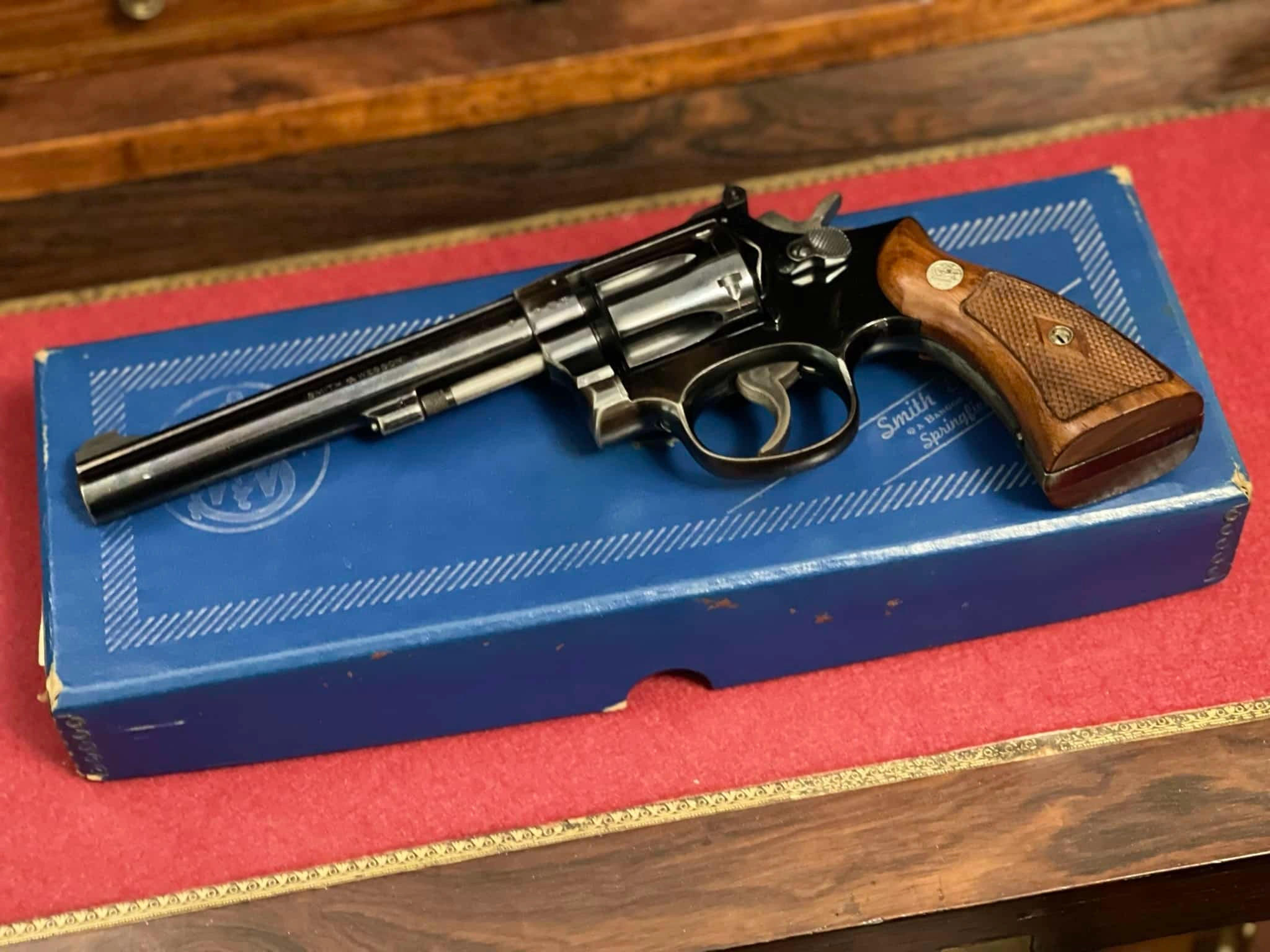
The Smith & Wesson Model 17 is the numbered-model continuation of the K-22 Masterpiece. Collectors search both names, and that is where confusion begins. A revolver marked “Model 17” inside the crane is still part of the K-22 Masterpiece story, but it belongs to the post-1957 numbered-model era.
This page is built as the bridge between those two search paths. If you are looking for Smith & Wesson Model 17 serial numbers, K-22 Masterpiece dating, or Model 17-1 identification, start here, then move into the deeper serial-number and K-22 pages in the Smith & Wesson cluster.
Smith & Wesson Model 17 Serial Number Starting Point
Use the frame serial number for dating, the crane model marking for dash identification, and the physical features to confirm whether the revolver fits the expected production period. The serial number narrows the date; the model marking and features prove whether the revolver makes sense.
The K-22 name and the Model 17 number are not separate collecting worlds. They are two ways of entering the same K-frame target-revolver story.

Smith & Wesson Model 17 vs. K-22 Masterpiece
The K-22 Masterpiece name predates the Model 17 designation. Smith & Wesson began using model numbers in the late 1950s, and the K-22 Masterpiece became the Model 17. Collectors still use both terms because they describe the same basic K-frame .22 target revolver lineage from different eras.
That overlap is exactly why a bridge page matters. A reader searching “K-22 serial number dating” may own a revolver stamped Model 17-1. A reader searching “Smith and Wesson Model 17 serial numbers” may be holding what older collectors still call a K-22. The correct answer needs both names.
| Search Term | What It Usually Means | Best Next Step |
|---|---|---|
| K-22 Masterpiece | Classic K-frame .22 target revolver, including pre-model-number and numbered eras. | K-22 Masterpiece Guide |
| Model 17 | Numbered-model K-22, generally post-1957 production. | Model 17 Serial Dates |
| Model 17-1 | Early dash variation with specific engineering-change context. | Model 17-1 identification |
| K-22 serial number lookup | Usually a dating question where the reader may not know the exact model marking. | K-22 Series |
Where to Find the Serial Number on a Smith & Wesson Model 17
Make the revolver safe first. On older Smith & Wesson revolvers, collectors commonly check the butt of the grip frame for the serial number. Stocks can cover that location, so the grips may need to be removed for a clean reading. Numbers inside the crane area can include model markings or assembly numbers; do not confuse those with the frame serial number used for dating.
For a proper collector record, photograph the butt serial number, the model marking inside the crane, the barrel address, the sideplate, the cylinder face, the stocks, the box label if present, and any included paperwork.
Smith & Wesson Model 17-1 Identification
The Model 17-1 sits in the early numbered-model period and is attractive because it still feels close to the classic K-22 Masterpiece era. A Model 17-1 should be evaluated by serial-number range, dash marking, barrel length, sight configuration, hammer and trigger style, stocks, box, and overall condition.
Do not judge a Model 17-1 from the dash number alone. The dash tells you the engineering-change family. The revolver’s originality comes from whether the visible parts agree with that period.
Model Marking
Open the cylinder and check the crane area for the Model 17 or Model 17-1 marking. Record it exactly.
Frame Serial
Use the frame serial number for dating. Do not rely only on assembly numbers or box labels.
K-Frame Target Features
Target sights, target hammer, target trigger, and full-size stocks are part of the appeal.
Originality
Finish, stocks, screws, box, tools, and paperwork can matter as much as the date.

K-Frame Target Revolver Features
The K-22 Masterpiece / Model 17 is part of Smith & Wesson’s K-frame target family. It shares a collector language with the K-38 and K-32 target revolvers: adjustable rear sight, finely finished blue steel, target-style handling, and a balance that rewards careful shooting.
Collectors like the Model 17 because it is both useful and elegant. It is a .22 Long Rifle revolver built with the seriousness of a centerfire target gun. That is why clean examples remain appealing even when they are not rare in the strictest sense.
Smith & Wesson Model 17 Dash Changes
Dash changes are engineering changes. They are helpful for identification, but they are not a substitute for inspection. A dash number should be read alongside the serial number, barrel pinning, cylinder details, extractor rod style, sight configuration, and stocks.
For searchers, the important point is simple: Model 17 serial number dating and Model 17 dash-number identification are related, but they answer different questions. The serial number estimates when the frame was made. The dash number identifies the engineering-change family.
| Item to Check | What It Tells You | Collector Use |
|---|---|---|
| Serial number | Approximate production or shipping-era context. | Start of dating work. |
| Model / dash marking | Engineering-change family. | Separates early Model 17s from later dash variants. |
| Barrel length and markings | Configuration and period clues. | Confirms whether the revolver fits the expected era. |
| Stocks | Originality, era, and collector completeness. | Can materially affect appeal and value. |
| Box and tools | Completeness and provenance. | Strong plus for high-condition examples. |
Smith & Wesson Model 17 Serial Number Dating
Smith & Wesson K-22 serial number dating begins with the frame serial number, normally found on the butt beneath or between the stocks. Record the entire number, including a letter prefix. Do not substitute a crane assembly number, model marking, or box-label number unless it matches the frame.
Compare the complete number with the appropriate Smith & Wesson K-frame serial-number range. For an interactive first pass, use the K-Frame serial-number lookup tool. The resulting year or period is an estimate: production, assembly, and shipment did not always move in perfect lockstep, and the K-22/Model 17 used the broader K-frame numbering system rather than a simple Model 17-only sequence.
After finding the likely date range, open the cylinder and record the model and dash marking inside the crane. A pre-numbered K-22 Masterpiece, a no-dash Model 17, and a Model 17-1 may share the same basic target-revolver lineage, but their markings and expected features belong to different production periods.
- Frame serial number: establishes the approximate K-frame production or shipping era.
- Model and dash marking: identifies the numbered-model engineering variation.
- Barrel, sights, and controls: help confirm that the configuration agrees with the estimated period.
- Stocks, box, and tools: support originality but should not replace the serial number as the dating reference.
If the serial range, dash marking, and physical features disagree, report a likely period rather than claiming an exact manufacture year. Factory records or a Smith & Wesson Historical Foundation letter provide stronger documentation for an important collector revolver.
Collector Caution
If the serial-number estimate, dash marking, grips, sights, box, or barrel markings disagree, slow down. The revolver may have replacement parts, swapped stocks, a later box, or a shipping date that does not match the apparent manufacture period.
The 1960 Model 17-1 as a Birth-Year Gun
A birth-year gun adds a personal layer to collector research. My 1960 Model 17-1 is more than a clean K-frame target revolver. It connects a specific year, a specific Smith & Wesson production period, and the practical joy of owning a .22 target revolver built with old-school standards.
That personal connection is useful for readers because it shows why serial-number pages matter. A date estimate is not just trivia. It can connect a firearm to a family year, a historical period, a collector theme, or a larger group of postwar American firearms.


Smith & Wesson Model 17 Value Factors
Model 17 values are driven by condition, originality, dash variation, barrel length, stocks, box, tools, papers, and overall eye appeal. A high-condition revolver with correct stocks and an original box will usually stand apart from a shooter-grade revolver, even if both date to similar years.
The K-22 / Model 17 also benefits from practical demand. It is collectible, but it is also a superb .22 revolver. That dual identity keeps interest steady among collectors, target shooters, and Smith & Wesson enthusiasts.
Common Model 17 and K-22 Research Mistakes
- Confusing assembly numbers inside the crane with the frame serial number.
- Assuming K-22 and Model 17 are unrelated because one is a name and the other is a model number.
- Dating the revolver from the box label before checking the frame serial.
- Ignoring dash-number changes when comparing examples.
- Valuing the revolver before checking stocks, screws, finish, sights, and mechanical condition.
- Failing to connect the Model 17 with the broader K-frame target-revolver family.
Smith & Wesson K-22 Serial Number Dating FAQ
How do I use Smith & Wesson K-22 serial number dating?
Record the frame serial number from the butt, including any letter prefix, and compare it with the appropriate Smith & Wesson K-frame serial range. Then confirm the estimate using the crane model and dash marking, barrel markings, sights, stocks, and other period features.
Can a serial number confirm the exact manufacture year of a Smith & Wesson firearm?
A serial-number range usually establishes an approximate production or shipping period rather than an exact manufacture date. Factory records or a Smith & Wesson Historical Foundation letter are stronger documentation when an exact shipping date and original configuration matter.
What markings should I check when the serial number alone is inconclusive?
Check the model and dash marking inside the crane, barrel address and caliber markings, barrel length, pinned-barrel and cylinder details, extractor-rod style, sights, hammer, trigger, stocks, and box label. These features should agree with the period indicated by the frame serial number.
Are K-22 Masterpiece and Model 17 serial numbers part of the same dating sequence?
The K-22 Masterpiece became the numbered Model 17 in the late 1950s, and both belong to the broader Smith & Wesson K-frame serial-number system. The serial number provides the date range, while the model and dash marking identifies the numbered-model engineering variation.
Where is the serial number on a Smith & Wesson Model 17?
Collectors normally use the frame serial number stamped on the butt for dating. Stocks may cover it. Numbers in the crane area may be model, dash, or assembly markings and should not automatically be treated as the frame serial number.
Smith & Wesson Research Cluster
Use this page as the bridge between Model 17 searches and K-22 Masterpiece searches. The cluster below keeps readers moving through the strongest Smith & Wesson reference pages.
Smith & Wesson Collector Tools
Good inspection starts with careful photographs, a proper screwdriver set, a clean bench, lighting, magnification, and written inventory notes. A revolver like the Model 17 deserves a record that preserves the serial number, dash mark, box label, stocks, and condition details.
Shop My Gear ListAs an Amazon Associate I earn from qualifying purchases. Firearms shown on this site are not for sale.

About Greg Cook
Greg Cook writes about firearms collecting, personal history, and the stories behind interesting guns. His Army MOS was 76Y, Unit Armorer, and he brings that practical background to his collector articles.
Sources Consulted
- Smith & Wesson factory catalog references and collector literature covering K-frame target revolvers.
- Smith & Wesson serial-number and model-number research notes used across Gun Collectors Club pages.
- Author inspection notes and photographs of a 1960 Smith & Wesson Model 17-1 / K-22 Masterpiece revolver.
- Gun Collectors Club internal Smith & Wesson K-22, Model 10, Model 19, and Model 58 collector pages.