
When Gary McLain sent photographs of his father’s Remington Model 1100, the conversation began with markings, dates, and a cracked forearm. What emerged was a family story reaching back to Spain in 1963—and a childhood adjustment that never went away.
Gary’s account places the purchase on a U.S. air base in Spain, where his father bought the shotgun new in 1963. Gary was ten, and he remembers it as the first 12-gauge he fired on a skeet field. There wasn’t much else to do on the base, he recalled, so father and son went to the range.
The photographs show glossy wood, decorative checkering, and scrollwork on the receiver. The receiver serial is clearly visible: 7026V. Those details are worth recording, but the memory of learning to handle his father’s shotgun is the heart of the story.
Ten years old—and learning to shoot left-handed
Gary could lift his father’s shotgun, but supporting it took some improvisation.
“I had to hold it as a lefty in order to use my stronger right arm to keep the barrel pointed up.”
He wasn’t left-handed. He was also right-eye dominant. Shooting from his left shoulder began as a practical way to manage the shotgun’s weight, but it became his lasting habit.
“To this day I shoot a rifle or shotgun as a lefty.”
There is another family connection in that detail. Gary’s late brother was left-handed, and so is his son. Gary’s own left-handed shooting came about differently, through the determination of a boy who wanted to shoot his father’s gun.

An early serial number, with a family history behind it
Remington lists 1963 as the Model 1100’s introduction year. The Remington Society of America records that receiver serial numbers began at 1001. Gary’s low serial number fits the early-production context, while his family’s account places the new purchase in that first year. [1] [2]
These are complementary pieces of evidence: a visible serial number, published model history, and Gary’s recollection of the purchase. They should not be confused with a factory shipping record or proof that every component has remained unchanged.
Gary’s Model 1100 at a glance
- Receiver serial: 7026V, visible in Gary’s photograph.
- Family account: bought new by his father in Spain in 1963.
- Choke marking: MOD., indicating Modified choke.
- Barrel markings: the clearer photograph shows A C K and a separate trailing symbol. CK is consistent with April 1963; the surrounding marks remain unidentified.
- Condition detail: a long forearm crack, visible inside and outside the wood.
What the barrel markings can—and cannot—tell us

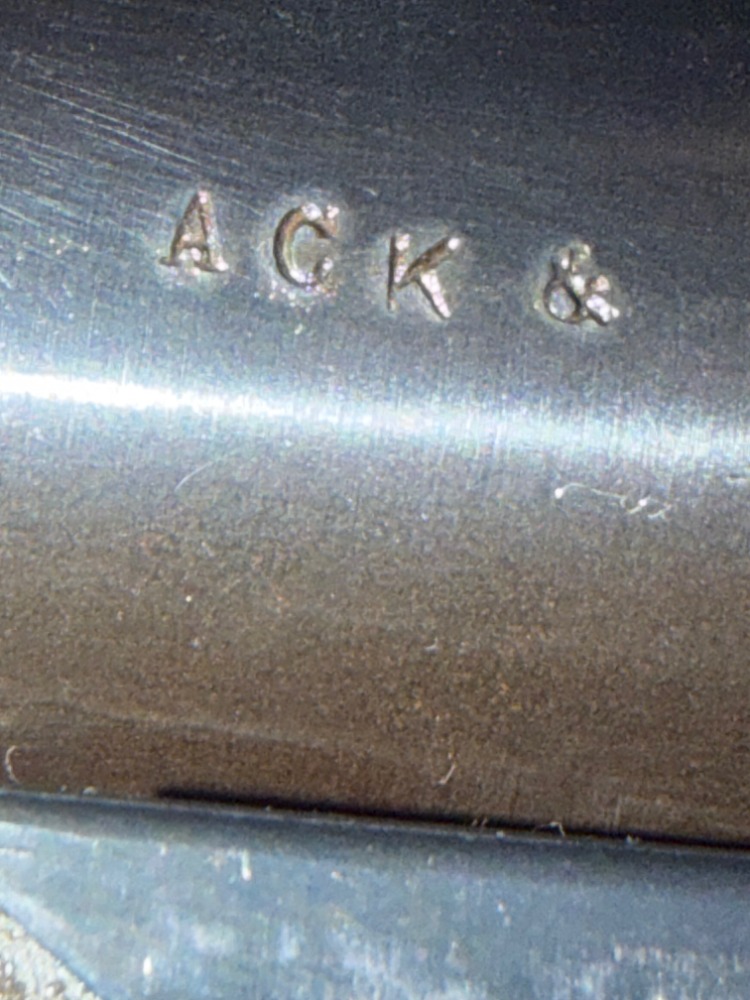
Gary supplied a clearer close-up on September 8, 2026, showing the letters A C K followed by a separate symbol. Remington’s barrel-date chart identifies C as April and K as 1963 in the relevant period. A plausible reading is therefore A | CK | symbol, with CK forming the date code and the surrounding stamps possibly serving inspection or assembly purposes. This arrangement is consistent with illustrated Remington marking examples, but an exact comparison confirming Gary’s complete stamp group has not been found. April 1963 remains a working interpretation, not a confirmed date. [3] [4]
The clearer photograph establishes the visible letters more confidently than their individual functions. The preceding A and trailing symbol remain unidentified. A barrel code also dates the barrel, and shotgun barrels can be replaced. Gary’s account of his father buying the shotgun new in Spain in 1963 remains a separate piece of family history; the markings alone do not establish that the barrel is original.
For the broader research path, see the Remington Model 1100 collector guide and 1100 serial-number and barrel-code lookup. For other models and company background, explore the Remington firearms history and collector hub.
The cracked forearm—and preserving what came down
When Gary had time to examine the shotgun closely, he discovered a long split in the forearm. He also reported that the magazine cap took effort to remove and wondered whether that had contributed. It is a useful observation for an inspecting gunsmith, but it does not establish the cause of the crack.


The discovery raised a familiar collector’s question: preserve the existing piece, have it repaired, or find a suitable replacement? Gary’s instinct is to respect what survives.
“I actually have a great fondness for collectables and know when it’s best to leave them as found.”
If he finds a suitable replacement forearm, he intends to keep the original with the gun. That preserves part of its history even if a properly fitted replacement is eventually used.
Before returning the shotgun to use
Gary hopes to shoot his father’s Remington again. A qualified gunsmith should inspect the shotgun, forearm, and any proposed repair or replacement before it is fired. A fully cured adhesive does not by itself establish that a repair will withstand firing, and photographs cannot settle that question.
The history worth writing down
A serial number can help place a firearm in its production history. Gary’s memories explain what this particular shotgun means to his family: his father, Spain, a skeet field, and the effort of holding a full-sized shotgun at ten years old.
His left-handed shooting is a reminder of those days that has lasted a lifetime. His brother and son add another connection across the generations.
Keeping the original wood, saving the photographs, and recording those memories all help preserve that history. The gun’s markings tell one story. The person who remembers holding it beside his father tells another.
My thanks to Gary McLain for sharing the photographs and giving permission to publish his family’s story.
Updated September 8, 2026, with a clearer barrel photograph and a revised, qualified interpretation of the markings.

About Greg Cook
Greg Cook writes about firearms collecting, personal history, and the stories behind interesting guns. His Army MOS was 76Y, Unit Armorer, and he brings that practical background to his collector articles.
Sources and photo credit
- Gary McLain’s correspondence and photographs, shared with permission. The family purchase history and childhood recollections are attributed to Gary.
- Remington: Model 1100 history — introduction year.
- Remington Society of America: Collecting Remington Model 1100 Shotguns — starting receiver serial number.
- Remington Society of America: Manufacture Dates — barrel-code chart and caution about interchangeable shotgun barrels.
- LeeRoy Wisner: Remington Barrel Date Code — illustrated marking layout and comparison photographs.
Photographs © Gary McLain, used with permission.