From Loading Gate to Swing-Out Cylinder: How the Modern Revolver Was Born
By Greg Cook · November 27, 2026
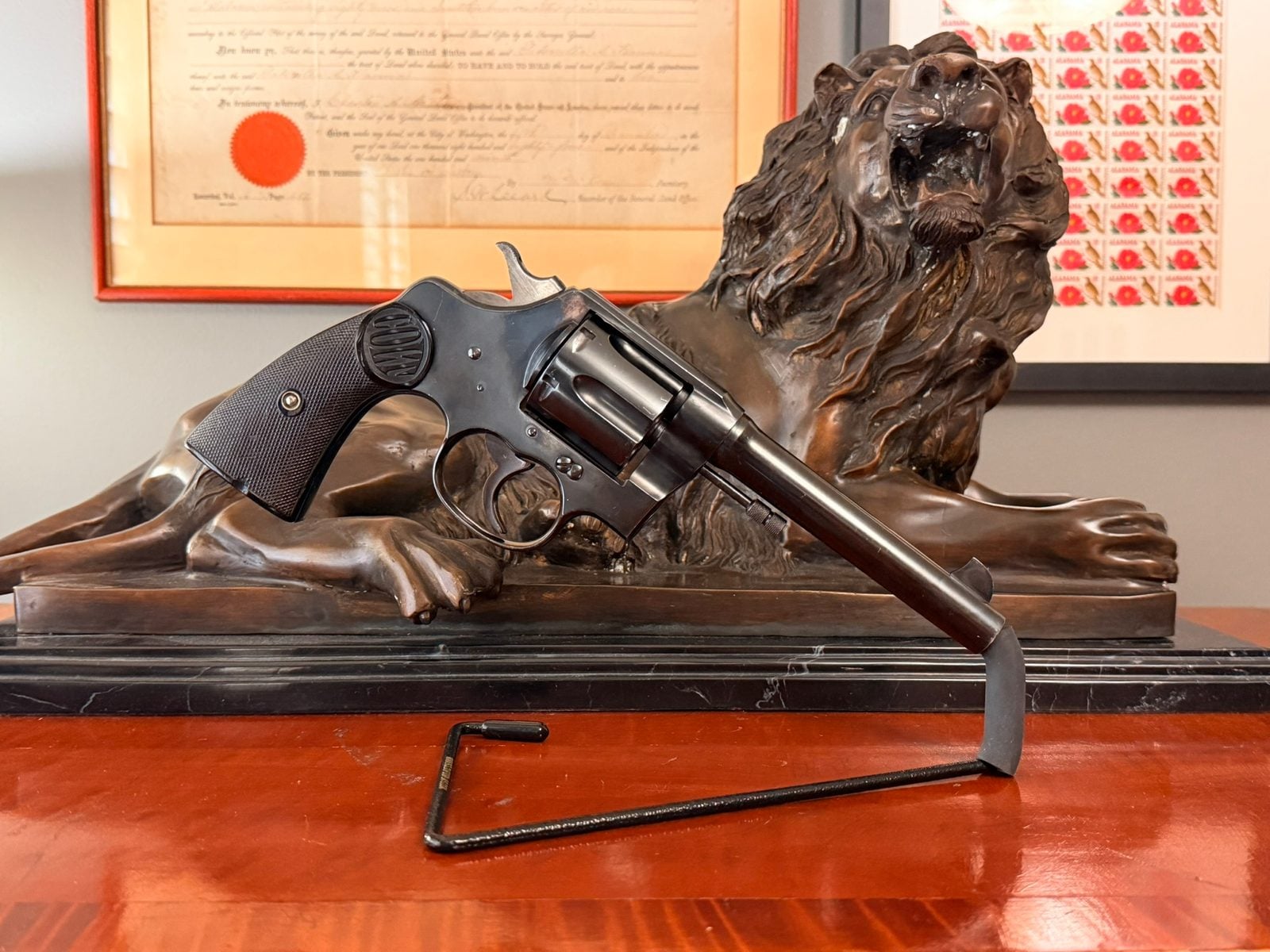
View photograph 13 in fullThe swing-out cylinder is one of the developments that turned the 19th-century revolver into the form we still recognize today. It combined the strength of a solid frame with much faster access to all of the chambers for loading and unloading.
Pick up almost any double-action revolver from the last hundred years, work the latch, and the cylinder swings out on its crane. Press the ejector rod and every empty comes out at once. It took American gunmakers most of the 19th century to get there.
Before the Swing-Out Cylinder
For much of the 1800s, getting cartridges into and out of a revolver was comparatively awkward.
Early percussion revolvers such as the Colt 1851 Navy and 1860 Army were loaded one chamber at a time. Each chamber took a charge of powder and a ball, or a combustible paper cartridge, and then a percussion cap went on the nipple at the rear of each chamber. Nobody would call it quick to reload.
Metallic cartridges changed that, but not right away for Colt. The Rollin White patent covered revolver cylinders bored straight through from end to end, and Colt could not start developing bored-through cylinders for metallic cartridges until that patent expired in April 1869. Once it did, several competing systems for loading and unloading cartridges developed.
Loading-gate revolvers such as the Colt Single Action Army, introduced in 1873, kept a solid frame. To load one, you drew the hammer back to the loading notch, which freed the cylinder to turn, and fed one cartridge at a time through the gate at the rear of the cylinder. Unloading meant turning the cylinder chamber by chamber and punching each empty out with the spring-loaded ejector rod beside the barrel. The Army used the Single Action Army as its standard revolver from 1873 to 1892. It is strong and simple, and it is slow.
Top-break revolvers, particularly those associated with Smith & Wesson and later other manufacturers, solved much of the speed problem. The Smith & Wesson Model 3 was a top-break: unlatch it, tip the barrel down, and the automatic ejector rises and throws out the cases. The U.S. Army adopted the .44 Model 3 in 1870, making it the first standard-issue cartridge revolver in U.S. service, and in 1875 Smith & Wesson brought out the Schofield version with Major George W. Schofield's improvements. Across the Atlantic, the British adopted the Webley top-break in 1887, and on the Webley, breaking the revolver open works the extractor.
The tradeoff was that the frame itself had to incorporate the hinge and locking mechanism. A hinge at the bottom and a latch at the top strap are not as rigid as a solid, one-piece frame.
There were other ideas, too. Merwin, Hulbert & Co. revolvers unloaded by twisting the barrel 90 degrees and pulling barrel and cylinder forward. The empties dropped clear, while loaded rounds, being longer, stayed put.
The ideal arrangement was increasingly obvious: retain a rigid, one-piece frame but somehow move the entire cylinder out of the frame for loading.
Colt and the Model 1889
That breakthrough appeared commercially with the Colt Model 1889.
The idea itself was not brand new. Daniel Moore patented a revolver with a cylinder that swung out to the right as early as 1860. In 1865, while working for Remington, William Mason patented a cylinder that swung out of the frame on a crane or yoke. Mason later became one of Colt's leading engineers and co-designed the Single Action Army.
The Model 1889 design is credited to Mason and Carl J. Ehbets. Mason left Colt in 1882 to work for Winchester, but Ehbets stayed and kept refining the design they had worked on together. In 1888 Ehbets patented a swing-out-cylinder revolver, and those refinements led to the Model 1889.
The Model 1889 is generally credited as the first double-action revolver with a swing-out cylinder to go into real production, and Colt as the first manufacturer to build one. A spring-powered latch on the left side of the frame released the cylinder, which swung out to the side while the frame stayed in one piece. The Navy version was a blued, six-shot .38 Long Colt with a six-inch barrel. The gun was also made in .41 Long Colt, and Colt sold it commercially as the New Army and Navy. The U.S. Navy bought 5,000 Model 1889 revolvers in 1889 and 1890.
It was a genuinely important step, but the first version wasn't perfect.
The Model 1889's cylinder turned counterclockwise. That seems to have come from a Navy requirement, but the direction of rotation worked against the cylinder lock and tended to push the cylinder out of line with the barrel, especially as the gun wore. In some cases the cylinder could even turn while the gun was holstered or while the shooter was pulling the trigger.
Colt subsequently refined the idea in the Model 1892 and succeeding military revolvers. The Army liked the Model 1889 but wanted a small, separate bolt to hold the cylinder in firing position. Colt made the change, and the Army bought more than 11,000 Model 1892s in 1892 and 1893. The Model 1892 still had counterclockwise rotation. The Models of 1894, 1895 and 1896 added a safety developed by Frederick Felton that kept the revolver from firing unless the cylinder was fully closed and latched, and many Model 1892s were retrofitted with it.
That makes the 1889 particularly interesting to collectors: you can essentially see the modern revolver being invented in front of you.
Smith & Wesson Perfects the Concept
Smith & Wesson soon developed its own interpretation.
Smith & Wesson followed Colt seven years later with the .32 Hand Ejector Model of 1896, also called the First Model or "Model I." It was the company's first revolver with a swing-out cylinder, and it introduced a new cartridge, the .32 S&W Long. Smith & Wesson made 19,712 of them from 1896 to 1903.
The First Model looks odd to anyone used to a modern Smith. There is no thumb latch on the side of the frame. To open it, you pull the knob at the front of the ejector rod forward, which draws the center pin out of its hole in the breech face and lets the cylinder swing out. Closed, the center pin locks into the breech face, and references often credit this combined center-pin and ejector-rod lock as an improvement over the 1889 Colt. The cylinder stop is also unusual. It sits on top of the frame, a hinged section of the top strap that the hammer lifts as it is cocked, borrowed from Smith & Wesson's early tip-up revolvers. The rear sight is cut into that moving piece.
The modern parts came within a few years. The .38 Hand Ejector Military & Police Model of 1899 introduced the thumb-operated cylinder release on the left side of the frame, which also blocks the hammer while the cylinder is open. The 1902 version of the M&P added a lug under the barrel with a spring-loaded plunger that locks the front of the ejector rod. Now the cylinder was locked at both ends.
The name "Hand Ejector" distinguished these revolvers from Smith & Wesson's familiar automatic-ejecting top-break guns. Instead of opening the frame and having the revolver automatically extract the cartridges, the shooter opened the cylinder and operated the ejector manually.
This architecture became extraordinarily important.
The Modern Revolver Emerges
By the beginning of the 20th century, the basic ingredients of the familiar double-action revolver had come together:
- a rigid frame;
- a cylinder mounted on a pivoting crane or yoke;
- a cylinder latch;
- simultaneous access to all chambers;
- and an extractor/ejector operated by a central rod.
The system provided an attractive compromise. The solid frame offered rigidity while the swinging cylinder made loading and unloading dramatically more convenient than a traditional loading-gate revolver.
Colt developed the principle through its New Army & Navy family and then built it into a long line of famous revolvers. The big New Service came first in 1898, an up-sized and strengthened version of the .38 Colt in calibers such as .45 Colt, .44-40 and .455 Webley. The Army adopted it in .45 Colt as the Model 1909, and the Model 1917 was a New Service for .45 ACP in half-moon clips. My own 1920 Colt New Service in .45 Colt shows how solid that big frame is.
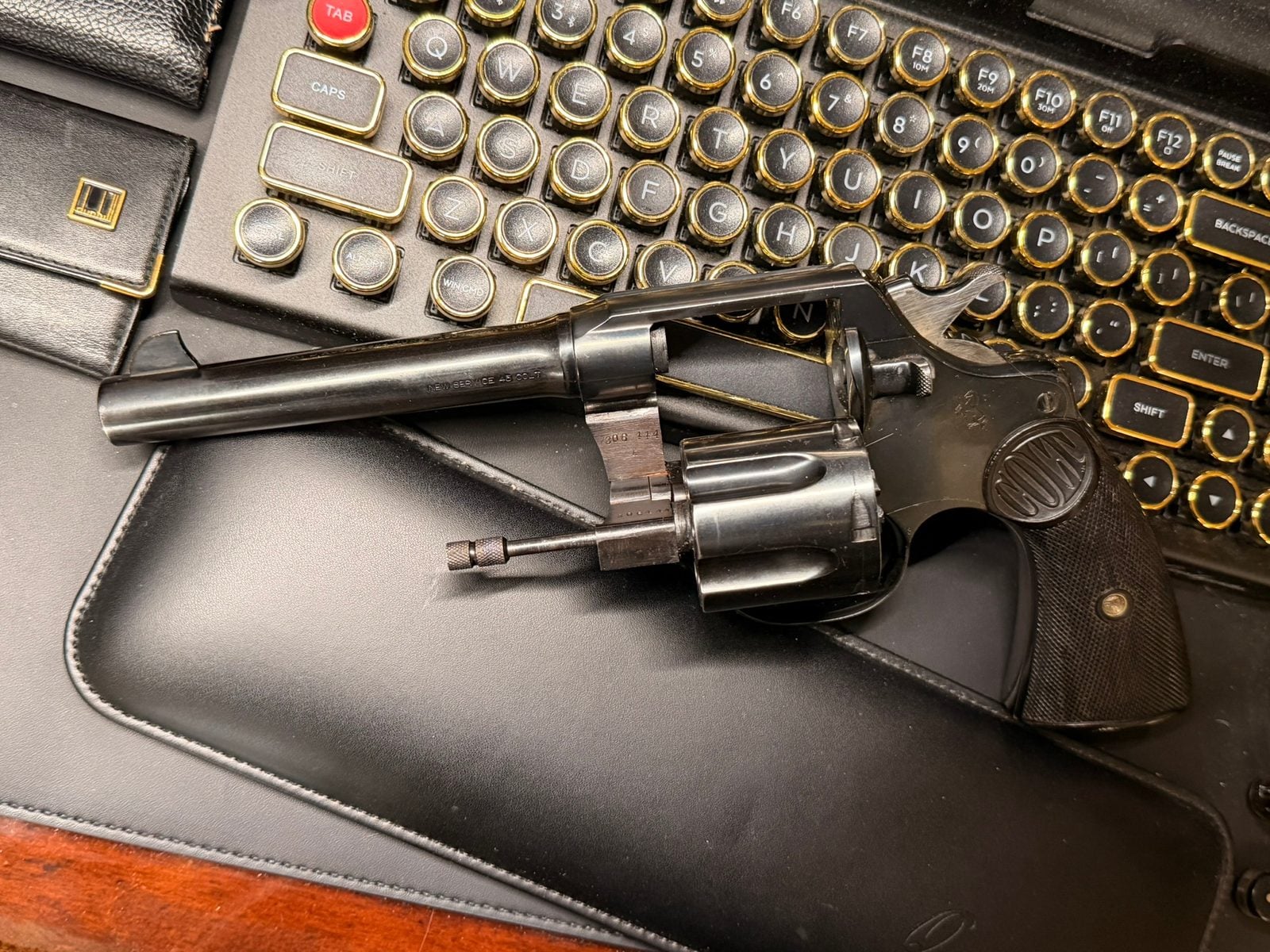
The top of my New Service barrel reads “PAT'D AUG. 5. 1884. JUNE 5. 1900. JULY 4. 1905.” That first date turns up on Colt double-action swing-out revolvers across several decades. The Mariners’ Museum records it on a Navy-pattern Colt from the 1890s, the Northwest Museum of Arts and Culture on an Army Special, and the Smithsonian on Charles Hamilton Houston’s M1917. There’s a coincidence in photograph 13: President Chester Arthur signed the land grant on the wall behind my Colt on December 5th, 1884, four months to the day after that first patent date.
The Police Positive followed in 1905, and the Army Special in 1908, renamed the Official Police in 1927. The Detective Special of 1927 was essentially a shortened Police Positive Special and the first production two-inch snub-nose. The aluminum-framed Cobra followed in 1950, and the Python in 1955. Colt made a selling point of the fact that its later cylinders turned clockwise, the opposite of the 1889. Its ads proclaimed "All Colt cylinders TURN TO THE RIGHT." My 1962 nickel Colt Python is about as far as that line of development goes. It still uses the same side latch, crane and star ejector.
Smith & Wesson's Hand Ejector concept likewise became the foundation for generations of revolvers. The Military & Police of 1899 was built on what became the medium K-frame. More than six million have been made, and when Smith & Wesson adopted model numbers in the late 1950s, it became the Model 10. The .44 Hand Ejector First Model of 1908, the famous "Triple Lock," added a third lock at the crane for the new .44 Special cartridge. By 1930 Smith & Wesson had its large N-frame .38-44, and in the 1980s it brought out the L-frame .357s, including the Model 686, introduced in 1981. The little .32 Hand Ejector line, meanwhile, led to the J-frame.
Why the Swing-Out Cylinder Won
The cleverness of the system wasn't simply that the cylinder opened.
It solved several problems at the same time.
A loading-gate revolver could have a very strong frame, but manipulating cartridges one chamber at a time was relatively slow. A top-break revolver provided excellent access to the cylinder, but required the frame itself to hinge.
The swing-out system allowed the manufacturer to keep the barrel and main frame together as a rigid structure while moving only the cylinder and its supporting assembly.
And when opened, all of the chambers became accessible simultaneously.
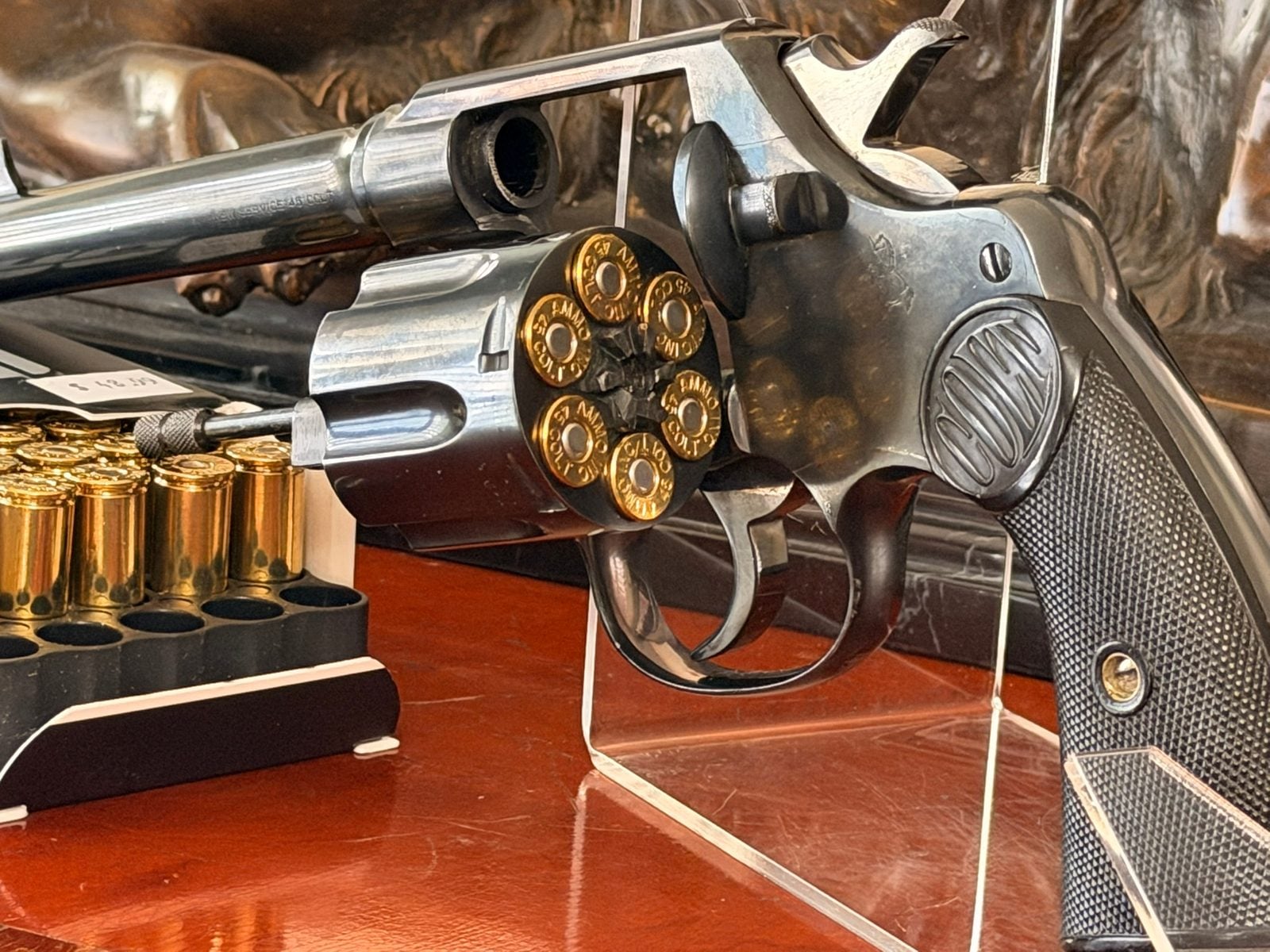
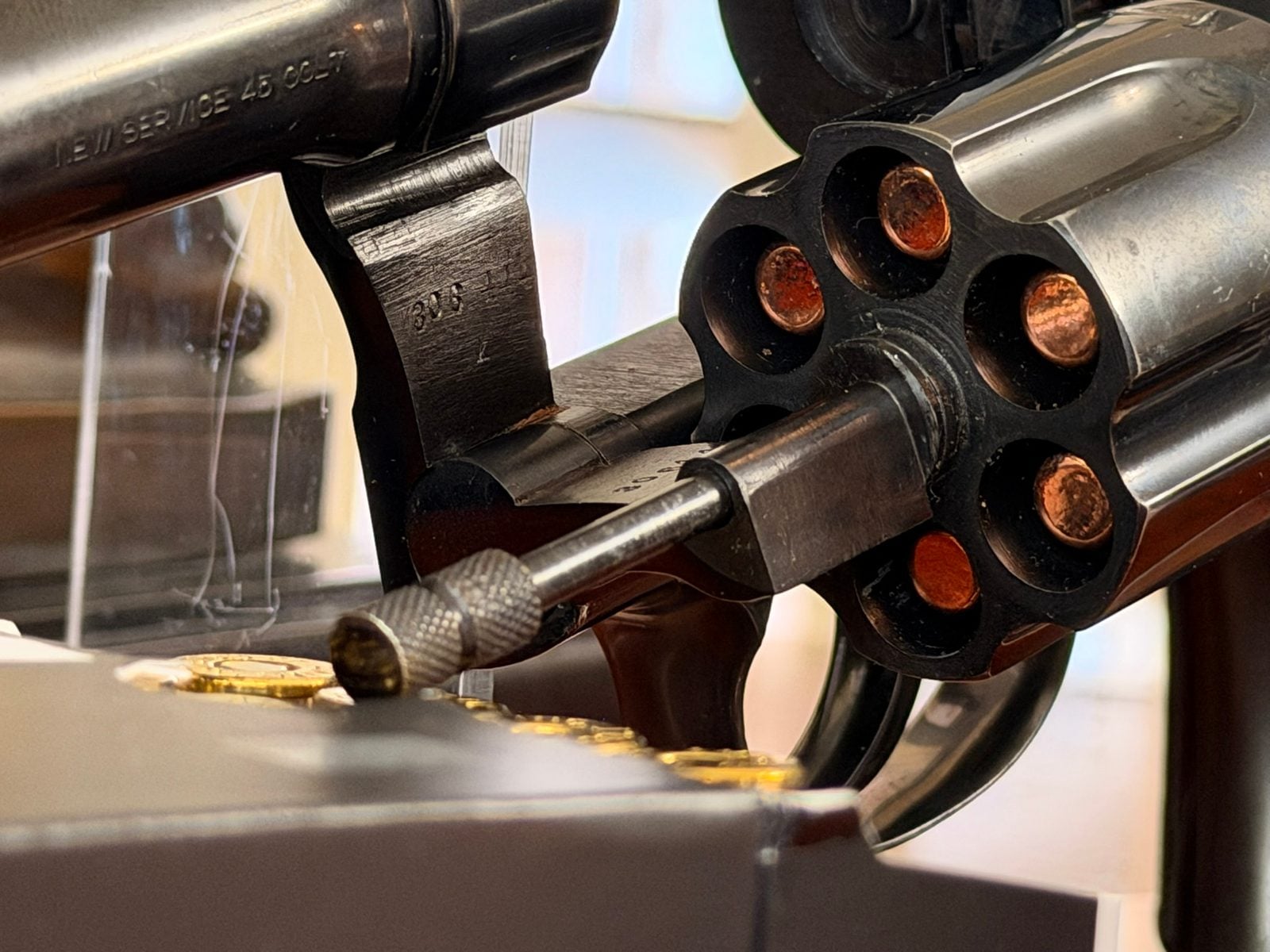
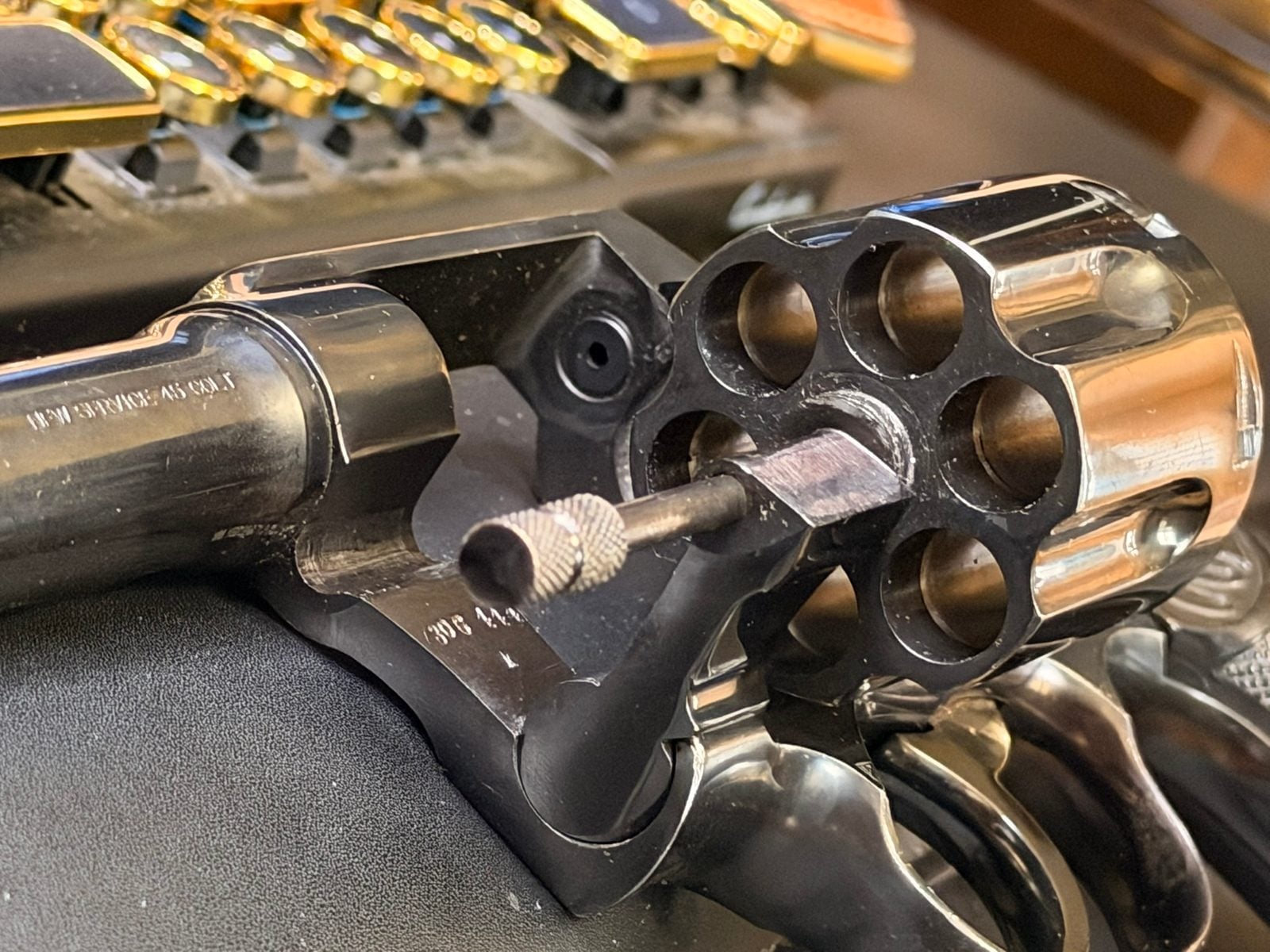
That rigidity mattered more as cartridges got hotter. The New Service was chambered for .357 Magnum in 1936, and the Python is a .357 Magnum.
That layout proved so successful that more than a century later, when someone pictures a conventional double-action revolver, there's a good chance this is exactly the mechanism they picture.
A Useful Collector's Timeline
- 1865William Mason, then at Remington, patents a cylinder that swings out on a crane or yoke.
- 1869The Rollin White patent expires, opening the way for Colt to build bored-through cylinders for metallic cartridges.
- 1870The U.S. Army adopts the Smith & Wesson Model 3 top-break.
- 1873The Colt Single Action Army, a solid-frame loading-gate revolver, enters production.
- 1888Carl Ehbets of Colt patents a swing-out-cylinder revolver.
- 1889The Colt Model 1889 becomes the first production double-action revolver with a swing-out cylinder. The U.S. Navy buys 5,000.
- 1892The Army adopts the Model 1892, with a separate bolt to hold the cylinder in firing position.
- 1896Smith & Wesson introduces the .32 Hand Ejector First Model, its first swing-out revolver. It opens by pulling the ejector rod forward.
- 1898Colt introduces the New Service.
- 1899The Smith & Wesson .38 Military & Police introduces the side thumb latch.
- 1902The M&P adds the barrel lug that locks the front of the ejector rod.
- 1905–1927Colt introduces the Police Positive (1905), Army Special (1908, renamed Official Police in 1927) and Detective Special (1927). Smith & Wesson introduces the Triple Lock (1908).
- 1950–1981Colt introduces the Cobra (1950) and Python (1955). The M&P becomes the Model 10 in the late 1950s. Smith & Wesson introduces the L-frame Model 686 (1981).
Conclusion
The swing-out cylinder did not come from one inventor in one year. Mason's 1865 patent, Ehbets' work at Colt, the Navy's 1889 revolver and the Army's call for a better cylinder bolt, and the Wessons' long run of patents all fed into it. Within about a dozen years of the Model 1889, Colt and Smith & Wesson had both settled on the layout we still use: a solid frame, a cylinder on a crane, a side latch, and a central ejector rod.
For a collector, that early period is the interesting part. A Colt 1889 with its counterclockwise cylinder, a Model 1892 with its added bolt, or a First Model .32 Hand Ejector with no thumb latch each shows one step on the way. Put one of them next to a New Service or a Python and you can see the whole development in a few inches of steel.
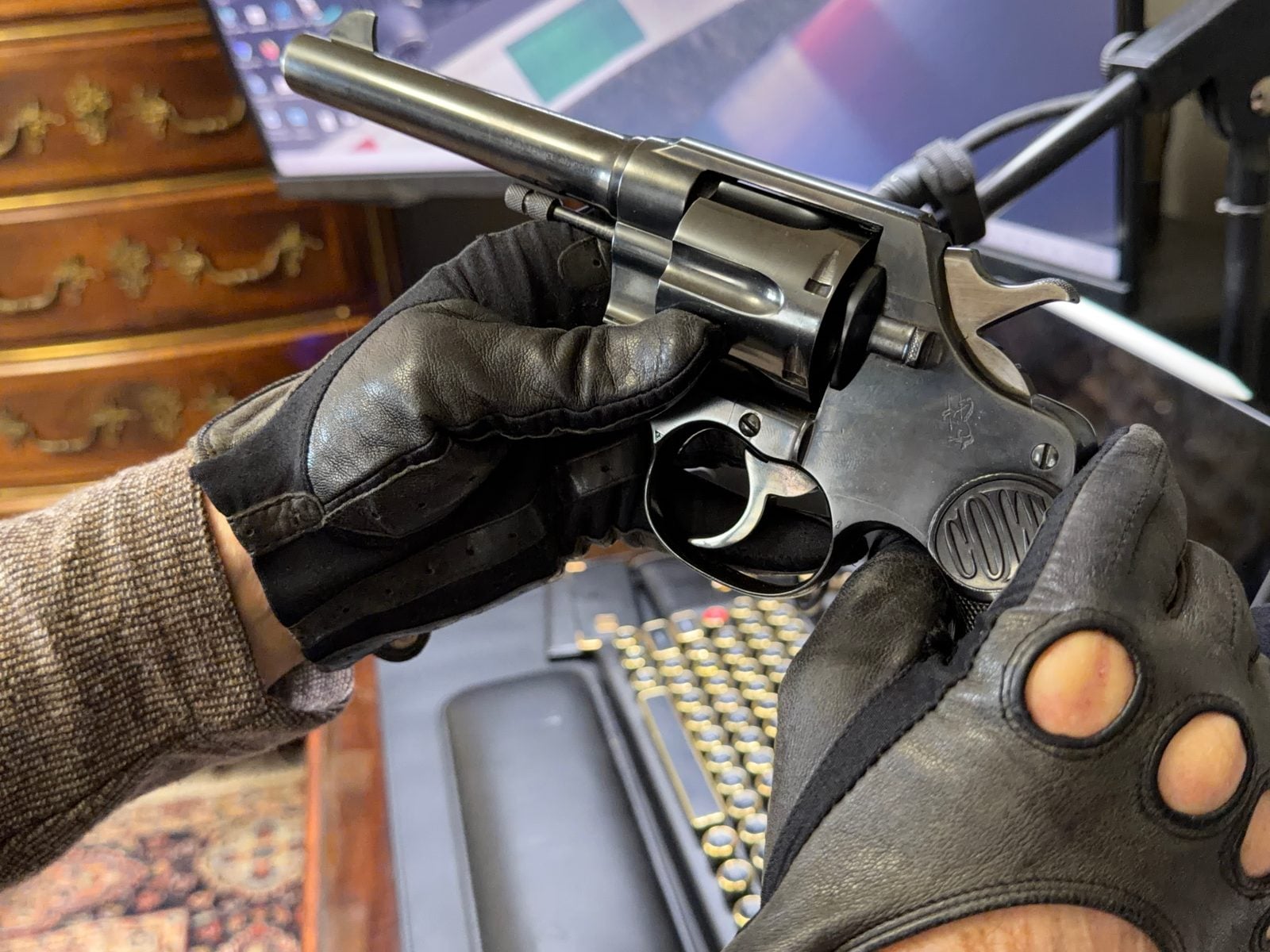
Explore the full Colt New Service photo gallery

About Greg Cook
Greg Cook writes about firearms collecting, personal history, and the stories behind interesting guns. His Army MOS was 76Y, Unit Armorer, and he brings that practical background to his collector articles.
References
- The Mariners’ Museum, U.S.M.C. Colt revolver
- Northwest Museum of Arts and Culture, Colt’s Army Special .38
- Smithsonian, Charles Hamilton Houston’s M1917
- Colt M1889
- Colt1889series.htm
- 100072
- 32he.html
- s-w-model-i
- sunday-smith-53-32-hand-ejector-model.html
- Colt 1851 Navy Revolver
- Colt Single Action Army
- Smith & Wesson Model 3
- Webley Revolver
- Merwin Hulbert
- Colt New Service
- Colt Police Positive
- Colt Official Police
- Colt Detective Special
- Colt Cobra
- Colt Python
- Smith & Wesson Model 10
- Smith & Wesson Triple Lock
- Smith & Wesson Model 686
- Smith & Wesson Model 30
Get in Touch
I enjoy hearing from fellow collectors, historians, and readers of Gun Collectors Club. Whether you have a question about an article, serial number research, or collector history, I welcome your message.