Collector disclaimer: Educational reference only—not an appraisal, offer to buy or sell, legal opinion, gunsmithing instruction, or authentication of any specific firearm. Verify that every firearm is unloaded before handling. Do not fire an old revolver until a qualified gunsmith has examined it, and use only ammunition appropriate to that exact firearm.
New Service serial tool
Estimate the Manufacture Year
Enter the Colt factory serial number from a confirmed New Service or Shooting Master. The result uses the annual starting numbers published by R. L. Wilson for 1898–1944.
M1917 caution: Use the Colt factory serial found on the frame at the crane area—not the separate U.S. military number on the butt. This is an estimated production year, not a factory shipping date or authentication.
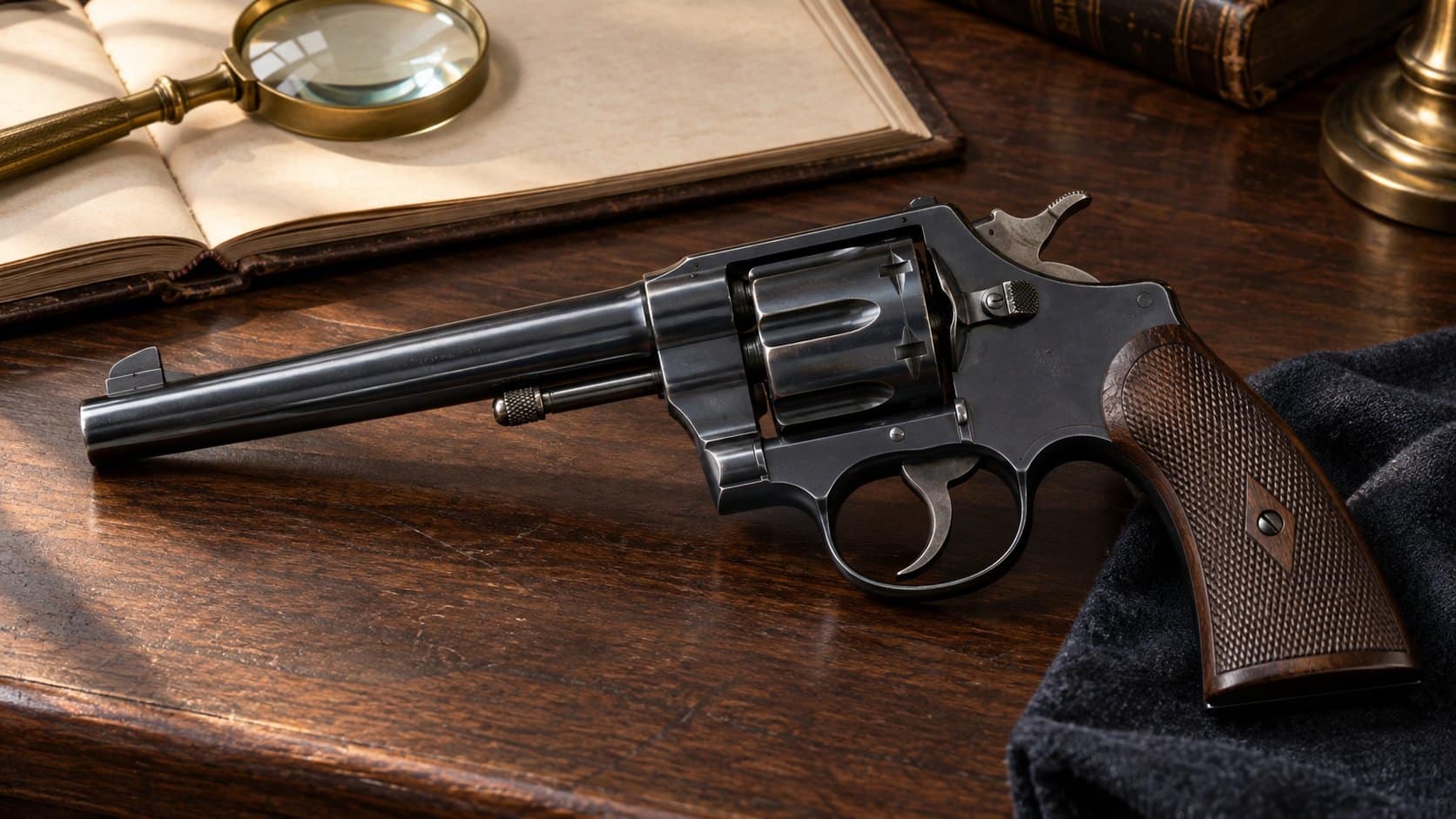
The Colt New Service sits at a fascinating intersection of American commercial gunmaking and military history. It was Colt’s large-frame, swing-out-cylinder double-action revolver for powerful cartridges, sold in numerous chamberings and configurations and adapted into two important U.S. service arms: the Model of 1909 and the Model of 1917. It also appeared in target form, in the premium Shooting Master variation, and in foreign-service chamberings. That variety makes the New Service historically rich—and makes casual identification surprisingly risky.
This guide combines model history with a practical collector workflow. It explains what to inspect, why a serial number by itself is not enough, where military and commercial features diverge, and when a Colt Archive letter is worth ordering. The estimator above uses a directly reviewed printed table and reports an approximate production year. Colt’s own lookup also describes its results as approximate and incomplete; the factory shipping record, when it survives, answers a different and usually more useful question.
Collector Quick Read
- Basic identity: a large-frame, six-shot, double-action Colt revolver with a cylinder that swings out to the left and an exposed ejector rod.
- Commercial introduction: 1898, according to the model histories cited below.
- Common branches: standard commercial New Service, New Service Target, Shooting Master, U.S. Model 1909, and U.S. Model 1917.
- Do not date from appearance alone: barrels, stocks, sights, finish, and even calibers may have changed during a century of use.
- Colt.com lookup: useful for an approximate lead, but Colt says it is not comprehensive or definitive.
- Best documentation: a Colt Archive letter may report original caliber, barrel length, finish, stocks, shipping date, destination, and special features found in the record.
From Colt’s Early Swing-Out Revolvers to the New Service
The New Service did not appear in isolation. Colt had already moved from gate-loaded revolvers toward double-action designs and then toward the swing-out-cylinder system familiar today. The Model 1889 and the subsequent New Army and New Navy series established the broad operating pattern: press or pull the cylinder latch, swing the cylinder to the left, and use the central ejector rod and star to clear the chambers together. The Smithsonian describes the earlier New Army and Navy family as a major .38-caliber Colt line made between 1892 and 1907. The New Service scaled the concept for more powerful cartridges and hard service.
American Rifleman’s model history places the New Service debut in 1898. The revolver’s appeal was straightforward: it combined double-action fire, a solid top strap, simultaneous extraction, and the capacity for large-bore cartridges in one substantial platform. It was not a pocket revolver and was never meant to be. Its size gave Colt room for a large cylinder and robust frame, while the range of barrel lengths, finishes, stocks, sights, and chamberings allowed the same basic platform to serve outdoorsmen, police agencies, target shooters, militaries, and foreign buyers.
The word service can mislead modern buyers into assuming that every example is a government gun. It is a model name, not proof of military issue. Many New Service revolvers were ordinary commercial products. Conversely, a revolver with military-style lanyard provisions or martial-looking finish is not automatically a U.S. contract arm. Government ownership marks, inspector marks, caliber, butt markings, serial placement, barrel profile, and cylinder configuration must agree before the identification becomes persuasive.
How to Identify a Colt New Service
Start with the whole revolver, not a single number. The New Service is visibly larger than Colt’s medium-frame Army Special, Official Police, Police Positive Special, or later Trooper families. A genuine example normally presents a six-shot fluted cylinder, a substantial solid frame, a left-swinging cylinder, an exposed rod beneath the barrel, and a grip frame proportioned for a full-size service arm. Details changed over a long production life, so no one feature should carry the entire identification.
Read every marking exactly as it appears. Record the barrel legend, caliber marking, patent dates, model wording, butt markings, frame serial, crane or yoke numbers, and any inspector or property marks. Photograph both sides, the butt, the cylinder face, the rear of the cylinder, the crane area, and the barrel address in even light. Do not scrub, polish, sand, or “improve” a faint marking before documenting it. An old refinish can soften lettering; aggressive cleaning can erase evidence permanently.
Pay special attention to the difference between a serial number and an assembly or fitting number. Revolvers may carry internal numbers used during manufacture that are not the legal serial and do not belong in a dating tool. Colt also warns that vintage firearms can share serial numbers across different models. A result is meaningful only when the number and the model identity agree.
Field identification checklist
- Confirm that the cylinder and frame are the large New Service pattern rather than a smaller Colt double action.
- Transcribe the complete serial exactly, including prefixes, suffixes, punctuation, or unusual spacing.
- Measure barrel length from the front face of the cylinder to the muzzle—not from the frame or ejector rod.
- Record the marked caliber; do not infer chambering only from what cartridge happens to fit.
- Note whether sights are fixed or target style and whether the top strap is rounded or configured for target sights.
- Inspect stocks for material, checkering pattern, medallions, fit, wear, and evidence of later replacement.
- Document finish honestly: blue, nickel, military finish, or a probable later refinish.
- Check for U.S. property, inspector, unit, agency, or foreign proof marks without assuming what they mean.
Commercial Chamberings, Barrels, and Finishes
The New Service earned its reputation partly through breadth. Period production included large American revolver cartridges and chamberings aimed at foreign markets. American Rifleman lists .38-40, .44-40, .44 Russian, .44 Special, and .45 Colt among the commercial offerings, with .450, .455, and .476-class chamberings for overseas demand. Later production included .38 Special, and the .357 Magnum joined the line in the 1930s. This is a model-family overview, not permission to fire ammunition based on a web list. Markings, chamber dimensions, alterations, and mechanical condition govern what any individual revolver can safely use.
Barrel lengths and finishes also varied. Standard commercial revolvers appeared with several barrel lengths, commonly including 4, 5½, 6, and 7½ inches in different periods and configurations. Blue was normal; nickel examples exist. Stocks evolved from hard rubber to walnut patterns. Target versions brought specialized sights and grip or control details. Because the same basic model spans decades, a feature that is correct for one period can be wrong for another.
Caliber conversions deserve particular caution. A barrel can be changed, a cylinder can be replaced or altered, and military .455 or .45 ACP revolvers have sometimes been modified after surplus sale. A barrel marking that disagrees with the cylinder or an archive letter is not a minor curiosity; it is a signal to stop and investigate. A qualified gunsmith should determine the actual chambering, headspace, timing, lockup, bore condition, and suitability for any proposed ammunition.
The U.S. Model of 1909
The U.S. military’s experience with .38-caliber service revolvers helped renew interest in a larger-bore handgun. After trials, the government adopted a New Service-based .45 revolver as the Model of 1909 for the Army, Navy, and Marine Corps. American Rifleman’s military-revolver history reports that roughly 14,000 were procured from February 1909 through April 1911. These were not simply ordinary commercial guns with a martial stamp; contract markings, inspection details, butt configuration, ammunition considerations, and branch-specific features matter.
The Model 1909 used a version of the .45 Colt cartridge with an enlarged rim intended to improve simultaneous extraction. That point matters because modern collectors sometimes assume that every .45 Colt cartridge behaves identically in every vintage revolver. The historical service cartridge, the cylinder’s condition, and the extractor design belong in the identification story. Do not turn a general history into a loading recommendation.
Marine Corps examples attract special interest, which also attracts optimistic attributions. A lanyard loop or a vaguely plausible serial is not enough. A serious Model 1909 evaluation compares exact butt markings, inspector stamps, serial location, barrel and cylinder features, grips, finish, and any archive information. The package’s research notes correctly keep “1905 Marine Corps Model” and “New Service” as separate names on Colt Archive’s price list; a collector should not merge separate catalog identities simply because the revolvers look related.
The Colt Model 1917 and the .45 ACP Solution
When the United States entered World War I, demand for handguns exceeded available M1911 pistol production. Colt and Smith & Wesson adapted large-frame revolvers to use the same rimless .45 ACP cartridge. The result was the U.S. Revolver, Caliber .45, Model of 1917. The U.S. Army’s own historical material explains that the Colt and Smith & Wesson revolvers were issued with three-round half-moon clips, which held the rimless cartridges for loading and extraction. The Smithsonian likewise identifies its Colt M1917 as based on the earlier Model 1909 New Service.
The clip is central to understanding the design. A rimmed revolver cartridge normally gives the extractor star a rim to push against. The .45 ACP case is rimless, so the half-moon clip holds three cartridges together and supplies the purchase needed for simultaneous extraction. Cylinder details evolved, and surviving guns may have been altered. Statements about firing without clips should therefore be tied to the exact cylinder in hand, not repeated as a universal rule.
Colt delivered roughly 151,000 Model 1917 revolvers during World War I according to the cited model histories. Many remained in government inventory. The Army’s historical survey notes that Colt and Smith & Wesson M1917 revolvers were reissued in World War II to rear-echelon personnel such as military police and prison guards, then displaced as M1911 pistols became available. That long service life helps explain the range of wear, arsenal work, mixed parts, refinishes, replacement stocks, and post-service modifications encountered today.
A Colt M1917 should not be identified solely by “U.S.” on the butt or by the presence of moon clips in the case. Examine the caliber marking, military property and inspector marks, butt serial, barrel profile, cylinder machining, and overall New Service frame. Also distinguish the Colt from the Smith & Wesson M1917; they share the military designation and cartridge solution, but they are different manufacturers’ revolvers.
Foreign and Police Service
The New Service also traveled. British and Commonwealth demand brought .455-chambered examples into military service, while Canadian mounted-police associations have made certain configurations especially collectible. Cuba and other foreign purchasers also acquired New Service revolvers. These histories are real, but they are easy to oversimplify. “Canadian,” “British,” or “Cuban” should be conclusions supported by markings, configuration, records, and credible provenance—not marketing adjectives attached to a caliber.
Foreign proof and ownership marks may reveal later sale, reproof, or commercial handling as well as original service. A .455 marking does not on its own prove a specific unit or owner. Likewise, a police agency’s known use of the model does not place an unmarked revolver in that agency’s inventory. Archive shipping destination can be especially valuable here because it may either support a destination claim or show that the gun originally went somewhere else.
New Service Target and Shooting Master
Colt also developed the platform for deliberate target shooting. The New Service Target used target-oriented sights and finishing details, while the Shooting Master represented a premium, carefully finished branch of the large-frame Colt line in the 1930s. American Rifleman describes the Shooting Master as a high-grade variation of the Target, normally with a 6-inch barrel and chamberings that included .38 Special, .357 Magnum, .44 Special, .45 Colt, and .45 ACP.
These variants are not labels to apply whenever a New Service has adjustable sights. Sights can be added, barrels can be swapped, and aftermarket work can imitate some outward features. Inspect the top strap, sight installation, barrel markings, trigger and backstrap treatment, stocks, finish, and serial-era consistency. Colt Archive’s current price material lists New Service and Shooting Master separately, reinforcing the practical point: identify the marked and configured model before ordering research.
Production Changes and Why “Correct” Is Period-Specific
A revolver made near the beginning of the model’s life should not be judged by the features of a late prewar example. Colt revised internal parts, safety provisions, markings, finishes, stocks, sights, and available cartridges. American Rifleman notes lockwork changes around 1909 and the adoption of Colt’s Positive Lock hammer-block system. Such changes matter, but they should be used as cross-checks rather than as a one-feature dating shortcut.
Collectors often ask whether a part is “correct.” The better question is whether the complete combination is plausible for the period and then whether the factory record confirms it. A correct-style barrel may still be a replacement. Correct walnut stocks may not be the stocks shipped with that serial. A military revolver may have legitimate arsenal replacement parts that reduce commercial-style originality but are part of its service history. An archive letter can establish recorded shipping configuration; it cannot tell you every later repair.
Production-end dates vary in retellings because writers may distinguish regular commercial manufacture, wartime assembly, or final completion from remaining parts. The cited American Rifleman history gives 1946 and approximately 357,000 revolvers, while many collector summaries use an earlier end point for regular production. This page does not force those different definitions into false precision. For an individual gun, use its markings, approximate serial research, and factory documentation rather than a single headline date.
Evaluating Condition and Originality
Condition is more than the percentage of blue remaining. Inspect screw slots, edges, lettering, cylinder stop notches, muzzle, ejector rod, stocks, and the fit of sideplate and frame surfaces. Rounded edges, washed-out legends, dished screw holes, or brilliant blue over visible pitting can indicate refinishing. Nickel can flake or hide preparation marks. Replacement stocks may fit poorly or look much newer than the metal. None of those observations alone proves deception, but together they guide the next questions.
Mechanical condition is a separate category. Timing, carry-up, cylinder lockup, end shake, headspace, forcing-cone condition, bore condition, firing-pin integrity, and the function of the safety system belong to a competent gunsmith’s inspection. Do not repeatedly dry-fire or cycle an unfamiliar collectible merely to “test” it. Verify it is unloaded, preserve its current state, and seek qualified help.
Originality and historical integrity are not always identical. A documented arsenal overhaul may be historically meaningful even though the revolver no longer matches its first shipping configuration. A commercial refinish can make a worn gun attractive while reducing collector interest. A well-used police revolver with credible agency markings can tell a stronger story than a shinier but undocumented example. Describe what the evidence supports and separate fact, inference, and seller claim.
What Serial-Number Research Can—and Cannot—Tell You
Colt’s online Serial Number Lookup is a sensible first stop. Colt explicitly says the information is approximate, should not be relied upon for legal, compliance, valuation, or other purposes requiring definitive documentation, and is not comprehensive. Colt also warns that multiple models may share a serial number. Those warnings are not boilerplate to ignore; they explain why a bare number should never drive the identification.
A third-party chart may help form a question, but it should not be represented as a factory record. Serial blocks were not necessarily assembled or shipped in strict sequence. A manufacture-year estimate and an actual shipping date can differ. A gun can sit before shipment, return for work, or acquire changed parts later. Public dating tools usually answer “approximately when does this number appear?” An archive letter answers “what does the surviving shipping record say about this serial?”
The estimator on this page is intentionally narrow. It uses the annual starting serial numbers for the “New Service & Shooting Master” table in R. L. Wilson’s Colt’s Dates of Manufacture, 1837 to 1978, pages 20–21. It does not identify the revolver, authenticate its configuration, establish its shipping date, or resolve military numbering. Treat the result as a dated reference range and confirm important conclusions through Colt’s lookup or Archive Services.
What a Colt Archive Letter May Establish
Colt Archive Properties says its letters typically provide original shipping details: configuration, shipping date, destination, caliber, barrel length, finish, stocks, and special features recorded for the firearm. The historian verifies the available information and issues a signed, stamped document. That can be decisive when a premium rests on an unusual barrel, finish, engraving, target configuration, or destination.
The letter has limits. Colt says ownership is not traced through the records, personal names are sparse, patent dates stamped on the firearm are not manufacture dates, many assembler or government markings were not recorded, and packaging details are generally absent. The archive also explains that its letter date may not match public serial lookups because those lookups use approximations and guns were not always assembled or shipped in consecutive order.
A mismatch between the letter and the revolver does not make the letter useless. It may document a later barrel change, caliber conversion, refinish, replacement stocks, or aftermarket engraving. Compare the letter line by line with the gun as it exists now. Record the discrepancy; do not rewrite either the document or the firearm to make the story cleaner.
When a New Service Letter Is Worth Ordering
Order a letter when the answer can change a buying, insurance, estate, publication, or preservation decision. Strong candidates include high-condition revolvers, rare chamberings, target variants, claimed military or police guns, unusual finishes, engraved examples, and guns whose present configuration conflicts with their apparent period. A letter is especially useful when original destination matters.
You may reasonably skip or postpone a letter for a common, heavily altered shooter when no historical claim affects your decision. If all you need is an approximate period, Colt’s public lookup may answer the narrow question. But do not let the cost of documentation push you into pretending that an approximate result is definitive.
Current Fee, Turnaround, and Ordering Path
These figures were rechecked on September 23, 2026, but fees and turnaround can change. Confirm them on the live order form before submitting an order.
| Item | Published information |
|---|---|
| New Service standard letter | $105 on Colt Archive’s price list marked “Prices as of February 1, 2024.” Recheck the live model selection. |
| Shooting Master / 1905 Marine Corps Model | Also listed in the $105 tier, but as separate model names. Do not substitute one identity for another. |
| Date of manufacture only | $30 on the same published list. |
| Retype / reissue | $40 for verification and reissue of a previously prepared letter in the current owner’s name. |
| Expedited service | For most models, standard letter fee plus $100; the published list describes preliminary information followed by the formal document. |
| Turnaround | The Orders & Pricing page says approximately 150 days. The separate FAQ still says approximately 90–100 days. Plan around the longer current orders-page estimate. |
| Appraisal | Colt Archive states that it does not offer appraisal services. |
Use Colt Archive’s Orders & Pricing page and its online form. The page says customers paying by card are generally invoiced by email when research is complete, while check or money-order arrangements differ. Unique shipping destinations, engraving, expedited work, or other special features can affect the charge. Calculate the total in the form and allow the archive to contact you if the research changes it.
A Practical New Service Research Workflow
- Make the firearm safe. Point it in a safe direction, open the cylinder, and verify every chamber is empty. Keep ammunition elsewhere.
- Photograph before cleaning. Capture full profiles and close views of every marking, serial location, butt, crane, cylinder, sights, stocks, and any property stamp.
- Build a written inventory. Record exact markings, marked caliber, measured barrel length, finish, stock material, sights, and apparent alterations.
- Identify the branch. Decide whether the evidence points to a commercial New Service, Target, Shooting Master, Model 1909, Model 1917, or another Colt family. Mark uncertain points as uncertain.
- Use Colt’s lookup as an estimate. Match the result to the correct model and retain Colt’s caveats.
- Compare credible references. Use museum examples and specialist books for physical details. Avoid treating auction copy as proof.
- Get a mechanical inspection. Before firing, have a qualified gunsmith familiar with vintage revolvers examine condition and chambering.
- Order the archive letter when it matters. Submit the exact serial and model information, then compare the returned configuration to the gun line by line.
- Preserve the evidence package. Keep the letter, photographs, receipts, gunsmith report, and prior provenance together without attaching permanent labels to the firearm.
Common New Service Research Mistakes
- “The serial lookup gave a year, so the gun is identified.” A shared or reused number can return multiple models. Identify the revolver first.
- “New Service means U.S. military.” It does not. Most model names do not prove ownership or issue.
- “It accepts the cartridge, so that is the caliber.” Never use cartridge fit as a firing test or final chamber identification.
- “Adjustable sights make it a Shooting Master.” Added sights and replacement barrels exist. The entire configuration must agree.
- “A letter authenticates every current part.” It documents recorded shipping information, not every later repair or alteration.
- “A factory letter adds a fixed dollar amount.” There is no universal premium. Relevance depends on what the letter confirms and the gun’s condition and market.
- “Patent dates are manufacture dates.” Colt Archive specifically says they are not.
- “One production-end year settles everything.” Regular manufacture, wartime assembly, and final completion can be described differently. State the source and definition.
Related Colt Research on Gun Collectors Club
- Factory Letters for Collectors — compare Colt, Cody, and Smith & Wesson record services.
- Colt Serial Number Lookup Hub — model-first dating guidance and routes to established Colt families.
- Colt Revolver Hub — broader revolver research.
- Colt Official Police section — a related but smaller-frame service-revolver path; do not transfer its identity or fee to the New Service.
- Colt Python Guide, Detective Special Guide, and Police Positive Serial Guide.
Collector Takeaway
The Colt New Service is not one simple revolver with one simple date chart. It is a large-frame platform that crossed commercial, target, police, foreign, and U.S. military markets over decades. The Model 1909 and Model 1917 are major branches, not interchangeable labels. The Shooting Master is a distinct premium configuration, not shorthand for any gun with target sights. Caliber, barrel, stocks, finish, markings, and serial context must tell one coherent story.
Use the online serial lookup for an approximate lead. Use physical examination to identify the model. Use a gunsmith to answer safety and mechanical questions. Use the archive letter when original shipping configuration or destination matters. And when the evidence stops, stop with it. “Unknown” is better collector language than a confident story assembled from mismatched clues.

About Greg Cook
Greg Cook writes about firearms collecting, personal history, and the stories behind interesting guns. His Army MOS was 76Y, Unit Armorer, and he brings that practical background to his collector articles.
Serial estimator source: R. L. Wilson, Colt’s Dates of Manufacture, 1837 to 1978 (David Madis, 1985), pp. 20–21, ISBN 0-9591991-0-1.
Sources & References
Research references checked September 23, 2026:
- Colt’s Manufacturing Company — Serial Number Lookup and limitations
- Colt Archive Properties — Orders & Pricing
- Colt Archive Properties — About the Archive Letter and FAQs
- Colt Archive Properties — Archive Letter Price List, prices as of February 1, 2024 (PDF)
- American Rifleman — “The Colt New Service: A Look Back”
- American Rifleman — “America’s Military Revolvers”
- Smithsonian Institution — Colt .38 Special New Service Revolver
- Smithsonian Institution — Colt M1917 Revolver
- U.S. Army Center of Military History — Survey of U.S. Army Uniforms, Weapons and Accoutrements (PDF)
- Gun Collectors Club — Factory Letters for Collectors
- Gun Collectors Club — Colt Serial Number Lookup Hub
- Gun Collectors Club — Colt Revolver Hub
Source boundary: The estimator transcribes the directly reviewed Wilson table cited above. It reports approximate annual serial placement, not a factory ledger result. Informal charts, forum posts, auction descriptions, and seller claims are not treated here as factory authority; this page does not invent ownership histories, shipping dates, or provenance.