The Diary of a Soldier — February 23 through March 1985. REFORGER had tested whether American forces and equipment could move into Europe. The return voyage tested the other half of the same machinery: securing the cargo, crossing the Atlantic, and bringing everything home.
Underway Aboard the American Eagle
Our first bridge report on February 23 placed the American Eagle at 53°12′ north, 4°22′ west. We had covered 140 miles during the first seven hours and 42 minutes at sea. There were more than 4,300 miles still to go.
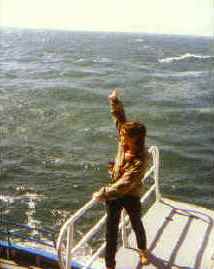
Life aboard ship settled into a routine. SFC Sawyers arranged for us to meet the first mate on the bridge deck. We checked cables, shackles, and shipping containers. Moving from one row of vehicles and containers to another could be dangerous.
Movies, Meals and Shipboard Details
The small details kept finding their way into my notebook. We watched Salem’s Lot in the television room. On another evening, Sawyer, Plotnicky, Lucas, Hayes, and Chief Stewart watched several triple-X movies. I stayed through one and a half before retiring for the evening.
Even the restroom had something memorable: a small black sign with white lettering that read, “If you don’t eat it, don’t flush it, except for toilet paper.”
A Sound Over the Atlantic
On February 24, a sudden sound over the Atlantic startled both me and the cook. It sounded as though something had broken the sound barrier. SFC Sawyers believed it was the Concorde on a flight from London or Paris.
That night we retarded the clocks by one hour as we continued west. The bridge report showed 594 miles behind us and 3,864.9 still ahead.
A Suspected Soviet Surveillance Ship
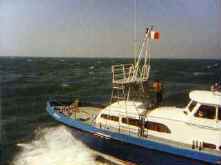
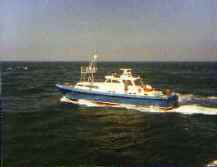
On February 25, I woke at 6:15 and saw a dark gray military vessel traveling parallel to us about half a mile away. Someone among the crew identified it as another Russian surveillance ship. I followed Lucas to his room to borrow binoculars, then joined others trying to make out the vessel’s markings.
The Tupolev TU-16
The Cold War became much less abstract the following day. After lunch, I went to the wheelhouse. Pete, who had the 12-to-4 watch, had invited me earlier. I looked at the world map and the course we were following.
A Soviet aircraft then buzzed the ship. It circled the American Eagle, apparently photographing us. SFC Sawyers and I watched from the navigation deck through binoculars. Chief Dominick brought out an aircraft-recognition book, and we identified it as a Tupolev TU-16 maritime reconnaissance aircraft.
For most of REFORGER, the Cold War meant plans, vehicles, convoys, and bitter weather. Over the Atlantic, it came close enough to circle the ship.
The Atlantic in Numbers
I copied the bridge reports into my notebook. They recorded the voyage one day at a time:
| Date | Position | Day’s run | Total | To go |
|---|---|---|---|---|
| Feb. 23 | 53°12′ N, 4°22′ W | 140 | 140 | 4,315.9 |
| Feb. 24 | 49°29′ N, 4°58′ W | 451 | 594 | 3,864.9 |
| Feb. 25 | 45°00′ N, 13°58′ W | 455.4 | 1,049.4 | 3,409.5 |
| Feb. 26 | 40°44′ N, 21°58′ W | 432 | 1,481.4 | 3,067.5 |
| Feb. 27 | 32°52′ N, 22°36′ W | 490 | 1,971.4 | 2,161.6 |
| Mar. 2 | 31°58′ N, 49°38′ W | 465.5 | 3,597.4 | 1,584.5 |
| Mar. 3 | 31°58′ N, 59°15′ W | 490 | 3,887.4 | 1,094.5 |
| Mar. 4 | 31°55′ N, 68°29′ W | 470.4 | 4,357.8 | 624 |
The ship maintained an average close to 19 knots. Several nights we set the clocks back an hour. My government-issued Hamilton watch kept time as precisely as Big Ben, but the repeated clock changes made the days feel unusual.
The Final Days at Sea
Not every day produced a Soviet ship or aircraft. One day the only notable sight was a huge tanker running parallel to starboard, perhaps 20 miles away and moving more slowly. Another morning came with a hangover earned from Bacardi and Coke, Jim Beam and Coke, and conversation that lasted until midnight.
Savannah and the End of the Journey
At 8 in the morning we left Savannah. I took pictures of River Street, where we had partied the night before. It was beautiful. We traveled until midnight, and I watched Night Shift, a Ron Howard movie starring Henry Winkler, Mike Keaton, and Shelley Long.

That was the quiet ending to a trip that had begun with quarantine, a 747, snow at Ramstein, and warehouses full of vehicles. Between those points were the convoy, the cold, the waiting, the people I met, and a Soviet aircraft circling above us in the Atlantic.
What REFORGER Left With Me
REFORGER ’85 was designed to prove that American forces could return to Germany quickly enough to reinforce NATO. From where I stood, it was also a lesson in how many people, vehicles, ships, railcars, warehouses, checklists, and small decisions were required to make that promise real.
I was one soldier with a notebook. Four decades later, the details are what remain: Beatles tapes on a German bus, an overheating deuce-and-a-half, two brooms for 37 vehicles, the name American Eagle painted across a gray bow, and the long Atlantic between Germany and home.
From My Bench
For readers interested in the books, tools, cleaning gear, and collector accessories I use, I keep a curated list of items that fit the way I work.
Browse My Gear ListAs an Amazon Associate I earn from qualifying purchases. I only link to products, books, tools, and accessories that fit the editorial purpose of Gun Collectors Club.

About Greg Cook
Greg Cook writes about firearms collecting, personal history, and the stories behind interesting guns. His Army MOS was 76Y, Unit Armorer, and he brings that practical background to his collector articles.