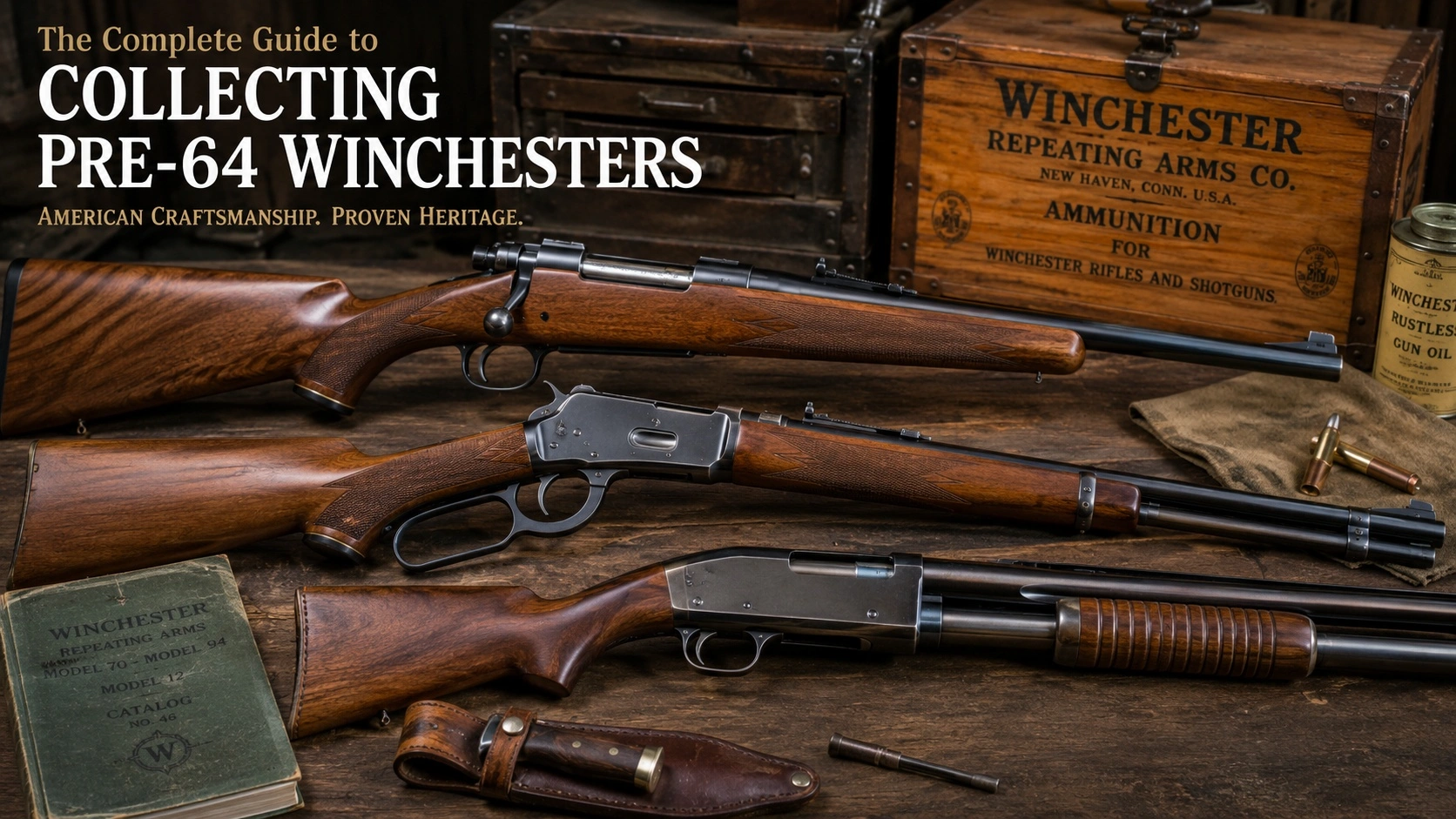
Few phrases in American gun collecting carry the same emotional weight as Pre-64 Winchester. It is more than a date marker. To many collectors, it describes an era when Winchester still represented polished steel, walnut stocks, careful machining, hand-fitting, and the kind of manufacturing character that made a sporting rifle feel permanent. The best examples were built for use, but they were built with enough pride that they became heirlooms.
The phrase usually refers to Winchester firearms made before the broad 1964 manufacturing changes that affected several major product lines, especially the Model 70 bolt-action rifle. Collectors often use the term as shorthand for the old Winchester standard: forged and machined parts, cut checkering, graceful stock lines, controlled-round-feed actions on the Model 70, and the finish quality associated with mid-century American sporting arms. The term can be overused, and not every pre-1964 gun is rare or valuable, but the collector interest is real and enduring.
This guide is written for the collector who wants to understand the Pre-64 Winchester field without getting lost in auction hype. It covers historical context, key models, serial-number cautions, originality checks, identification details, common buying mistakes, condition issues, value considerations, documentation, storage, and frequently asked questions. Use it as a starting framework, then confirm any specific firearm with model-specific reference books, factory records when available, and careful hands-on inspection.
Quick Answer for Collectors
Pre-64 Winchester usually means a Winchester firearm made before the company’s broad 1964 manufacturing changes, with the Model 70 being the best-known example.
- Start with the serial number, then confirm the physical features.
- Original finish, untouched wood, correct sights, and sharp markings matter more than age alone.
- Common models can still be excellent collectibles, but rare configurations require stronger documentation.
Why 1964 Became the Dividing Line
The 1964 divide was not a single magic switch that instantly made every older Winchester desirable and every newer Winchester undesirable. It was a visible change in manufacturing philosophy. Winchester, like many American manufacturers in the postwar period, faced rising labor costs, pressure to reduce production expense, and competition from newer designs that could be produced more efficiently. The company redesigned portions of its product line, most famously the Model 70, to make production faster and less expensive.
The collector reaction was immediate because the differences were easy to see and feel. Earlier rifles generally had more carefully polished metal, better-fitted walnut, machined small parts, and more traditional checkering. Later rifles could be perfectly serviceable hunting arms, and many have given decades of reliable use, but collectors recognized that a particular style of workmanship had ended. Over time, that perception hardened into the collector language we now use: Pre-64 Winchester.
The Model 70 became the symbol of the divide because its pre-1964 controlled-round-feed action, blade ejector, forged receiver, machined bottom metal, cut checkering, and classic stock lines represented everything enthusiasts admired. Winchester introduced the Model 70 in 1936 as a refinement of the earlier Model 54. Gun writers, hunters, and competitors helped establish its reputation, and the old version eventually earned the nickname “The Rifleman’s Rifle.”
Collectors should avoid turning the story into a cartoon. The post-1964 guns are not automatically bad, and some later Winchester firearms have strong followings of their own. The collector premium exists because the earlier guns captured a particular moment in American sporting arms history. They came from a time when rifles and shotguns were expected to be carried hard, repaired when needed, passed down, and admired for the way they were made.

Key Pre-64 Winchester Models Collectors Watch
The Pre-64 conversation often begins with the Model 70, but it does not end there. Winchester’s classic period includes lever actions, pump shotguns, rimfire rifles, target rifles, and fine doubles. Some were produced in large quantities. Others were specialized, expensive, or offered in configurations that now bring substantial collector attention.
Winchester Model 70
The Model 70 is the centerpiece of Pre-64 collecting. For a closer inspection, compare the extractor, stock, and bottom-metal identification cues. Introduced in 1936, it combined controlled-round-feed reliability with a refined commercial sporting-rifle design. Collectors look for standard rifles, Featherweights, Super Grades, target models, varmint configurations, rare calibers, and rifles retaining factory sights, original pads, and unaltered stocks.
The strongest collector examples tend to share several features: original blue, sharp markings, correct stock profile, untouched checkering, uncut barrel, period-correct sights, and a serial number that fits the configuration. Super Grade rifles are especially desirable because they represented the premium sporting version, typically with upgraded walnut and finer details. Rare chamberings and documented provenance can move a rifle into a different price category entirely.
Winchester Model 94
The Model 94 is one of the great American lever actions. By the mid-twentieth century it had become closely associated with deer hunting, rural hardware stores, saddle scabbards, and the practical side of Winchester ownership. Pre-64 Model 94 carbines in .30-30 Winchester remain common enough to be approachable, but high-condition examples, special configurations, early rifles, and unusual features can attract advanced collectors.
Because the Model 94 was used heavily, many surviving examples show honest field wear. That is not automatically a defect. A clean, original rifle with carry wear can be far more appealing than one polished, reblued, and stripped of its character. Collectors should pay close attention to receiver finish, tang markings, stock fit, screw condition, barrel address, and whether the gun has been drilled, tapped, or otherwise modified. Use the Model 94 collector guide for a closer comparison of variants, condition, and originality.
Winchester Model 12
The Model 12 pump shotgun earned a reputation for smoothness and strength. Many shooters consider it one of the finest pump shotguns ever made. Pre-64 Model 12s appear in field, trap, skeet, heavy duck, riot, and special configurations. Condition and originality are critical because many were hunted hard, refinished, or altered with recoil pads, Cutts compensators, opened chokes, or shortened barrels.
Collectors often seek high-grade examples, original small-gauge guns, trap and skeet configurations, and guns with factory features still intact. A plain field gun may be a wonderful shooter, but a rare configuration in high original condition can be a serious collector piece.
Winchester Model 61 and Model 62 Rimfires
Winchester rimfire rifles have a devoted following because they blend mechanical quality with nostalgia. The Model 61 hammerless pump and Model 62 exposed-hammer pump are both highly collectible in the right condition. Original finish, correct sights, clean bores, and chambering variations are all important. These rifles were often used by young shooters, carried around farms, or stored casually, so pristine examples can be difficult to find.
Winchester Model 52
The Model 52 target rifle occupies a special place among precision rimfire collectors. Known for accuracy and quality, it was used by competitive shooters and serious marksmen for decades. Collectors study variations carefully because the model evolved over time. Original sights, target blocks, stocks, magazines, and configuration details influence desirability.
Winchester Model 42
The Model 42, essentially a scaled .410 version of the Model 12 concept, has strong collector appeal. It is elegant, handy, and expensive to buy in high condition. Skeet grades, deluxe guns, and original examples with strong finish and correct wood can command significant premiums. For a detailed example of checking configuration and originality, see the Winchester Model 42 collector article.
Winchester Model 21
The Model 21 side-by-side shotgun sits in a different collector category because it was Winchester’s premium double gun. It was expensive when new and remains desirable today. Factory originality, gauge, barrel length, engraving, wood quality, stock dimensions, and documentation matter greatly. A Model 21 should be evaluated with specialized knowledge because small details can make a large value difference. Compare the gun with surviving paperwork using the Model 21 factory-letter guide.
How to Identify a True Pre-64 Winchester
Identification begins with the serial number, but it should never end there. A collector should examine the entire firearm as a system: receiver, barrel, stock, sights, screws, finish, markings, and configuration. A serial number may place a gun in the right date range, but later modifications can reduce collector interest. Conversely, a rifle with honest wear may still be very desirable if it remains original.
Start by confirming the exact model. Winchester reused similar styling across different lines, and casual descriptions in classified ads are often incomplete. Once the model is known, compare the serial number to reliable model-specific date references. Then compare the physical features to what should be present for that production period. The best collector inspection is both numerical and visual.
Receiver and Barrel Markings
Sharp markings are a good sign. Blurred, shallow, or washed-out lettering may indicate aggressive polishing before rebluing. On original guns, barrel addresses, proof marks, caliber markings, and receiver edges should remain crisp. The surrounding finish should look consistent with the firearm’s age and use. If a receiver looks polished while the barrel looks worn, ask why.
Stock Shape and Checkering
Original stock shape is a major value factor. Cut stocks, replacement recoil pads, sanded wood, re-cut checkering, and altered combs are common issues. On many rifles, the wood should fit cleanly around the tangs and receiver without proud or sunken edges caused by sanding. Finish on the wood should look appropriate for the period rather than thick, glossy, and modern.
Sights, Pads, and Small Parts
Factory sights and original pads are frequently missing. Many hunters removed iron sights to mount scopes, changed recoil pads for comfort, or installed sling swivels that were not factory. None of those changes make a firearm useless, but they affect collector value. Small screws should also be inspected. Buggered screw slots often reveal repeated disassembly or careless gunsmithing.

Serial Number Research and Production Cautions
Serial-number research is essential, but it must be used carefully. Published serial number tables are helpful starting points, not perfect substitutes for factory records or expert inspection. Production transitions, leftover parts, repair work, special orders, and record limitations can create edge cases. When a rifle is expensive, rare, or represented as factory-original, the burden of proof should be higher.
For the Model 70, the commonly cited end of the Pre-64 serial range is 581,471, with post-1963 production beginning at a higher block. The broader collector shortcut “below 700,000” is often used in casual conversation, but a serious buyer should use the Pre-64 Model 70 year estimator and evaluate features. The serial number should agree with the rifle’s physical configuration.
| Model | Collector Starting Point | Important Caution |
|---|---|---|
| Model 70 | Pre-64 production generally ends at serial number 581,471. | Verify configuration, not just the number. Date tables and physical features should agree. |
| Model 94 | Pre-64 examples are generally associated with serial numbers below roughly 2,700,000. | Model 94 records and transition details should be checked against specialized references. For post-war examples, see the 1946–1964 Model 94 serial chart. |
| Model 12 | Use model-specific date tables and barrel/configuration inspection. | Many Model 12s were altered, rebarreled, fitted with pads, or modified for clay target use. |
| Model 61 / 62 / 52 / 42 | Use model-specific serial references. | Rimfires and small bores often have missing sights, replaced magazines, or altered wood. |
A good collection file should include photographs of the serial number, barrel markings, proof marks, buttplate or pad, sights, and any unusual factory features. This documentation helps with insurance, resale, estate planning, and future research. It also protects the collector from relying solely on memory years later.
Originality, Finish, and Alterations
Originality drives the Pre-64 market. A refinished rifle can be attractive and useful, but it usually does not command the same premium as an original example. Collectors generally prefer honest wear because it tells a consistent story. A rifle carried in the field for decades may have thinning blue, small stock marks, and edge wear while still remaining far more collectible than a heavily polished restoration.
Signs of Rebluing
- Rounded receiver edges or softened screw holes.
- Lettering that looks shallow, smeared, or uneven.
- Bluing inside areas that should show different wear patterns.
- Mismatch between barrel, receiver, bolt, and floorplate finish.
- Overly dark or glassy finish inconsistent with period Winchester polish.
Signs of Stock Refinishing
- Wood below the metal line from sanding.
- Washed-out checkering or re-cut checkering with uneven points.
- Glossy modern finish that fills pores and checkering.
- Rounded edges around the tang, pistol grip, or fore-end.
- Replacement recoil pad installed after cutting the stock.
Alterations are not always deal breakers. A scoped hunting rifle may be exactly what a practical buyer wants. A refinished Model 12 may still be a beautiful shooter. But the price should reflect the work performed. The mistake is not buying an altered gun; the mistake is paying original-condition money for one.
Common Buying Mistakes
The Pre-64 market rewards patience. Many mistakes happen because a buyer falls in love with the phrase “Pre-64” and stops inspecting the firearm. Treat the label as the beginning of the conversation, not the conclusion.
Buying the Story Instead of the Gun
Family stories, gun-show descriptions, and auction language can be interesting, but the firearm must support the claim. If a seller describes a rifle as rare, special order, unfired, or factory original, ask for evidence. Documentation, factory letters where available, original boxes, hang tags, receipts, and old photographs can add value, but unsupported claims should not carry much weight.
Ignoring the Cost of Missing Parts
Original sights, buttplates, magazines, swivels, and period accessories can be expensive or difficult to replace. A rifle priced cheaply because it is missing small parts may not be a bargain once restoration costs are considered. Replacement parts may also remain obvious to advanced collectors.
Overpaying for Common Configurations
Some Pre-64 Winchesters were produced in large numbers. A common model in average condition should not be priced like a rare factory configuration. Collectors should learn the difference between a historically desirable firearm and a scarce variant within that model.
Trusting Poor Online Photos
Online listings often hide the very details collectors need to see: tang cracks, pad installations, screw slots, barrel markings, muzzle wear, proof marks, and bore condition. Before paying serious collector money, request clear photographs in natural light. A seller who refuses to provide basic detail photos is asking the buyer to take unnecessary risk.
Forgetting Bore and Mechanics
Exterior condition is only part of the evaluation. A rifle with a poor bore, damaged crown, feeding issues, or unsafe mechanical condition may be less desirable even if it looks good in photographs. Collectors who intend to shoot their firearms should be especially careful.
Value Considerations Without Chasing Hype
Pre-64 Winchester values vary widely. A well-used but honest Model 94 carbine may be attainable for many collectors, while a high-condition Model 70 Super Grade in a desirable caliber can reach serious collector territory. The difference is not merely age. Value is shaped by originality, rarity, condition, configuration, historical association, and buyer demand.
Condition is usually the first major driver. Original blue, sharp wood, strong checkering, and clean markings create collector confidence. Rarity is next, but rarity must be meaningful. A configuration may be uncommon because few collectors wanted it, or it may be scarce and highly desirable. The market treats those situations differently.
Caliber also matters. Standard chamberings can be easier to sell because they fit the image many collectors have of classic hunting rifles. Rare chamberings can bring large premiums, but only when the rest of the rifle is correct. A rare caliber in poor condition may not outperform a common caliber in exceptional original condition.
Provenance can change the equation. A rifle with documented ownership by a notable hunter, writer, competitor, lawman, or military figure may attract specialized interest. Family provenance is meaningful for sentimental reasons and can be helpful in documentation, but market value usually requires proof that outside buyers can verify.
Collectors should avoid making decisions from one auction result. A single high sale may reflect two determined bidders, unusual condition, or a temporary market moment. Study multiple sales, compare condition honestly, and remember that asking prices are not the same as completed transactions.
Historical Context: Why These Guns Still Resonate
Pre-64 Winchesters belong to a broader American story. They were made during years when hunting, marksmanship, hardware-store gun counters, sporting catalogs, and family firearms traditions were part of ordinary life. Many were carried by returning World War II veterans, fathers teaching sons and daughters to shoot, ranchers, competitive marksmen, and hunters who expected one rifle or shotgun to serve for decades.
The postwar economy expanded the market for sporting arms, and Winchester’s reputation gave buyers confidence. A Model 70 in .270 Winchester, a Model 94 in .30-30, a Model 12 in the duck blind, or a Model 61 behind the kitchen door all reflected different pieces of American life. Collectors respond to that connection. The appeal is not only mechanical. It is cultural.
This is also why original wear can be attractive. A rifle that shows careful use may speak more honestly than a perfect example locked away from the day it was purchased. Collectors differ in taste, of course. Some pursue the highest condition possible. Others prefer rifles with history in the wood and blue. Both approaches are valid when the buyer understands what is being purchased.
Preservation and Long-Term Care
Once a collector acquires a Pre-64 Winchester, preservation becomes part of ownership. These firearms are durable, but they are not immune to neglect. Rust, poor storage, foam cases, unstable humidity, excessive oil, and careless handling can damage value over time.
Humidity control is one of the simplest and most important habits. Avoid storing firearms in soft cases or foam-lined cases for long periods. Use a stable safe environment, inspect regularly, and wipe handled metal with an appropriate protective cloth. Wood stocks should not be saturated with oil, and old recoil pads should be monitored because some deteriorate with age.
Cleaning should be conservative. Collectors should avoid aggressive polishing, harsh abrasives, and attempts to “improve” patina. The goal is preservation, not cosmetic transformation. When in doubt, seek advice before altering anything original. A few minutes with steel wool in the wrong hands can erase decades of collector value.
Documentation and Collection Records
Every serious collector should maintain records. Documentation protects the collection, supports insurance, assists heirs, and preserves the story attached to each firearm. A simple folder or spreadsheet is enough to begin. Include make, model, caliber, serial number, purchase date, seller, price paid, condition notes, photographs, and any provenance.
Photograph the firearm from both sides, then record closeups of serial numbers, barrel markings, proof marks, sights, buttplate or recoil pad, and any special features. If the firearm has a box, paperwork, factory letter, or old receipt, photograph those items too. Store digital backups in more than one location.
For estate planning, documentation is especially helpful. Heirs may not know the difference between a common shooter and a scarce collector firearm. Clear records reduce the risk that valuable pieces are sold too cheaply or altered unintentionally.
Where a Pre-64 Winchester Fits in a Collection
A Pre-64 Winchester can serve several roles. It can be a centerpiece, a representative example of American manufacturing, a hunting heirloom, a study piece, or the beginning of a specialized collecting path. The best approach depends on budget and interest.
A beginner might start with an honest Model 94 or Model 12. A rifle collector may pursue a Model 70 standard rifle before moving into Featherweights, Super Grades, or rare chamberings. A shotgun collector might study Model 12 grades, Model 42 variations, or the more specialized Model 21 market. Rimfire enthusiasts may gravitate toward the Model 61, Model 62, or Model 52.
The smartest collectors usually buy the best originality and condition they can afford within a focused lane. A small collection of carefully chosen rifles often has more long-term appeal than a large group of compromised examples purchased only because they were available.
Frequently Asked Questions
What does “Pre-64 Winchester” mean?
It generally refers to Winchester firearms made before the major 1964 manufacturing redesigns. In collector conversation, the phrase is most closely associated with the original controlled-round-feed Winchester Model 70, but it is also used more broadly for earlier Winchester production.
Are all Pre-64 Winchesters valuable?
No. Age alone does not create high value. Condition, originality, model, configuration, caliber, documentation, and market demand all matter. Some common examples remain affordable compared with rare or high-condition guns.
How do I know if a Model 70 is Pre-64?
Start with the serial number and then confirm the physical features. Pre-64 Model 70 production is commonly associated with serial numbers through 581,471. Also examine the action type, stock, checkering, bottom metal, markings, and other period features.
Can a refinished Winchester still be collectible?
Yes, but refinishing usually lowers collector value compared with an original example. A refinished rifle may still be desirable as a shooter, display piece, or affordable representative example, but it should be priced accordingly.
Should I shoot a Pre-64 Winchester?
Many collectors shoot carefully selected examples, especially common configurations in sound mechanical condition. Rare, high-condition, or historically significant firearms may be better preserved with limited handling. Have any older firearm inspected if there is doubt about safety.
What is the best first Pre-64 Winchester to buy?
For many collectors, an honest Model 94, Model 12, or standard Model 70 is a practical starting point. The best first purchase is usually original, mechanically sound, fairly priced, and easy to understand.
Do factory boxes and paperwork add value?
They can. Original boxes, hang tags, manuals, receipts, and factory letters can strengthen provenance and improve collector confidence, especially on high-condition or unusual firearms.
What should I avoid?
Avoid unclear serial-number claims, heavily polished reblues sold as original, cut stocks, missing hard-to-replace parts, poor online photos, unsupported rarity claims, and prices based only on hopeful auction language.
Final Thoughts
Collecting Pre-64 Winchesters is not just about owning old firearms. It is about understanding an era of American sporting arms when design, machining, walnut, steel, and reputation came together in a way that still attracts collectors decades later. The best examples reward careful study. They invite close inspection, historical curiosity, and respect for originality.
For the collector building a serious American firearms collection, at least one well-chosen Pre-64 Winchester deserves consideration. Whether it is a Model 70 carried in deer country, a Model 94 with honest saddle wear, a Model 12 that still cycles like glass, or a rimfire that recalls a first lesson in marksmanship, these firearms preserve a tangible link to the classic Winchester era.
For model guides and related date references, return to the Winchester collecting hub. Buy slowly, document carefully, preserve conservatively, and let originality guide your decisions. The Pre-64 Winchester field is broad enough for beginners and deep enough for lifelong study.
