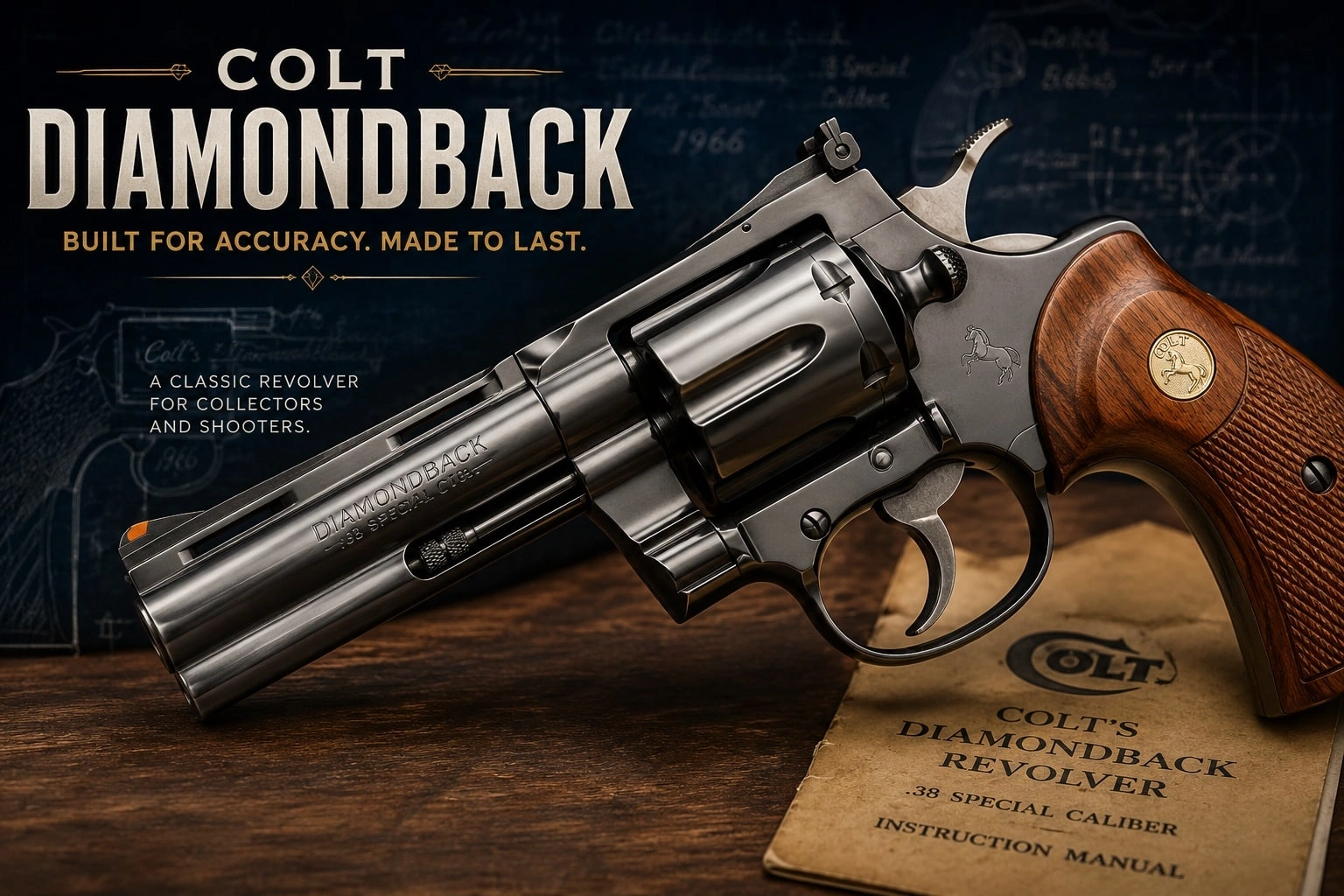
The Colt Diamondback is the revolver many collectors describe as a scaled-down Python, but that description only gets you halfway there. It carries the Python look: ventilated rib, full underlug, adjustable sights, a graceful Colt profile, and a polish that made it stand apart from ordinary service revolvers. Underneath, however, it belongs to the Colt D-frame family, closer in frame size and mechanical ancestry to the Detective Special, Police Positive Special, and Cobra than to the larger Python.
For related date-of-manufacture research, use the Colt Diamondback identification research in the Colt serial-number lookup tool.
That combination is exactly why the Diamondback is so interesting. It has the elegance of a target revolver, the hand-fitted feel associated with older Colt production, and the compact balance of a small-frame sixgun. Introduced in 1966 and produced into the late 1980s, it remains especially desirable in .22 LR, nickel finish, short barrels, and boxed high-condition examples.
The Diamondback uses Colt’s classic D‑frame lockwork, which produces three audible actions during slow single‑action cocking: st movement: Hand begins rotating the cylinder, 2nd movement: Bolt drops into the cylinder notch, and 3rd movement: Full‑cock notch engages and the hammer locks back. The famous “four clicks” belong to old‑style Colt single‑action revolvers (like the Peacemaker), where each click corresponds to a separate hammer notch: C‑O‑L‑T. The Diamondback is a double‑action D‑frame, so its internal timing is completely different. You’ll hear smooth, continuous movement with two or three mechanical sounds, not four discrete clicks.
Colt Diamondback Overview
| Feature | Identification Notes |
|---|---|
| Manufacturer | Colt’s Manufacturing Company |
| Production period | Introduced in 1966; regular production generally associated with 1966 through the late 1980s. |
| Frame | Colt D-frame, the small-frame family used for several classic Colt revolvers. |
| Calibers | .38 Special and .22 Long Rifle are the standard collector calibers. |
| Common barrel lengths | 2.5 inch, 4 inch, and 6 inch. |
| Primary finishes | Blue and nickel, with documentation important on unusual finish claims. |
| Signature features | Ventilated rib, full underlug, adjustable rear sight, ramp front sight, Colt medallion stocks. |
History of the Colt Diamondback
By the mid-1960s Colt already had the Python at the top of its revolver line. The Python was large, expensive, beautifully finished, and chambered in .357 Magnum. Colt also had practical D-frame revolvers that served police officers and civilians well, but they did not have the same target-sight, ventilated-rib personality.
The Diamondback filled that space. It gave buyers a smaller Colt with much of the visual character of the Python, but in lighter, handier calibers. A 4-inch .38 Special made sense as a premium shooter. A 6-inch .22 LR suited target and field use. A 2.5-inch example, especially in high condition, now has strong appeal because short-barrel small-frame Colts are simply attractive guns.
The Diamondback is not just a small Python. It is a D-frame Colt with Python styling, and that distinction matters when evaluating parts, timing, grips, and collector originality.
Understanding Colt Diamondback Serial Number Eras
This section is not a year-by-year factory serial-number chart. It explains the broad numbering eras encountered on Diamondbacks and how to record the complete marking accurately. For a manufacture-date estimate, use Colt’s official serial-number lookup. For confirmation of the original shipped configuration, request a Colt Archive Letter.
Serial numbers are the first place most Diamondback research begins, but they should not be treated as the final answer by themselves. The Diamondback shared Colt D-frame serial-number systems with other revolvers, and Colt’s serial practices changed during the Diamondback production period. That means the number helps establish an era, but exact dating is best confirmed with Colt’s own lookup resources or a Colt Archive Letter.
For collector use, think in eras rather than forcing every Diamondback into a single isolated table. Early guns generally fall into the D-prefix period. Later guns move into alphanumeric systems that can include different letter placements and prefixes. The most important practical step is to record the serial exactly as it appears, including any prefix, suffix, spacing, or leading zero.
| Serial Era | What to Look For | How to Interpret It |
|---|---|---|
| Early production | D-prefix serial numbers are commonly associated with the first Diamondback years. | These guns attract interest when condition, finish, grips, and box details remain period-correct. |
| 1970s production | D-prefix numbers continue into later ranges before broader alphanumeric systems appear. | Very strong collector interest remains, especially for .22 LR, nickel, and scarce barrel combinations. |
| Late 1970s and early 1980s | Alphanumeric serial patterns become more important to read exactly. | Do not drop letters when researching; the letter placement can be the clue that keeps the dating accurate. |
| Later production | Later alphanumeric ranges, lower availability in some configurations, and more emphasis on condition. | High-condition boxed examples and factory nickel guns often draw more attention than ordinary shooter-grade guns. |
How to Record a Diamondback Serial Number
- Write the serial number exactly as stamped, including letters before or after the number.
- Photograph the serial number for your own records, but crop or redact it before posting publicly if you prefer privacy.
- Do not assume the Diamondback has its own completely separate serial-number sequence; compare it within Colt D-frame context.
- Use the serial number to establish an era, then verify the gun against physical features and documentation.
- For insurance, estate records, or a high-dollar sale, consider a Colt Archive Letter when the configuration needs support.
How to Identify a Genuine Colt Diamondback
A real Diamondback has a recognizable set of features. The danger for collectors is not usually mistaking it for a Python; the bigger risk is misunderstanding altered guns, refinished guns, or D-frame revolvers wearing parts or descriptions that make them sound more valuable than they are.
| Checkpoint | What It Should Show |
|---|---|
| Ventilated rib | The rib is part of the Diamondback identity. A fixed-sight D-frame without the vent rib is not a Diamondback. |
| Full underlug | The full-length ejector rod shroud gives the gun much of its Python-like profile. |
| Adjustable rear sight | Diamondbacks were target-style revolvers, not plain fixed-sight service revolvers. |
| Rollmarks | Check the barrel marking for Diamondback and caliber. Watch for soft, washed-out lettering on refinished guns. |
| Frame size | It is a D-frame Colt. Do not evaluate parts or mechanical issues as though it were a Python. |
| Stocks | Correct Colt medallion stocks, fit, checkering, and screw condition all matter to collectors. |
Diamondback Calibers: .38 Special and .22 LR
.38 Special Diamondback
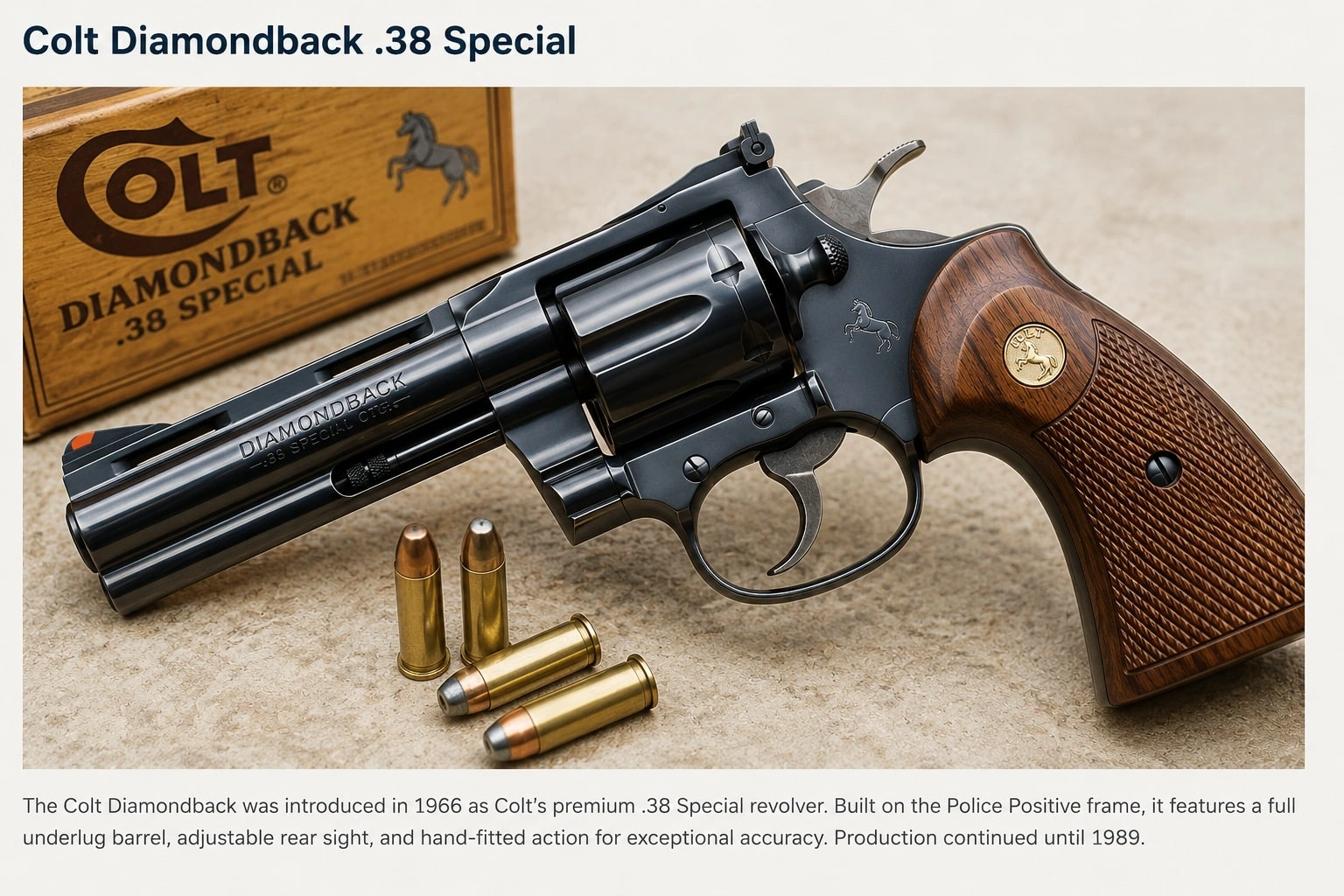
The .38 Special is the version many shooters think of first. It has enough weight and sight radius to be pleasant, especially with the 4-inch barrel. It also preserves the graceful small-frame balance that made the D-frame Colts so popular. Condition and originality matter more than mere chambering, but .38 Special examples remain the most accessible entry point for many buyers.
.22 LR Diamondback
The .22 LR version often attracts closer attention. It combines Colt quality, target sights, inexpensive rimfire shooting, and lower availability than the more common .38 Special examples. In excellent condition, a .22 LR Diamondback can command a serious premium, especially with a box, paperwork, original stocks, and a scarce barrel or finish combination.
.22 Magnum Claims
Be cautious with any claimed .22 Magnum Diamondback. The standard collector understanding is that Colt did not catalog the Diamondback as a normal .22 WMR production model. Treat any such claim as a conversion or special situation unless it is backed by exceptionally strong factory documentation.
Colt Diamondback Barrel Lengths
| Barrel Length | Market Notes |
|---|---|
| 2.5 inch | Shortest and very attractive to collectors, especially in .22 LR or nickel. Condition is often the challenge because short guns were carried and handled. |
| 4 inch | Excellent balance and probably the most natural all-around Diamondback configuration. Strong demand from both shooters and collectors. |
| 6 inch | Target-style appearance, longer sight radius, and especially popular in .22 LR. High-condition examples display well. |
Factory Finishes and Refinish Warnings
Original blue Diamondbacks show the deep Colt polish that made the company famous. Nickel examples tend to draw special attention because they are scarcer and visually striking. The problem is that a bright finish can hide a lot in photographs. Rounded edges, soft rollmarks, dished screw holes, and inconsistent polish around the barrel address can all suggest refinishing.
- Blue: The classic Colt look and the finish most collectors expect to see.
- Nickel: Desirable, but factory origin matters. Documentation is especially useful.
- Unusual finishes: Treat unusual finish claims carefully until supported by a Colt letter, original paperwork, or expert inspection.
What Drives Colt Diamondback Value
Diamondback value can change quickly depending on configuration and condition. A worn .38 Special shooter is not the same market as a boxed nickel .22 LR. As with most collectible Colts, the expensive examples are usually expensive because multiple factors line up at once.
| Factor | Why It Matters |
|---|---|
| Caliber | .22 LR examples often bring the strongest collector premiums. |
| Barrel length | 2.5-inch and 6-inch examples can be especially desirable depending on caliber and finish. |
| Finish | Factory nickel and high-polish original blue both matter, but refinishing lowers collector value. |
| Condition | Sharp edges, strong finish, clean screws, correct stocks, and minimal cylinder line all help. |
| Box and papers | Original box, manual, hang tag, and paperwork can add meaningful premium. |
| Documentation | A Colt Archive Letter can support shipped configuration and provenance. |
Mechanical Checks Before Buying
The Diamondback uses Colt’s classic double-action lockwork, and that is part of its charm. It is also why timing and lockup matter. A beautiful Diamondback with poor timing can become an expensive project, and replacement parts or qualified Colt revolver work are not as casual as they once were.
- Check cylinder lockup on each chamber.
- Check timing slowly in double action and single action.
- Look for endshake, side play, and evidence of amateur gunsmithing.
- Inspect screws for damage and mismatched wear.
- Confirm the ejector rod, crane, and cylinder fit properly.
- Avoid heavy +P use in collectible .38 Special Diamondbacks; preserve the gun for what it is.
Common Diamondback Mistakes
- Calling it a small Python: It looks Python-inspired, but it is a D-frame revolver with different parts and mechanics.
- Ignoring serial letters: Prefixes and suffixes are part of the serial number. Leaving them out can produce bad dating results.
- Overvaluing every Diamondback equally: Caliber, finish, barrel length, box, papers, and condition create very different markets.
- Assuming nickel is always factory: A refinish can look impressive and still be worth much less to a collector.
- Buying the story instead of the gun: Verify the physical details before paying for rarity.
Best Research Path for a Colt Diamondback
- Record the exact serial number, including letters.
- Identify caliber and barrel length from the barrel marking and physical configuration.
- Inspect finish originality, rollmarks, stocks, screws, sights, and muzzle wear.
- Compare the features against the expected production era.
- Photograph the gun in natural light, including rollmarks and close-up details.
- Use Colt documentation for high-dollar, rare, nickel, or unusual examples.
For broader Colt serial-number work, see the Colt Serial Number Lookup by Model. For condition language, use the Firearm Condition and Value Guide before writing a sale description or insurance record.
Collector Takeaway
The Colt Diamondback has earned its place among the great postwar Colt revolvers. It is compact without feeling ordinary, elegant without being fragile, and distinctive enough that even casual collectors recognize the ventilated rib and underlug silhouette. The best examples are not merely “old Colts.” They are original, properly identified, carefully documented revolvers where serial number era, configuration, and condition all tell the same story.
From My Bench
If you are setting up your own workspace or maintaining a collection, I keep a curated list of tools, books, cleaning gear, and bench items that fit the way I work.
Browse My Gear ListAs an Amazon Associate I earn from qualifying purchases. I only link to products, books, tools, and accessories that fit the editorial purpose of Gun Collectors Club.

About Greg Cook
Greg Cook writes about firearms collecting, personal history, and the stories behind interesting guns. His Army MOS was 76Y, Unit Armorer, and he brings that practical background to his collector articles.
Sources Consulted
- Colt factory catalogs and period advertising literature.
- Colt owner’s manuals and factory reference material for D-frame revolvers.
- Colt Archive Letter guidance for confirming shipped configuration.
- R. L. Wilson, The Book of Colt Firearms, for broader Colt production and model context.
- Author observations, collector notes, and comparative inspection of Colt double-action revolvers.