Why the Thompson Still Matters
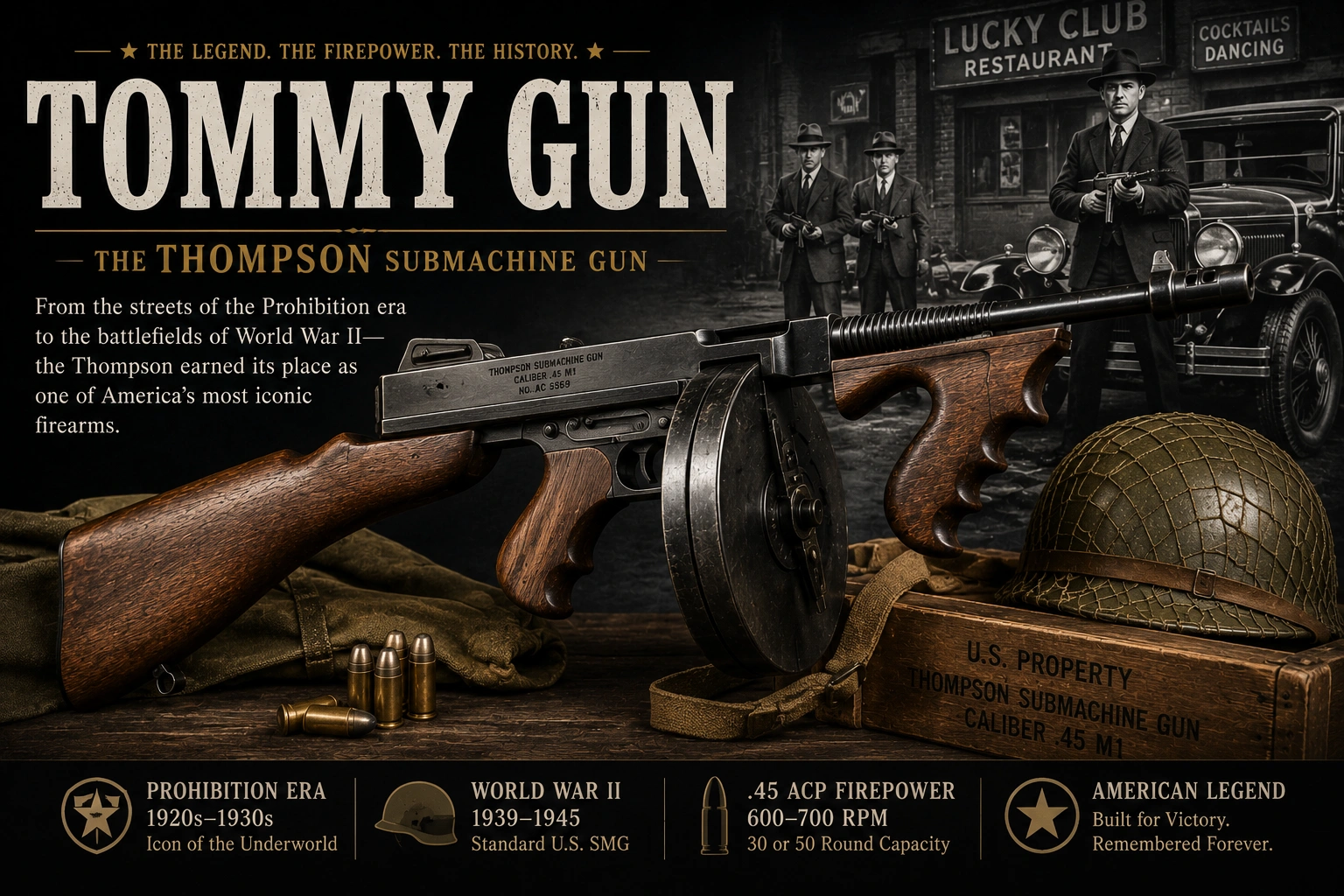
The Thompson submachine gun occupies a rare place in American firearms history because it is instantly recognizable even to people who do not collect guns. The vertical foregrip, Cutts-style compensator on many early examples, finned barrel, and drum magazine profile made it a symbol before most owners ever handled one. That symbolism can obscure the more useful collector story: the Thompson was an ambitious post-World War I design that found fame in unexpected places before being simplified for mass wartime production.
The collector should separate the legend from the mechanism. Early commercial and law-enforcement Thompsons tell one story. World War II M1928A1, M1, and M1A1 guns tell another. Later semi-automatic replicas and commemorative arms add a third category that may satisfy display interest but should not be confused with original transferable automatic arms.
Development and Auto-Ordnance
General John T. Thompson promoted the idea of a compact automatic shoulder arm at a time when military doctrine was still sorting out the lessons of trench warfare. Auto-Ordnance pursued a weapon that could deliver controllable automatic fire with pistol ammunition at short range. The concept was practical in theory, but the timing was difficult. The major war had ended, military procurement cooled, and the early Thompson was expensive to manufacture.
The Thompson is best understood as a premium, complex interwar design that became famous before it became simple.
That matters to collectors because workmanship changed over time. Early models are associated with finely machined parts and commercial polish. Wartime versions retained the Thompson identity but reflected a different priority: speed, durability, and simplified production. The collector value often lies in knowing which period a particular gun represents.
Prohibition Fame and Public Image
The Thompson’s popular reputation was shaped heavily by Prohibition-era crime reporting and Hollywood storytelling. Gangland images, drum magazines, and newspaper nicknames made the “Tommy Gun” part of American vocabulary. That fame was not the whole truth, but it did guarantee that the firearm would never be just another technical entry in a reference book.
Collectors should treat Prohibition associations carefully. A documented police department gun, agency-marked example, or firearm with credible provenance is very different from a vague claim that it was “gangster era.” Documentation matters. Without records, colorful stories should be treated as sales language, not collector evidence.
World War II Service
During World War II, the Thompson served with American and Allied forces in several configurations. It was valued for short-range firepower, especially in patrol, urban, jungle, and vehicle-adjacent roles. It was also heavy, costly, and more complicated than later substitute arms. The M1 and M1A1 versions reflect a move toward simplified manufacture, eliminating some earlier features and moving away from the drum-magazine image that dominates popular memory.
| Model/Period | Collector Notes |
|---|---|
| Early commercial / 1921 pattern | Highly collectible, expensive, and documentation sensitive. |
| M1928 / M1928A1 | Classic military profile; check markings, parts, and arsenal history. |
| M1 / M1A1 | Simplified wartime versions with strong WWII collector appeal. |
| Semi-auto replicas | Display and shooting interest, but a separate category from original automatic arms. |
Thompson Model Variations Collectors Should Know
The Thompson name covers several distinct collecting categories. Early Colt-produced Model of 1921 and Model of 1928 examples represent the finely machined commercial era. These are the guns most closely associated with the classic polished look, early Auto-Ordnance marketing, police sales, and the high-value end of Thompson collecting. They are also the examples where originality, finish, correct parts, matching documentation, and provenance can dramatically affect value.
The wartime M1928A1 kept much of the recognizable Thompson profile but was built for military service rather than commercial presentation. Depending on configuration, collectors may encounter horizontal or vertical foregrips, finned or smooth barrels, Lyman or simplified rear sights, Cutts compensators, and both stick-magazine and drum-magazine associations. Each detail should be read as part of the gun’s production and service story rather than as a decorative feature.
The M1 and M1A1 versions are especially important because they show the Thompson becoming a simpler wartime arm. The bolt system, sighting equipment, barrel treatment, and receiver details were simplified to reduce cost and production time. These models lack some of the romantic “Roaring Twenties” styling, but they have powerful World War II appeal and often make more sense to a military collector than a purely Prohibition-themed display.
Collector Notes: Markings, Provenance, and Lawful Status
A serious Thompson evaluation should begin with markings and configuration. Document the receiver markings, serial number, manufacturer, model designation, barrel style, sight type, stock hardware, compensator or muzzle treatment, selector markings, magazine type, and any agency or military property marks. Photograph these details clearly before relying on a seller’s story. A documented police, prison, military, or agency connection may add interest; an undocumented “gangster gun” claim should be treated with caution.
Collectors should also separate original automatic Thompsons from later semi-automatic carbines, commemoratives, and display-oriented reproductions. Those later firearms can be enjoyable and collectible in their own lane, but they are not the same market as an original transferable Thompson. Because automatic firearms are heavily regulated, lawful status, paperwork, transferability, and jurisdiction-specific restrictions are not side issues. They are central to value, ownership, and risk management.
Condition is only one part of the story. A refinished gun may look attractive but lose collector value if the work erased markings, changed edges, or replaced historically important parts. Conversely, a worn but well-documented wartime example may have more authentic appeal than a shiny gun assembled from mismatched components. With a Thompson, originality and documentation often matter as much as cosmetics.
Collector Takeaway
The Thompson rewards study. The same nickname can describe firearms that differ greatly in mechanism, production period, legal status, finish, and value. A collector should document markings, configuration, magazine type, actuator style, rear sight, compensator presence, stock hardware, and any agency or military provenance. With a Thompson, small details are not trivia; they are the story.
Thompson Submachine Gun FAQ
For identification details, compare these answers with the article’s Thompson model variations and markings discussion above.
When was the Tommy Gun invented?
The Thompson submachine gun was developed under John T. Thompson and Auto-Ordnance after World War I. The first production Model of 1921 Thompsons were made by Colt for Auto-Ordnance, too late for service in World War I.
What is a Tommy Gun?
“Tommy Gun” is the popular nickname for the Thompson submachine gun, an American .45 ACP automatic firearm developed by Auto-Ordnance. The nickname became familiar through its use by law enforcement, criminals, and military forces.
What are the major Thompson submachine gun models?
Major Thompson models include the Model of 1921, Model of 1928, wartime M1928A1, and the simplified M1 and M1A1. Later semi-automatic carbines and replicas belong to a separate collecting category from original automatic Thompsons.
What era is associated with the Tommy Gun?
The Tommy Gun is most closely associated with the Prohibition and gangster era of the 1920s and early 1930s, but it also became an important World War II firearm used by American and Allied forces.
Which Thompson variants were used in World War II?
World War II service included the M1928A1 and the later M1 and M1A1 Thompsons. The M1 and M1A1 simplified the earlier design to reduce manufacturing cost and production time.
From My Bench
For collecting work, I keep a short list of reference books, humidity control, cleaning supplies, lighting, and bench gear that fit the way I document and maintain older firearms.
Browse My Gear ListAs an Amazon Associate I earn from qualifying purchases. I only link to products, books, tools, and accessories that fit the editorial purpose of Gun Collectors Club.

About Greg Cook
Greg Cook writes about firearms collecting, personal history, and the stories behind interesting guns. His Army MOS was 76Y, Unit Armorer, and he brings that practical background to his collector articles.